
The popular PayPal-owned extension Honey has been under fire for the past year regarding sketchy tactics against online creators as well as its customers, and as millions have already ditched the app, a new video breaks down how Honey has probably done some sketchy things with your user data while also harming businesses.
Roughly a year ago, Honey was publicly accused of taking advantage of affiliate codes by taking attribution away from online creators. It sparked outrage among influencers, but the bigger story revealed was that the extension was shadily not doing what it promised and would actually hide coupon codes that its partners didn’t want users to see.
In the months that followed, Honey lost around 7 million users on Google Chrome alone, and even led to Google making policy changes that specifically targeted the shady behavior that Honey had been proven to be doing, eventually leading to changes by Honey itself.
Fast forward to today, and the promised “Part 2” of that original Honey expose from MegaLag has finally been released.
The video goes over a whole new set of accusations, starting with how Honey is affecting small businesses. The video details that Honey is scraping coupon codes that are meant to be private and sharing them with its full user base, even without the original user’s knowledge. Making matters worse, some businesses revealed that Honey refused to take down those private codes unless the business partnered directly with Honey.
More impactful to end users, though, is that Honey has apparently also been collecting huge amounts of user data from its Chrome users. The video details that Honey collects a lot of personalized user data, beyond just shopping data.
Amazon, at one point, even placed a warning on its website for Honey users to say that the extension is a “security risk” and accusing the extension of collecting data on “your private shopping behavior.” While it remains up in the air whether or not Honey sells user data, Datarequests.org found that Honey tracks a lot of user data, including timestamps, location, the URL of pages visited, and more data, which is all attributed to specific user IDs. This includes not just shopping data, but general browsing data as well, so long as those other pages are attached to a domain that is classified as an “online shopping website.”
The investigation found that, looking at one user’s information, Honey had enough information to piece together that a user had viewed a repair guide on iFixit, checked tracking details for an order on AliExpress over a dozen times before opening a dispute, looked for “entire home” or hotel accomodations in Berlin on Airbnb, viewed a support page on how to unlock an iPhone if you forgot the code on Apple’s website, watched a specific documentary on CuriousityStream after registering via an affiliate link from Tom Scott on YouTube, redeeming a game code on Steam, visiting a support page for Premiere Pro on Adobe’s website, and more over the course of just three or so months. Honey also had data showing that this user had an AWS account and showed a specific file in that account.
As mentioned, it’s a lot of personal data. And the same level of personal data collection was found from a second user who hadn’t even created a Honey account, only having installed and used the Honey extension with their browser.
It’s further worth noting that the investigation was published in 2020, well before more controversies against Honey began, and just after PayPal’s $4 billion acquisition of the company in early 2020.
In its privacy policy, Honey says that it “may disclose your personal information with your consent or in ways you’d expect” but explicitly says that it does “not sell personal information to third parties for money.” Data may be shared with “service providers” such as businesses Honey is partnered with, including its parent company PayPal.
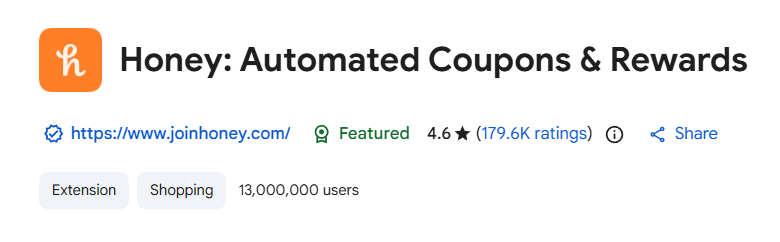
Meanwhile, Honey continues to bleed users. In July 2025, we noted that Honey had dropped to 14 million users on Chrome. The number has fluctuated in the months since, but is now at 13 million, down over 8 million users since its peak in 2024.
The whole MegaLag video is available on YouTube and goes over some further shady practices such as directly advertising Honey to children.
Notably, PayPal’s Honey controversy led to multiple lawsuits, specifically over lost revenue as Honey took over creator/influencer/publisher affiliate codes, which have since been dismissed in court.
Follow Ben: Twitter/X, Threads, Bluesky, and Instagram


FTC: We use income earning auto affiliate links. More.


Comments