
The increased cost of memory components is having the expected effect on devices, raising their costs for consumers. An interesting report points out some nuance to that, predicting that cheap Android devices will get hit much harder than your standard flagship.
A new report, courtesy of Counterpoint Research, sheds some light on device costs within Q1 2026. As DRAM prices have increased 50% since Q4 2025, NAND Flash prices have jumped beyond with a rise by 90%. Those numbers correlate to a timespan of months, not years.
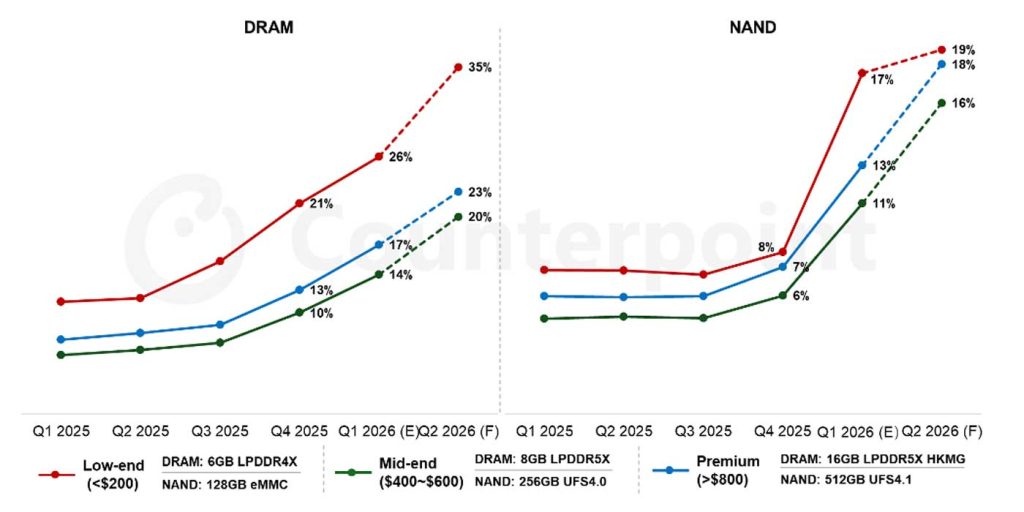
Those device components directly contribute to a rise in Bill of Materials costs, which Counterpoint says will be “disproportionately severe for entry-level devices.” The standard configuration of an entry-level phone means that memory is 43% of its BoM makeup. In comparison, DRAM will account for 14% of device BoM in mid-range devices and 23% in flagship phones, according to the report.
- Low-end (wholesale price <$200): Assuming other component costs remain stable, a typical 6GB LPDDR4X + 128GB eMMC memory configuration will drive its total BOM cost surge by 25% QoQ in Q1 2026. Memory will account for a massive 43% of the total BOM.
- Mid-end (wholesale price $400-$600): This segment often uses diversified specs to target different groups of users. For an 8GB LPDDR5X + 256GB UFS 4.0 configuration, the BOM share for DRAM and NAND will rise to 14% and 11%, respectively, in Q1 2026. These figures are expected to climb to 20% and 16% by Q2 2026.
- Premium and Flagship (wholesale price >$800): Flagships are going to face dual cost pressures from high-capacity memory and 2nm flagship SoCs. For a 16GB LPDDR5X HKMG + 512GB UFS 4.1 flagship setup, BOM costs are projected to rise by $100-$150 by Q2 2026. By then, DRAM and NAND will represent 23% and 18% of the total BOM, respectively.
In essence, the parts that are getting more expensive (DRAM and NAND Flash) account for a larger cost share of the parts list in cheap, or entry-level, Android phones, such as the Galaxy A series.
Those numbers are severe, with entry-level and budget devices seeing the largest dependency on fluctuating RAM costs more than any other product category.
Brands are expected to minimize loss by doing a couple of things. For one, it’s likely OEMs will start to simplify offerings and manufacture limited device runs. Second, users might need to begin expecting rather boring generational updates and spec sheets until things stabilize.
This is something we saw with Samsung, as the brand struggled to nail down a proper lineup in the Galaxy S26 series. The abandoned Galaxy S26 Edge gave way to an S26+ that didn’t excite anyone, simply because it didn’t offer much of anything different from the version before it. On the other hand, the Galaxy S26 Ultra didn’t increase in price while bringing something new.
Counterpoint doesn’t expect this to be the norm, suggesting flagships will rise $150-$200 this year. It may not be all bad news for users looking to purchase entry-level devices, as the report also suggests an average price increase for those cheaper devices may be around $30, instead.


FTC: We use income earning auto affiliate links. More.




Comments