

Anthropic has today announced its latest Claude model, Opus 4.7, which makes major improvements to software engineering and coding tasks, but it’s not quite as powerful as Mythos.
In a post, Opus 4.7 is introduced as the latest model available to power Claude. The focus here, Anthropic explains, is around “advanced software engineering,” with “particular gains on the most difficult tasks.” The result, Anthropic says, is allowing users to be able to “hand off their hardest coding work… with confidence.”
With the rise of vibe coding, Claude has been one of the more popular and capable tools for building out new software, so this focus makes sense.
Opus 4.7 is a notable improvement on Opus 4.6 in advanced software engineering, with particular gains on the most difficult tasks. Users report being able to hand off their hardest coding work—the kind that previously needed close supervision—to Opus 4.7 with confidence. Opus 4.7 handles complex, long-running tasks with rigor and consistency, pays precise attention to instructions, and devises ways to verify its own outputs before reporting back.
Other improvements in Claude Opus 4.7 include “substantially better vision” for images, while the model is apparently also more “tasteful and creative” in tasks such as slides, documents, and interfaces.
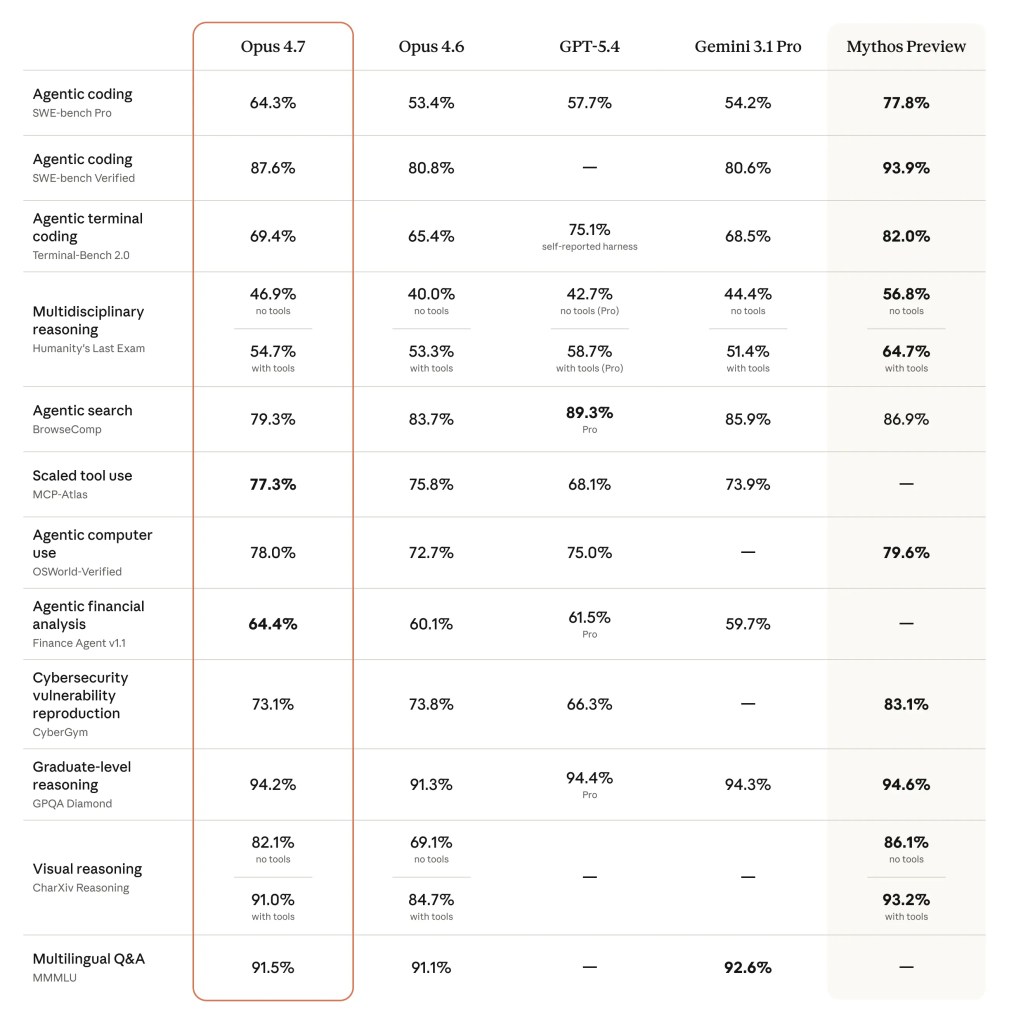
Opus 4.7, per Anthropic’s comparison chart, stacks up well against the competition, beating out both Google’s Gemini 3.1 Pro and OpenAI’s GPT 5.4 in several areas, but nothing quite beats Anthropic’s Mythos model, which is still behind closed doors because, apparently, it’s just too dangerous. Anthropic directly says that Opus 4.7 is “less broadly capable” compared to Mythos. Where Anthropic found that Mythos was particularly good at exposing security vulnerabilities, Opus 4.7 has safeguards “that automatically detect and block requests that indicate prohibited or high-risk cybersecurity uses.”
Users can start migrating to Opus 4.7, though it is noted that the new model “uses an updated tokenizer that improves how the model processes text,” which can end up using more tokens and, thus, potentialy inflating costs.
More on AI:
- Google updates best AI models for coding Android apps, Gemini & GPT 5.4 at the top
- ChatGPT’s free tier gets GPT 5.4 mini model with improved coding capabilities
- Gemini app starts rolling out Personal Intelligence globally
Follow Ben: Twitter/X, Threads, Bluesky, and Instagram


FTC: We use income earning auto affiliate links. More.


Comments