

Right as it’s been revealed that Google’s upcoming Pixel 11 probably won’t have new face unlock hardware, a new name is showing off some impressive under-display face unlock tech that could start showing up in Android devices as soon as next year.
Detailed in a report from Wired, a company called Metalenz is revealing its new “Polar ID” system that effectively makes iPhone-style face unlock hardware invisible. It does that by hiding most the hardware underneath an OLED display.
This new technology uses a flat lens system that takes up a fraction of the space of existing face unlock setups found in the iPhone and some other devices. It relies on optical metasurfaces technology, which uses a single lens with nanostructures to bend light towards the sensors used for face unlock. Metalenz has built out this technology to also capture polarization data, which can tell how light bounces off of specific surfaces. Combined, these make up the foundation of “Polar ID,” which works a lot like Apple’s Face ID, just without needing a big cutout in the display. That polarization data is important here, as Metalenz notes that the data from an actual human face would be different from say, a silicon 3D mask.
Metalenz struck a deal with Qualcomm over this tech a few years ago and, now, it’s ready to hit the market.
“Polar ID” is set to start showing up in smartphones and laptops in 2027, with under-display tech “likely” pushed to a 2028 debut. The Wired report notes that, unlike Google’s existing camera-based face unlock system on Pixels, this works in the dark. The under-display tech isn’t all that different from under-display cameras, but the biggest difference is that the polarization data isn’t bothered by the loss in quality that was noticeable in under-display selfie cameras on Samsung’s Galaxy Z Fold devices, for example. In a demo, there’s a minimal difference in data collection when the “Polar ID” hardware is hidden under an OLED display.
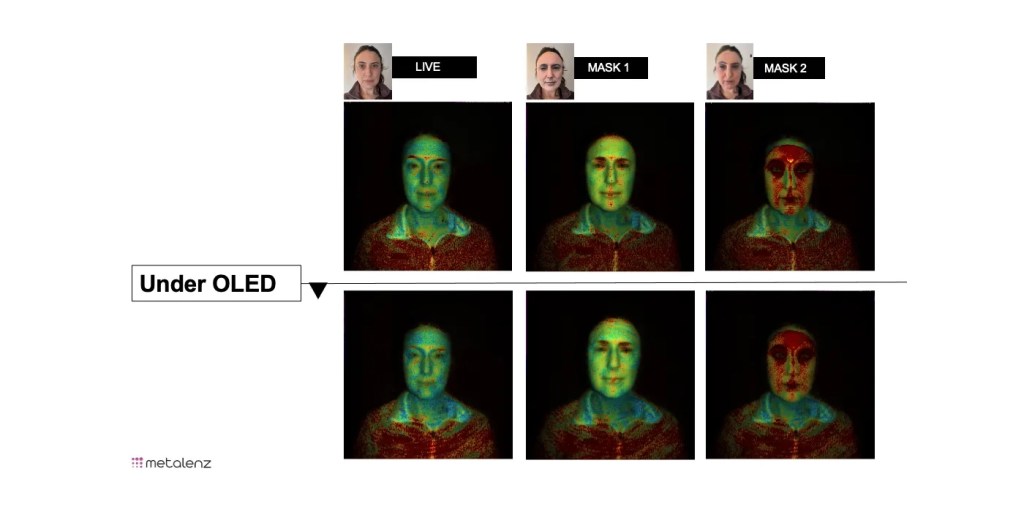
The only difference required in the actual display is a “thinned out” section.
Google has reportedly been working on under-display face unlock tech for a while now, with “Project Toscana” originally having been expected to launch in the Pixel 11 later this year. But, with ironic timing, a report from earlier today revealed that the Pixel 11 series will not have this hardware ready this year. It’s unclear if Google’s tech has anything to do with Metalenz, but it was previously mentioned to be using IR hardware in some capacity.
Whatever happens with Google’s tech in future Pixels, it’s rather exciting to see that there’s an option out in the wild that could show up on other Android phones.
More on Android:
- This chart shows why the RAM shortage has become a ‘mageddon’
- Pixel ruined voice typing on every other phone for me, but the fix is in sight
- Google hosting The Android Show before I/O 2026: ‘one of the biggest years for Android yet’
Follow Ben: Twitter/X, Threads, Bluesky, and Instagram


FTC: We use income earning auto affiliate links. More.


Comments