
Budget phones have been impacted the most by the rapid increases in RAM pricing, but that’s expanding to more expensive devices. A new report shows that devices sold for under $400 are being hit hard enough to where they’re gradually being left behind.
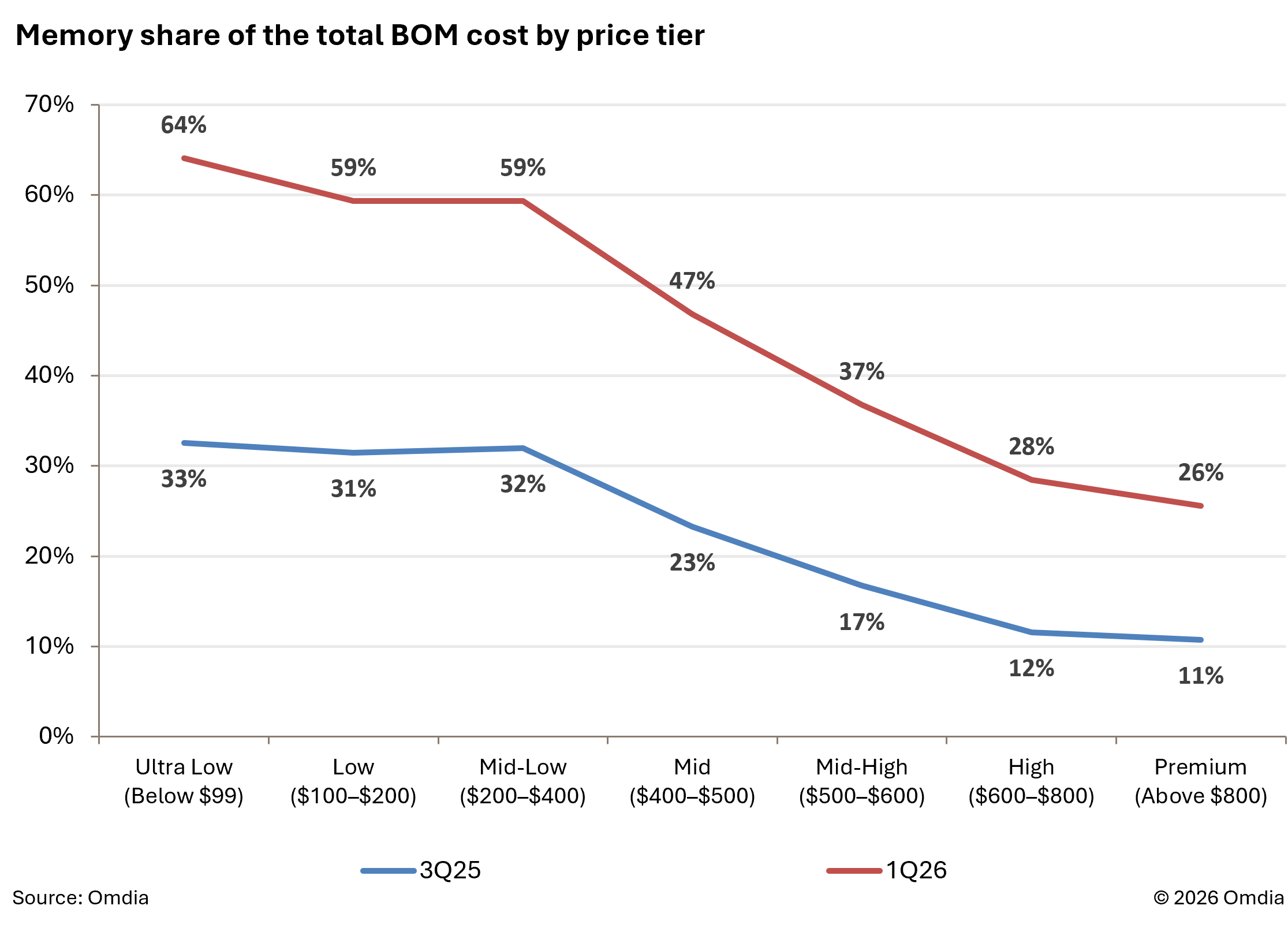
Omdia published a new report that says memory (RAM) now accounts for up to 64% of the cost of making a budget smartphone. That’s for “ultra low” devices that sell for $99 or less, but devices in the $100-400 segment are not far behind, with memory accounting for up to 59% of the total material cost. It drops from there, but every segment has seen the cost of memory more or less double over the past few months (compared to Q3 2025).
Apparently, $400 is the current tipping point, with smartphone makers either increasing the cost on these devices or cutting them out of the lineup altogether. There will be a 22% drop year-over-year in smartphones under $400, Omdia says.
Memory costs have become a serious burden for mid-to-low-end smartphones, contributing to a year-on-year decline of over 22% in the market for smartphones priced below $400.
…However, higher prices are likely to lead to a significant decline in demand, as low-end consumers are highly price-sensitive. Based on the memory price trend for the coming quarters, low-end products are already becoming unprofitable and face a high risk of weakening demand as retail price continues to rise. As a result, smartphone vendors are proactively and gradually retreating from the low-end segment in this year.
It’s not hard to see why brands are less incentivized to build these products, and it’s also easy to see the impact it’s having on new releases. Just today, Nothing released its Phone (4b) which was forced into a price point barely cheaper than the more-capable Phone (4a).
Omdia adds that while there’s likely to be a steep drop in these cheaper phones, shipments of new phones over $400 are expected to rise by 5.7% this year.
That said, they’ll still feel the impact.
The report suggests that more Android brands will opt to downgrade devices to save money that’s being forced to RAM costs. These include downgrading display panels, “more flexible” camera configurations such as lessening the number of camera sensors or using smaller sensors, as well as using last-gen SoC options.
We’re seeing some of that already. Motorola, for instance, stuck with the same chipsets across most of its Moto G and Motorola Razr series releases this year. As we’ve mentioned, buying last year’s hardware is more attractive than ever.
More on Android:
- What’s new in Android’s July 2026 Google System Updates
- All Android backup data now counts toward your Google Account storage, but it won’t take up much space
- Turns out I don’t want a physical QWERTY keyboard for my Android phone – do you? [Video]
Follow Ben: Twitter/X, Threads, Bluesky, and Instagram


FTC: We use income earning auto affiliate links. More.


Comments