
Google today announced WeatherNext 3 as its “most advanced and accurate global weather AI model,” with immediate benefits for Search and Gemini.
Other AI weather models (including WeatherNext 2 from November 2025) are “trained on data from numerical weather prediction (NWP) models.”
Although useful, NWP models are complex, supercomputer-driven physics simulations that carry a six-hour data lag. This lag can lead to biases for fast-changing variables like rain or surface temperature.
WeatherNext 3 uses a “mosaic of live, global geostationary satellite data.” This ability to learn “directly from real-time observations” allows for a “continuously updating view of the atmosphere” that results in “timely and more localized predictions for the weather events.” The Google DeepMind and Google Research model can generate “hourly forecasts at multiple spatial resolutions.”
- Temperature and moisture at 5-kilometer resolution
- Surface variables at 10 kilometers
- Wind speed at 25 kilometers
A forecast’s utility often comes down to detail and how finely it resolves both time and space.
Top comment by Michael Ball
Does this not include the Pixel weather app itself? I want to use it more often but its accuracy in my location is often pretty poor.
Compared to WeatherNext 2’s 25-kilometer grid in 6-hour increments, this update provides a global weather picture that is “roughly five times sharper.”
This is important because critical weather develops fast. When storms, fronts, or precipitation systems materialize suddenly, our rapid update cycle and higher resolution provides earlier, more detailed insights needed to help drive an effective response.
Google also touts a “significant leap in precipitation forecasting accuracy” by training WeatherNext 3 with “two exceptionally high-quality sources of precipitation data: NASA’s satellite-based Integrated Multi-satellite Retrievals for GPM (IMERG) and our own global precipitation reanalysis based on satellite radar.”
In medium-range global forecasts, evaluations against baselines show a Continuous Ranked Probability Score (CRPS) improvement of up to 60% against IMERG, 30% for MRMS, and 10% against rain gauge measurements for early lead times.
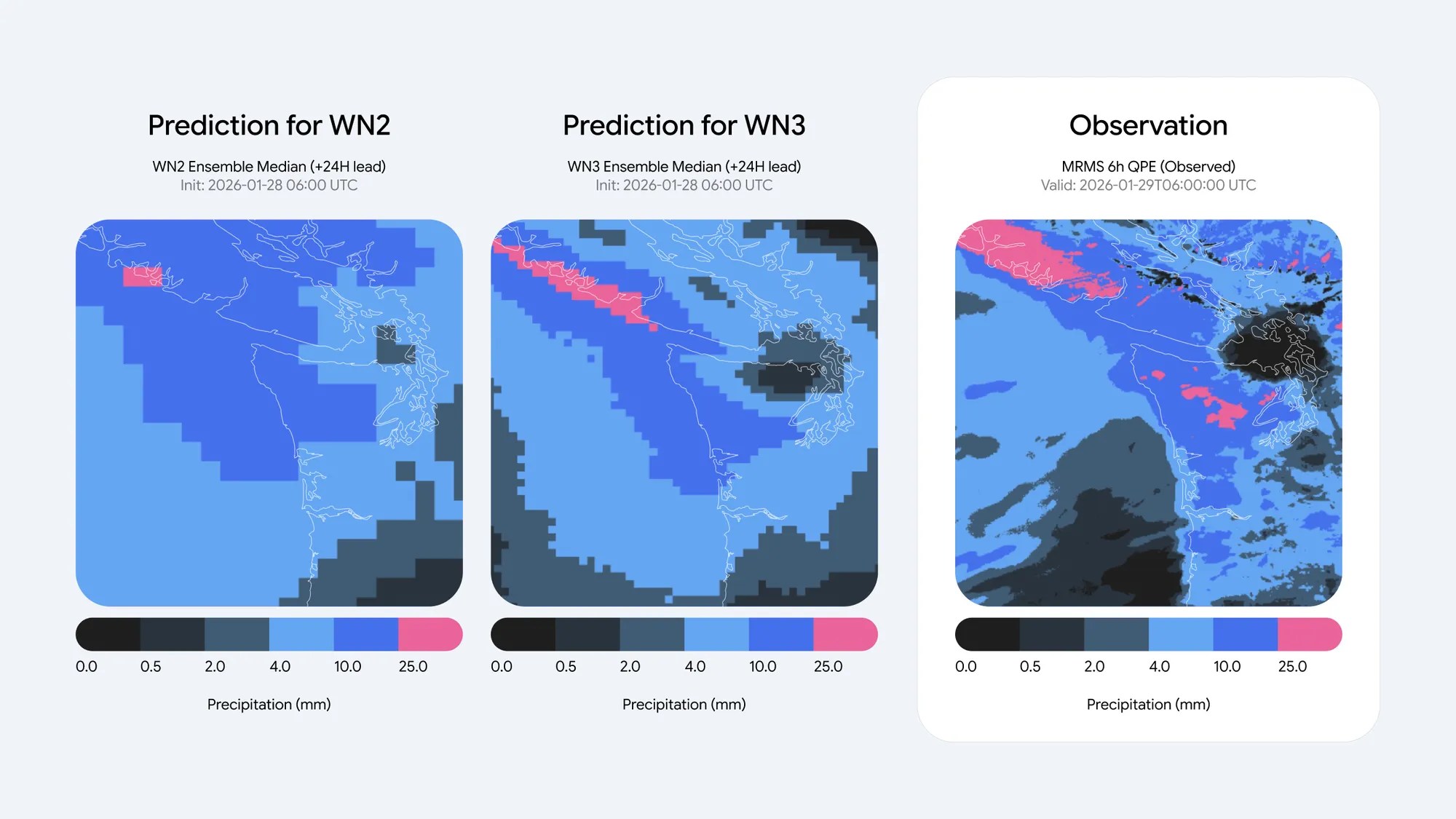
Other benefits include:
- “This breakthrough is particularly vital for regions across Latin America, Africa, and Asia-Pacific that have historically been underserved by high-resolution forecasting due to the immense supercomputing costs of traditional regional models. It brings localized, high-fidelity forecasting to billions of people and local businesses in these areas.”
- “Beyond improved resolution and forecast frequency, our model introduces predictions specifically engineered for renewable energy production. The model forecasts 100-meter wind speeds (roughly at turbine-height) for precise wind-energy output, alongside high-resolution cloud cover and sun radiation levels to help solar farms estimate how much light they will receive on the ground.”
In terms of consumer-facing benefits, WeatherNext 3 is rolling out to Google Search, Maps, and the Gemini app. Google says to expect “dramatically improve[d] longer term forecasts.”
When planning a day or more ahead, people will see up to 50% more accurate precipitation forecasts — with the greatest improvements in regions where forecasts have historically been less reliable.


FTC: We use income earning auto affiliate links. More.

Comments