
A week on from Google’s biggest update of the year so far, we have results on whether your performance has improved after updating a Pixel to Android 17 – here’s what you need to know.
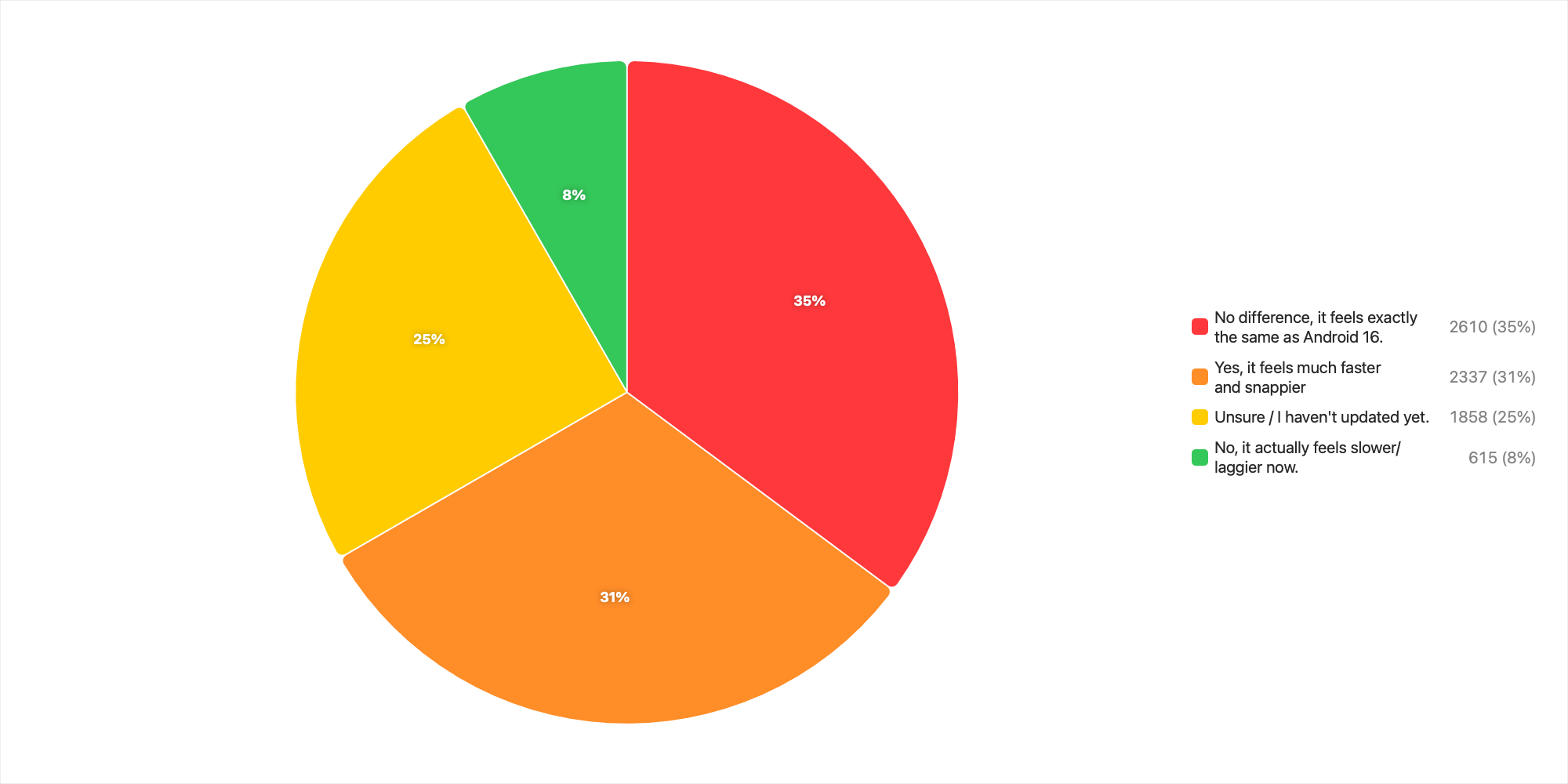
So last week, we asked you if your Google Pixel device was running any smoother after making the jump to the stable release of Android 17. With a substantial turnout of over 7,400 responses, the community has provided a clear picture of how the latest OS upgrade impacts daily usability.
The single largest group of voters noted that the upgrade brought no noticeable change in raw speed or Android 17 performance. A dominant 35% of readers felt absolutely no difference, stating their Pixel runs exactly the same as it did on Android 16 – which isn’t all that shocking given Android 17 isn’t a huge leap.
This sentiment is perfectly mirrored by readers like jimv1983, who noted that they “haven’t noticed any difference in performance” and that ongoing battery struggles are simply a hardware reality software won’t fix. Similarly, Mattia shared that their Pixel 9 Pro maintains the exact same smoothness and battery life, though they noted their companion Pixel Watch 4 felt way sluggish after the transition to Wear OS 7.


For a large portion of the community, however, the update delivered a welcome shot in the arm. Coming in just behind the top spot, 31.50% (2,337 voters) reported a positive boost, noting their device feels much faster and snappier. Even for those where the speed up was subtle, the patch ironed out frustrating wrinkles. Niyasseen observed that while general performance felt the same on their Pixel 9 Pro XL, it crucially fixed random Wi-Fi disconnections and brought standby battery life back to normal after bugs introduced in the March Feature Drop.
A quarter of our audience, sitting at a smidgen over at 25.04%, were either still unsure or hadn’t pulled the trigger on installing the update yet, so they have no opinion on Android 17 performance. This caution might be justified for some, as a small minority of 8.29% (615 votes) reported that the update actually made their phone feel slower or laggier. Users on slightly older hardware or specific configurations seem to be taking the brunt of this slowdown. Reader RedDucky shared that their baseline Pixel 8 – which has 8GB of RAM – got noticeably sluggish, causing games that previously ran smoothly to randomly stutter and freeze during intense animations.
Beyond the raw numbers, the community highlighted a fascinating mix of architectural optimism and minor visual bugs. Some users pointed out that while day-to-day speed feels identical, behind-the-scenes engineering might be helping overall system health. Regular reader Mckillio wondered if any subtle improvements owe credit to Google implementing more Rust code instead of C/C++, noting that while it is primarily for security, it also reduces crashes and memory leaks.
Still, a major OS upgrade rarely lands without a few strange glitches. While Allen mentioned that their Pixel 10 Pro might be smoother, they lamented that it failed to fix a frustrating lock screen bug where the display freezes entirely until placed face down. Meanwhile, RedCar highlighted a much lighter visual bug, pointing out that the 3D shape wallpaper effect completely stopped working on their Pixel 10 Pro after moving to stable 17.
Final Thoughts
Overall, Android 17’s performance on Pixel appears to be largely stable and, as we have expected for months, iterative. While it may not transform your device into a brand-new machine overnight, it successfully preserves the fluidity of Android 16 for most, while throwing in a handful of welcome system optimizations and bug fixes.
Did you notice any performance changes or strange bugs that didn’t make the poll? Let us know down in the comments below!


FTC: We use income earning auto affiliate links. More.



Comments