
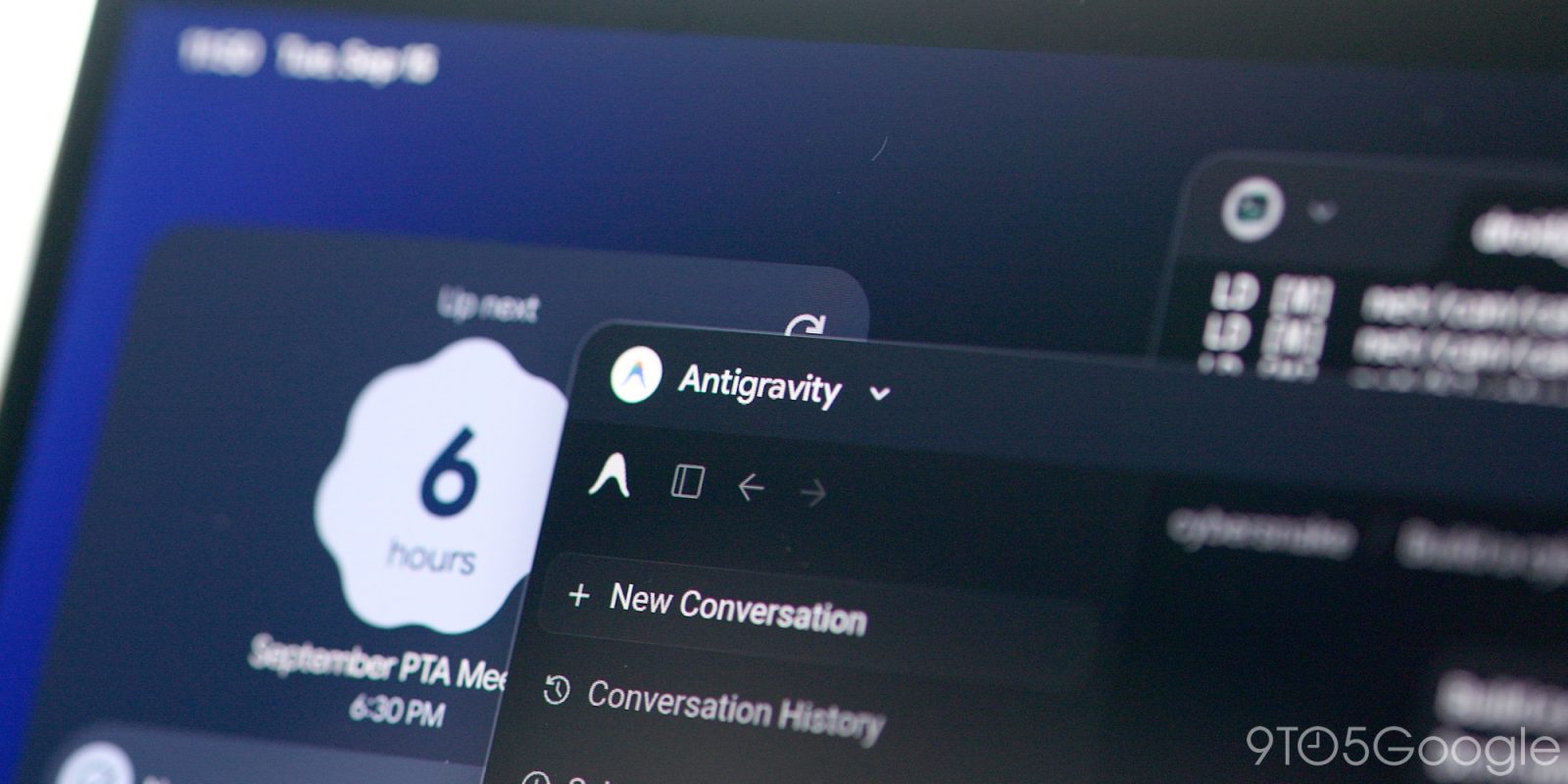
Google is now rolling out support for Gemini 4 Argon to Antigravity, its AI coding tool.
Gemini 4 Argon is Google’s latest flagship AI model, announced at the end of September and having widely rolled out to users earlier this week. Now, it’s also available within Antigravity.
Antigravity is an agentic development platform, as Google describes it, which leverages AI and agents to assist in coding and building apps. Google announced that Argon would be available in Antigravity earlier this week, and it’s now actively rolling out to AI Pro and AI Ultra subscribers – we’re seeing it live on our end, too.
In a post on Twitter/X, Google adds that there’s “a separate weekly-only Argon quota” on top of the existing quota for Gemini 3.8 Flash, meaning you’ll be able to use the model that best suits your needs. Google says that Argon is “designed to tackle your hardest problems.”
Google also provided a host of examples of how Argon in Antigravity has been used internally, including:
- YouTube comment optimization: Argon in Antigravity helped the team cut the CPU footprint of YouTube’s comments frontend in half. By tracing production profile data, Argon identified that redundant emoji rendering alone accounted for nearly 45% of server overhead, leading to 12 targeted optimizations. The updates reduced server comment-load latency by 30 ms and dropped client end-to-end latency by 20 ms.
- Debugging Wing drone physics simulator: Argon in Antigravity reviewed Wing’s proprietary internal drone physics simulator, reasoning through the underlying physics and math rather than just the structure of the code. It highlighted areas for improved physics simulations and proposed 18 targeted modelling improvements across aerodynamics, propulsion, and structural dynamics to resolve long-standing legacy issues.
- Burning down the backlog: Argon in Antigravity took an aging queue of 134 open bug reports spanning multiple services, and ran agents to work out which were still real, cross-referencing commit histories, checking whether candidate fixes actually reached production, and inspecting live telemetry for whether the error still occurs. In under 3 hours it closed 97 stale or duplicate bugs with documented commit proof (a 72.4% queue reduction) and sorted the remaining 37 by owner with no unassigned tickets left.
- Migrating legacy code: For decades, vital scientific research has been locked inside fragile legacy codebases like Fortran. Using a custom skill within Antigravity, a team deployed Argon to map and execute a complete rewrite into modern Rust. Argon autonomously delivered the modernized codebase, achieving a 1.8x performance boost and memory safety while giving scientists a robust foundation for future work.
- Performing security audits: Argon in Antigravity was used to audit a batch of access-control changes. Argon traced how permissions actually flowed at runtime rather than just reading the code diff, and found four critical security bugs. Two earlier frontier models had audited the identical code and both concluded there were zero security holes.
- Triaging production support tickets: Argon in Antigravity batch-processes dozens of tickets from an on-call rotation. It sorts them by issue type, tracing root causes through the code and logs, proposing fixes and drafting the replies for human approval. This has freed up 2-3 hours per shift, enabling the team to focus on resolving issues faster.
- Marketing website localization: The Antigravity DevRel team used Argon in Antigravity to localize hundreds of pages of developer documentation into 17 languages in a matter of hours. This improved the accessibility and UX of the website by shrinking a multi-week process down to hours and shifting human effort exclusively to high-quality review.
- Accelerating data center pipeline modernization: Demonstrating how AI-augmented execution helps teams do more with less, a Data Science Technical Program Manager leveraged Argon in Antigravity to fast-track development of a 3,200-line Google Data Center fleet analytics pipeline (Python, SQL, and dashboards) into production in days. Pairing with Argon to rapidly resolve complex multi-system edge cases, eliminate hardcoded legacy assets, and optimize timeseries queries against timeouts drove end-to-end efficiency — delivering a clean, production-grade, and extensible architecture for fleet-scale analytics.
- Vetting sales prospects: Argon in Antigravity built an automated qualification workflow for an account executive in Ads sales that checks prospective company website traffic, confirms the site has clear conversion funnels, and cross-references the sales database to see whether the account is a qualified prospect. This reduced research time by 90%, saving the account executive upwards of 10 hours of manual work each week so they can spend time on direct client outreach instead.
- Financial planning and analysis: With custom finance plugins, a finance lead used Argon in Antigravity for end-to-end financial reconciliations, budget tracking, contract extraction, and daily executive briefings across 80 separate workflows. Over seven business days, 15.5 hours of human direction produced about 335 human-equivalent hours of validated financial output, saving more than eight weeks of manual work.
More on Gemini:
- Google Antigravity Googlebook app hits the Play Store
- Google rolling out Universal Cart that lets you shop the web and find deals with Gemini, Search
- Gemini AI Plus subscribers will lose access to Pro models next month
Follow Ben: Twitter/X, Threads, Bluesky, and Instagram
Kyle Bradshaw contributed to this article.


FTC: We use income earning auto affiliate links. More.


Comments