

Sideloading has been a key part of Android since the beginning, not only delivering a lot of flexibility to Android, but also a sense of openness and freedom. After Google announced it would make major changes to sideloading, the community (somewhat understandably) panicked, but as Google has now shown exactly how its new sideloading flow on Android will work, I’m not only happy to see that sideloading isn’t going away at all, but that Google’s compromise is as close to perfect as I think we can reasonably get.
9to5Google Weekender by Ben Schoon is a part of our free newsletter that also includes ‘Inbox,’ a twice-weekly roundup of key stories from around the web by Daniel Bader. Sign up here to get Weekender delivered to your inbox every Sunday along with ‘Inbox’ on Tuesday and Thursday. You can find past issues here.
“Android Developer Verification” has been referred to by some as the death of Android’s open nature. Google announced the change last year as a restriction to app installation, including sideloading, which would require developers to register with Google in order to allow their apps to be installed on Android devices. Google originally pitched this as being like an ID check at the airport – confirming the “who” an app is coming from.
The focus here was always on combating scams, including “convincing” fake apps, as well as cutting down on malware and other malicious attacks that were prevalent, especially through sideloading from sources outside of the Google Play Store. Google has been targeting scams on Android more aggressively over the years, to some success, in part by blocking sideloaded apps used in scams.
This week, Google finally showed the new “advanced flow” that is designed to allow users (and developers) to sideload apps that aren’t from a registered developer.
The 4-step process asks the user to confirm that “no one is instructing me,” then starts a 24-hour delay. The user is asked to reboot their device to start the timer and, 24 hours later, they can continue the sideloading process after again acknowledging the risks – the delay only kicks in once, if you choose to leave it on “indefinitely.” So, really, this is just a one-time hurdle. The biggest “headache” is that developer options need to be turned on, but you can later turn them back off.
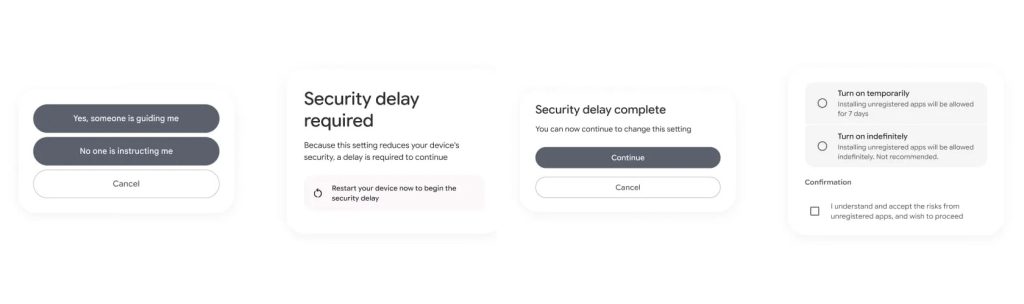
Google will be rolling this out to all versions of Android starting in August 2026.
And, in my eyes, it’s a near-perfect compromise.
Google has repeatedly made it clear that a “crackdown” on sideloading isn’t about removing functionality or freedom, it’s always been about user protection and, above all else, shutting down scams that are prevalent on Android in some regions. By limiting sideloading as it plans, Google doesn’t stop developers or even users from doing what they actually want to do, but it’s a massive wall in front of scammers.
Scammers often rely on creating timed pressure, a sense of urgency. A 24-hour waiting period with a couple of extra warnings in place? That’s a hard obstacle to those types of scams. It’s also a huge hassle for users that are being walked through more common scams. A personal example – a family member called me a few weeks ago after buying a cheap fitness tracker, asking why their homescreen had changed. As it turns out, the product had required they sideload an unknown app which replaced their launcher. I talked them through uninstalling it, but a 24-hour delay and all of these additional warning screens? The installation never would have happened.
It’s a thoughtful way of balancing user protection along with functionality. Because, while the “average Joe” needs to wait for that 24-hour period to end, developers and enthusiasts who need/want to sideload an app right away can still use the usual ADB tools. That’s a hassle for “normal” users – and even more so for scammers – but the people who really can’t wait the 24-hour period (which, again, only needs to be once) still have options.
And let’s not forget that, in many cases, you won’t have to deal with this anyway. Google’s developer verification program just requires developers to register, at which point sideloading becomes a non-issue with no waiting periods or anything else “in the way.”
What do you think of Google’s changes to Android sideloading? I’m sure there are plenty who still take issue with this but, as mentioned, I’m not sure there’s a better compromise out there. It could be worse.
This Week’s Top Stories
The Galaxy Z TriFold is dead already
Samsung has confirmed that, after just a few months, it is discontinuing the Galaxy Z TriFold. The reason? Samsung didn’t say, but a report suggests it boils down to complex manufacturing and the increasing pressure of the RAM/storage shortage.
- Galaxy Z TriFold officially being discontinued, likely won’t be restocked online
- Samsung reportedly preparing Galaxy Z TriFold sequel, slideable phone for 2027
More Top Stories
- Gemini screen automation rolling out to Pixel 10 series
- Gemini for Android redesigns voice input to be like audio memos
- The Gemini for Home voice assistant is now more concise, faster, & better at alarms/timers
- I’ve been using the Nothing Phone (4a) Pro for a week, and it’s absolutely brilliant
- Google rolling out Personal Intelligence to free Gemini, Chrome, & AI Mode users
- ‘Galaxy Glasses’ with Android XR reportedly match the battery on Meta Ray-Ban Display
- Google Pixel found enough of a foldable phone niche to maybe stay relevant following ‘iPhone Fold’
- Samsung admits Galaxy S26 Ultra’s screen quality is slightly hindered by Privacy Display
- Google’s scrapped Fuchsia UI has been revived in a web app
- Fitbit improves sleep tracking, new Sleep Score and health records coming
- Redmagic’s tiny Android gaming tablet has a 9-inch, 200Hz OLED display, leak reveals
- Galaxy Watch 8 Classic is discounted to just $219 for some, and it doesn’t make any sense
- Claude is letting users bypass its standard usage limits for the next two weeks
- Your favorite image-saving Chrome extension was scraping your data for cash
- Phone trade-ins paid out $6.4B in 2025 as Android users kept their phones longer than iPhone users
- Peter Parker is an irresponsible Galaxy Z Flip owner in ‘Spider-Man: Brand New Day’ trailer
- This new cassette player has USB-C and Bluetooth, in case you want to ditch Spotify
From the rest of 9to5
Top comment by PurplePopcorn
Phones are not toys, appliances or vending machines for software. They are computers. If we normalize the idea that installing software on them requires special language, special warnings and a special mental framework, we are not just changing distribution. We are changing what people think a computer is for.
And once that idea settles in, everything else gets easier: more warnings, more friction, more gatekeeping, more commissions, fewer competing stores, less room for independent developers, and less freedom presented as something normal.
Security vs. freedom is a false choice. The baseline is simple: owners decide what runs on their machines. Security should adapt to that reality, not replace it.
9to5Mac: Google begins testing dedicated Gemini app for Mac
9to5Toys: Major Switch 2 update delivers new Handheld Mode Boost to enhance Switch 1 games
Electrek: The US’s only true street-legal electric micro-car just got big upgrades
Follow Ben: Twitter/X, Threads, Bluesky, and Instagram


FTC: We use income earning auto affiliate links. More.



Comments