
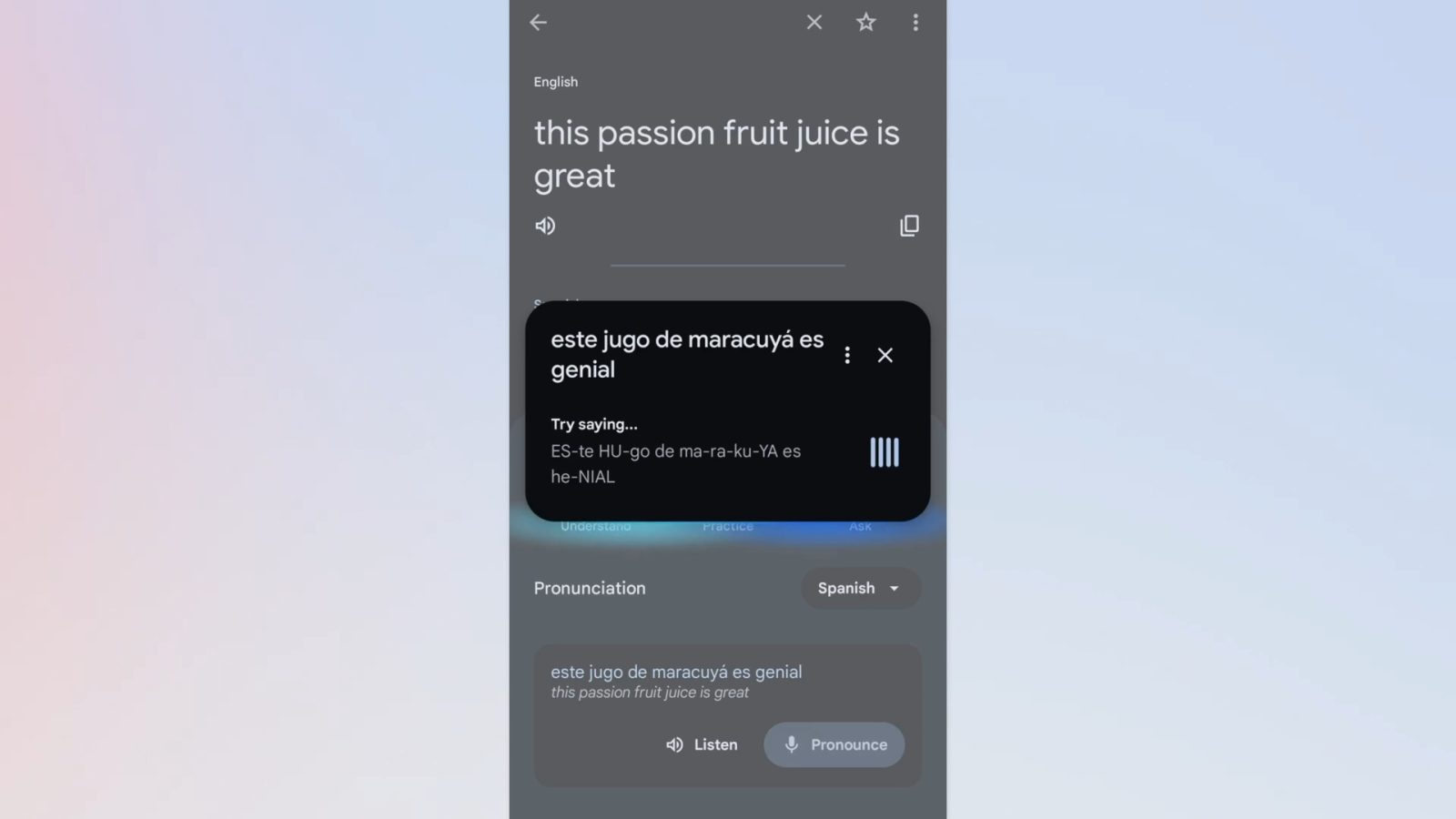
Google Translate launched on April 28, 2006. To mark its 20th anniversary, Google is adding a pronunciation tool to Translate for Android.
Pronunciation practice is one of Google Translate’s most requested features. After you get a translation, select the “Practice” button. It joins the Gemini-powered Understand and Ask capabilities introduced earlier this year.
Tapping “Pronounce” will let you speak it and have AI “analyze your speech and provide instant feedback.” Google Translate pronunciation practice is available on Android in the US and India in English, Spanish, and Hindi.
The company also shared the history behind Translate, including how it was “one of the initial experiments that kickstarted Google’s machine learning work decades ago within Google Research.”
- “In 2006, Translate relied on statistical machine learning, and a key part of making more fluent and natural translations was our research into how to maintain much larger-scale and more accurate language models (which capture how often words and short phrases occur) across trillions of words of data.”
- “In 2016, we pioneered a massive shift to neural networks to move beyond literal word-for-word translations (building on our research on Sequence-to-Sequence models and our initial work on Tensor Processing Units), proving that deep learning could work at a global scale to be truly helpful for people.”

Today, Gemini models are leveraged and help power Live translate’s real-time conversations, with over a third of these sessions lasting five minutes or more.
Each month, 1 billion users use Google for translation help, while 1 trillion words are translated monthly across the Google Translate app, Search, Lens, and Circle to Search.


FTC: We use income earning auto affiliate links. More.


Comments