
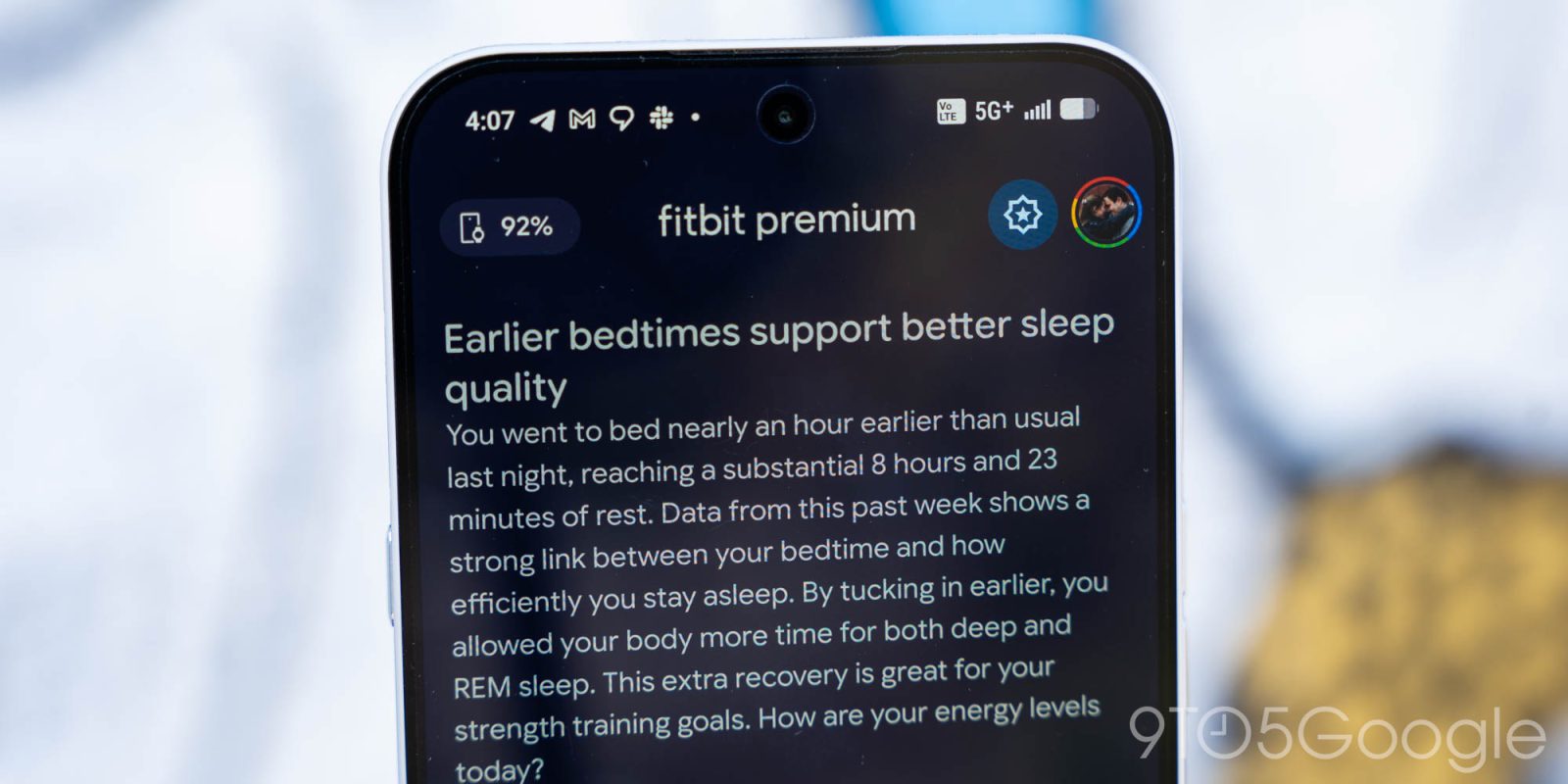
Fitbit Public Preview users are getting a redesigned Sleep Score experience with “actionable advice that will help improve your sleep health.”
Think of this as a higher-definition view of your rest. By capturing a more detailed and complete picture of your night, your score now offers a more accurate reflection of your personal patterns. This shift allows Fitbit to go beyond simply tracking your sleep and start identifying the real habits that shape how rested you feel.
It starts with making the Sleep Score “more transparent” by showing “exactly which metrics contributed to your score.” This will make it “easier to see what you may want to focus on over time.”


You will now see six metrics (emphasis ours):
Total sleep duration: This makes up the majority of the score and represents how much time you were estimated to be asleep during your primary sleep window for the day. We consider any time that you were likely asleep to be part of your sleep duration.
Time to sound sleep: This is the time it takes from when you first appear to get to bed until the moment your body fully settles into Deep, REM, or a steady phase of Light sleep with a calm heart rate. Usually, the faster you settle in, the better you’ll feel.
Sound sleep: This is one of a few descriptions of how your sleep looked, reflecting the total amount of steady, undisturbed sleep you got. We add up all the moments during your sleep period where your body appears to be soundly asleep (Deep/REM/Light with low, steady HR).
Restlessness: The time you were likely asleep, but moving, stirring, or in a transitional/wake-like state. We add up all the very brief, minor wakeful moments that happen while you are asleep. We exclude longer, memorable awakenings that are less than five minutes. Reducing these “active” moments leads to a better score.
Interruptions: This is the total time you appeared fully awake during the night. We look for longer, likely memorable moments of wakefulness rather than tiny, natural stirs.
Full awakenings: This is the number of distinct, memorable times you woke up for at least five minutes. Fewer interruptions lead to a better Sleep Score, with zero being the ideal.
Fitbit also touts a “more holistic” Sleep Score that “assesses the full spectrum of your sleep quality, from falling into sound sleep to restlessness, or interruptions.”
Our updated algorithms now also unify your night into a single, continuous journey, providing a score intended to reflect how well you slept.


Fitbit Premium subscribers will get Personalized Insights and Coach guidance on how to improve their sleep.
- Targeted insights: If your “Time to Sound Sleep” is consistently high, your app won’t just show you a graph, you’ll also receive an insight suggesting changes to your wind-down routine – like putting screens away 30 minutes earlier or trying a guided breathing exercise.
- Guidance from the Coach: When you’re looking at your score and wondering “Why is this lower than yesterday?”, you can turn to the coach. For example, the coach might point out that a highly active day or a late-afternoon nap shifted your body’s sleep requirements for the night.
Given the new approach, Fitbit says your Sleep Score will change from what it was before. Once available, you’ll see a new in-app prompt when heading to the Sleep Score page with a brief set-up process. Your Fitbit device might not have the new Sleep Score, with Google encouraging you to check the mobile app for the time being.


FTC: We use income earning auto affiliate links. More.


Comments