IPhone

See All Stories

Analyst says Android losing steam in America to Apple’s unreleased iPhone 5

Site default logo image


While we’re at it, check out the sharp decline of RIM’s once powerful BlackBerry platform.

It’s always a good idea to take whatever analysts are predicting with a healthy dose of skepticism. That said,  Needham’s Charlie Wolf cites IDC data that portrays Android as losing ground to iOS in America. Android, of course, is the country’s leading smartphone platform which in the first quarter grabbed a whopping 49.5 percent of the smartphone market while Apple’s iPhone had 29.5 percent. The momentum cannot continue forever so it’s little surprise then that Android controlled 52.4 percent of the market in the quarter-ago period. Fortune’s Philip Elmer-DeWitt calls this Android’s “first sequential loss ever in any region of the world”, quoting Wolf’s Monday note to clients:

In our opinion, this is just the beginning of Android’s share loss in the US. The migration of subscribers to the iPhone on the Verizon network should accelerate this fall when Apple coordinates the launch of iPhone 5 on the GSM and CDMA networks. The iPhone could also launch on the Sprint and T-Mobile networks.

It looks like ol’ Charlie’s trying to offload some AAPL shares. He argues that…
Expand
Expanding
Close

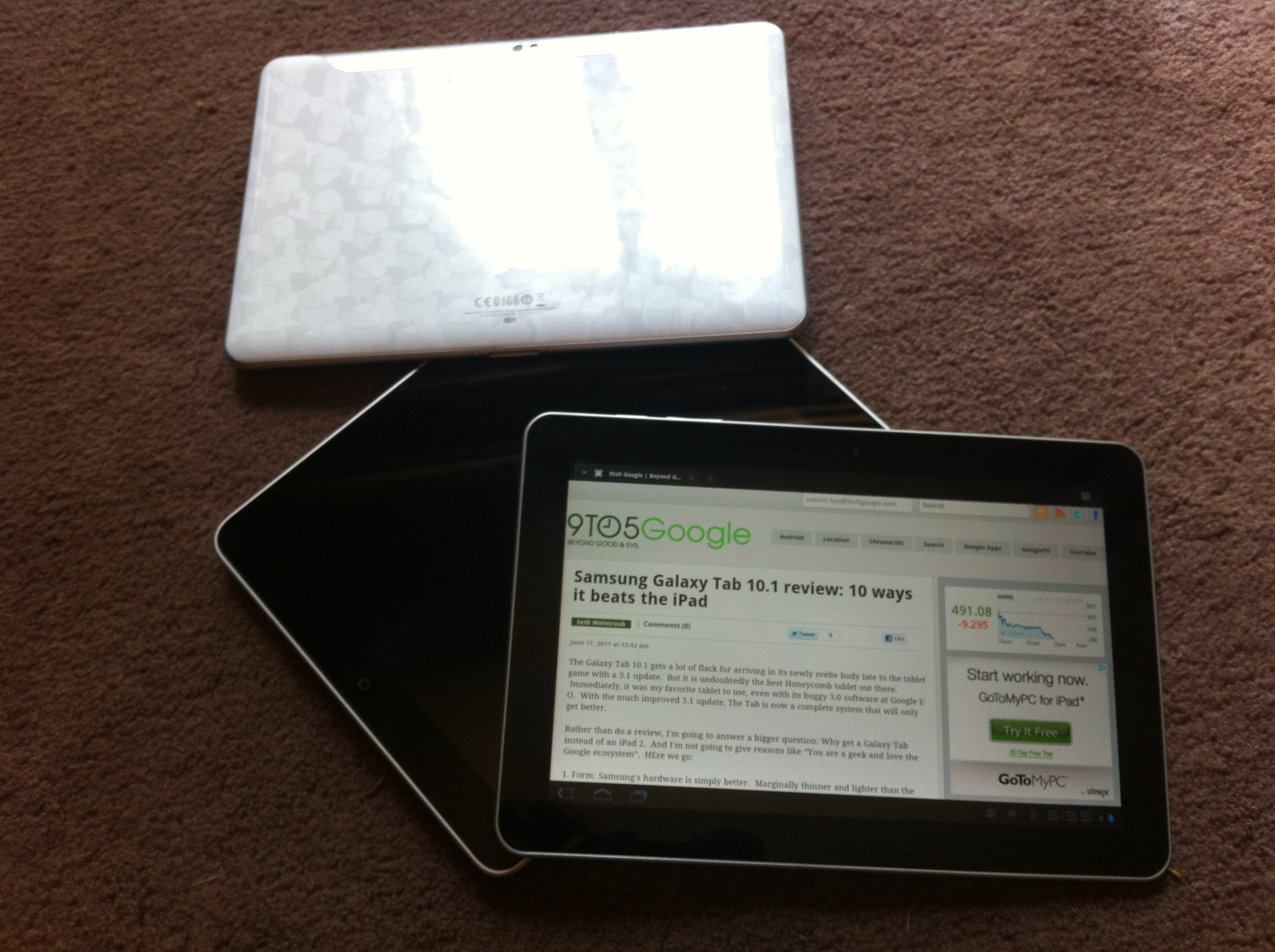
Why get a Galaxy Tab instead of an iPad 2

Site default logo image

The Galaxy Tab 10.1 gets a lot of flack for arriving in its newly svelte body late to the tablet game with a 3.1 update.  But it is undoubtedly the best Honeycomb tablet out there.  Immediately, it was my favorite tablet to use, even with its buggy 3.0 software at Google I/O.  With the much improved 3.1 update, The Tab is now a complete system that will only get better.

Rather than do a review, I’m going to answer a bigger question: Why get a Galaxy Tab instead of an iPad 2.  And I’m not going to give reasons like “You are a geek and love the Google ecosystem”.  Here we go:


Expand
Expanding
Close

ECS jumps on the phone-docking bandwagon with the Trinity accessory

Site default logo image

The Asus Padfone has inspired what appears to be a cottage industry of phone-docking tablets in the making. Take a new docking accessory from ECS. Code-named Trinity, it’s the result of joint efforts by ECS and its partner ICE Computer. Unlike the Padfone which is a real tablet, the ECS solution is an intelligent docking station that can house various smartphone brands. It takes your phone’s video and outputs it via HDMI to the built-in display which is of the same 9.7-inch variety and 4:3 format as the iPad’s.

You also get an SD card slot, two USB ports and a front-facing camera. It’s a cross-platform play of sorts due to its ability to work with and house multiple smartphone brands, from Apple’s iPhone to Windows Phone and Android smartphones. Best of all, the gizmo should work with future iOS devices – including iPhone 5 – using “simple upgrades”. Expect the Trinity to hit the market in the fourth quarter costing $200 or less. Go past the break for a video introduction. via ITProPortal

(Cross-posted on 9to5Mac.com)


Expand
Expanding
Close

Marissa Mayer talks Apple, location, and learning

Site default logo image

[vodpod id=Video.9929744&w=650&h=400&fv=%26amp%3BembedCode%3DUzNDJoMjpzR4v5RcbxsAczC071d3QOq1]

On the possibility of Apple dropping Google Maps (we’ve heard they aren’t): Mayer says there are 200 million active users of Maps and in June more people will use them on mobile than the desktop. (Although at 100 million iPhones out there, an Apple exodus would put a monster dent in those numbers. Also, new Google Mobile Maps (not iOS) use vector tiles which can be up to 100 times smaller files than the traditional bitmap tiles.

Also, location is getting better as more data is input (learning), especially in big cities like New York with check-ins helping out.

Finally, she expects phones to know what you want before you ask, called ‘serendipity’ or ‘zero-click’.

Full transcript available here.

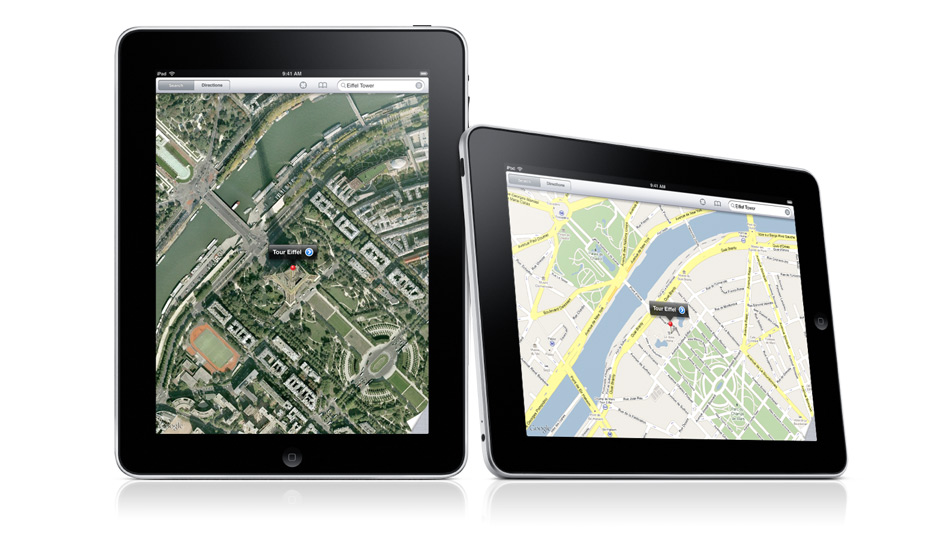
iOS 5 will continue to use Google mapping data

Site default logo image

With Apple’s purchase of two mapping companies over the last couple of years – Poly9 and Placebase – many have speculated that iOS 5 will finally be the iOS release where Apple moves from a Google Maps backend to an Apple backend. Multiple job postings on Apple’s official site backed up this speculation and even Apple promised some under-the-hood maps tweeks for their next-generation iPad, iPhone, and iPod touch operating system.

Now, sources have told 9to5Google that although Apple is working to improve the iOS Maps application, iOS 5 will not bring an Apple developed maps service and Google Maps is still in. Besides Apple’s purchase of both Placebase and Poly9, some speculated that Apple is building their own maps service to either compete with Google or step away from their input into iOS.

Apple began the process of distancing themselves from Google when former Google CEO Eric Schmidt resigned over “conflict of interest.” Apple has also added Microsoft’s Bing as a Safari search option and will be competing with Google head-to-head with their upcoming cloud-based music service. Those who enjoy Google Maps should not fear iOS 5, though, and hopefully Apple is working to implement turn-by-turn directions or something else to improve their maps application without changing the backend.
Expand
Expanding
Close

In Japan, Samsung Galaxy S beats the iPhone

Site default logo image

Samsung’s Galaxy S, arguably the most successful consumer smartphone powered by Google’s software, has outsold Apple’s baby for the first time in Japan where the iPhone has been a huge hit. The achievement has enabled Samsung to climb on the list of Japan’s top handset makers to the fourth slot, ahead of local vendors NEC, Casio and Kyocera. Furthermore, Android has flown by iOS in just three quarters and Android smartphones are now outselling iOS smartphones in the country. That’s the gist of a Strategy Analytics survey of Japan’s smartphone market based on first quarter shipments. Their director Neil Mawston explains in an InfoMobile story:

Strategy Analytics believes that the healthy demand for the Android-powered Galaxy S at NTT DoCoMo drove Samsung growth in Japan. Samsung is the main player behind surging Android smartphone sales, followed by Sharp. Japan had always had a unique competitive landscape, but is now looking more and more like any other advanced smartphone market in the world as Android has flown by iOS in just three quarters.


Expand
Expanding
Close

Is Japan's smartphone Android/iOS duopoly a sign of things to come?

Site default logo image

(Cross-posted from 9to5Mac.com)

A pattern is emerging in smartphones. Think about it, the same scenario has been playing out over and over in every territory where Google and Apple battle for supremacy. Apple first wows the market with its iPhone. Then, Google brute forces its way into the game and eventually takes the lead thanks to countless Android handsets in all shapes, sizes and price points, carried by virtually all wireless operators. Japan, however, is an indication of a new pattern that has iOS and Android forming a duopoly that squeezes out entrenched players, upping the barrier to entry.

In the latest survey of the Japanese market by MMI Research Institute reported by Bloomberg Businessweek, Android posted an incredible 2,000 percent year-over-year growth, capturing 57 percent of the country’s 2010 smartphone market versus 38 percent for Apple’s handset (as big as anywhere) – a notable decline for the iPhone’s 72 percent share from a year earlier and also a catastrophic loss for other platforms.

Shipments of Android phones rose to 4.91 million units in the year ended March 31, Tokyo-based MM Research said in a statement today. That compares with sales of 250,000 units, or 11 percent of the market, a year earlier when devices running Google’s software started to be widely available in Japan.

Apple shipped 3.23 million iPhones in the country in the last fiscal year, all sold excursively via Softbank. The combined 57 percent share for Android plus 38 percent for iPhone leaves little room for Nokia and BlackBerry maker Research In Motion. Both brands have been reduced to the Others category with a minuscule five percent market share. Is this a sign of things to come? Read on…


Expand
Expanding
Close

Google Goggles gets new tricks including better business card scanning

Site default logo image

Another update ahead of I/O tomorrow, this one looks pretty good.

What’s in this version of Google Goggles:

  1. Enhanced Search History feature allows you share results with others & search for prior results
  2. Improved business card scanning
  3. Suggest a result when Goggles fails to recognize an object
  4. Option to save query images to SD card
  5. Pictures taken during slow connectivity can be saved for later.
  6. ( Improved network reliability


Expand
Expanding
Close

The most important 256 pixels on the planet?

Site default logo image

Google announced its second favicon change this year after having the same favicon for the past 8 years. Why is this so important?

Google Favicon, its most important 256 pixels

Google.com gets over 150 million hits a day. Every time someone visits Google in their search bar, they’ll see these pixels. This image also accompanies Google in your bookmarks and page history. Browsers that support a tabbed document interface typically show a page’s favicon next to the page’s title. The Microsoft Windows Shell also uses favicons to represent “Internet shortcuts” to web pages. If you save a Webpage to your iPhone, it will be represented by the favicon.

Google’s favicon is looked at millions of times every hour by Google’s customers all over the globe. You’d better believe those 256 pixels are important to Google and they’ve obviously spent some time thinking about it. Have you considered your most important 256 pixels?
Expand
Expanding
Close