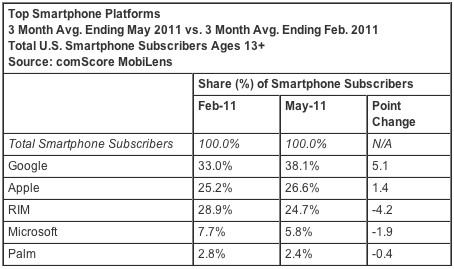
The Android train keeps chugging along with the comScore showing a 5.1 point increase in total US Android use in the Feb-May Quarter putting the OS at 38.1% of the total US smartphone market. Apple also gained, though less spectaculary with 1 percentage point improvement, coming in at 26.6%. Android head Andy rubin said last month that Android activations had grown to over half a million a day worldwide.
For the other guys, it wasn’t a happy quarter. RIM continues its slide down to a under quarter of all US smartphone purchases, while Microsoft and webOS risk being bundled into the “other” category as their marketshare continues to erode into almost nothing.
Best Buy Music Cloud streams songs to Android, iOS and BlackBerry smartphones and supports offline mode
Come on, you knew this day would come now that Amazon, Google and Apple have legitimized music lockers in the cloud. Yes, Best Buy is jumping on the bandwagon with a cloud service of their own, dubbed Music Cloud and powered by Catch Media Inc’s Play Anywhere platform. Should you care? It depends, as Music Cloud seems to be a mixed bag of best ideas taken from others, clearly with some limitations stemming from their lack of Apple’s stranglehold of the music industry.
You can upload songs to Music Cloud, just like with Google’s Music Beta and Amazon’s Cloud Player. More importantly, the service lets you stream songs from the cloud to any device, unlike Apple’s service that only lets you download individual files (although that’s likely to change in the near future). Best Buy’s offering, however, excludes the scan-and-match feature that Apple’s iCloud will offer for $25 a year come this Fall. Music Cloud has a couple of other nice perks (and more annoying limitations)…
Google mobile search has been revamped for tablets, including Image Search shown above
Google this morning unveiled new search-related features during the Inside Search even at San Francisco where Amit Singhal and other engineers gave an under-the-hood look at Google search. The latest goodies include a revamped search interface that rolled out on mobile. Using Ajax, the new mobile search pulls local results right away. Moreover, query suggestions from your history now appear alongside your live suggestions from Google.
Another example included a search query for hotels in Russia. Typing “Hilton” returns a bunch of suggestion, each with the plus sign. This so-called query builder allows you to tap a suggestion you like in order to drill deeper. We’re just getting started. Go past the fold for more info and nice video tours…
Google Goggles translations are now available in Russian
Google last week updated their mobile search page on Android and iOS devices with visual tweaks, including quick access to multiple searches via handy tabs, enlarged icons that provide an easier access to search silos and more. It looks like another face-lift has been recently rolled out. Now when you run a search at m.google.com, a small magnifying icon appears next to each item on the search results page. Tapping it takes you to full-screen so you can flip through big beautiful thumbnails one screen at a time. Each thumbnail is a live preview of what the site looks like and is accompanied by a shortened description that normally appears on the search page. It looks kinda cool, like a cross between Reader Play and Fast Flip.
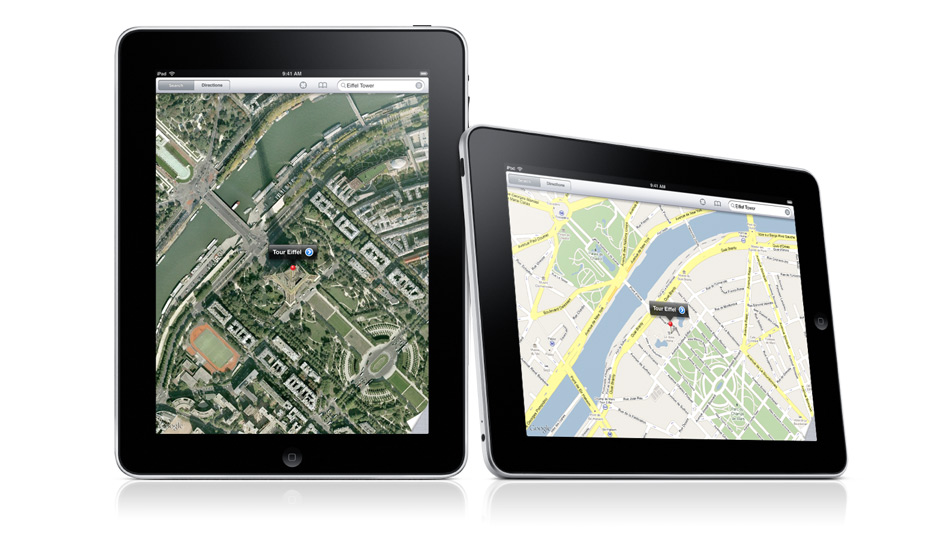
With Apple’s purchase of two mapping companies over the last couple of years – Poly9 and Placebase – many have speculated that iOS 5 will finally be the iOS release where Apple moves from a Google Maps backend to an Apple backend. Multiple job postings on Apple’s official site backed up this speculation and even Apple promised some under-the-hood maps tweeks for their next-generation iPad, iPhone, and iPod touch operating system.
Now, sources have told 9to5Google that although Apple is working to improve the iOS Maps application, iOS 5 will not bring an Apple developed maps service and Google Maps is still in. Besides Apple’s purchase of both Placebase and Poly9, some speculated that Apple is building their own maps service to either compete with Google or step away from their input into iOS.
Apple began the process of distancing themselves from Google when former Google CEO Eric Schmidt resigned over “conflict of interest.” Apple has also added Microsoft’s Bing as a Safari search option and will be competing with Google head-to-head with their upcoming cloud-based music service. Those who enjoy Google Maps should not fear iOS 5, though, and hopefully Apple is working to implement turn-by-turn directions or something else to improve their maps application without changing the backend. Expand Expanding Close
Samsung’s Galaxy S, arguably the most successful consumer smartphone powered by Google’s software, has outsold Apple’s baby for the first time in Japan where the iPhone has been a huge hit. The achievement has enabled Samsung to climb on the list of Japan’s top handset makers to the fourth slot, ahead of local vendors NEC, Casio and Kyocera. Furthermore, Android has flown by iOS in just three quarters and Android smartphones are now outselling iOS smartphones in the country. That’s the gist of a Strategy Analytics survey of Japan’s smartphone market based on first quarter shipments. Their director Neil Mawston explains in an InfoMobilestory:
Strategy Analytics believes that the healthy demand for the Android-powered Galaxy S at NTT DoCoMo drove Samsung growth in Japan. Samsung is the main player behind surging Android smartphone sales, followed by Sharp. Japan had always had a unique competitive landscape, but is now looking more and more like any other advanced smartphone market in the world as Android has flown by iOS in just three quarters.
Gartner is out with their first quarter 2011 mobile phone market survey. The results are astounding. The first quarter belonged to Google and everyone else was reduced to extras in an Android show. Both Apple and Google grew their respective share of the smartphone market, estimated at 100.8 million quarterly units – nearly double the 54.5 million units from the year-ago quarter. Smartphones grew 85 percent and cut into sales of regular handsets, accounting for almost one quarter (23.6 percent) of the 427.8 million handsets shipped during the first quarter.
Predictably, Android was the leading smartphone platform in the first quarter of 2011. And here comes your mind-boggling takeaway: More Android-powered smartphones were sold during the first quarter than the combined sales of Apple’s iPhone, RIM’s BlackBerrys, Microsoft Windows Phone smartphones and vendors belonging to the Other OS category. And that is worldwide, mind you. Go ahead, do the math yourself (the below table).
It’s fascinating that Microsoft and Symbian combined had three percentage points lower market share than Android. Also, while Apple doubled iPhone sales, they barely gained any marketshare. This just shows that Android is gobbling up market share at a rapid pace, eating pretty much everyone’s lunch in the process…
A pattern is emerging in smartphones. Think about it, the same scenario has been playing out over and over in every territory where Google and Apple battle for supremacy. Apple first wows the market with its iPhone. Then, Google brute forces its way into the game and eventually takes the lead thanks to countless Android handsets in all shapes, sizes and price points, carried by virtually all wireless operators. Japan, however, is an indication of a new pattern that has iOS and Android forming a duopoly that squeezes out entrenched players, upping the barrier to entry.
In the latest survey of the Japanese market by MMI Research Institute reported by Bloomberg Businessweek, Android posted an incredible 2,000 percent year-over-year growth, capturing 57 percent of the country’s 2010 smartphone market versus 38 percent for Apple’s handset (as big as anywhere) – a notable decline for the iPhone’s 72 percent share from a year earlier and also a catastrophic loss for other platforms.
Shipments of Android phones rose to 4.91 million units in the year ended March 31, Tokyo-based MM Research said in a statement today. That compares with sales of 250,000 units, or 11 percent of the market, a year earlier when devices running Google’s software started to be widely available in Japan.
Apple shipped 3.23 million iPhones in the country in the last fiscal year, all sold excursively via Softbank. The combined 57 percent share for Android plus 38 percent for iPhone leaves little room for Nokia and BlackBerry maker Research In Motion. Both brands have been reduced to the Others category with a minuscule five percent market share. Is this a sign of things to come? Read on…