Earlier this evening, the Oracle vs. Google lawsuit revealed Android’s revenues and profits for the first time. The same case has now revealed that Google paid Apple $1 billion in 2014 as part of its ongoing deal to be the main search provider—as in the one that resides in the search bar by default—on iOS devices.
Legal cases always make for a good source of information. In the early days of Android, lawsuits revealed the inner workings between Google and its OEM partners. The latest court hearing in the five-year legal saga between Oracle and Google revealed how much money Android generates.
A seemingly drastic turn of events in the appeals court has reversed the ruling on some elements of the Google-Oracle trial.
The ruling enables Oracle to claim copyright ownership over some parts of Java. The crux of the trial was whether API names and constructs could be owned. The initial decision said that it couldn’t, giving Google a landslide victory. However, the appeal court papers now say the exact opposite:
For the reasons that follow, we conclude that the declaring code and the structure, sequence, and organiza- tion of the 37 Java API packages are entitled to copyright protection. Because there is an insufficient record as to the relevant fair use factors, we remand for further proceedings on Google’s fair use defense.
We told you earlier this month that a judge in the Google/Oracle case ordered the companies to disclose any payments it made to journalists, bloggers, and other members of media who made commentary or reported on the lawsuit. It was no secret at the time, but even paid blogger Florian Mueller of Foss Patents admitting previously that Oracle, in addition to other companies such as Microsoft, funded some of the posts on his blog.
While the majority of the people listed by Google include former interns, copyright lawyers, and the Electronic Frontier Foundation, The Verge noted Mark Lemley, a Stanford professor who is often quoted by Google with no mention of the relationship, appears on the list as Google’s “outside counsel” for unrelated cases. Another name mentioned in the document is Google employee Tim Bray. The document cited tweets made by Bray from his personal Twitter account related to the case:
A judge ruled today that Google and Oracle must disclose any payments made to Internet authors, journalists, or bloggers for published commentary related to the Google vs. Oracle lawsuit involving Android software.
The trial is just now ending, but Judge William Alsup issued a court order (PDF) today that calls for both companies to divulge which Internet-based journalists were compensated. The judge is apparently concerned that evidence in the case includes analysis from influenced bloggers.
FOSS Patents‘ Florian Mueller revealed in April that Oracle and Microsoft pay for posts on his blog, where he regularly discusses the Google vs. Oracle case.
A jury decided this last month that Google did not infringe upon Oracle’s patents, but it has recently come to light that Oracle must pay Google’s steep legal fees accrued during the trial.
Oracle, a database software giant based in Redwood City, Calif., sued Google in August 2010, while alleging the Android operating system violated a number of patents and copyrights within Java, which Oracle acquired through Sun Microsystems. Android currently powers more than 150 million mobile devices. Google, based in Mountain View, Calif., adamantly denied Oracle’s contention, and claimed the Android team was unaware of Sun’s patents before the suit.
Google spokesperson Jim Prosser told Business Insider that Oracle did not succeed in landing a $6 billion settlement from Google, but it did win the responsibility of paying Google’s $300,000 in legal expenses.
Texas-based shell company Lodsys has often been accused of being a patent troll for its various attempts to take legal action against app developers and companies that it claims uses its technologies. Most notably, the company last year attempted to get iOS and Android developers to pay royalties over in-app purchasing before Apple’s legal team eventually intervened on behalf of developers. Now, after recent threats from Lodsys to Oracle customers such as Walgreens over a web-chat technology, Oracle is suing Lodsys in an attempt to invalidate its patents. GigaOMreported:
Oracle has decided to weigh in because Lodsys “has repeatedly threatened numerous Oracle customers” such as Walgreens over the use of a web-chat feature Lodsys claims to own. Oracle is asking the court to declare that the four patents Lodsys is using to bully its customers are not new inventions. The patents, including US Patent 5,999,908 (“customer based design module”), came to prominence last year when Lodsys used them to sue Best Buy, Adidas and others.
A jury decided this morning that Google did not infringe upon Oracle’s patents.
The verdict came unanimously as jurors in the Google vs. Oracle trial found six claims in U.S. Patent RE38,104, including two claims in U.S. Patent number 6,061,520, did not infringe.
“Today’s jury verdict that Android does not infringe Oracle’s patents was a victory not just for Google but the entire Android ecosystem,” announced Google in a public statement, according to CNET.
Oh, and here is Oracle’s public statement on the decision: “Oracle presented overwhelming evidence at trial that Google knew it would fragment and damage Java. We plan to continue to defend and uphold Java’s core write once run anywhere principle and ensure it is protected for the nine million Java developers and the community that depend on Java compatibility.”
Google’s former CEO Eric Schmidt took the stand at 9 a.m. PST this morning to give his direct testimony during the Oracle v. Google trial, and while the questioning hulked along, the executive’s answers glimmered with cynicism.
Oracle’s counsel immediately showcased a plethora of documents from 2005 and 2006 that seemingly depicted the Internet giant as having prior knowledge about needing Sun software licensing agreements to apply Java in the Android mobile operating system, but the Executive Chairman denied the exhibited emails and presentations and remained steadfast to his defense that he was unaware Google even needed permission to employ the open-source software.
Oracle, a database software giant based in Redwood City, Calif., sued Google in August 2010, and alleged the Android operating system violated a number of patents and copyrights within Java, which Oracle acquired through Sun Microsystems. Android currently runs on more than 150 million mobile devices. Google, based in Mountain View, Calif., denies the contention.
In today’s court appearance, Oracle is essentially alleging that Schmidt and Google had clear knowledge that they did not have explicit rights to use Java in Android. Meanwhile, many Google officials, including Schmidt, profess otherwise.
[Schmidt’s testimony lasted until 12 p.m. PST—see below for details.]
So, everyone is aware that Java platform maker Oracle is amid a courtroom grapple with Google over whether Java patents were infringed in the search engine’s mobile operating system Android, but not everyone is clued in to the defendant’s intriguing side of the story.
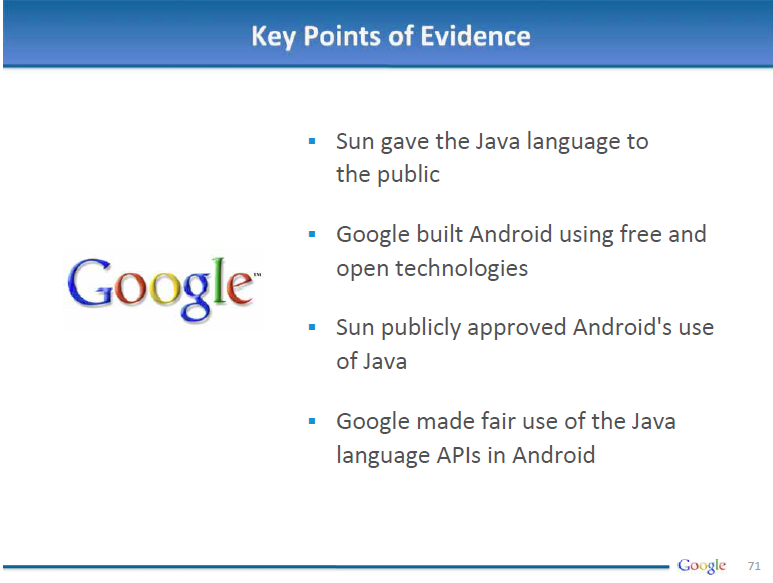
According to Google’s money slides (via ZDNet), the heart of Google’s defense is summarized in three clear-cut points: Java code was free and openly available to the public; Google did not violate any patents or copyrights when developing Android; and, Oracle is disgruntled due to its and Sun’s failed attempts to market a Java-based platform for smartphones.
Software maker Oracle estimated that each day’s worth of Android activations makes Google approximately $10 million in annual revenue while also strengthening its Google+ service, German patent blogger Florian Mueller wrote on his FOSS Patents blog today. Oracle made this claim at a German court in regards to its patent infringement claims against the search giant:
While this case awaits trial, more than 700,000 Android-based devices are activated every day, all fundamentally built around the copyrighted Java APIs and the enhanced performance enabled by Oracle’s patents. Each day’s worth of activations likely generates approximately $10 million in annual mobile advertising revenue for Google.
Oracle did not explain its math, however, leading Mueller to suspect that the figure is based “on the assumption of annual advertising revenues of $14 per Android user.” Interestingly, Oracle wrote in court documents “Analysts have predicted that the number of new Android devices will reach 2.5 million per day within twelve months.” However, it is not just about mobile advertising, the success of Android is benefiting Google’s other properties, namely its Google+ social network…
Oracle purchased Sun for $7.4B in 2009. The deal closed at the outset of 2010 and some wondered why Oracle had outbid IBM for the hardware/software giant. Today we finally hear how much Oracle is after in its suit against Google over Android’s use of Java: $1.5 – $6 Billion. That means that Oracle could recover more than half of the purchase price. Perhaps most? Just from one intellectual property suit.
Java pioneer and recent Google hire James Gosling gave a hint to what was to come when he resigned from Oracle right after the purchase
During the integration meetings between Sun and Oracle where we were being grilled about the patent situation between Sun and Google, we could see the Oracle lawyer’s eyes sparkle. Filing patent suits was never in Sun’s genetic code.
So, it seems that Oracle always had some Google Java money baked into its purchase price. That’s why it could outbid IBM so spectacularly. Expand Expanding Close