Zee Aero, a low-profile company based in Mountain View very close to Google X, the company’s research lab, has registered a patent for what appears to be a flying car, reports SFGate (via Gizmodo). And from two photos uncovered by the paper, it looks like the company has already got as far as either a prototype or large mockup.
The patent illustrations look all but identical to an aircraft spotted from a helicopter at an abandoned Naval base on Alameda just under a year ago. If the photo looks a little odd it’s because Greg Espiritu used a camcorder to zoom in and then took this photo of the LCD display.
The latest numbers from Android’s Current Distribution page reveal somewhat exciting results for the folks in Mountain View. Android 4.1 – 4.2 Jelly Bean has now crossed the 10 percent threshold for all Android devices on the market. It now sits at 10.2-percent. Additionally, Gingerbread has dropped below the 50 percent mark for the first time in over a year, as Ice Cream Sandwich made gains to get close to 29.1-percent total share. Maybe this is how things should have always been. But, at any rate, sales from the Samsung Galaxy S III, HTC One X, and more seem to be paying off.
Google’s Director of Product Management, Hunter Walk, who works specifically on YouTube, just gave Bloomberg a brief insight into his latest project made possible by the company’s famous 20 percent time.
Walk manages roughly a dozen engineers at YouTube, but he also utilizes Google’s 20 percent time—a time Google freely allots to employees every week for side projects— to mold YouTube into a platform for social causes and change, and not just a resource for endless cat videos.
“There is a real desire for YouTube to be a global classroom and a global town square, not just a global living room,” said Walker to Bloomberg in an interview.
Over the past year, Walk has been quietly evangelizing within Google for his initiative called YouTube for Good. He has convinced about a fifth of YouTube’s 1,000 or so employees, as well as some from Google’s headquarters in Mountain View, California, to set aside a chunk of their time to build online tools used by organizations including the United Nations World Food Program and Charity: Water.
YouTube for Good also made it possible to live stream last year’s AIDS symposium by the ONE Campaign, and it developed innovative tools like automatic face blurring to protect protest activists in YouTube videos. Aside from YouTube for Good, Google Reader, Gmail, and Google News are a few of the many successful side projects created with Google’s 20 percent time program.
The Wall Street Journal just published a lengthy report detailing how Google convinced Nevada state assemblywoman Marilyn Dondero Loop, as well as other states’ transportation committees, to introduce legislation that would help legalize its driverless cars for streets.
“This will save taxpayers countless millions of dollars and revolutionize driving as we know it. No more being distracted, no more accidents, and not another DUI attorney again.”
The Mountain View, Calif.-based company persuaded lawmakers, according to The Wall Street Journal, with “demonstrations and rides in its exotic cars,” and it subsequently earned “legislative wins” in Nevada, California, and Florida. There are even bills pending before legislators in Hawaii, New Jersey, Oklahoma, and the District of Columbia:
In the process, the Mountain View, Calif., company is building its credentials as an astute political operator. Google has been “pretty savvy” at navigating state capitols, said Frank Douma, a transportation-policy author and associate director at the University of Minnesota’s Humphrey School of Public Affairs. With its self-driving cars, Google “knew what they were doing by moving forward in Nevada” before approaching bigger states, he said. “If you blow it in the first state, you’ve really got problems.”
Success at legalizing self-driving car technology has broader implications for Google. Skills learned from lobbying state lawmakers could aid other endeavors that will require local policy-making, including the potential expansion of its Google Fiber Internet and TV service into markets dominated by cable companies.
Google spent roughly $9 million during the first and second quarters of 2012 lobbying in Washington and coaxing lawmakers and U.S. Department of Transportation officials, but Google did not disclose how much went toward lobbying state officials.
Google just unveiled its “YouTube Creator Space” in London.
The high-tech studio will essentially allow YouTubers to create premium content for Google’s video-sharing platform. They will have access to technical equipment, and other YouTube content producers, which will undoubtedly encourage quality videos based on fresh, collaborative ideas.
“We’re delighted to announce that in the next few weeks we’ll be opening the doors to our new creator space, housed in the offices of Google London’s Soho office,” announced the company on its YouTube Creator Hub channel.
Our partners from all over Europe, Middle East and Africa will be able to book time in the space to create and collaborate with other creators, learn new techniques, as well as gaining access to state-of-the-art audio visual equipment, to help them generate great new content for their channels. The creator space is complete with the latest equipment such as DSLRs and cinema cameras, two studios including a green screen and fully staffed editing suites.
The YouTube Next Lab, which is a team “focused on accelerating the growth and development of channels and creators on YouTube,” will oversee the London studio.
As BetaBeat first noticed, Google is attempting to peel back the anonymity cloak that surrounds YouTube.
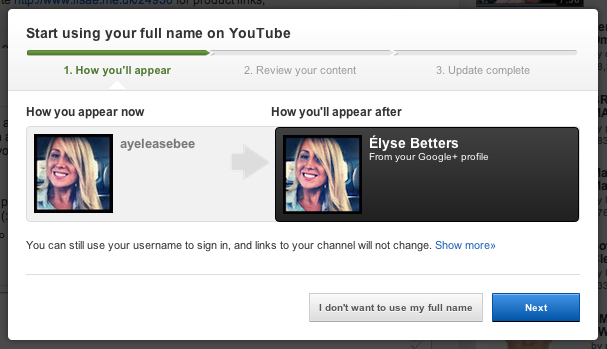
The search engine, which seems to dabble in all things Web, mobile, and tech, now displays a pop-up box to YouTubers who try to leave a video comment. The notice prompts users to start surfing the video-sharing platform with their full name instead of a username or pseudonym.
Google appears to crop names from Google+ profiles, which is likely a byproduct of the Google+ integration from last year that required all YouTubers to login with their Gmail account credentials.
YouTube just launched a face-blurring feature for when “footage requires anonymity.”
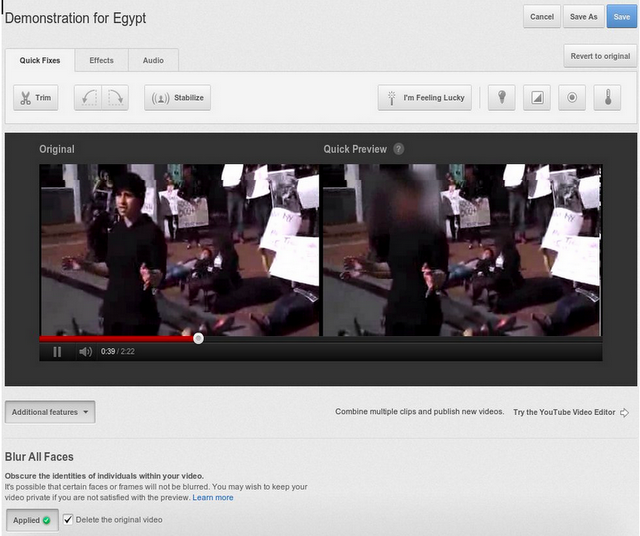
The new addition to the video-sharing platform is self-explanatory. It is a tool that allows users to muddle faces in videos with just the click of a button.
“Whether you want to share sensitive protest footage without exposing the faces of the activists involved, or share the winning point in your 8-year-old’s basketball game without broadcasting the children’s faces to the world, our face blurring technology is a first step towards providing visual anonymity for video on YouTube,” explained the official YouTube Blog.
To blur faces: Go to Additional Features under Video Enhancements, and then click the “Apply” button below Blur All Faces. Users can see a preview before publishing, and a new copy is created with the blurred faces when saved. Users have the option to delete the original video.
YouTube warned that the tool is an “emerging technology,” so Face Blur may have difficulty auto-detecting faces.
Get the full breakdown at the officialYouTube Blog.
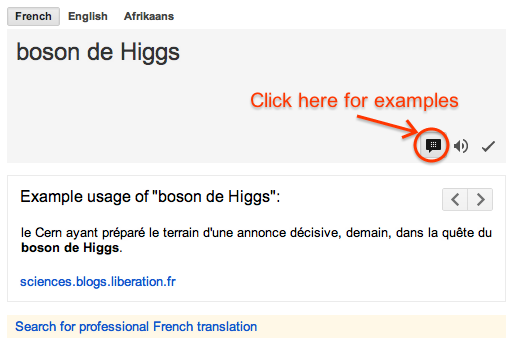
Of course, that is Google’s own statistic. The folks in Mountain View took to the official Google Translate blog to explain how its, well, Google Translate tool now offers example sentences for those newly created words. The examples are aggregated from “fresh new stories around the web,” wrote Google Associate Product Manager Etienne Deguine.
To use the feature, type into the left-hand text box of Google Translate, and then click on the example sentence icon on the bottom right (screenshot above).
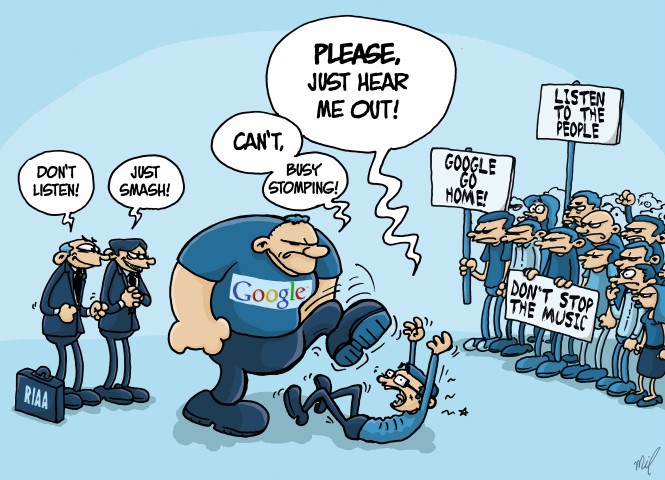
Google wanted to stop YouTube-MP3.org last month from ripping audio embedded in YouTube’s videos, but the conversion website’s 21-year-old owner is not ready to roll over and admit defeat.
YouTube-MP3.org received a letter from the Mountain View, Calif.-based Company last month that threatened to take legal action. Google’s video-sharing platform is free and provides content that is embeddable or accessible through its API, while YouTube-MP3.org is also free and pulls audio from YouTube videos. The website then converts those files into downloadable MP3s. Apparently, despite the API that gives developers access to many features, pirating any sound directly violates YouTube’s Terms of Service agreement.
The June 8 “cease and desist” letter from YouTube’s Associate Product Counsel Harris Cohen addressed the website’s Germany-based owner, Philip Matesanz. Cohen cited the platform’s terms for API in the legal notice, and he noted separating, isolating, or modifying “the audio or video components of any YouTube audiovisual content made available through the YouTube API” is strictly prohibited. Cohen warned of “legal consequences” for YouTube-Mp3.org, and he gave the website a week to comply. However, Google immediately blocked the website’s servers from accessing YouTube.
Matesanz took to his website yesterday, conveniently on the United States’ Independence Day, to give a “Situation Update” on the, well, situation:
After numerous reports questioning the legality of this service I have decided to get case studies from two highly reputable lawyers in Germany to prove the difference. I have asked them to create English reports about the legal situation of this service and the accusations Google has made. They agree that there are no copyrights of a third party violated by providing this service and it has to be considered legal. It might be surprising to some but they also agree that all claims Google has brought up so far are not justified: There is no TOS violation. They even question if Google can take action against so called “YouTube Converters/Recorders” since they seem to be protected by federal law. Google would have to make massive changes to their public broadcasting service to demand that such services shut down e.g. no more embedded videos, restrict access to registered users who have agreed to the TOS[..]. There are also doubts about the legitimacy of the section Google is accusing me to violate: Section 6.1K is designed to abandon a fundamental right all German citizens have. According to federal law you have the unquestionable right to create a private copy of certain media; including YouTube. Google’s attempt to abrogate the rights of the public in their TOS has to be considered as illegal and is in a strong contrast to their public self-representation.
Matesanz further disclosed to readers that YouTube-mp3.org is officially operated through PMD Technologie UG, which is a company registered in Germany, and he has tried to contact Google “multiple times,” but all of his attempts have failed. A recent call to Google’s main legal head was even blocked by an assistant, Matesanz wrote, who claimed Google would only communicate in written form but allegedly did not respond to three e-mails sent.
“I don’t have any marketing or public relations experts […] I am just an IT guy with no experience whatsoever,” Matesanz added, while referring to the case as a “David vs. Goliath situation.”
The computer science student-turned-Google arch nemesis is now attempting to level the playing field with a petition on Change.org, where he asks Google to permit third-party recording services to access YouTube. The petition has over 343,000 signatures.
Google launched Search by Image last year, and then updated algorithms for it almost every week since, but now the search engine will use its Knowledge Graph to power the popular feature.
Search by Image allows users input an image, and then Google offers images and search results related to that image. Users select an image through the ‘ole drag-and-drop, and then uploading, or even inputting a URL. Meanwhile, the Knowledge Graph is new technology that allows Google to provide search results for concepts linked between words, rather than showing results for just the query term.
With the recent launch of the Knowledge Graph, Google is starting to understand the world the way people do. Instead of treating webpages as strings of letters like “dog” or “kitten,” we can understand the concepts behind these words. Search by Image now uses the Knowledge Graph: if you search with an image that we’re able to recognize, you may see an extra panel of information along with your normal search results so you can learn more. This could be a biography of a famous person, information about a plant or animal, or much more.
Google wants to improve its image search. When a user uploads an image of a specific type of flower, for instance, Google would previously give general flower search results. Now, Google will try to guess the exact type of flower. Google will also show the most recent content in search results, which is helpful for news images.
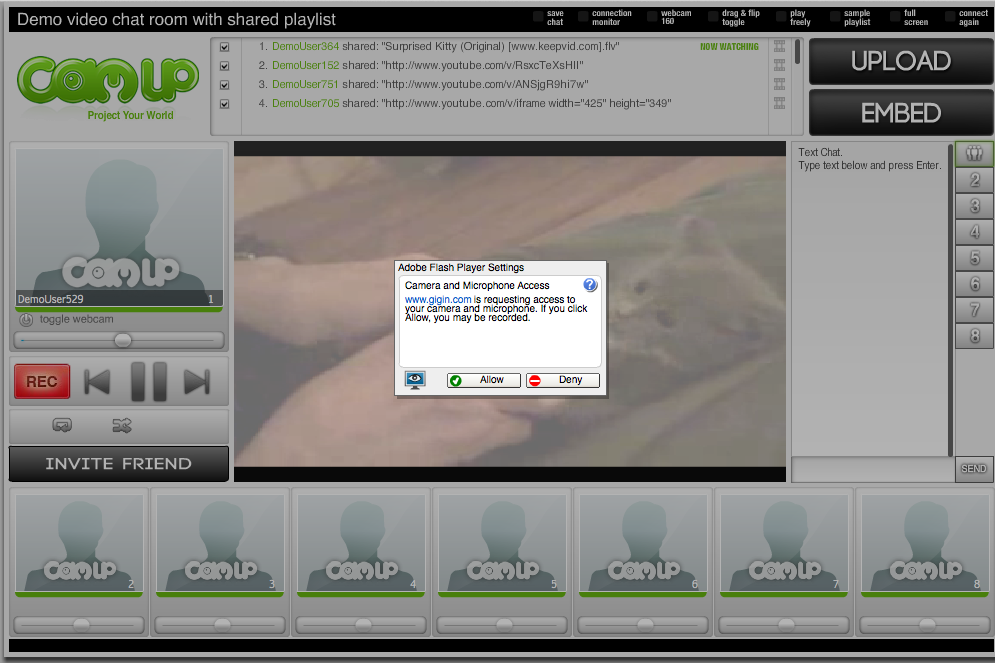
CamUp filed a lawsuit late last week that claimed Google ripped its video-chat feature for Google+ and YouTube.
The lawsuit filing revealed Marissa Mayer, Google’s vice president, along with a few Mountain View engineers, approached the New York-based startup at the South by Southwest Festival in March 2011. They later met in London to negotiate adding a Hangout-like button, called “Watch with your friends on CamUp,” to Google’s popular video-sharing platform, YouTube. Despite receiving accolades on its product, CamUp did not hear from the Googlers after the meeting.
By May 2011, CamUp detected an alarming amount of visits from Google’s headquarters in California. The startup suggested that the traffic is evidence of Google beginning to examine its product for copying purposes. Google launched Hangouts with a “Watch your friends” button just one month later, which were allegedly indistinguishable from CamUp’s offerings.
CamUp is seeking damages, an injunction to remove Hangouts on YouTube and Google+, and it is suing Google UK’s Director of Business and Markets Richard Robinson.
Google Inc. (GOOG) is negotiating with the U.S. Federal Trade Commission over how big a fine it will have to pay for its breach of Apple Inc. (AAPL)’s Safari Internet browser, a person familiar with the matter said. The FTC is preparing to allege that Mountain View, California-based Google deceived consumers and violated terms of a consent decree signed with the commission last year when it planted so-called cookies on Safari, bypassing Apple software’s privacy settings, the person said.
The SVAndroid Hackathon is taking place at Google TV headquarters in Mountain View, Calif., and tickets are $20, but purchasing options end April 17.
Team ideas will be announced April 20, and the following day is “devoted to building, with breaks for demo sessions, Q&As, and a hangout with Google TV developers,” according to the Official Google TV Blog. The teams will present ideas to judges April 22 for the chance to win tickets to Google I/O and other prizes.
The Londroid Hackathon is occurring at the Google Campus in London, United Kingdom. It will run concurrent with the Mountain View event to gather Android devs throughout Europe.
“We will kick things off bright and early on Saturday, April 21, with introductions and background information on developing for Google TV. Teams will power on through Saturday night so that we can do a round of presentations and prizes at lunchtime on Sunday,” explained Google TV Senior Developer Advocate Paul Carff on the Official Google TV Blog.
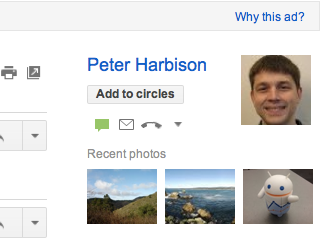
Gmail updated its people widget to include three photos from recent emails for a showcased person (example to the right).
“The next time you look at the people widget, you might see up to 3 photos from recent emails from that person. Not only does this remind you of photos they’ve sent to you, but it also gives you one click access to the emails with those photos,” announced Gmail on Google+.
The Gmail people widget is located on the right-hand side of messages and displays users’ contextual information about people their interacting with in the email service.
Google expanded its GoMo initiative to offer small businesses an opportunity to mobilize their websites for free.
According to Fortune, the Mountain View, Calif.-based search engine teamed with startup Duda Mobile to offer the $9 per month service at no cost for an entire year starting today. Users will save $108 a year, and then they can purchase the premium service after the complimentary period ends—if desired.
In a blog post, Duda Mobile’s Dennis Mink explained the collaboration:
Our hope is that by offering both the education AND the service at no cost for one year, we can help businesses make the shift to mobile more quickly, benefiting both their business as well as us consumers who no longer want to pinch and zoom our way through their regular websites on our phones.
World—meet Google Consumer Surveys: Just when it looks like Google has extended its reach into every dark corner of the Internet, the search engine launches a new service to reap more cash online.
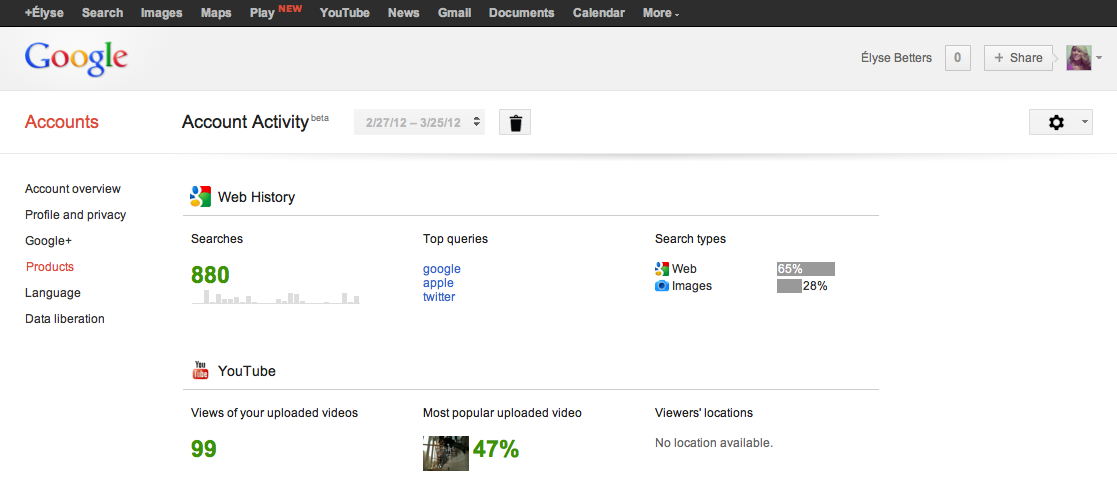
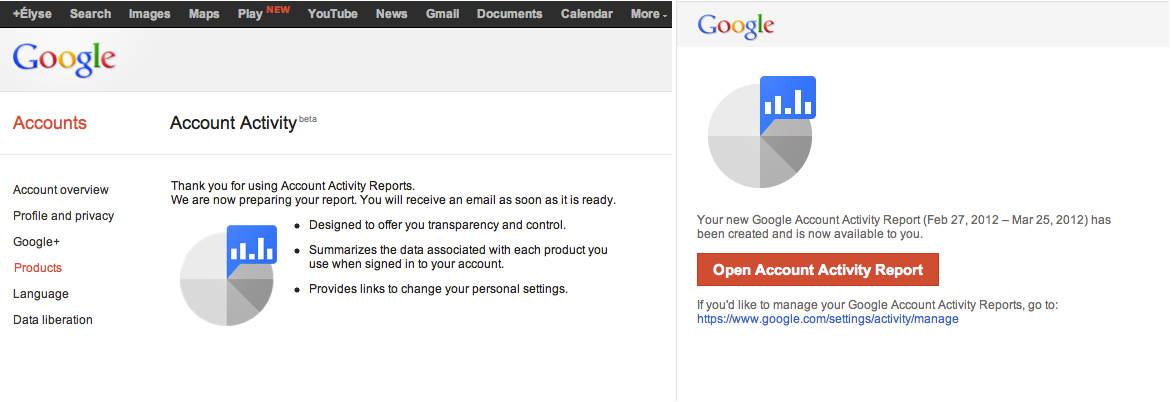
Google just launched a new feature called “Account Activity” that sends account-holders monthly encrypted reports about their signed-in frittering across the Web and Google services.
Once a user opts-in to the feature, Google will confirm and then send the first monthly report (see image below). The full-report gives Account information, such as locations, browsers, and platforms employed while Internet surfing.
The report also gives Gmail specifics, like most contacted addresses and to-and-fro message counts, and it breaks-down other Google services’ particulars, including Web history with users’ top searches, types, and queries, and a personal YouTube report on uploaded video activity and viewers’ location data. Users can also delete old reports or browse previous months as they begin to pile up.
The “Googleplex” has been Google’s hallmark offices for years and rates as one of the top places to work by many magazines. According to a new report from the Mercury Times, Google is expanding on its already large Googleplex. The Mountain View, Calif.-based Company reportedly plans to spend $120 million to add new advancements to its sprawling headquarters, from a new museum to new testing labs for the secret Google X projects.
Google plans to open a new Experience Center as a museum not open to the public. The Experience Center would show Google’s history to special invited groups. Some of the products shown off could potentially be confidential. The focus here would be selling products to groups, such as school districts.
There has been much in the news lately regarding Google’s “Project X.” In Project X, the team is reportedly working on new HUD glasses, which we exclusively told you last month. As part of its new $120 million addition, Google is attaching new additions to that sector. Google is also adding to its “Google/@home” initiative. As part of @home, Google is reportedly developing a new streaming home-entertainment device. This break through into consumer electronics could be announced tomorrow, according to a teaser from the Google TV team.
A rumor debuted yesterday that claimed Google is currently developing and testing a streaming home-entertainment system in many of its employee’s homes. Today, a new temporary Federal Communications Commission license awarded to Google revealed that the company is testing a “next generation personal communication device,” whether it is connected to the home-entertainment system or not. A total 102 units of this prototype are in employee’s homes across Mountain View, Los Angeles, New York, and Massachusetts’ areas. The request is specifically for the use of Bluetooth and Wi-Fi in the prototype. (via The Verge)
This prototype could also certainly be Google’s new personal HUD glasses that we told you about earlier this week. Our sources said the Google X crew is developing them, and they could ship in a beta like Chromebook did. We also told you that the glasses will sport Bluetooth and Wi-Fi, so today’s FCC request could certainly be the glasses.
A report from GigaOM today noted Google is requesting permission from the Federal Communications Commission to test an unknown “entertainment device.” The trials will take place in the homes of Google employees, and see tests of the mystery device connecting to home electronic equipment over Bluetooth or Wi-Fi to test it on home networks in real world situations. Other than that, there is not much we learned from the Google’s filing with the FCC from December (below).
We told you about one yet to be unveiled product we heard Google has in the works with our recent story about the company’s wearable glasses with a heads up display and computer interface. We will have much more on those this coming week…
Google is requesting the trials take place with up to 252 devices from Jan. 17 to July 17 in various locations including Mountain View, New York, Cambridge, Mass., and Los Angeles. Google’s description of the mystery product from the FCC filing is below:
Are you dreaming of a white Christmas online? Don’t worry, Google’s gone all out this year to make winter festivities memorable for both its employees and users. As we reported this morning, Google staffers, also known as Googlers, were treated with a free Galaxy Nexus smartphone sporting a customized back cover depicting Android and Google Plus icons.
Then, in another display of holiday spirit, the company brought in much ice and snow and sprayed it in front of building B44, also known as the Android building, at their Mountain View, Calif., headquarters.
The company’s social biz head Vic Gundotra posted the above image on his Google Plus profile with the caption: “Who says it never snows in Mountain View, California?”
The time-lapse clip below that shows the event was posted by Jason Chen, a technical program manager with Google. The search company did not forget about its users, surprising and delighting them with a few big improvements to Google Plus ahead of New Year. Google also let folks call Santa right from Gmail to leave him a Holiday message (Google Voice number 855-34-SANTA).
Lastly, Google tweaked its search engine with a snowflake animation. Go to Google.com and search for ‘let it snow’. This search term should produce snowflakes that will fill the page and eventually whiten out thesearch results. You can even click the left mouse button and drag the pointer around for fog removal. On an unrelated Holiday note, Google also revamped their Doodle website with the Google Plus design language.
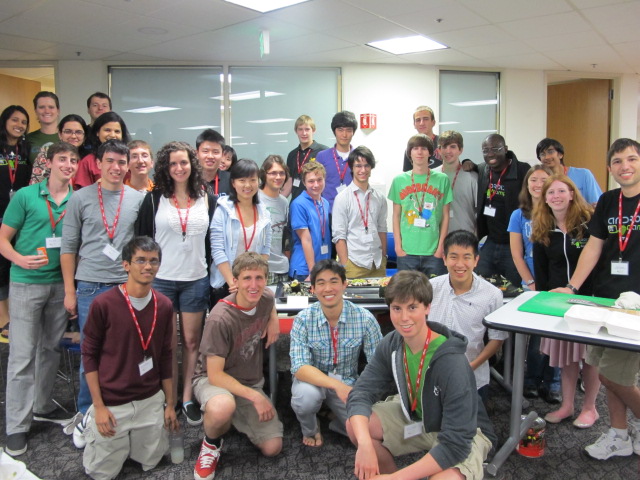
Undergraduate students from universities across the U.S. and Canada spent a week at Android Camp, Google’s “Android Development 101” course. The program was somewhat like an internship. Students, most of which who are in school for computer science, spent the week at Google’s Mountain View campus and got hands-on help from engineers. Students were assigned teams and began to hammer away at creating an Android app. Google notes a few of the applications developed:
At the end of the week, each group presented its application to other Android campers and Google engineers. Applications spanned a variety of categories: recipeBEAR provides people with a list of meal recipes based on ingredients they have on hand; Blazin’ Contacts uses QR codes to automatically collect contact information from a large group of people and input it into your mobile device; OnTime combines Google Maps with the device’s alarm to help people gauge how much time they’ll need to arrive somewhere; The Shake Race, as you may imagine, was the most entertaining of the bunch—group members demonstrated the game by shaking their Xoom Tablets furiously to race their characters across the screen.
This new program is going to be annual for college freshman and sophomores. Sign-ups for next year’s camp will go up in November. Expand Expanding Close