Motorola


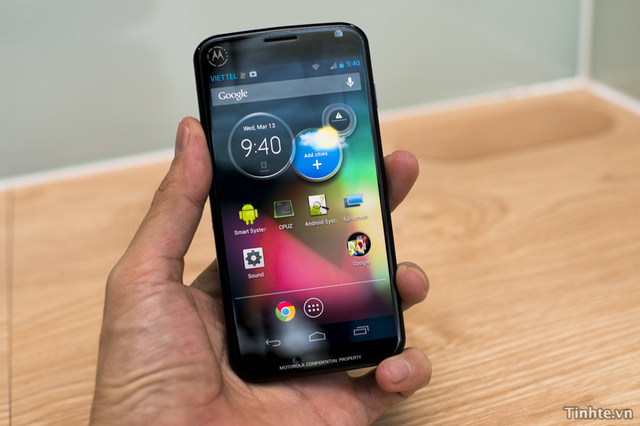
After months of leaks and rumors, Motorola CEO Dennis Woodside finally confirmed the Moto X phone at the AllThingsD conference, but was cagey with details and didn’t share all that much. Thanks to the often reliable @evleaks on Twitter, however, we now have a pretty good idea of what to expect when the X phone hits the market.
According to the report, the device will feature a 1.7GHz dual-core MSM8960 Pro processor, 720p display, 2GB of RAM, 16GB of storage, 10MP rear-facing camera, 2MP front-facing shooter, and Android 4.2.2 Jelly Bean. For those wondering, that’s the Snapdragon S4 Pro processor, which we saw in devices like the LG Optimus G last year.
At the AllThingsD conference earlier this year, Woodside said the Motorola Moto X phone would be manufactured in Texas and be coming to all major US carriers sometime in October.
Expand
Expanding
Close

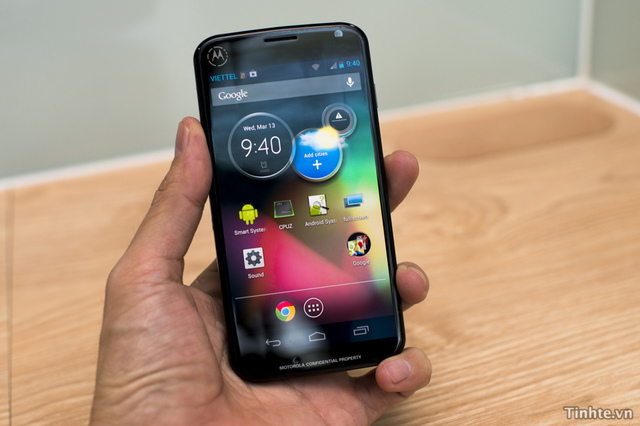
We recently delivered a comprehensive summary of everything we know about Google’s rumored Motorola X Fon, and today is looks like a device labeled Motorola XT1058 has appeared in official FCC filings as discovered by AndroidGuys.com.

Update: We’ve been asked to remove the picture.
We’ve been sitting on some good Motorola X Fon information for awhile but weren’t able to confirm it until the most recent leaks which seem to corroborate what we have. It turns out that the leaked images by Tinhte and @Evleaks appear to be legitimate Motorola X prototypes according to our source. The phone above is a drawing the X FON which now appears to be the same phone pictured below:
The information we’ve heard from our source who has seen it a LTE version was that it will be released on all 4 US carriers and come in over 25 different color options. The bottom bezel is remarkably small as you can see from the drawing above and the Tinhte.vn images. Like the other ones pictured, this one was 32GB storage, 2GB of RAM, and no SDCard. Like the others, it was still running Android 4.2 recently and was codenamed ‘ghost’.
Both volume and power buttons are on the right side. Headphones jack is on top center, charging port was on bottom center.
The display was estimated to be 4.7 inches but with the very slim bezel on the bottom it felt very small. Perhaps as small as a 4.3-inch phone.
What we’re thinking at this point is that this phone looks like the successor to the Droid RAZR or RAZR M – small bezels, 4.3-4.7-ish display, extremely long battery life. But what about all of those colors and protection we’ve heard so much about?
Here’s what we’re thinking: Motorola is going to offer protective plates/skins in 25 colors from the point of ordering. 80-90% of people buy protection for the phones so perhaps Motorola is owning this aspect of the device from the order and can provide almost an almost indestructible, perhaps water-resistant customization.
Well, that’s our current thinking. We’ll likely hear what’s on offer at Google I/O in a few weeks.

via skattertech.com
Since acquiring Motorola for $13 billion last May, Google has been expected to launch a Motorola smartphone running stock Android, but the most recent Google-branded Nexus 4 device was made in partnership with LG.
Motorola’s design chief Jim Wicks tells PC Mag, though, that Google and Motorola have been working closely during that time on multiple devices running stock Android with less overlay that we should expect later this year.

 In an ongoing case in which Apple and Google’s Motorola have accused each other of infringing various mobile related patents since 2010, U.S. District Judge Robert Scola said in an order yesterday that the two companies have no interest in reaching a settlement. Bloomberg reports Scola said in his order that both companies are using the litigation as a “business strategy that appears to have no end”:
“The parties have no interest in efficiently and expeditiously resolving this dispute; they instead are using this and similar litigation worldwide as a business strategy that appears to have no end,” U.S. District Judge Robert Scola in Miami said in an order dated yesterday. “That is not a proper use of this court.”
“Without a hint of irony, the parties now ask the court to mop up a mess they made by holding a hearing to reduce the size and complexity of the case,” he wrote. “The court declines this invitation.”
The result is Apple and Google will now have a four month period to narrow their claims related to the case that now includes over 180 claims for 12 patents. Bloomberg notes that Scola said the case currently includes “disputes over the meaning of more than 100 terms,” and that the case would be put on hold until the disputes are resolved if the two companies are unable to come up with a solution before the four month timeframe expires…
Expand
Expanding
Close
We heard in October that Google had plans to further reduce Motorola’s workforce after cutting around 20 percent, or roughly 4,000 jobs, in August. The Wall Street Journal reported today on an email from Google that confirmed the company is beginning to cut around 1,200 employees (a little over 10 percent of its current total headcount):
Motorola MSI -0.74% staffers were informed by the company via email this week that “while we’re very optimistic about the new products in our pipeline, we still face challenges.” The company email added that “our costs are too high, we’re operating in markets where we’re not competitive and we’re losing money.”
As for where the cuts might take place, we previously reported that Motorola, which was unprofitable for 14 of its last 16 quarters, planned to reduce its operations in Asia and India, but today’s report said the layoffs would hit workers in the United States, China, and India. Google also warned that further restructuring might be necessary and significant costs could be involved.
In a recent piece from The Wall Street Journal highlighting Google executives’ fear that Samsung is gaining too much dominance, Android chief Andy Rubin said the purchase of Motorola was “a kind of insurance policy against a manufacturer such as Samsung gaining too much power over Android.”
While Google might be happy with the mobile ad revenue Samsung brings in shipping roughly 40 percent of the devices running Android, The Wall Street Journal said Google execs worry behind closed doors that Samsung could use its dominance to renegotiate its cut of revenue from mobile ads and search:
Google executives worry that Samsung has become so big—the South Korean company sells about 40% of the gadgets that use Google’s Android software—that it could flex its muscle to renegotiate their arrangement and eat into Google’s lucrative mobile-ad business, people familiar with the matter said.
Citing its usual “people familiar with the matter,” WSJ claimed executives at Google are betting on companies like HTC and HP to release compelling Android devices that compete with Samsung. According to the report, Android chief Andy Rubin discussed the situation at a recent event for Google executives. He described Motorola as “a kind of insurance policy against a manufacturer such as Samsung gaining too much power over Android.”
Expand
Expanding
Close

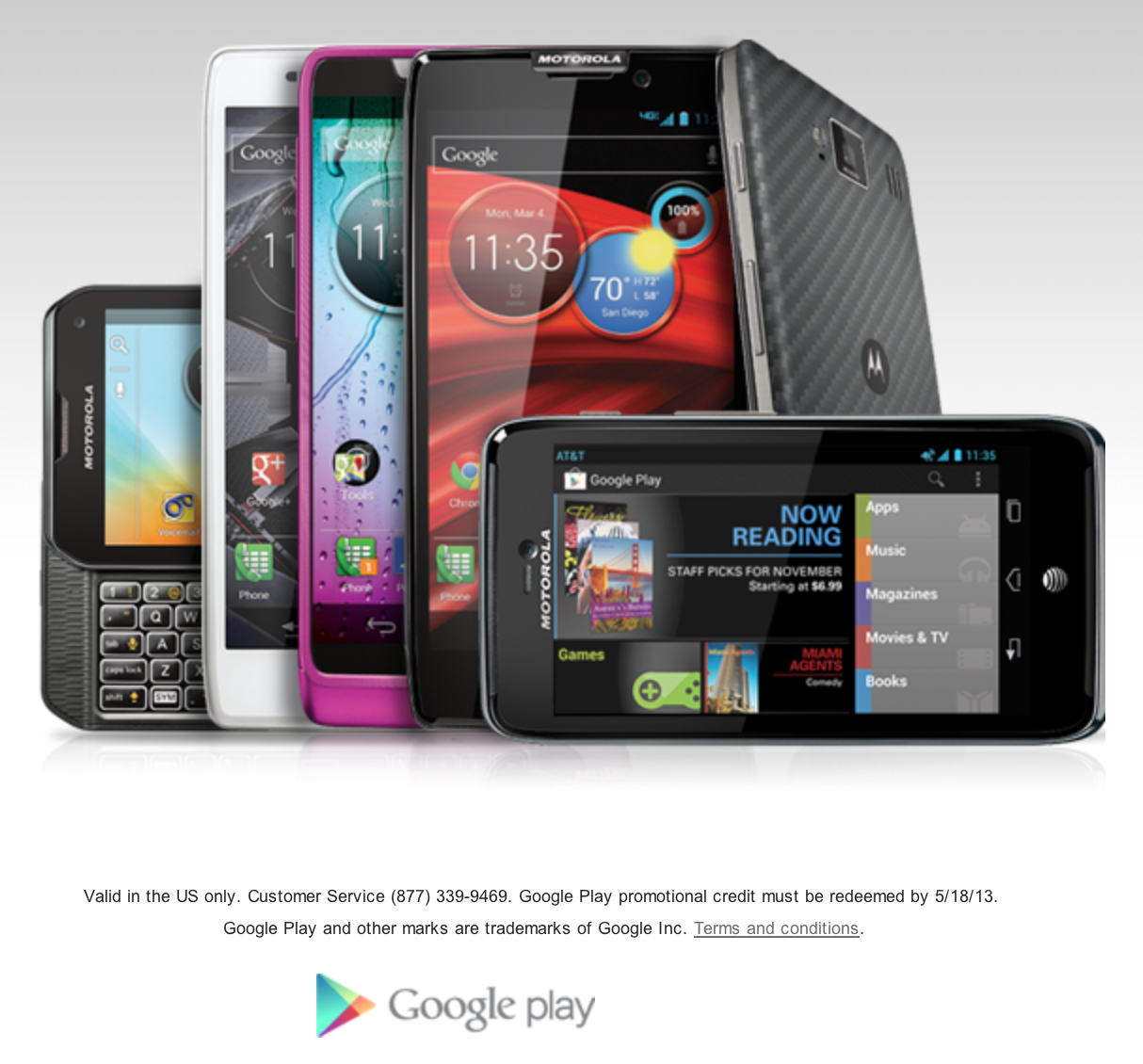
With so much mobile competition, companies are always trying to get you to buy their phone, today, Motorola has decided to join in on the fun. In an announcement made online, Motorola is offering a $50 dollar Google Play gift card to use on anything available in the app store. You’ll only get the gift card though if you purchase one of the eligible phones Motorola is promoting such as the Droid Razr Maxx or HD. The sale ends on March 4th, so if you want in on the deal you’ll have to act fast. The full list of phones is available below.
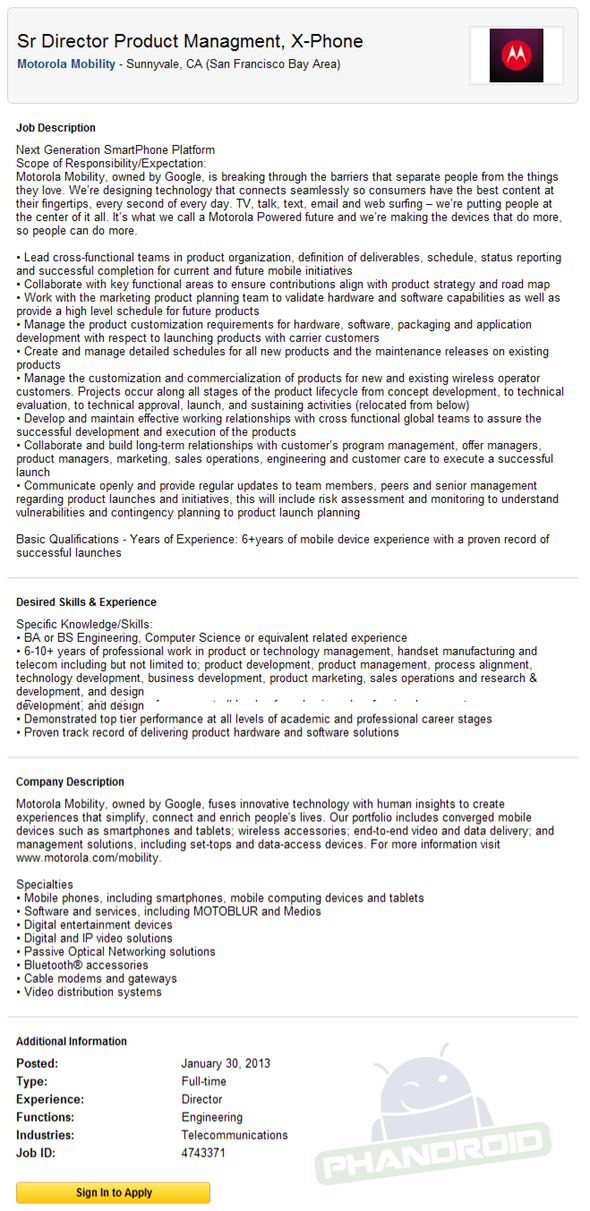
It’s been hinted about by CEO Larry Page, rumored about by the Wall Street Journal, and now it’s been mentioned in a new job listing on Motorola’s website. The top-secret X-Phone would be Google’s first collaboration with Motorola since it purchased the handset company in August 2011. The phone was mentioned this morning in a job listing described as “Senior Director of Product Management for Motorola, X-Phone”. The listing has now removed all mention of the X-Phone, but it is still available to see and apply to.
While the phone is rumored to be a continuation of the Nexus line, even possibly replacing the Nexus 4 come I/O this year, CNET claimed the ad listing—judging by the blurb from the listing that quotes “product customization requirements”— implies it will be a carrier-customized device. CNET also said the X-Phone is not the only device launching by Motorola soon, because multiple products are on the way if the bullet point “high level schedule for future products” means anything. One thing is for sure, though. Rarely do rumored names turn out to be official. So, with such a generic name like ‘X-Phone’, you can bet the final product will have a much more creative name.
Google CEO Larry Page just wrapped up his opening comments during the company’s Q4 2013 earnings call taking place right now. While noting that “managing our supply better” is a priority (see Nexus 4 supply constraints), Page also hinted at some possible upcoming Motorola smartphone features. Page said Motorola is working on the following two areas: better batteries and impact-resistant designs.
I am excited about the business. In today’s multi screen world, the opportunities are endless. Think about your device. Battery life is a huge issue. You shouldn’t have to worry about constantly recharging your phone. When you drop your phone, it shouldn’t go splat. Everything should be a ton faster and easier. There’s real potential to invent new and better experiences.
Page also said Motorola’s new CEO, Dennis Woodside, has a built a “world-class team” that is currently exploring these new opportunities:
Expand
Expanding
Close

http://www.youtube.com/watch?feature=player_embedded&v=_p7w4cKdqTk#!
Larry Page’s voice was quite raspy still, but the news was good and the CEO is upbeat. Some notable bits he laid down on Motorola: “We’re working on batteries you won’t have to remember to charge and enclosures you don’t have to worry about dropping.”
I am excited about the business. In today’s multi screen world, the opportunities are endless. Think about your device. Battery life is a huge issue. You shouldn’t have to worry about constantly recharging your phone. When you drop your phone, it shouldn’t go splat. Everything should be a ton faster and easier. There’s real potential to invent new and better experiences.
Sounds good.
On the downside, Page noted, “Clearly there is work to be done managing our supply better, and that is a priority.” The fact that you can’t buy most of Google’s Nexus products right now clearly shows that.
GOOG stock price is up almost 5 percent.
According to a report from Reuters, Google issued a statement that a Wisconsin federal court has decided to dismiss Apple’s “patent lawsuit with prejudice.” The report explained this particular case was brought on by Apple in part to determine what the courts considered fair and reasonable licensing terms for the patent portfolio Google acquired when purchasing Motorola.
Google said in a statement that it is still interested in making a deal with Apple “at a reasonable and non-discriminatory rate in line with industry standards”:
“We’re pleased that the court has dismissed Apple’s lawsuit with prejudice,” a Google spokeswoman said in an emailed statement on Monday…”Motorola has long offered licensing to our extensive patent portfolio at a reasonable and non-discriminatory rate in line with industry standards,” Google said in its statement. “We remain interested in reaching an agreement with Apple.”
Reuters explained the case being dismissed with prejudice means it is officially over at the trial court level. However, Apple can still appeal:
Expand
Expanding
Close

Beginning at 4:30PM EST, we’ll be getting the full break-down of Google’s earnings for the third fiscal quarter. In an odd turn of events, Google released its earnings early this afternoon due to a screwup with its SEC filing. The screwup caused Google to close down its stock for the better part of the afternoon, causing a steep drop. Google may discuss the situation on the call… stay tuned after the break:
Check up on Google’s numbers from earlier this afternoon.
Expand
Expanding
Close
It looks like Google’s Q3 earnings have been released early with The Wall Street Journal reporting Google posted revenue of $14.1 billion and a net of $2.18 billion. A summary of the company’s earnings report from a U.S. Securities and Exchange Commission filing is below. In the report, we see Motorola accounted for 18 percent of consolidated revenues. It brought in $2.58 billion, while reporting a $527 million operating loss. Of that $527 million operating loss, $505 million comes from Motorola’s mobile segment and $22 million from its home business. Google reported cash, cash equivalents, and short-term marketable securities at $45.7 billion as of Sept. 30 and operating income of $3.26 billion.
As highlighted in the screenshot above, Google is down almost 10 percent following the news. Google made a statement on what happened with the early filing (via Business Insider):
“Earlier this morning RR Donnelley, the financial printer, informed us that they had filed our draft 8K earnings statement without authorization. We have ceased trading on NASDAQ while we work to finalize the document. Once it’s finalized we will release our earnings, resume trading on NASDAQ and hold our earnings call as normal at 1:30 PM PT.”
Google is scheduled to announce earnings later today at 4:30 p.m. EST.
Q3 Financial Summary
Google Inc. reported consolidated revenues of $14.10 billion for the quarter ended September 30, 2012, an increase of 45% compared to the third quarter of 2011. Google Inc. reports its revenues, consistent with GAAP, on a gross basis without deducting traffic acquisition costs (TAC). In the third quarter of 2012, TAC totaled $2.77 billion, or 26% of advertising revenues.
Operating income, operating margin, net income, and earnings per share (EPS) are reported on a GAAP and non-GAAP basis. The non-GAAP measures, as well as free cash flow, an alternative non-GAAP measure of liquidity, are described below and are reconciled to the corresponding GAAP measures at the end of this release.

[youtube=http://www.youtube.com/watch?v=c0F0V8F8yqk&feature=plcp]
Motorola just published a new television commercial for the Droid Razr M on its YouTube channel. The 30-second ad depicts everything from the animated film “Rango” to Google Maps projected onto everyday hands just to show how Verizon’s 4G LTE Droid Razr M has a “big screen that’s fit for your hand.” It is pretty cute, actually. Check it out above.
[youtube=http://www.youtube.com/watch?feature=player_embedded&v=K2zDApeDXJc#!]
Motorola made things official today for two new Droid RAZR’s hitting the United States. Following the introduction of the Droid RAZR M, Verizon announced today that it would get the Droid RAZR HD and RAZR Maxx HD starting Oct. 18. The 4.7-inch devices were unveiled in September at Motorola’s New York City launch event and landed in Canada yesterday, but today we get confirmation on pricing and availability for the U.S. market.
In case you forgot: both devices pack a 4.7-inch HD display, 1.5 GHz dual-core processor, 8-megapixel camera, NFC, and 4G LTE. The Razr Maxx HD is identical to the Razr HD—apart from a bigger battery and double the internal storage (32GB). Both will ship with Android 4.0, but a Jelly Bean update is expected in the future. We have all the details in our coverage of the launch event.
As far as pricing goes…the HD will cost you $200 on a two-year contract, while the Maxx HD is $100 more.
The DROID RAZR HD will be available for $199.99 and the DROID RAZR MAXX HD will be $299.99, both with a new two-year contract. The DROID RAZR HD will be available in either Black or White and have 16 GB internal storage. The DROID RAZR MAXX HD will be available in Black and have 32 GB internal storage. The new smartphones will be available in Verizon Wireless Communications Stores and online on Oct. 18.
Expand
Expanding
Close
Motorola Mobility apparently yanked all tablets and most smartphones from its German store.
According to the company’s online German store (translated), just three devices are available for purchase: the Motorola Razr I, the Motorola Razr HD, the Motorola Gleam+. Meanwhile, there are absolutely no Motorola tablets for sale through the website (translated).
Tech news website ZDNet first noticed the lacking selection of Android-powered devices from Google-owned Motorola, and it blamed the insufficient stock on “aggressive and successful litigation” against the company in recent months:
The mobile hardware maker has suffered a series of defeats in German courts after the firm was accused of patent infringement by software giant Microsoft. However, Motorola recently batted one victory to the back of the cage proving that Microsoft’s litigious advances were not fool-proof.
A German regional court ruled earlier this week that a patent belonging to the Redmond, WA.-based company was not infringed by Motorola. In spite of Motorola’s recent victory against Microsoft’s claims, the previous injunctions remain in place.
Apple also had a hand to play in the ongoing playbook against Motorola after the phone maker infringed a European patents belonging to Apple, a software feature described as a ‘rubber-banding’ patent.
According to the Mannheim Regional Court in Germany, Motorola Mobility does not infringe on a Microsoft patent enabling a “method and radio interface layer comprising a set of application programming interfaces (APIs).” The patent, which Reuters described as allowing “applications to work on different handsets,” is considered a rare victory for Google’s Motorola. Throughout its countersuits, Microsoft has been able to win three patent cases against Motorola in Germany. As noted by Microsoft-funded blogger Florian Mueller, “Microsoft should actually thank Motorola for this initiative, which at this stage has been far more productive for Microsoft than for Google.”
Microsoft is expected to appeal the decision, as usual, but the Judge Voss did not go over the reasoning behind the ruling during the announcement. Microsoft’s associate general counsel David Howard provided a statement to Reuters:
Following the verdict in the Apple vs. Samsung trial today, where Samsung was found guilty of infringing various Apple patents related to the case, Apple is also coming out a winner, at least temporarily, in Google/Motorola’s attempt to block imports of iPhones and iPads to the United States.
In late June, we told you about Google’s attempt to block U.S. imports of iPhones and iPads based on a previous ruling that Apple infringed on one standard-essential Motorola patent. The initial ruling was under review by the ITC, which has power to block U.S. imports of Apple devices from Asia, with a decision expected at a hearing scheduled for today.
The ITC has now concluded its review (via paid blogger FossPatents), finding no violations for three of the four patents in the initial suit (including the one mentioned above), but remanded an investigation on a fourth, non-standard essential patent to Judge Thomas Pender. The result? According to FossPatents, there might be a violation and import ban related to the patent, but a remand and ITC review could take up to a year:
Expand
Expanding
Close
As first reported by the New York Times, Google-owned Motorola is cutting 4,000 jobs, or roughly 20-percent of its workforce, in the hopes of becoming profitable again. The news was confirmed in a U.S. Securities and Exchange Commission filing released this morning just before the markets opened. Google/Motorola further noted in the filing that it would consolidate 30 of its 90 facilities and “shift its emphasis from feature phones to more innovative and profitable devices.” Two-thirds of the job cuts will occur outside of its U.S. facilities.
Google’s $12.5 billion acquisition of Motorola was officially completed in May, after news of the acquisition was announced in August 2011. The deal went through many regulators before becoming official. Google is said to have acquired the company for its large portfolio of over 17,000 patents, and the company has reassured time-and-time again that it will keep Motorola running as a separate entity but will use Motorola’s large patent portfolio to protect its Android operating system.
Fueling the job cuts, Motorola has not been profitable the last 14 out of 16 quarters—even with popular smartphones like the Motorola DROID RAZR and RAZR HD on the market. Since the acquisition was completed in May, Motorola’s CEO Sanjay Jha stepped down from his post with as many as five other Motorola executives. Motorola also announced last week that it is moving its headquarters from suburban Illinois to downtown Chicago, signaling a major overhaul in the company. As major company changes occur, Google warned “investors should expect to see significant revenue variability for Motorola for several quarters” and the company will lose roughly $275 million from the cuts and closures.
However, Motorola hopes to someday turn to profitability. [WSJ via NYT]

Motorola is set to make a “big reveal” this Friday, according to its Facebook post from late last evening. The details of the reveal are scant, but Motorola shared that the device being unveiled rocks 4G LTE. Putting two-and-two together, we think it is more than likely Motorola will reveal the sequel to its Droid Razr (announced at a media event last fall)—the Droid Razr HD. The device is expected to feature Ice Cream Sandwich (sadly, no Jelly Bean), Verizon radios, a badass Kevlar body, and a 2530mAH battery. We will have to wait until the end of the week for the rest of the details.
The Droid Razr HD is also expected to be unveiled overseas and in Canada, but we think a United States announcement is more likely to come first since Motorola teased 4G LTE. Stay tuned. [Facebook]
Update: Cancelled by Motorola.
Microsoft is no stranger to signing up Android vendors to licensing agreements. Most of the major Android device manufactures are already paying the company royalties, and Microsoft is currently involved in various cases with Motorola in the U.S. and elsewhere. The latest from Microsoft’s intellectual property group is a statement posted by the group’s head Horacio Gutierrez and Microsoft General Counsel Brad Smith (via AllThingsD). In a message titled “A Solid Foundation for Peace”, Microsoft explained its willingness to negotiate a settlement of its current litigation with Motorola:
Microsoft has always been, and remains open to, a settlement of our patent litigation with Motorola. As we have said before, we are seeking solely the same level of reasonable compensation for our patented intellectual property that numerous other Android distributors – both large and small – have already agreed to recognize in our negotiations with them. And we stand ready to pay reasonable compensation for Motorola’s patented intellectual property as well.
However, within the post, Microsoft also noted its requirements for reaching a settlement over its various Android-related patent cases with Motorola—which include a comprehensive agreement covering all patents in question:
Expand
Expanding
Close
A new report from The Wall Street Journal today, citing an SEC filing, noted Google has put an exact value on the patents acquired in its purchase of Motorola Mobility. In the filing, Google claimed “patents and developed technology” acquired in the deal were valued at $5.5 billion—less than half of the $12.4 billion Google paid for the company.
Google also broke down the rest of the purchase price in the SEC filing:
Expand
Expanding
Close
As noted in a report from Ars Technica, the ITC’s import ban on Motorola Android devices is set to kick in tomorrow. It covers 18 Motorola products infringing patents related to Microsoft’s Exchange Active Sync technology. Motorola, of course, has the option to pay Microsoft to license the patent, as it has in the past, but the company told Ars in a statement that it plans to continue selling its flagship devices in the U.S. following tomorrow’s ban:
“In view of the ITC exclusion order which becomes effective Wednesday with respect to the single ActiveSync patent upheld in Microsoft’s ITC-744 proceeding, Motorola has taken proactive measures to ensure that our industry leading smartphones remain available to consumers in the US,” Motorola said. “We respect the value of intellectual property and expect other companies to do the same.”
The following Motorola devices are covered by the ITC ruling: the Motorola Atrix, Backflip, Bravo, Charm, Cliq, Cliq 2, Cliq XT, Defy, Devour, Droid 2, Droid 2 Global, Droid Pro, Droid X, Droid X2, Flipout, Flipside, Spice, and Xoom.
Ars also received a statement from Microsoft’s Deputy General Counsel David Howard:
Expand
Expanding
Close