Google not only escaped criminal prosecution in Germany after its Street View cars were found to be capturing private wifi traffic, but it has now pretty much walked away scott-free as the Commissioner for Data Protection and Freedom of Information fined it just €145,000 ($190,000).
The pointless fine (reported by Engadget) could probably be paid with the change found buried in the seats of the Streetview cars … Expand Expanding Close
German prosecutors investigating the Street View Wi-Fi data-cropping scandal just announced they are no longer going after Google.
Bloomberg reported this morning that the public prosecutors office in Germany apparently could not find any criminal violations during its two-year-long probe into the Street View matter:
German prosecutors will drop a criminal probe into whether Google Inc. illegally gathered wireless-network data for its Street View mapping service, two people familiar with the issue said.
Prosecutors in the city of Hamburg didn’t find criminal violations, according to the people, who declined to be identified because the matter hasn’t formally ended.
Google’s Street View is a service highlighted in Google Maps and Google Earth that offers panoramic views of streets, but the global plotting venture ran into hot water when complaints surfaced in 2010 that it allegedly poached unencrypted Internet data from wireless networks for roughly three years.
A privacy complaint was subsequently filed in Germany in 2010, but Google has now reportedly sidestepped any fault in that particular country. It has, however, run into penalties across the world for its handling of inquiries.
The Federal Communications Commission, for instance, found the search engine did not break any laws, but it slapped the Mountain View, Calif.-based company with a $25,000 fine earlier this year for obstructing its investigation.
Google has been working with businesses to get panoramic Street View-style imagery for quiet a while to essentially provide Google Maps users with the ability to browse the inside of retail stores and other buildings. Today, Google is rolling out some improvements to the feature including an easier way to access the 360-degree imagery. Now, when browsing Google Maps, you can drag the orange Pegman onto any orange circle (which indicate a location with interior imagery) to zoom right into the building:
Now, if you’re searching or browsing Google Maps and want to check out what a business looks like on the inside, we’ve improved your ability to find and view these 360-degree panoramics. Simply drag and drop the orange Pegman on the left hand side of your screen onto an orange circle on the map. Voila! You’ll be virtually transported through the doors, and able to pan around and explore the interior of the establishment.
Google also posted the video above showing off where to find some of these interior business photos.
Google’s map offerings build in the human intelligence on the front end, and that’s what allows its computers to tell you the best route from San Francisco to Boston.
In an exclusive story by the Senior Editor at The Atlantic, Alexis C. Madrigal, Google for the first time gives us a look at “Ground Truth”. It is a project described by Madrigal as a secretive, complex internal map that contains data, such as “no-left-turns and freeway on-ramps, speed limits and traffic conditions,” necessary to help users navigate through Google Maps:
I was slated to meet with Gupta and the engineering ringleader on his team, former NASA engineer Michael Weiss-Malik, who’d spent his 20 percent time working on Google Mars, and Nick Volmar, an “operator” who actually massages map data.
“So you want to make a map,” Weiss-Malik tells me as we sit down in front of a massive monitor. “There are a couple of steps. You acquire data through partners. You do a bunch of engineering on that data to get it into the right format and conflate it with other sources of data, and then you do a bunch of operations, which is what this tool is about, to hand massage the data. And out the other end pops something that is higher quality than the sum of its parts.”
Describing Ground Truth to be an elaborate internal Map Maker of sorts, perhaps the most interesting aspect of the story is just how much human input goes into making the Google Maps experience accurate. In the story, Madrigal noted the Ground Truth Geo team aims to address most of the fixable problems reported by users (thousands daily) within minutes: Expand Expanding Close
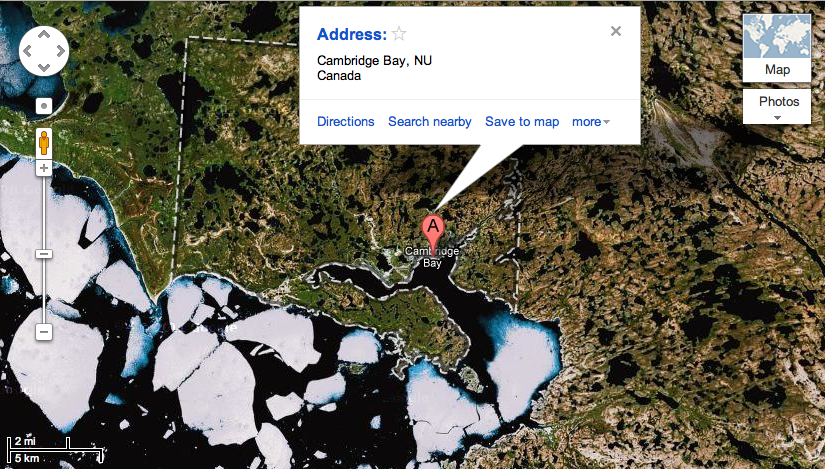
Every hear of Cambridge Bay? It is not in the United Kingdom, as one might think, but rather the Kitikmeot Region of Nunavut in Canada’s Arctic and Google is trying to put it on the map.
There are 4,000 years’ worth of stories waiting to be told on this map. Today, we’re setting out on an ambitious mission to tell some of those stories and to build the most comprehensive map of the region to date. It is the furthest north the Google Maps Street View team has traveled in Canada, and our first visit to Nunavut. Using the tools of 21st century cartography, we’re empowering a community and putting Cambridge Bay on the proverbial map of tomorrow.
Google further revealed a local nonprofit group, Nunavut Tunngavik, is helping to map the hamlet in both English and Inuktitut, which is one of Nunavut’s official languages, while the Internet giant pedals around with a tripod and the Street View trike to collect imagery.
“This is a place with a vast amount of local knowledge and a rich history. By putting these tools in the hands of our people, we will tell Nunavut’s story to the world,” said Nunavut Tunngavik’s Chris Kalluk, who’s organization helped plot the remnants of an ancient Dorset stone longhouse that pre-dates Inuit culture.
Get more mapping details and images at the Google blog.
Google announced today on the Lat Long Blog that it added even more Street View imagery to Google Maps; this time for Brazil and pre-hispanic Mexican cities. While there was already Street View imagery available for the locations, the latest additions include panoramic imagery for 70+ cities throughout Brazil including “colonial cities like Fortaleza, architecturally compelling cities like Brasilia and coastal landmarks like Recife, Natal and Salvador.”
You can even virtually travel to the west side of Brazil and visit Foz de Iguaçu, or if you’re planning an upcoming trip, preview the the area around your hotel as well as nearby shopping malls, historic monuments, restaurants and more. With so many upcoming events, like the 2014 World Cup and the 2016 Olympics, we’re excited to share the riches of Brazil’s cities not only with tourists from around the world, but also with locals who might want to visit a city, neighborhood or landmark they’ve not yet experienced.
Also included in today’s update is 30 Mesoamerican archaeological areas in Mexico, including the 1,100-year-old Kukulkan’s Temple pyramid, and other sites such as Teotihuacan, Chichen Itza, and Tulum.
My, how time flies. It has been nearly seven years since Hurricane Katrina wreaked havoc on Louisiana, but a fresh look through Google’s Street View imagery shows New Orleans and the surrounding area has come a long way.
“The Street View imagery in Google Maps, which has just been updated today, more accurately reflects the major construction and renewal that’s underway,” announced New Orleans Mayor Mitch Landrieu on the official Google Lat Long blog.
Both the Google Earth and Google Maps for Android apps were updated with several new features. Google outlined the new features available in the latest release of Maps on its Lat Long Blog. A couple of the notables include offline maps for more than 150 countries and a new Compass Mode for Street View:
Today we’re also releasing a smoother and faster Compass Mode for Street View within Google Maps for Android. It’s the next best thing to being there, because your device becomes a window into a 360-degree, panoramic view of the outdoor or interior location through Business Photos. To experience the improved qualities of this feature you need a device with Google Maps for Android, Android 3.0 or higher and a gyroscope sensor plus version 1.8.1 of Street View on Google Maps.
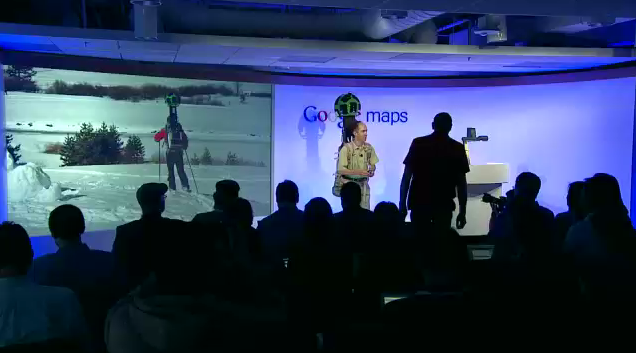
Google just revealed a backpack-like Street View capture device called “Trekker” that snaps images in areas impossible to navigate by vehicle (above).
“It’s 40 pounds and includes two batteries that’ll last you all day. It’s Android-powered…. We intend to take it to National Parks, the Grand Canyon, castles, etc.,”explained Google’s Engineering Director of Street View Luc Vincent at the “Next Dimension” Google Maps event in San Francisco.
The director further said street level data “could be” useful for users, and then he showed off an original Street View van (below). It is a Chevy Astro and definitely does not compare to newer Street View cars.
It is worth mentioning that Google announced it drove over 5 million unique miles to collect 20 petabytes of imagery for Street View.
Google just updated its Maps for Android app to version 6.7 by adding a number of notable new features like integration of Google offers, indoor walking directions, and new 360-degree Street View-like panoramic views for the insides of certain buildings.
As for Google Offers integration, Google will launch the feature only in the United States and provide access to the deals through a new “Offers” option within the app’s “Maps” drop-down menu. The app will also let you opt-in to receive notifications for nearby deals. The feature is limited to the Android app, but we are likely to see Offers integration across all Google Maps products in the near future.
Another new feature rolling out to both U.S. and Japanese users is the ability to get indoor walking directions, but this is in addition to the indoor floor plans launched earlier this year in version 6.0 and will only rollout to select buildings initially.
Taking advantage of its Street View technology, Google is introducing 360-degree panoramic views in version 6.7. To access the feature, Google noted to keep an eye out for the “‘See Inside’ section on the Place page of select businesses.”
Wikipedia updated its Android and iOS apps today, but the noteworthy feature is that the online encyclopedia-like website dumped Google Maps for OpenStreetMap, which marks a growing trend for technology firms preferring an alternative mapping solution.
The company just announced its Android counterpart witnessed 2.25 million installs in less than two months since its birth, while netting over 23 million Wikipedia page views per month. Despite the success with Google’s mobile OS, Wikipedia updated its apps with Open StreetMap data in favor of the service’s “nearby view” feature.
Wikipedia further explained the reasoning behind the switch:
Previous versions of our application used Google Maps for the nearby view. This has now been replaced with OpenStreetMaps – an open and free source of Map Data that has been referred to as ‘Wikipedia for Maps.’ This closely aligns with our goal of making knowledge available in a free and open manner to everyone. This also means we no longer have to use proprietary Google APIs in our code, which helps it run on the millions of cheap Android handsets that are purely open source and do not have the proprietary Google applications. OpenStreetMaps is used in both iOS and Android, thanks to the amazing Leaflet.js library. We are currently using Mapquest’s map tiles for our application, but plan on switching to our own tile servers in the near future.
In the last couple of months alone, both Apple and Foursquare also shifted to OpenStreetMap. It is worth mentioning that Yahoo implemented OpenStreetMap data within Flickr in 2009 for a plethora of worldwide cities, such as Baghdad, Beijing, Kabul, Santiago, Sydney, and Tokyo.
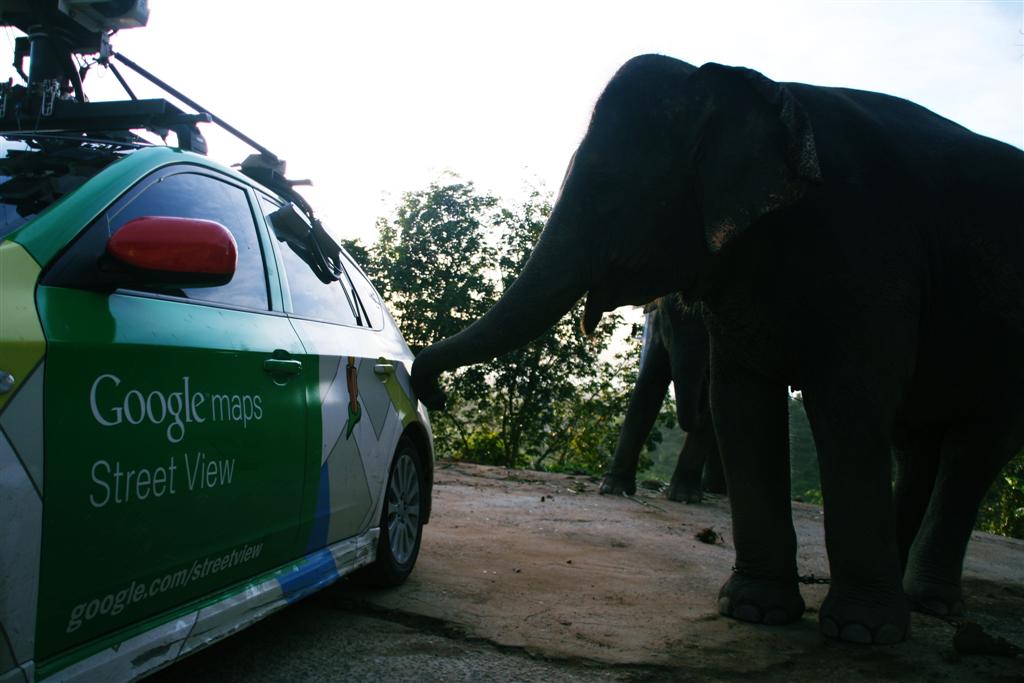
Google launched its Street View galleries this past week for Amazon and Thailand without a hiccup, but the Internet giant was not-so lucky elsewhere, as it has faced many obstacles over its mapping applications throughout the globe—especially in Asia.
Reuterspublished a lengthy reported today detailing how Google often meets hurdles worldwide, such as the recent debacle on its privacy policy, and it fully described the Mountain View, Calif.-based Company’s tenacious attempts to chart the streets and landscapes of Asia while consistently meeting privacy, political, and cultural barriers.
For those that live under a rock: Google Street View is a service highlighted in Google Maps and Google Earth that offers panoramic views of streets. It launched in 2007 in the United States and has expanded to many cities and rural areas worldwide.