Author

Avatar for Seth Weintraub

Seth Weintraub

Founder, Publisher and Editorial Director of the 9to5/Electrek/DroneDJ sites.

Seth Weintraub is an award-winning journalist and blogger who won back to back Neal Awards during his three plus years  covering Apple and Google at IDG’s Computerworld from 20072010.  Weintraub next covered all things Google for Fortune Magazine from 2010-2011 amassing a thick rolodex of Google contacts and love for Silicon Valley tech culture.

It turns out that his hobby 9to5Mac.com blog was always his favorite and in 2011 he went full time adding his Fortune Google followers to 9to5Google.com and adding the style and commerce component 9to5Toys.com gear and deals site. In 2013, Weintraub bought one of the Tesla’s first Model S EVs off the assembly line and so began his love affair with the Electric Vehicle and green energy which in 2014 turned into electrek.co.

In 2018, DroneDJ was born to cover the burgeoning world of drones and UAV’s led by China’s DJI.

From 1997-2007, Weintraub was a Global IT director and Web Developer for a number of companies with stints at multimedia and branding agencies in Paris, Los Angeles, New York, Sydney, Hong Kong, Madrid and London before becoming a publisher/blogger.

Seth received a bachelors degree in Industrial and Systems Engineering from the University of Southern California with a minor in Multimedia and Creative Technology in 1997. In 2004, he received a Masters from NYU’s Tisch School of the Art’s ITP program.

Hobbies: Weintraub is a licensed single engine private pilot, certified open water scuba diver and spent over a year traveling to 60 cities in 23 countries. Whatever free time exists is now guaranteed to his lovely wife and two amazing sons.

More at About.me. BI 2014 profile.

Tips: seth@9to5mac.com, or llsethj on Wickr/Skype or link at top of page.

Google has activated half a billion Plus users, 235M active on a daily basis, and 135M read their streams

Site default logo image

Google released some Plus numbers today for the first time in a while. While Facebook has surpassed 1 billion active users, Google said its users number about half that and that is only for activations. Meanwhile, less than half of those people (235 million) are actually using the service (+1′ing apps in Google Play, hanging out in Gmail, writing reviews in Maps, etc.). Who is using the stream? Just 135 million— or 27 percent of the people Google has activated.

More than 500 million people have upgraded, 235 million are active across Google (+1′ing apps in Google Play, hanging out in Gmail, writing reviews in Maps…), and 135 million are active in just the stream.

I have to say from a personal standpoint that there was a lot of excitement and new features surrounding the launch of Google Plus, but it feels like the excitement is stagnating somewhat as Google struggles to bring itself up to feature parity with Facebook. Of particular interest is getting websites integrated into Google Plus like Facebook and Twitter with automatic feeds.

Still, 135 million users is a pretty high number for such a young service.
Expand
Expanding
Close
Review: A month with the Samsung Chromebook

TL;DR: This is the first Chromebook effort that fulfills the ChromeOS mission: good quality, excellent (MacBook Air-like) design, low cost and functional, and easy to use. It won’t replace a mid-high end machine, but, for people with basic needs or who want an inexpensive second computer, this is a no brainer at $250.

Background:

Google’s Android and ChromeOS  represent two different visions of the future of computing from inside the same company. The Android vision is a touch-enabled platform with apps that has been in vogue since the iPhone was released in 2007. The ChromeOS is the realization of the decades-old network client computer—which is just a browser as a user interface for a bunch of cloud services.

Android has clearly been popular on both phones and now tablets, but Chrome sales have been pretty lackluster until now. From my point of view, that’s due to a couple of reasons. For one, the devices, made by Samsung and Asus, were lackluster in speed compared to the Windows and Mac counterparts. ChromeOS devices should be faster than comparably equipped Macs and PCs because there is no overhead—it is just a browser. Yet the CR-48 and again with the second-generation Chromebooks weren’t noticeably faster than cheap netbooks. That’s the other problem: Chromebooks weren’t cheap – compared to similarly specced PCs, anyway. Often, you’d be able to find a cheaper Windows PC on sale that otherwise was the same or better.

So, to break it down: Chromebooks were overpriced and slow (and the design wasn’t very inspired).

Then came the third generation…


Expand
Expanding
Close

PSY’s ‘Gangnam Style’ passes Justin Bieber on way to a billion YouTube views

Site default logo image

.

The world feels a little bit more right today as South Korean Pop Star PSY’s “Gangnam Style” music video passes Justin Bieber’s “Baby” on YouTube’s all-time watched list. With my kids still watching the video a few times a day, it shouldn’t be long until the video is the first to pass 1 billion views. The hit is notable because it is the only top video not from VEVO and not from a North American English speaker.

Need more information? Of course you do, and we plopped in an animated GIF infographic below.


Expand
Expanding
Close

We’re giving away an LG Optimus G on AT&T (winner!)

Site default logo image

Update: We have a winner: Josh Eck!

We’re kicking off Black Friday week with something new. AT&T has given us an Optimus G smartphone to give away to one of our US-based commenters.

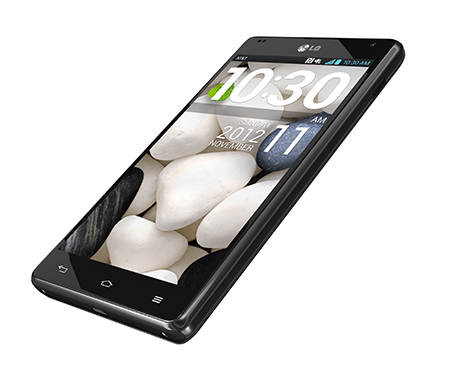
The Optimus G is much like our well-reviewed Nexus 4 except it adds support for AT&T’s LTE network. It also adds LG’s overlay and some extra AT&T apps.  However, it does keep the fantastic 4.7-inch 768×1280 IPS display, 1.5GHz S4 Processor with 2GB or RAM and that great 8megapixel camera.

Since it is closely related to the Nexus 4, it likely means that Android updates should come quicker than for other devices.  We’ll see.

We’ll contact one of the commenters below on Black Friday. 
Expand
Expanding
Close

Verizon Droid DNA Review: This display gives reality a run for its money

Site default logo image

[slideshow]

We pretty much knew what to expect going into the Droid DNA event this week. The 5-inch “don’t call it a phablet” phone had been leaked in various forms, although its specs and specifically its 5-inch, 1080p 441PPI display seemed a little “too good” to be true.

It wasn’t. Pretty much from the second we picked up this monster of a phone, reality set in in a big way.  While the phone is large  —mostly just a wrapper for the 5-inch display— it is also much lighter than you’d expect, especially if you are coming from last year’s hand-grenade of a Verizon HTC flagship phone, the Rezound.  The rubbery-plastic back that is becoming popular with Android phones, and red-plastic ‘race car’ accents shave a lot of weight from the device, but it still feels plenty solid. The back picks up oils from hands and seems to scratch fairly easily, although with that screen on the other side, you probably won’t spend much time looking at the back.

It is important to say here…HTC and Verizon are positioning the DNA as a phone and not a ‘phablet’, and they can make that claim for two reasons: the DNA is much narrower than the Note/2, and it is much, much lighter. In fact it is 42 grams lighter.

NOTE 2: 5.94″ x 3.17″ x 0.37″ (151 x 81 x 9 mm)6.34 oz (180 g)

DNA: 5.55″ x 2.78″ x 0.38″ (141 x 70.5 x 9.73 mm) 4.87 oz (138 g)

The narrow body lets you do one-handed typing, and the weight is actually a lot less than the 4.5-inch phones released over the last two years.

The speaker, also located on the back, didn’t impress me as much as a ‘Beats’ device with a dedicated amplifier probably should have. Still, I’d rate it as very good for a smartphone. However, when it is laid on its back, the sound is muffled. There is some room for improvement here. Also, on the back near the camera, an indicator light flashes when you have a notification. HTC could probably have been a bit more creative here and used the camera’s flash.

Speaking of the camera, this is one of the best I’ve ever used on a smartphone. HTC continues to lead on a hardware front with its F2.0 8-megapixel-backside camera and perhaps the best front-side camera I’ve used: an F2.0 2.2MP 1080p front-facing camera. Both are top-notch for both stills and 1080p video.

Then there is the screen.


Expand
Expanding
Close

Google-Dish wireless service is a go, plans for 2013 launch being hatched

Site default logo image

Regarding the Google-Dish tie up that was reported last night, we just got word that this is really happening. While the details haven’t been finalized, Google is already deep into development on plans to roll out the service and have it live by mid-late 2013.

Google plans to make the service data-only with voice and SMS only being used as VoIP services, likely with Google Voice. Google of course already has its ISP feet on the ground with its Fiber rollout on the Stanford Campus and its just-opened Kansas City network.

Google is launching its Glass head gear next year and would benefit from total control of the network.  Without full control, Google is seeing its Voice and Wallet services being blocked by carriers, specifically AT&T, Verizon and T-Mobile.

Dish has previously said on numerous occasions that it would like to build a wireless network with the wireless spectrum it has acquired since 2008, but the company wants a partner to help fulfill this endeavor. As the Wall Street Journal noted in its report from yesterday, Dish Chairman Charlie Ergen said potential partners include companies that would like to be in the industry and currently don’t have a wireless sector.


Expand
Expanding
Close

Microsoft Office for Android and iOS shows its face, release in early 2013

Site default logo image

.

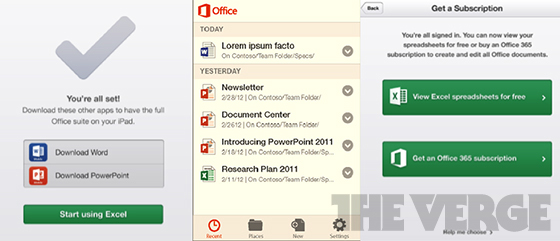
The Verge has what it says are previews of Microsoft Office for the two platforms that own 90 percent of the smartphone and tablet markets.

The Verge has learned through several sources close to Microsoft’s plans that the company will release Office versions for Android and iOS in early 2013.

Iosoffice_560

Office Mobile will debut in the form of free apps that allow Android and iOS users to view Microsoft Office documents on the move. Like the existing SkyDrive and OneNote apps, Office Mobile will require a Microsoft account. On first launch, a Microsoft account will provide access to the basic viewing functionality in the apps. Word, PowerPoint, and Excel documents will all be supported, and edit functionality can be enabled with an Office 365 subscription.


Expand
Expanding
Close

Is Google subsidizing the price of the $299 LG Nexus 4?

Site default logo image

.

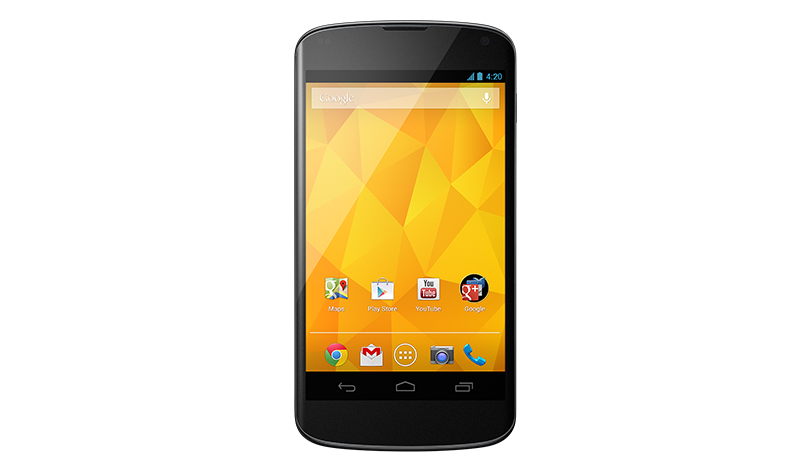
As part of our review of the Google Nexus 4, one of a game-changers we noted was its seemingly impossible $299 price for the 8GB model ($349 for the 16GB model).  With a beautiful 1280×768 IPS Retina-quality display, insanely fast Qualcomm s4 Krait chipset with 2GB of RAM, 8 megapixel cameras and beautiful design, it is clearly a high end flagship phone.

Phones with those specs typically run in the $500-$700 range unsubsidized and the lack of a LTE chip in the Nexus 4 isn’t likely to drop the price down too terribly much.  Certainly not cut it in half.  Could Google be throwing in a few bucks to make this phone cheaper?  Certainly the Galaxy Nexus before it was a bargain at $349 but it had a significantly cheaper pentile display, less RAM, and an older generation chipset with a midrange 5 megapixel camera.

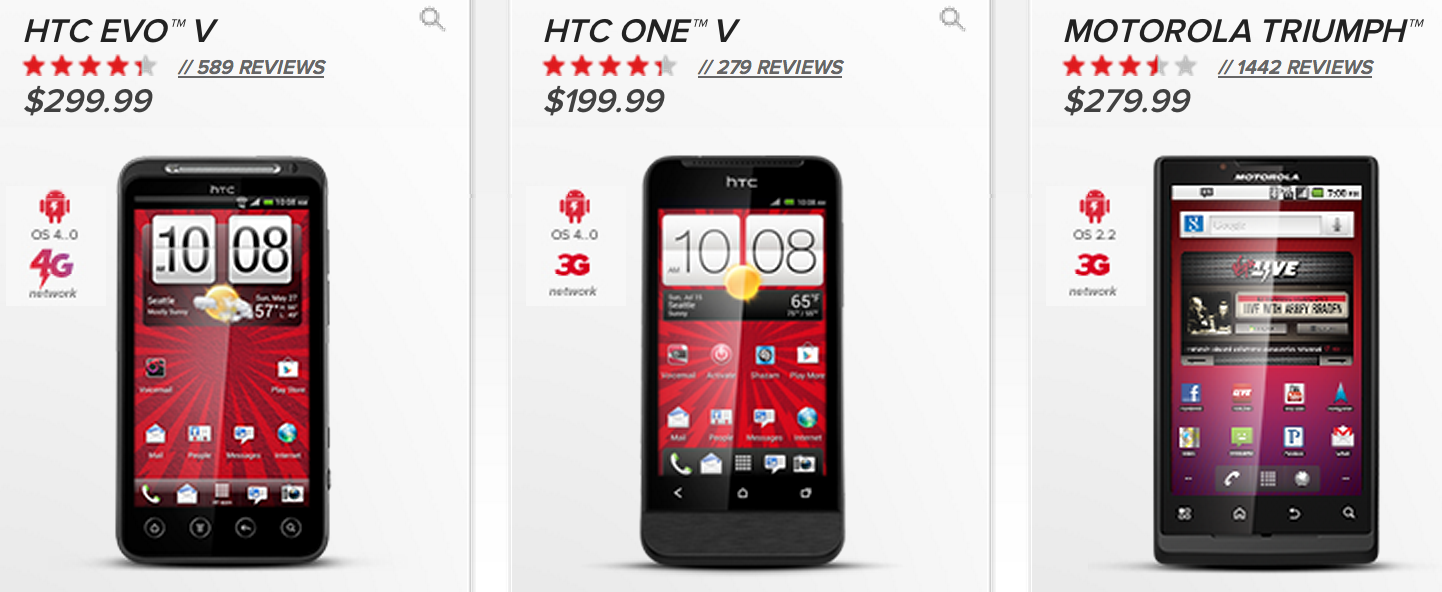
It isn’t easy to find non-subsidized prices in the US phone market but low-price prepaid carrier Virgin does offer phones at retail prices. Have a look at their higher end Android phones:

.

The Motorola Triumph is an over a year old 4-inch single core phone that got lackluster reviews. It currently sells for $279.99 unsubsidized. The $299.99 HTC EVO V is a rebrand of the EVO 3D which is almost two years old and was discontinued from Sprint when it moved away from WiMAX almost a year ago. Both of these phones are in a whole other league (Busch) than the Nexus 4.

T-Mobile, which will also sell the Nexus 4 on its website and at its stores, will offer the device in the following configurations:

  • Paired with a qualifying T-Mobile Value voice and data plan and two year service agreement, the Nexus 4 will cost an out-of-pocket down payment of $199.99 with 20 equal monthly payments of $15 per month via T-Mobile’s Equipment Installment Plan (EIP). The Value plan paired with EIP is offered at T-Mobile retail stores.
  • Customers can also purchase the Nexus 4 at T-Mobile retail stores and online for $199.99 (after a $50 Mail in Rebate) qualifying T-Mobile Classic voice and data plan and two year service agreement.

The $199 + $300 in monthly payments comes out to $500 for the same phone Google is offering for $350. The $199 with two year plan is the same price that other high end phones like the Galaxy S3 or even iPhone 5 cost on other carriers. That seems to imply that T-Mobile isn’t getting the Nexus 4 for the same $299 price…or they are adding a serious margin.

What tipped me off to the disparity wasn’t just T-Mobile, however…
Expand
Expanding
Close

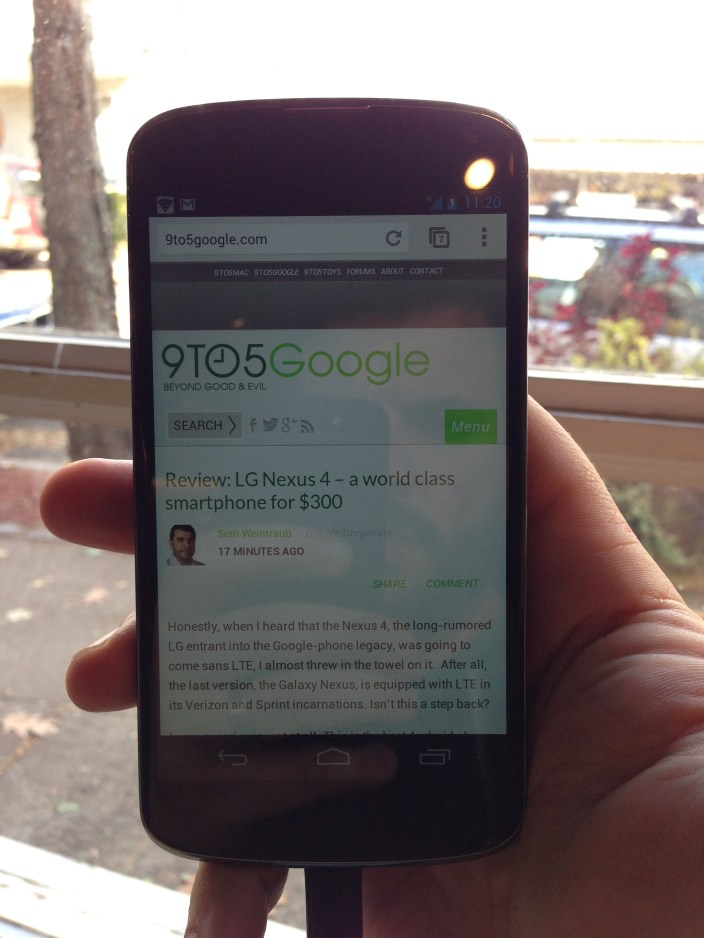
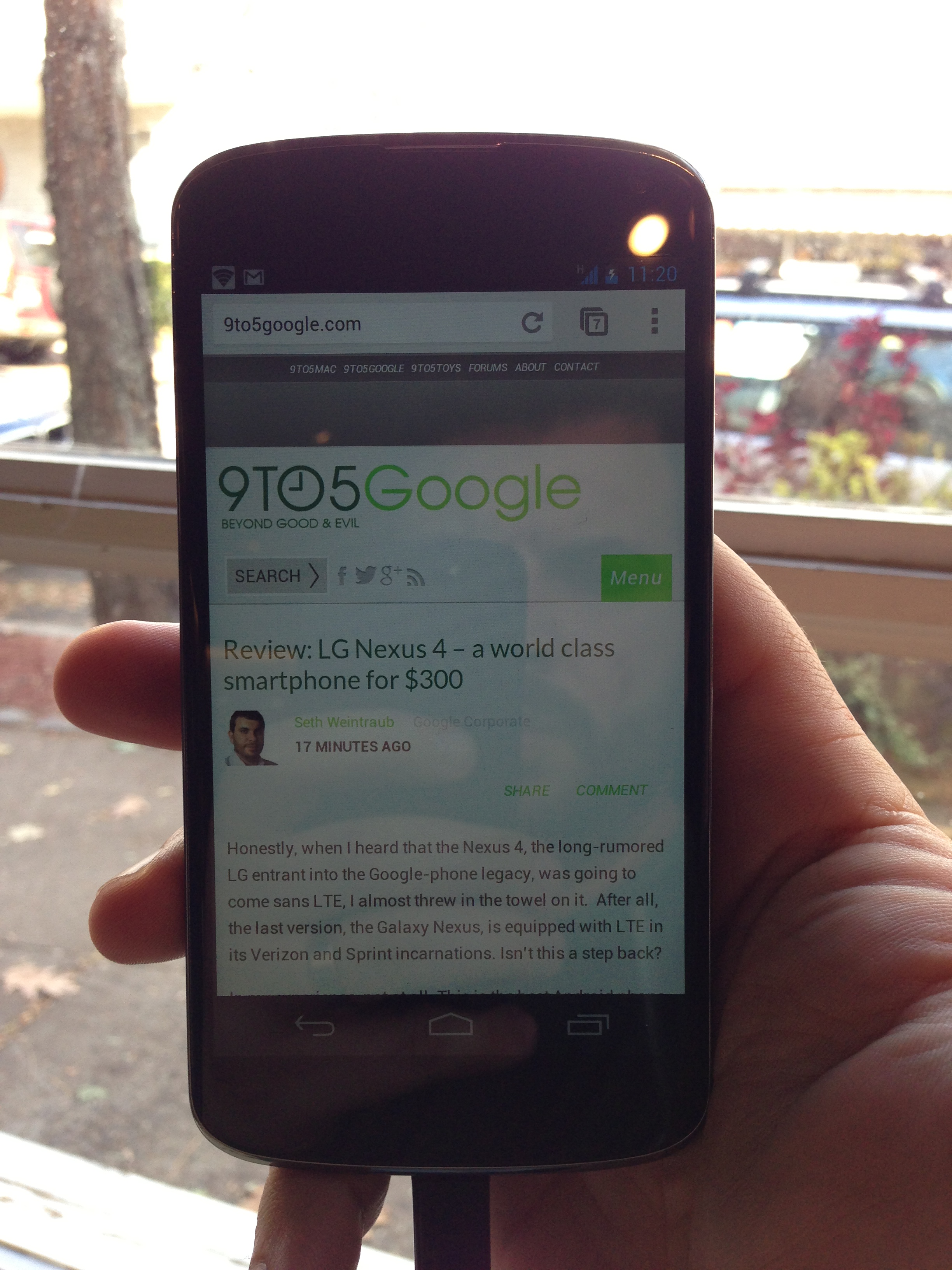
Review: LG Nexus 4 — a world class smartphone for $300

Site default logo image

Honestly, when I heard the Nexus 4, the long-rumored LG entrant into the Google-phone legacy, was going to come sans LTE, I almost threw in the towel. After all, the last version, the Galaxy Nexus, is equipped with LTE in its Verizon and Sprint incarnations. Is this a step back?

In my experience, not at all. This is the best Android phone ever made. And, for many purposes, it is the best phone I’ve ever used. It is almost a no-brainer to hit the buy button once you add that it only costs $299 for 8GB or $349 for 16GB.

But, before you do, let’s talk hardware:


Expand
Expanding
Close

T-Mobile will be the premier Nexus 4 US launch partner, launches holiday lineup

Site default logo image

.

T-Mobile’s event in New York City is obviously cancelled because of Hurricane Sandy, but the launch continues.  Along with the $299 off-contract Nexus 4, T-Mobile is rounding out its Android lineup with the previously announced Note II, Samsung Galaxy S3, LG Optimus L9, and the lower-end Samsung Galaxy S Relay 4G.

Some fun facts on data usage from the release:

  • Just three years ago, our smartphone customers consumed on average 25MB of data each month (primarily email). Contrast that with today when, on average, T-Mobile smartphone customers are consuming 847 MB of data each month.
  • Customers using our fastest, HSPA+ 42 capable smartphones, are averaging nearly 1.6 GB per month (an increase of 11% in < 60 days).
  • In fact, users of the recently launched Samsung Galaxy S III consume an average of 1.8 GB per month (an increase of 14% in < 60 days).

The full press release follows:
Expand
Expanding
Close

Google is testing its same-day delivery service, soon it will use driverless vehicles

Site default logo image

The New York Times reported that Google is testing its same-day delivery service around San Francisco.

Plans for the service have been under way for more than a year. But it recently went live for some Google employees and their friends, according to two people briefed on the service who were not authorized to discuss it because Google has not yet publicly introduced it. At least one national apparel chain is involved, one of these people said. A Google spokesman, Nate Tyler, declined to comment.

Google is just one company tackling same-day delivery. So are Wal-Mart,Amazon.com, eBay and the United States Postal Service.

Though the service propels Google into commerce, the company does not intend to operate warehouses or a shipping service, but to team up with retailers and delivery companies. Several San Francisco retailers, including national chains, are participating in the program already. There is no word on whether Google will eventually send its self-driving cars to make deliveries.

We’ve been told this was coming, and we have some additional information on the program. Google does plan to use its self-driving cars in the program that is run inside the Google X incubator headed by cofounder Sergey Brin.

We also heard that Google has even wilder aspirations for the program, which we’ll be able to detail in the coming weeks.

Review: Galaxy Note 2 – Even bigger and better

Site default logo image

I knew Samsung had a hit on its hands the first time I saw the original 5.3-inch Galaxy Note at IFA in Berlin last year. I immediately loved the monster smartphone and I knew others would too. Even though initial reviews poo-pooed it as a too big to be a phone, too small to be a tablet, I knew there would be a big market for a device with so much screen but small enough to put in large pockets or in a purse. As Apple is showing with its bigger iPhone 5 and smaller iPad mini, there is no one size fits all solution and people are after devices in the middle.

Samsung offloaded 5 million of these things in the first month of sales and  Samsung Exec JK Shin expects Samsung to sell three times as many of the Galaxy Note 2. I believe the Note 2 will sell well because it is significantly improved in almost every way:


Expand
Expanding
Close

Google’s thin 11.6-inch ARM based Samsung ChromeBook with 100GB of online space is finally compelling at $249 (Video)

Site default logo image

http://www.youtube.com/watch?feature=player_embedded&v=S95J5BowMmk

Google just announced some extremely aggressive-priced Samsung Chromebooks starting at $249 at major U.S. retailers:

The new Chromebook is a great computer at any price, but it’s an incredible computer at $249. It’s one of the lightest laptops on the market. You can easily carry it around all day—it’s 2.5 pounds, a mere 0.8 inches thick, with more than 6 hours of battery life for the typical user. And with 100 GB of free storage on Google Drive*, you can get to all of your stuff anytime, anywhere.

Even with its compact design, it’s packed with performance—it boots up in less than 10 seconds and resumes instantly. High-resolution videos (in 1080p) are beautiful to watch and when using the touchpad, you’ll notice smooth scrolling due to a hardware-accelerated user interface. And as you‘d expect from a Chromebook, it’s easy to share with others. Everyone—mom, dad, grandparents, tech lovers, tech haters—can have separate accounts where all of their stuff is kept safe. Finally, if you’re an active Google user of products like Gmail, Drive, Search, Maps, YouTube, Play or Google+ Hangouts, everything just works seamlessly.

The new Chromebook weighs a little less than 2.5 pounds, but it boasts the same 6.5-hour battery life. The screen, however, is 0.5-inches smaller with a 1,366-by-768-pixel resolution. The most notable difference in Google’s thinner Chromebook is the Samsung Exynos 5250 dual-core processor inside, and it features a Cortex-A15 chip that reportedly runs 1080p video and ChromeOS pretty well. GigaOm’s Kevin C. Tofel even noted the overall performance is “comparable to the Intel-powered Chromebook I have, but perhaps a half-step behind; at least in my few hours of using the device.”

This is finally a compelling offer at $249—as long as the hardware is fast. It looks like a base-line MacBook Air (and will surely draw criticism for that) for a quarter of the price. Again, so long as it performs, I don’t think Google will have a problem selling them to its intended audience: grandparents, kids, and as second or third computers for those who are heavy Google service users, and companies that need cheap mobile workstations.

Update: More reviews are starting to come in and unfortunately many are complaining about slowness. Not surprising for a $249 machine but clearly not for power users.

A gallery is below.


Expand
Expanding
Close

Google to offer AdWords credit to advertisers

Site default logo image

The Financial Times reports that Google is getting into the credit business tomorrow in the United Kingdom, but this is not a typical credit card. It is only available for spending on Google’s own Adwords product.

Google’s decision to issue its own credit card, which will also be made available in the US within weeks and other unspecified countries later, signals the company’s first attempt to use its huge cash reserves to support its core search advertising business by subsidising low-interest rate credit lines.

Google provided all the info on its Adwords blog:

  • In the UK, AdWords Business Credit will have a variable 11.9% APR Representative.   In the US, AdWords Business Credit will offer an APR as low as 8.99%*, the same rate as in the pilot. Neither card will have annual fees, and they will both have an ample credit limit for AdWords.
  • We’re teaming up with Barclaycard, part of the Barclays group, in the UK and Comenity Capital Bank in the US to issue the card. Both are MasterCard cards.
  • AdWords Business Credit can only be used for AdWords advertising purchases.


A pilot program has been going on in the U.S. for over a year. The results of the study proved that Google could sell more and more valuable ad space by putting the money up front. Customers would receive between $200 and $100,000 a month to pay for their use of Adwords. The money, theoretically, would be paid back after Adwords drew bigger audiences and increased revenues of the client’s website.

This play is not an attempt at a new profit center or necessarily tied to (or confused with) Google Wallet. It is simply to drive higher revenues to Adwords—especially from cash-strapped companies.


Expand
Expanding
Close

Google touts Google Map API on new Morethanamap.com website

Site default logo image

Google Maps API Product Manager Ken Hoetmer shows off Google’s new Mapping API website: Morethanamap.com.

Through morethanamap.com you’ll learn how developers can embed popular Google Maps features like Street View, public transit directions, location data, and advanced data visualization capabilities into their website or app. The interactive demos on morethanamap.com show how these features are ready to be added to any website or app.

With Apple’s switch from Google Maps to its own mapping solution, Maps have been thrust into the foreground. Google hopes to build on its strengths by getting developers (more) involved. There are many videos on the #Morethanamap Google Plus page.


Expand
Expanding
Close