Author

Avatar for Jordan Kahn

Jordan Kahn

jordankahn

Senior Editor

9to5Mac / 9to5Google / 9to5Toys / Electrek.co

Jordan writes about all things Apple as Senior Editor of 9to5Mac. He covers Google for 9to5Google.com, the best gadgets and deals on 9to5Toys.com, and delivers a weekly roundup of EV and solar news on Electrek.co. Sometimes he makes weird electronic music as one half of Makamachine.

Contact Jordan with news tips and long-winded complaints:  

Connect with Jordan Kahn

Google spreadsheets updated with simplified edits & resizable charts

Site default logo image

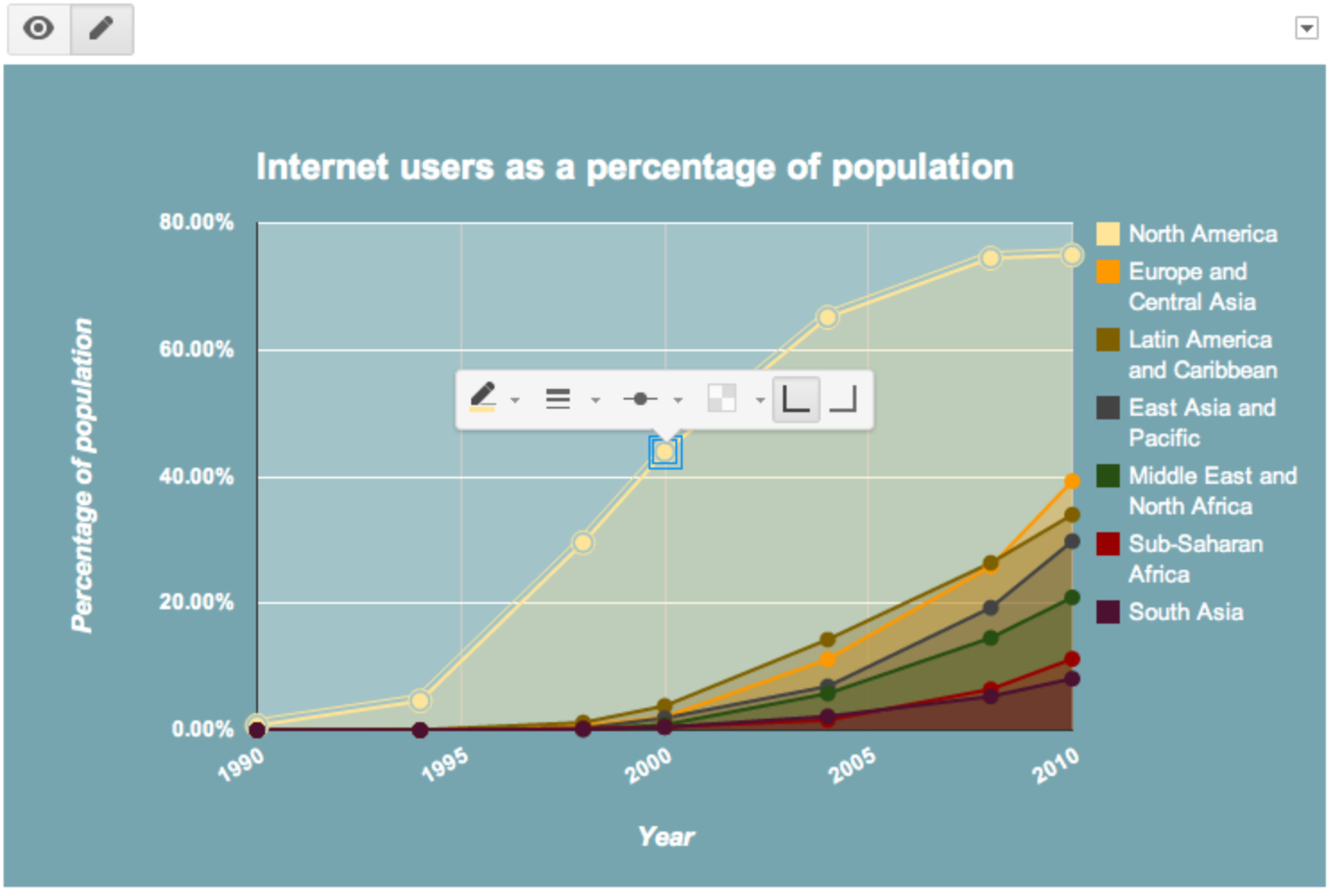
Google announced today on the Google Drive blog that it is updating Google spreadsheets with some new editing options and enhanced charts. The first update is the ability to click directly on any aspect of a chart to edit its colors, labels, legend, etc., without having to open the chart editor. The new quick edit mode (pictured above) will definitely make the app quicker and easier to use by providing the ability to edit the chart title, horizontal or vertical axis, legend, or any data series in just a few or less clicks.

Many chart types allow you to make formatting changes by clicking directly into the chart itself. Clicking anywhere in a line, area, bar, column, pie or candlestick chart, for example, will activate Quick Edit mode. You can then hover and click into specific areas of your chart that you’d like to modify… When you use Quick Edit, two buttons will appear in the top-left corner of your chart: View mode and Quick Edit mode. When you click into a chart, you’ll initially find yourself in Quick Edit mode. When you’re done making changes, click View mode.

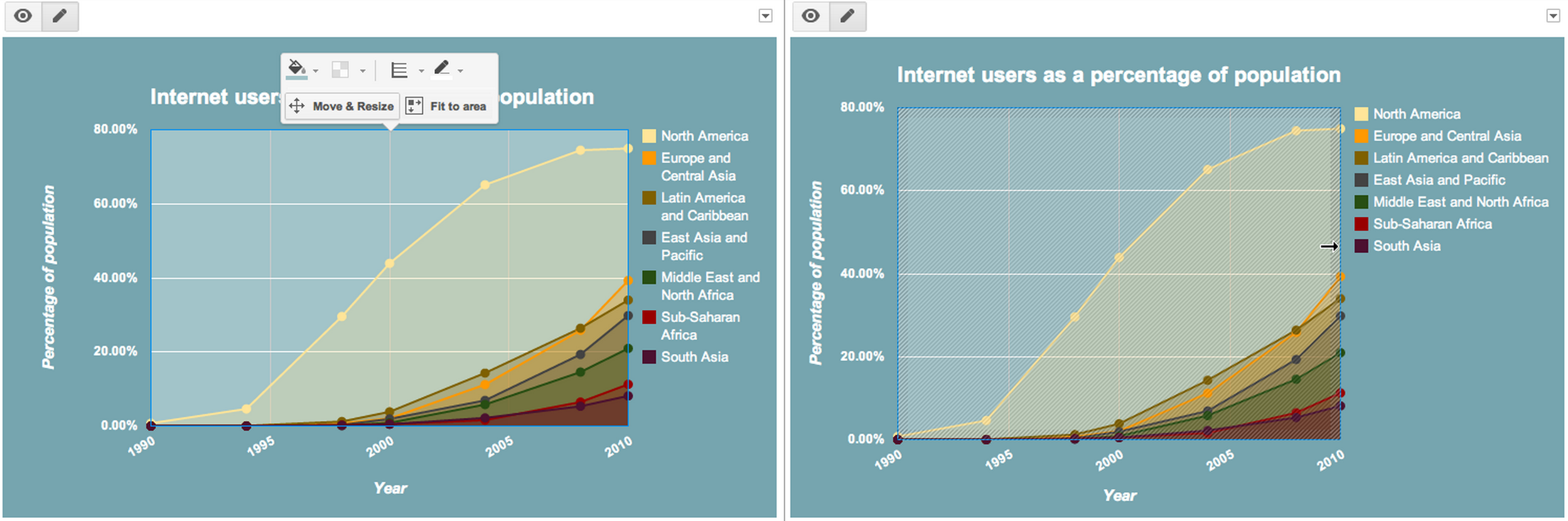
You will also now be able to enter a Move and Resize mode that Google explained would allow you to “drag the edges of the chart and move it around to allow things like the legend labels to all fit on one line.” You can access the new resizing option (pictured below) by clicking the background of a chart and a selecting “Move and Resize”.

Expand
Expanding
Close

Google rolls out OAuth 2.0 support for Gmail and other IMAP/SMTP, XMPP services

Site default logo image

[tweet https://twitter.com/googledevs/statuses/247765747248533506]

We reported earlier on hints from Google employee Tim Bray that the company might be working on an integrated password and login solution. We know Bray is working on OAuth and OpenID-related projects, and Google announced in a blog post today that it is adding OAuth 2.0 support for IMAP/SMTP and XMMP. The majority of Google’s API’s already support the OAuth 2 authentication standard for sharing your account data with third-party apps, but today’s addition of support for IMAP/SMTP and XMMP opens OAuth 2.0 to third parties accessing services such as Gmail and GTalk.

Today we’re going a step further by adding OAuth 2.0 support for IMAP/SMTP and XMPP. Developers using these protocols can now move to OAuth 2.0, and users will experience the benefits of more secure OAuth 2.0 clients.

According to Ryan Troll of Google’s Application Security Team, clients never ask for a user’s password with the OAuth 2.0 authentication mechanism. He also noted “users have tighter control over what data clients have access to, and clients never see a user’s password, making it much harder for a password to be stolen.”

Google outlined a timeline for support for older authentication standards:

Expand
Expanding
Close

Google planning on an integrated 1Password type of service?

Site default logo image

Google employee and XML pioneer Tim Bray has been known for delivering awesome tweets from his personal Twitter account regarding issues happening at the company. Today, Bray took to his popular ‘Ongoing’ blog to share what he worked on at Google for the past three months (since he left Android developer relations for OAUTH group). In a blog post, titled “Less Pain, More Money”, Bray appears to hint that Google is working on a solution for storing passwords and simplifying logins:

Google really wants you to type things like “good mountain bike” or “Knoxville pediatrician” into the search box…. More often than you’d think, people don’t; they click in the address bar and type in the URL of a big bookstore or Somebody’sList, as a first step on their search. When we ask why, surprisingly they often say ”Oh, if I found something good on a random site out there I’d have to log in, and either remember my stupid password or fight through the stupid sign-up page.” The numbers are probably secret, but they’re very significant.

[tweet https://twitter.com/timbray/status/247567089974513665]

While Bray does not go into detail about a specific feature that he or Google is working on, he noted his job currently centers on reducing the frustration associated with logging in to various websites. We have a feeling Google is working on a new feature that will make storing passwords and logging into websites much easier.

It is not hard to imagine doing a Google search to a page, where you would normally need to login to, and then find yourself already logged in with account credentials stored in your Google account.


Expand
Expanding
Close

Site default logo image

Amazon releases Maps API for new Kindle Fires with interactive maps and custom overlays

Amazon took some time today to discuss the new Amazon Maps API it released alongside the Kindle Fire HD earlier this month. According to a post on the Amazon Mobile App Distribution blog, the new API will make it easy for developers “to integrate mapping functionality into apps that run on the all-new Kindle Fire and Kindle Fire HD.” The Maps API is now in beta and available through the Amazon Mobile App Distribution Portal.

If you are curious about exactly what the new API provides, Amazon provided a description of the core features:

  • Interactive Maps. You can embed a Map View in your app for customers to pan, zoom and fling around the world. You have the option to display a user’s current location, switch between standard maps and satellite view, and more.
  • Custom Overlays. You can display the locations of businesses, landmarks and other points of interest with your own customized markers and pins.

iFixit tears down Kindle Fire HD, finds completely new internals

Site default logo image

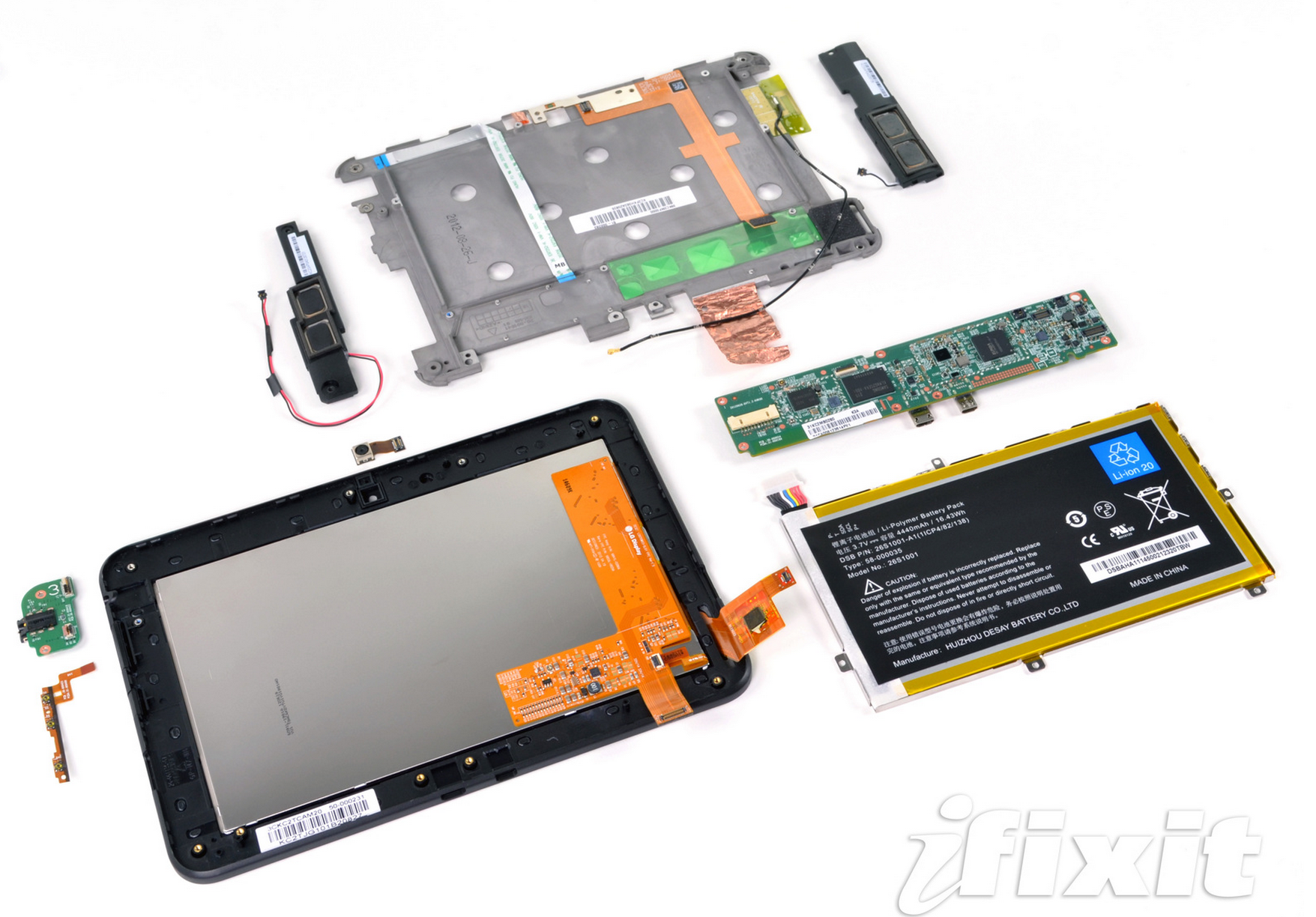
The folks at iFixit are performing its usual teardown ritual today. This time it has a full breakdown of Amazon’s new Kindle Fire HD announced earlier this month. One of the teardown highlights: the device includes a 3.7 V, 4400 mAh, 16.43 Wh Li-ion battery that has about the same juice as the previous-generation Kindle Fires, which means the 11 hours of expected battery life is up for debate. Other findings: The Kindle Fire HD sports an upgraded Texas Instruments OMAP 4460 dual-core processor with 1GB of RAM from Elpida, a LCD from LG Display, and 16GB of flash memory from Samsung. Overall, the device scores a decent 7 out of 10 repairability score, which ties with the Nexus 7 and beats the third-generation iPad.

-Samsung KLMAG2GE4A eMMC 16 GB Flash Memory and Flash Memory Controller
-Elpida B8164B3PF-1D-F 8 Gb (1 GB) DDR2 RAM
-Texas Instruments TWL6032 Fully Integrated Power Management IC
-Broadcom BCM2076 GPS, Bluetooth 4.0, and FM Receiver/Transmitter
-Wolfson WM8962E Ultra-Low Power Stereo CODEC
-B50 5222 12507A9A10

iFixit’s notes on the teardown are below:

Expand
Expanding
Close

Sprint announces $100 Samsung Galaxy Victory 4G LTE for Sept. 16

Site default logo image

Sprint confirmed today that it would release a new Galaxy this Sunday with the Samsung Galaxy Victory 4G LTE landing for $100 on contract. Sprint might be telling the truth when it said the device packs in high-end smartphone specs at less than a high-end price. Specs listed in Sprint’s press release: a 4-inch display, a 5 megapixel main camera with LED flash, 1.3 megapixel front-facing camera, a 1.2GHz dual-core processor, Google Wallet, and a few Galaxy S III features such as S Beam and AllShare. Sprint’s full press release is below:


Expand
Expanding
Close

Google Apps for Education welcomes 14 new schools

Site default logo image

Google published a blog post today on the Official Google Blog that highlights some of the new schools it will welcome for the upcoming school year. Among them: 72 of the 100 top U.S. Universities and seven of the eight Ivy League universities. The full list of 14 is below:

By going Google, students and teachers have access to a whole new way of doing things: They can better collaborate in and out of the classroom; office hours can be held via hangouts; e-portfolios can be created and maintained in a Google Site; professors can give real-time feedback in a Google document (no red pen necessary); and group projects can take place across continents instead of side-by-side in a library.


Expand
Expanding
Close

Behind the scenes at New York Fashion Week filmed entirely with Google Glass

Site default logo image

[youtube=http://www.youtube.com/watch?v=XhpQ1pD-EsA&list=UUR5-Qb8IYR8vsx4-7DFXmXA&index=0&feature=plcp]

We brought you photos from runway models sporting Google Glass headsets last week during New York Fashion Week, including an appearance from Diane von Furstenberg and Google’s Sergey Brin. Google teamed with Furstenberg to shoot a video with Glass that documents the behind-the-scenes making of a fashion show, and now the video project has finally made its way to the DVF Google+ page. The description for the video, titled “DVF through Glass,” explained all of the footage was filmed with just Google Glass:

Experience the DVF Spring 2013 show at New York Fashion Week through the eyes of the people who made it happen—the stylists, the models and Diane von Furstenberg herself. All the footage you see here was filmed using only Glass, Google’s latest technology that lets you capture moments from a unique, new perspective. See what happens when fashion and technology come together like you’ve never seen before.


Expand
Expanding
Close

Google adds Six Degrees of Kevin Bacon tool to Search

Site default logo image

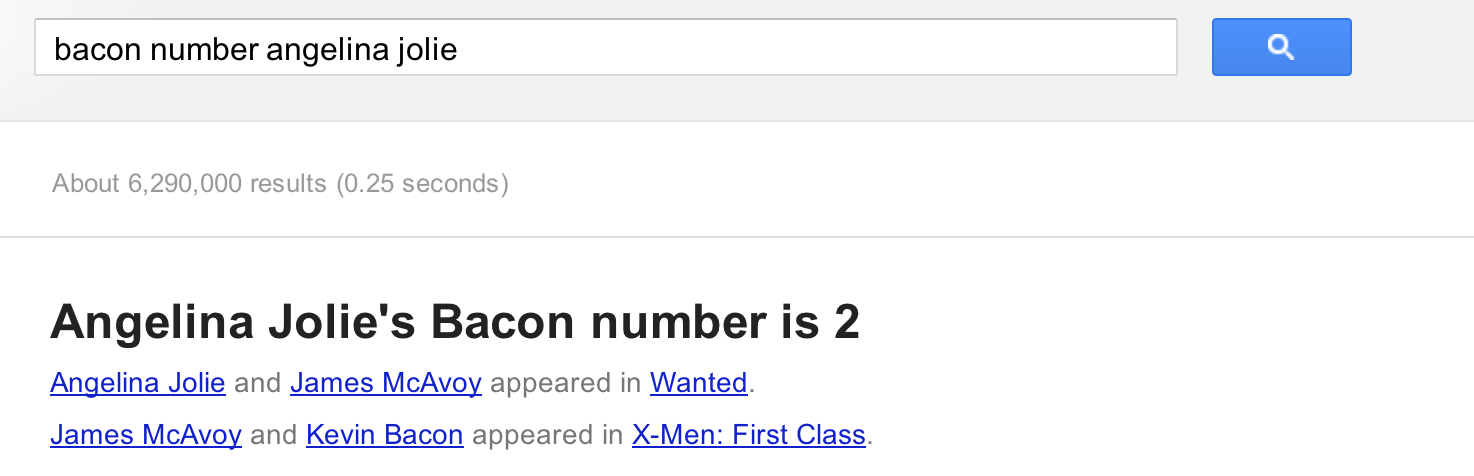
As pointed out by the TheNextWeb, Google appears to have recently added another easter egg to Search with a “Six Degrees of Kevin Bacon” tool. This adds to barrel roll, Zerg Rush, and a long list of other Google Search easter eggs we told you about, while Google also recently added some more useful tools such as a 34-button scientific calculator. To use the Kevin Bacon tool, you simply type “Bacon number” followed by the name of a celebrity. Wikipedia provided an explanation of the Six Degrees of Kevin Bacon if you are unfamiliar:


Expand
Expanding
Close

Google Maps updated with new Street View imagery to celebrate Space Day

Site default logo image

[youtube=http://www.youtube.com/watch?feature=player_embedded&v=H-rKcjAYDiI]

In celebration of “Space Day” in Japan, Google announced today that it is releasing new panoramic Street View imagery for the Japan Aerospace Exploration Agency and the National Museum of Emerging Science and Innovation (Miraikan).

The JAXA imagery allows you to walk through the Tanegashima Space Center (TNSC) down on the idyllic beach island of Tanegashima. TNSC is the site from which the Kounotori 3 rocket recently lifted off to send supplies (and the YouTube Space Lab winning experiments) to the International Space Station…In addition, today’s release also includes 360-degree views of the National Museum of Emerging Science and Innovation, known in Japan as the “Miraikan.” Now, you’re able to virtually walk inside the museum and see the famous “Geo Cosmos” hanging Earth model, as well as the other permanent exhibits like the model of the International Space Station.


Expand
Expanding
Close

A look behind the scenes at Google’s NYC offices

Site default logo image

[slideshow]

The images above are courtesy of Refinery29 who recently went behind the scenes to snap some photos at Google’s NYC offices. In the images, we see part of Google’s computer history museum, a Pac-Man arcade and Pac-Man themed kitchen, a replica B1 Battle Droid, and a lego version of the entire HQ sitting in another one of the building’s micro-kitchens. Head over to Refinery29 for another dozen photos of the offices. You might be somewhat familiar with the building already if you saw Eric Schmidt’s tour on CNN of the downtown Manhattan location. We also found out in May that Google will be lending a portion of the building to CornellNYC Tech for five years while it constructs its new engineering university campus.

Expand
Expanding
Close

Sony explains Xperia V’s sensor-on-lens touchscreen tech

Site default logo image

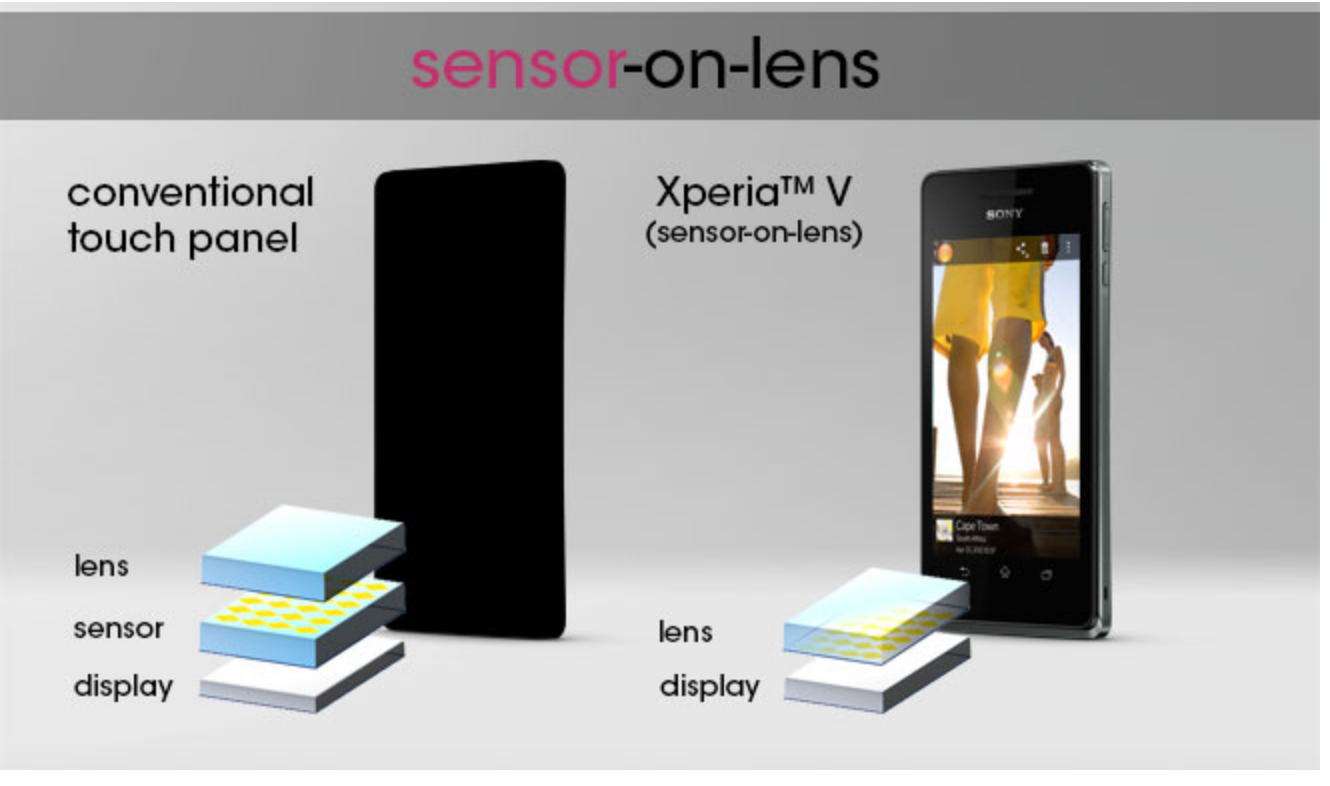
After announcing the new ICS-powered Xperia lineup last month, Sony shared some details today on the new sensor-on-lens touch screen tech being built into the Xperia V. Sony described the tech as providing the same benefits to smartphones as in-cell and on-cell touch technology, which Apple is rumored to be including in the next-generation iPhone. In a blog post on the Sony Mobile Developer blog, the company explained exactly how the sensor-on-lens technology works and some of the benefits it provides to the Xperia V. Some of those benefits include better image quality, less haze, 5 percent better display luminance, and a lighter and thinner device due to an extra layer of glass being removed:

Sensor-on-lens touch technology means that the number of physical layers in the touch panel (handset stackup) is reduced, as the sensor layer is actually part of the lens itself. This in turn means that you will get better image quality, as there is no interference from the touch sensor component.  There is one less layer of glass and one less layer of glue, compared to conventional touch panels… This technology also moves the image plane closer to you as a user, which makes it feel like you are actually touching the image itself. With this direct touch experience, you will get less parallax issues compared to a conventional touch panel, as the image and the point of touch are closer together in the sensor-on-lens touch screen technology.


Expand
Expanding
Close

Google Apps passes Lotus and GroupWise in market penetration down under

Site default logo image

[tweet http://twitter.com/aksingh77/status/245572583301455874]

As pointed out by Google’s Vice President of Enterprise, Amit Singh, Australian publication Delimiter reported on a study from analyst firm Telsyte that revealed Google Apps is now second to Microsoft Outlook and Exchange in the country. The news means Google officially passed both IBM’s Lotus Notes/Domino and the GroupWise platform from Novell, which battled for second and third place behind Microsoft up until now:

Yesterday, Telsyte revealed how far the pair have fallen, with new research from the analyst firm placing Google Apps — which only launched in 2006 — ahead of Lotus and Groupwise in terms of Australian market penetration… According to a statement released by the company, it conducted a survey of more than 330 local chief information officers and senior IT decision-markers on their enterprise software use and intentions…“The search engine giant’s Apps suite is now second only to Microsoft’s Exchange for enterprise market penetration in Australia and is ahead of more established products like Novell’s GroupWise and IBM’s Lotus Notes,

Google begins blocking The Pirate Bay from Google Instant and Autocomplete

Site default logo image

Following its decision in January of last year to begin censoring search terms related to piracy and torrent sites, TorrentFreak reports today that Google is now censoring The Pirate Bay and searches related to the popular torrent tracker. While you can still access the site through Google, like other torrent related searches, Google is now blocking The Pirate Bay in its apps that utilize autocomplete and Google Instant.

Google has quietly expanded its list of censored search phrases with the addition of The Pirate Bay’s domain names. The blacklist prevents popular keywords from appearing in Google’s Instant and Autocomplete search services, while the pages themselves remain indexed… By censoring parts of their search services, Google is sending out a strong signal that they are committed to combating online copyright infringement, and to a certain degree their efforts are effective.

Pirate Bay responded to TorrentFreak about the decision the block that kicked in sometime last month:

Expand
Expanding
Close

Google Glass makes an appearance on the runway at New York Fashion Week (as expected)

Site default logo image

We told you the other day that Google’s Project Glass was teaming with Diane von Furstenberg at New York Fashion Week for a video project documenting the creative process of a fashion show. We also noted it wouldn’t be surprising to perhaps see Google Glass headsets on some models during the fashion shows. As expected, the above images show Google’s Sergey Brin walking with Diane von Furstenberg down the runway wearing a few new colors of the Google glasses. You will also notice many of the models during the show were also wearing the headsets and the images were taken by Google Glass for the DVF video project.

Toys ‘R Us announces $150, Android 4.0-powered ‘Tabeo’ tablet, goes on sale Oct. 21

Site default logo image

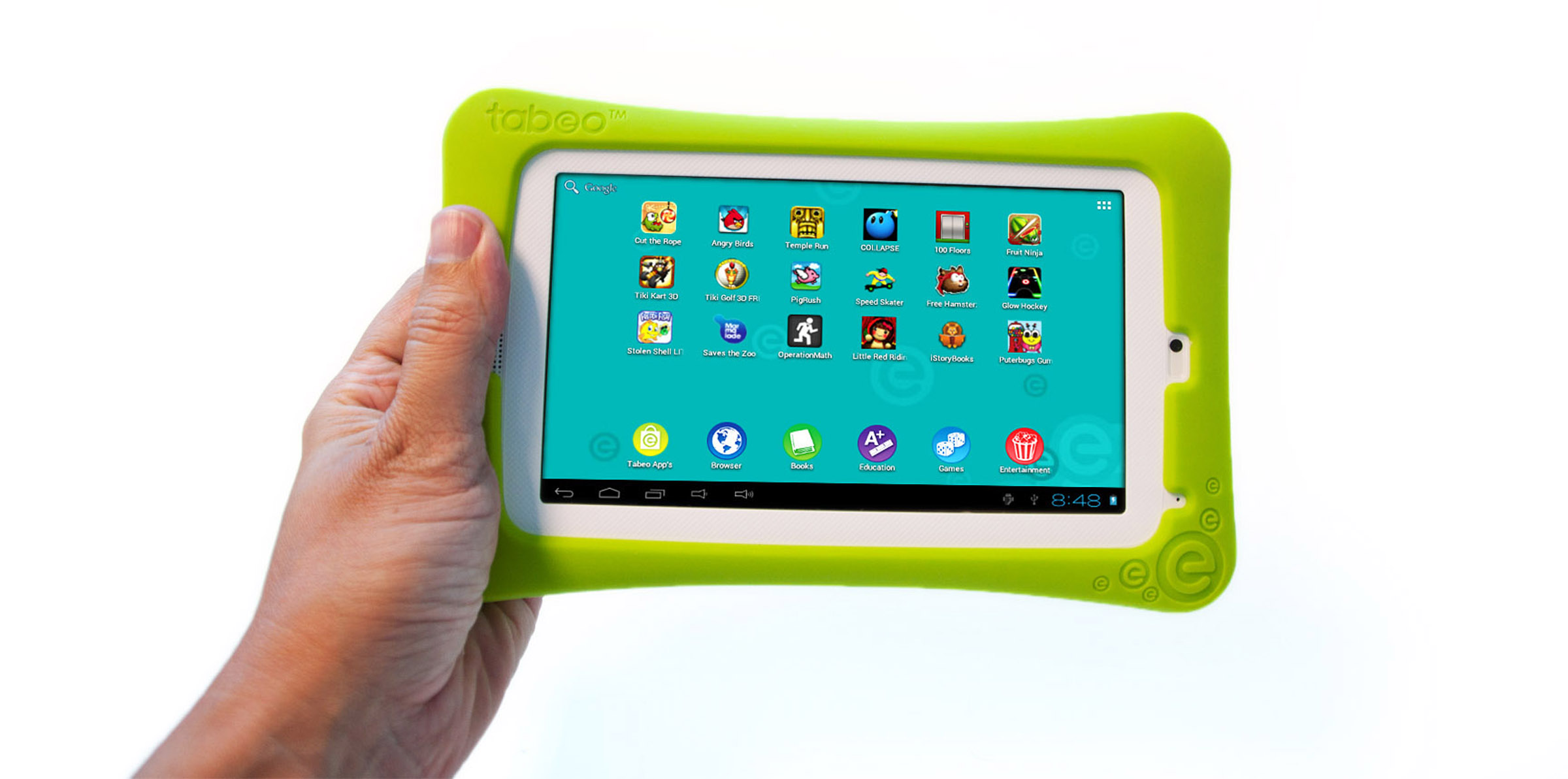
Not content with letting Amazon dominate the $200 tablet category, The Wall Street Journal reported that Toys ‘R Us announced it would soon sell its own Android-powered tablet geared specifically towards children. The $150 “Tabeo” will start hitting the company’s retail stores Oct. 21 with preorders already being accepted through Toysrus.com. The report noted Toys ‘R Us, which is in its second year of profit declines, already has competition in the tablets for children market. Some of the leading kids’ tablets, such as Kurio 7, Meep and Lexibook, have each recently been discounted to $150 to match the price of the upcoming Toys ‘R Us Tabeo. It appears Toys ‘R Us plans to sell a tablet closer to the Kindle Fire than the LeapPad, equipped with well-known, preloaded apps and a marketplace with over 7000 apps, but that device was also just recently dropped to $169 during Amazon’s unveiling of the new Kindle lineup:

The Toys “R” Us tablet, which uses Google Inc.’s Android mobile operating system, more closely resembles an adult tablet; it comes loaded with 50 free game applications, including popular titles such as “Angry Birds,” and the retailer has developed its own app store with 7,000 titles… Focus groups of parents and children prompted the company to include features that allow parents to control what websites their children visit and how much time they spend playing with the tablet.

The device will pack 4GB of flash memory (expandable via microSD), 1GB of RAM, a 1GHz ARM Cortex A8 processor, and run Android 4.0 Ice Cream Sandwich. Also included: USB 2.0, Mini HDMI out, a built-in speaker, microphone, G-sensor, and front-facing camera. Toys ‘R Us said the display is a 7-inch capacitive, TFT LCD with 16 million colors and a resolution of 800-by-480. Battery life: 10 hours in normal usage, 6- to- 7 hours of video. Parental controls include filters to “block 27 predetermined categories of content, and parents can choose additional sites to block and can select specific online content to unblock.”

There is, however, substantial risk for Toys ‘R Us if the tablets do not sell:

Expand
Expanding
Close

Site default logo image

Google Apps Vault now available to new customers directly from Control Panel

[youtube=http://www.youtube.com/watch?feature=player_embedded&v=wZd_hIln1-I]

Google officially rolled out a new service to Apps customers in March, called “Google Vault“, that helps users securely preserve and manage important data. The service has since launched to new and recent customers, and Google announced today that Vault is being made accessible directly from the Google Apps Control Panel:

Starting today, Apps customers can purchase Google Apps Vault online directly from the Control Panel…Google Apps Vault can be added to your Google Apps account for an additional $5 per user per month… Google Apps Vault is available for new and recent Google Apps for Business and Education customers. We’re working to enable Vault for existing customers, and we’ll announce availability when it is ready.

Google acquires online virus scanning service VirusTotal

Site default logo image

According to a statement from VirusTotal (via TNW), a free online virus scanning service, its long-time partner Google has acquired the service. There is no specific word on how Google might take advantage of the company to improve security offerings across its products, but VirusTotal confirmed it will continue to “operate independently, maintaining our partnerships with other antivirus companies and security experts”:

Our goal is simple: to help keep you safe on the web. And we’ve worked hard to ensure that the services we offer continually improve. But as a small, resource-constrained company, that can sometimes be challenging. So we’re delighted that Google, a long-time partner, has acquired VirusTotal. This is great news for you, and bad news for malware generators, because:

  • The quality and power of our malware research tools will keep improving, most likely faster; and
  • Google’s infrastructure will ensure that our tools are always ready, right when you need them.

A look at how Google builds accurate maps with ‘Ground Truth’ data

Site default logo image

Google’s map offerings build in the human intelligence on the front end, and that’s what allows its computers to tell you the best route from San Francisco to Boston.

In an exclusive story by the Senior Editor at The Atlantic, Alexis C. Madrigal, Google for the first time gives us a look at “Ground Truth”. It is a project described by Madrigal as a secretive, complex internal map that contains data, such as “no-left-turns and freeway on-ramps, speed limits and traffic conditions,” necessary to help users navigate through Google Maps:

I was slated to meet with Gupta and the engineering ringleader on his team, former NASA engineer Michael Weiss-Malik, who’d spent his 20 percent time working on Google Mars, and Nick Volmar, an “operator” who actually massages map data. 

“So you want to make a map,” Weiss-Malik tells me as we sit down in front of a massive monitor. “There are a couple of steps. You acquire data through partners. You do a bunch of engineering on that data to get it into the right format and conflate it with other sources of data, and then you do a bunch of operations, which is what this tool is about, to hand massage the data. And out the other end pops something that is higher quality than the sum of its parts.”

Describing Ground Truth to be an elaborate internal Map Maker of sorts, perhaps the most interesting aspect of the story is just how much human input goes into making the Google Maps experience accurate. In the story, Madrigal noted the Ground Truth Geo team aims to address most of the fixable problems reported by users (thousands daily) within minutes:
Expand
Expanding
Close

Amazon drops price of Kindle Fire to $159 adds $199 and $299 HD models in 7 and 8.9-inch varieties (and $499 LTE)

Site default logo image

[youtube=http://www.youtube.com/watch?v=jrgO8Zseh6E&feature=youtu.be]

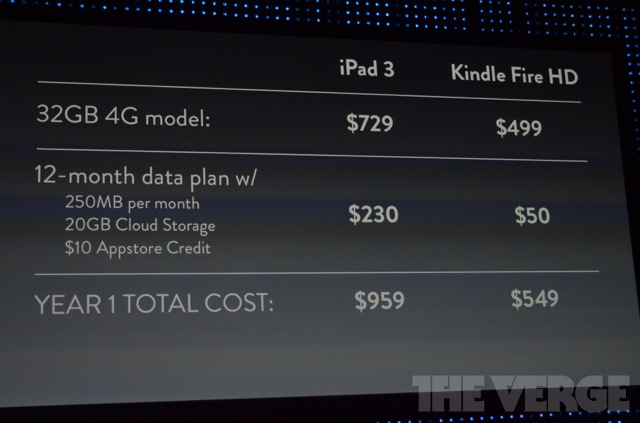
Live from Amazon’s Kindle event; the company just unveiled a refreshed Kindle Fire lineup dubbed the “Kindle Fire HD”. A few of the highlights: the device now comes in an 8.9-inch 1,920-by-1,200-pixel variant (in addition to a new 7-inch 1,280-by-800-pixel HD model) with 254 ppi, double the RAM of previous models, longer battery life, and a laminated touch sensor that reduces screen glare by up to 25 percent. The 8.9-inch Fire HD is set to ship Nov. 20 for $299, while a 7-inch Fire HD will cost you $199 when it ships Sept. 14.

Amazon also announced a 32GB 4G LTE model will ship Nov. 20 for $499 with LTE packages starting at $50 per year:

A few other notable specs for the new Fire HD line:

Expand
Expanding
Close

Site default logo image

Samsung Galaxy Player on Jimmy Kimmel Live [Video]

[youtube=http://www.youtube.com/watch?v=YLFMTLSKI-4&feature=youtu.be]

A frustrated Guillermo from Jimmy Kimmel Live is saved when the FUNcruiser surprises him with a Galaxy Player that brings the fun wherever it goes.

[tweet http://twitter.com/Samsungtweets/status/243725249034735616]

South Korean regulators investigating Samsung monopoly concerns following antitrust complaints from Apple

Site default logo image

According to a report from Reuters, South Korean regulators, the Korea Fair Trade Commission, are investigating Samsung regarding complaints from Apple that the company is “abusing its dominant position in wireless technology.” The issue at hand is whether Samsung is using its monopoly in the tech industry to demand higher licensing fees from Apple.

The FTC is investigating whether Samsung is unfairly competing in the market by abusing its dominance in wireless technology patents. Apple filed its complaints earlier this year, said an FTC official, who is not authorized to talk to the media…European Union regulators have also been investigating Samsung for possible breaches of antitrust rules by accusing rivals of infringing its technology patents.


Expand
Expanding
Close

Samsung says Galaxy S III hits 20M sold in just 100 days after launch

Site default logo image

After the company’s mobile division head, JK Shin, said it expected sales of 10 million Galaxy S IIIs during July, it is perhaps not too much of a surprise that the company has now confirmed sales of 20 million units in just 100 days following the device’s launch. That’s roughly 200,000 units a day. To put it in perspective, the S III is selling about three times as fast as the Galaxy S II, which we found we heard in February took about 10 months after its release to hit the 20 million-unit mark.

Samsung also broke down the sales by region: 4 million units for North America; 6 million in Europe; 4.5 million in Asia; and 2.5 million at home in Korea. In just over three months, the S III has almost reached the S II’s 28 million units sold to date. Samsung also announced a few new colors for the device including Amber Brown, Garnet Red, Sapphire Black and Titanium Gray:
Expand
Expanding
Close