TmoNews discovered a T-Mobile-branded Samsung Galaxy Note, and then posted an entire gallery of pictures (above). There are no confirmed details on pricing or a release date as of this time. However, keep checking 9to5Google for more.
According to a report from Bloomberg, U.S. International Trade Commission Judge Thomas Pender has ruled in favor (PDF) of Motorola and claimed Apple’s devices infringe on one Android-related patent owned by the company. The ruling is only a partial victory for Motorola’s attempt to receive an injunction on iPhones and iPads, because the judge’s decision will still have to be reviewed before import blocks can be achieved:
ITC Judge Thomas Pender said Apple violated one of four Motorola Mobility patent rights. The patent relates to Wi-Fi technology. The judge’s findings are subject to review by the six-member commission, which has the power to block imports that infringe U.S. patents.
As for the Wi-Fi patent in question (# 6,246,697), Apple spokesperson Kristin Huguet told AllThingsD that Motorola refused to license its industry-standard technology on “reasonable terms”: Expand Expanding Close
As of the latest research from Nielsen, we know the United States smartphone market has quickly become an iOS/Android duopoly with 90 percent of devices on either one of those platforms. While smartphone usage in Japan is still at 1-in-5 mobile phone owners, new numbers from comScore today show Japan’s smartphone market is also quickly becoming dominated by Apple and Google. To be specific, 95.6-percent of smartphones in the country are Android or iPhone, and Apple has outgrown Google in the last three months while Android’s share remains steady.
Google spent $5.03 million lobbying in Washington last quarter.
According to the company’s lobbying report (PDF), the search engine’s lobbying efforts focused on the regulation of Web-based privacy, advertising, and competition, including International tax reform.
CNET’sLance Whitney explained that Google only spent $3.76 million lobbying in Q4 2011 and $1.48 million Q1 2011, but attributed the recent surge in expenses mainly to one Congressional bill:
The search giant devoted lobby dollars to H.R. 1389 – Global Online Freedom Act of 2011, a Congressional bill designed to prevent U.S. companies from cooperating with repressive foreign governments in using the Internet for censorship and surveillance. Google has of course squared off in the past with China over the censorship of its search results.
The company lobbied for H.Con.Res. 114, a bill ‘expressing the sense of Congress that the United States should preserve, enhance, and increase access to an open, global Internet.’
It is worth noting that Apple only spent $500,000 lobbying last quarter.
Reuters reported that a judge rejected Google and Apple’s bid last night to have an antitrust lawsuit dismissed. The lawsuit claimed the companies illegally entered “no-poach” agreements in an effort to stop competitors from stealing talent:
District Judge Lucy Koh in San Jose, California, rejected the companies’ bid to dismiss claims brought under the Sherman Act and California state law, in a decision released Wednesday night. […] The proposed class action lawsuit was brought by five software engineers, who accused the companies of conspiring to depress employee pay by eliminating competition for skilled labor.
Other defendants in the case included Intel, Adobe Systems, Intuit Walt Disney Co’s Pixar, and Lucasfilm.
Badoo is a social discovery website founded in 2006 that is managed out of SoHo, London and quickly reaching its 148 million user, but today it announced a very pivotal hire.
Google’s Product Management Director of Search Products and Local Business Products Benjamin Ling is leaving the search engine to become Badoo’sChief Operating Officer. He will help Badoo expand across mobile and Web platforms, which is essential since the website is widely revered as one of Europe’s leading Internet firms.
“One of the things that attracted me to Badoo is its mainstream appeal. Badoo is putting the ‘social’ back into social networking, and it’s doing it on a massive scale. To me, that’s a thrilling opportunity,” announced Ling.
Ling’s new gig starts May 2012 in London, where he will oversee corporate matters, product, business operations, engineering, and partnerships.
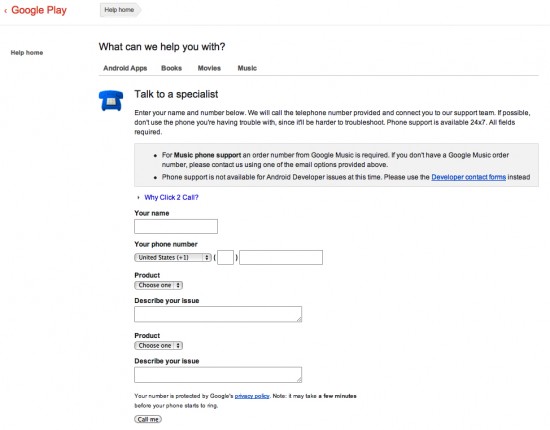
Google offers a variety of services, but its technical support is—well—lacking.
Until now, that is. The ever-popular search engine just debuted 24/7 technical support for Google Play users only. The most interesting part is that Google will now call you to provide answers. That’s right, no more are the days of automated support lines and endless waiting. Just fill out a form on the website, submit the form, and then wait for the phone to ring.
Unfortunately, Android devs are out of luck. They need to use ‘ole Help Center if questions should arise.
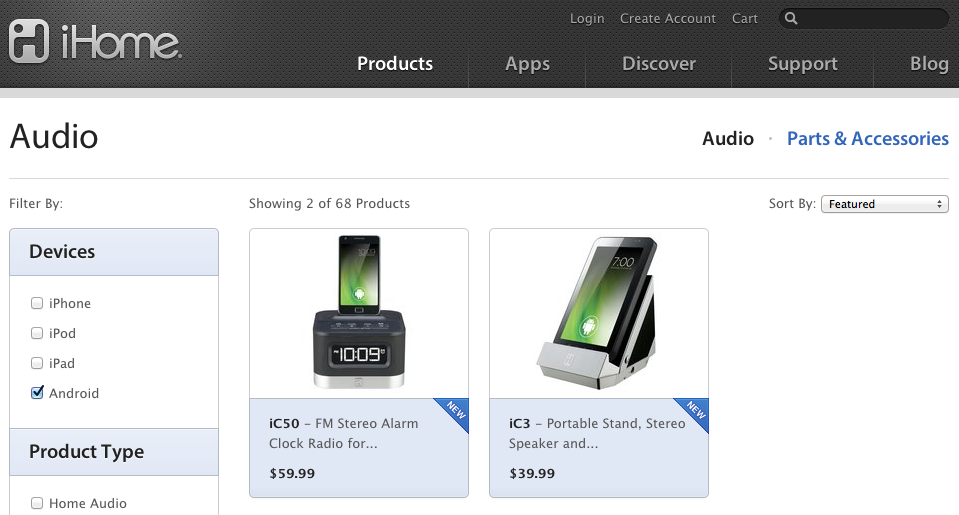
“The size of the worldwide Android audience and lack of current speaker options gives us a significant opportunity to introduce our products to a new group of consumers,” announced iHome’s Director of Marketing Evan Stein in a press release. “Our new SmartDesign products maintain the high quality and innovation that is synonymous with iHome.”
First up is the iC50 for Android smartphones. It is a $59.99 alarm/radio clock with a microUSB charging cable, stereo audio cable, and 3.5 mm plug:
Wake and sleep to radio (you can also wake to tone). Reson8® speaker chambers and EXB bass enhancement provide great sound that’s perfect for your music, games or apps. Works with iHome Sleep app (free download) to wake and sleep to your favorite music and advanced custom alarms. SmartSlide™ dock with custom micro USB cable for smartphone charging regardless of its charging port location/orientation. Also enjoy FM radio with digital tuning. A microUSB charging cable and stereo audio cable with 3.5 mm plug are included.
A recent interview with Google’s cofounder Sergey Brin received a lot of attention due to his view that Apple and Facebook are the biggest threats to the open Internet. While Brin still recommends reading the full article here, he posted a note on his Google+ account today to clarify some thoughts that he felt were “particularly distorted in the secondary coverage” of the interview.
In the post, Brin clarifies that on the issue of app ecosystems, which are not as open as the rest of the Web, he does not think the “issue is on a par with government based censorship.” He also took time to clarify his view of Apple and Facebook, noting he has “always admired Apple’s products,” especially while using an iMac to type his post. He also called Facebook “a key tool for political expression.” Brin’s full post is below: Expand Expanding Close
According to a report fromFoss Patents (and confirmed byReuters), Apple Chief Executive Officer Tim Cook and Samsung Chief Executive Officer Gee-Sung Choi will meet within the next 90 days for settlement talks over ongoing patent disputes. Judge Lucy Koh, who is presiding over the two cases in California, initiated the meeting after ordering the companies to submit their CEOs and legal counsels to an Alternative Dispute Resolution.
“As directed by the Court, Apple and Samsung are both willing to participate in a Magistrate Judge Settlement Conference with Judge Spero as mediator. At Apple, the chief executive officer and general counsel are the appropriate decision-makers, and they will represent Apple during the upcoming settlement discussions. At Samsung, the chief executive officer and general counsel are also the appropriate decision-makers, and they will represent Samsung during these settlement discussions.”
The report called the talks “semi-voluntary,” because the companies did not have to submit to the Alternative Dispute Resolution. However, as pointed out by Foss Patents, “if only one of them had made the CEO available, the other one would have appeared to be less than constructive.” Apple and Samsung executives will meet in San Francisco with U.S. Magistrate Judge Joseph C. Spero sometime over the next three months: Expand Expanding Close
While Greenpeace’s “How Clean is Your Cloud” report had not so great things to say about Apple, Amazon, and Microsoft’s use of coal energy in their data centers, Google was praised for its “comprehensive energy reduction plan”. The organization is urging consumers to contact the companies to convince them to change their approach to powering the cloud and read the 50-page report to learn more.
“Google has been the most open in the industry about the importance of increasing not only energy efficiency within the sector, but also the need to move our energy sources to renewable energy… Google has a comprehensive energy reduction plan that has resulted in its data centers using half the energy of the industry standard… Google’s commitment to using renewable energy as much as possible has set the bar for the industry.”
Photographer Scott Kelby is gathering 15 world-renowned photographers together for an unofficial Google+ Photographer’s Conference.
“On May 22-23, fifteen of the biggest photographers, instructors, and social media magnates on Google+ are gathering in San Francisco for the first-ever Google+ Photographer’s Conference at the Yerba Buena Center for the Arts (in San Francisco), “announced the Google+ Photographer’s Conference page.
The official Google+ page later reposted the conference’s announcement, but the social network clarified: “This is not an official Google event, but we are excited to see this launch! Hope you can attend.”
HTC released unaudited Q1 2012 sales figures today, and the painful results show the Taiwanese manufacturer is floundering due to heavy competition.
First-quarter revenues pulled $2.3 billion USD, which is a 35-percent drop year-over-year (PDF), while net profit plummeted 70 percent to roughly $148 million USD.
“We simply dropped the ball on products in the fourth quarter,” said Yung said during the Feb. 6 conference call, while noting the Rezound and Vivid handsets did not meet the company’s expectations.
Ahead of its full quarterly report scheduled for April 27, Samsung Electronics today estimated its operating profits for the three-month period that ended in March. Estimated at 5.8 trillion won or $5.15 billion USD, that is nearly double the company’s results from the same quarter a year ago and up from the roughly 5 trillion won originally forecasted by analysts. While attributing the strong quarter to the Galaxy Note, the report fromReuters noted Samsung is “set to consolidate its market position with new products” over the next few months, including a “revamped Galaxy S” that will compete with Apple’s next iPhone: Expand Expanding Close
Google’s dominance in mobile advertising and Apple’s growing iAd platform on iOS convinced Samsung to launch its own rival advertising platform called “Samsung AdHub Market.” The Wall Street Journalreported the company officially announced the platform on Tuesday, which uses technology from OpenX Technologies Inc. According to the report, the company will allow advertisers to buy space within apps through developers and Samsung. The ads are expected to appear on Samsung phones and tablets sometime in last half of the year.
Samsung said Tuesday it’s adding a mobile phone advertising exchange platform using technology from closely held U.S. firm OpenX Technologies Inc…The platform, called Samsung AdHub Market, will enable advertisers to place targeted messages within apps on Samsung phones and tablets… The move is part of Samsung’s broader push to bring targeted advertising to electronic devices including Internet-connected televisions. It will also pit the company against other mobile-ad services from Apple, Google and Millennial Media Inc., which held an initial public offering last week.
Following Nielsen’s latest survey that showed over 90 percent of United States smartphone buyers are choosing iOS or Android, research firm comScore today released its data of the top smartphone platforms and OEMs in the U.S. The survey included more than 30,000 people over a three-month period ending February 2012. It found Android was up 17 percentage points from a year ago with 50.1-percent of the U.S. smartphone market. In comparison, Apple’s 30.2-percent accounted for an increase of 5 percentage points from the same period a year ago.
According to comScore, Google passed the 50 percent milestone for the first time during February 2012. The numbers represent a 3.2-percentage point increase over previous three-month period for Google, and a 1.5-percentage point increase for Apple.
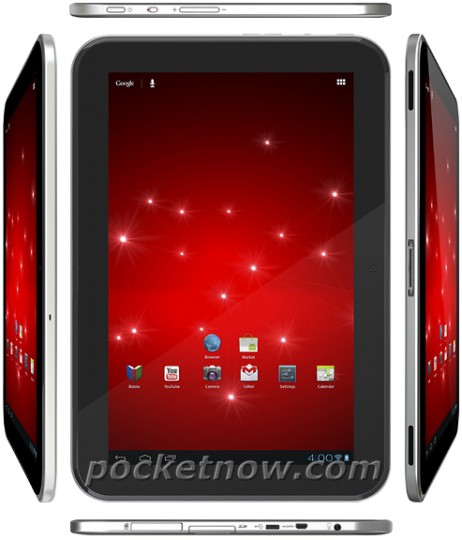
The Android rumor mill is quick to debate the authenticity of recently surfaced image leaks (above) that have an albeit-slim “Nexus Tablet” association.
The Android Community(via PocketNow) dissected the rendering and concluded the tablet boasts standard buttons and Ice Cream Sandwich-specific apps on the display, which means the leak is a potential Nexus Tablet rendering.
Reports fail to mention, however, that the slate in question looks uncannily similar to a first-generation Apple iPad (right). With that said, the image leak could easily be fabricated with a few spare Android tablet shots and a copy of Photoshop. Oh, and PocketNow’s absent source attribution begs the question of legitimacy.
RadioShack’s “Trade & Save” app is now on Google Play and helps a user determine an old Android device’s worth for optimum trade-in value.
The app will also offer to buy the device, while providing the free prepaid shipping label, in exchange for a RadioShack gift card for use in-store or online. The gift card is sent by mail.
Samsung is making headlines this quarter with show-stopping commercials that critics claim vastly surpass all of Apple’s advert offerings.
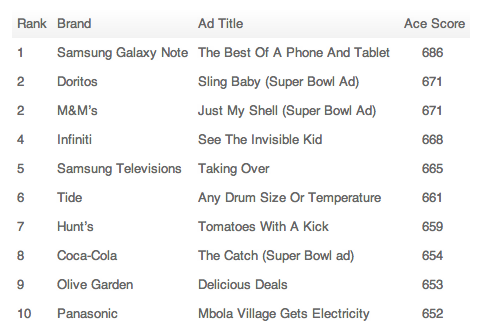
Television analytics firm Ace Metrix dubbed the Galaxy Note’s “The Best of a Phone and Tablet” commercial by Samsung (above) as the “Most Effective Ad” in Q1 2012.
“Q1 is arguably the most important quarter for advertising, as the Super Bowl, Oscars, and awards season in general drives the advertising agenda,” said Ace Metrix Chief Executive Officer Peter Daboll in a press release. “[…] Samsung’s top-ranked ad was particularly brilliant because it conveyed innovation and information without a narrator.”
The Android-based device’s ad garnered a 686-point score, which gave Samsung the No. 1 spot on the Top 10 Most Effective Ads list. Samsung released nine ads in Q1, and three were heralded as the most effective technology ads for the quarter, earning between 686 and 636 points each.
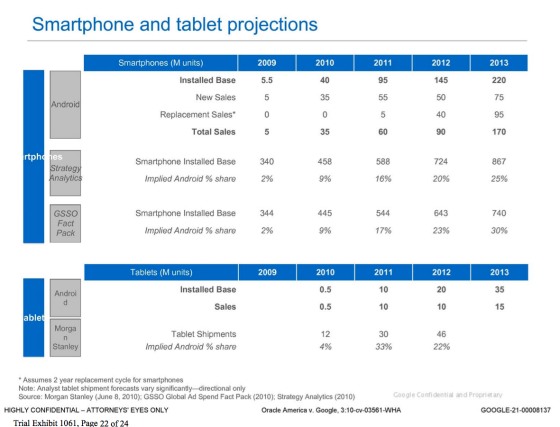
Google made less than $550 million in revenues for Android between 2008 and 2011, while making four times as much revenue during the same period with Apple products that employ Google services like Search and Maps.
According to The Guardian, the settlement offer provided yesterday by Google to Oracle depicted Android’s revenue streams. Settlement discussions ordered by Judge William Alsup were derailed when Oracle rejected Google’s low offer to pay royalties on Android if alleged patent infringements deem true in court.
Today, Google Enterprise announced a new offering designed to aid Apps customers in managing information and preserving important data. “Vault” is aimed at easing document and email management as it relates to corporate litigation, regulatory investigation and compliance actions.
Businesses of all sizes need to be prepared for the unexpected. In today’s environment, using Vault to manage, archive and preserve your data can help protect your business. Litigation costs can really take a toll on a business when minor lawsuits can run up to many thousands of dollars, and larger lawsuits can cost even more. Significant litigation costs come from having to search and find relevant data, which is also known as electronic discovery (eDiscovery).
The tool costs $5/user/year and will knock down some walls of companies who would not have been able to get Google Apps if it were not for this tool. Expand Expanding Close
Reports surfaced in China that claim Apple plans to integrate Baidu into iOS next month as the country’s possible default search function—suggesting iOS aims to become less dependent on Google’s services.
Sina Technology News on March 26 morning news, according to informed sources, Apple iOS operating system next month will be formally introduced Baidu search, Baidu and Apple between cooperation component in the China region.
Google’s Susan Creighton revealed last fall that two-thirds of the Mountain View, Calif.-based Company’s mobile search comes from Apple iOS devices.
Meanwhile, recent speculation claims Apple is moving to an in-house Mapping solution that would replace Google Maps. The firm also recently removed its publish to YouTube option in QuickTime for Mountain lion. If these latest rumors deem true, Apple’s move to Baidu would further indicate a significant effort to reduce Google’s presence in iOS.
China now holds the No. 1 spot for Android and iOS activations.
Mobile analytics firm Flurry released new data that depicted the Chinese market skyrocketing from No. 11 in 2011 to No. 1 for smartphone activation, thereby bumping the United States to No. 2.
The statistics are staggering: China accounted for 8 percent of Android and iOS activations in January 2011, while the United States held a big slice of the pie with 28 percent. The tables have turned, however, as China passed the U.S. and now boasts 24 percent of activations by March 2012 (end-of-the month projections included). Meanwhile, the United States slipped to 21 percent.
Google is reinventing its Web-search technique with direct information for queries to better maintain the majority market share.
The Wall Street Journalsaid Google aims to replace some Web links with summarized answers and facts. The search formula transition will roll out over the next few months as the search engine begins to merge relevant results with semantic search, which attempts to understand the meaning of words versus keyword identification. One source said the change could influence 10 percent to 20 percent of all search queries.
Under the new strategy, a search for “Mount Everest” will display key attributes, such as the mountain’s location, altitude, or geographical history, aggregated from Google-indexed websites. Longer queries might uncover a real answer instead of links to websites. For example, the question “What are the 10 largest mountains in the United States?” would subsequently reveal a list of mountains and not ambiguous links to various state parks or hikers’ fan pages.
Google’s top executive Amit Singhal told WSJ that the new search results are the product of hundreds of millions of “entities” stored in a database. The company’s Metaweb team of 50 engineers painstakingly gathered particulars on people, places, and things over the last two years to build an immense collection for associating different words through semantic search.