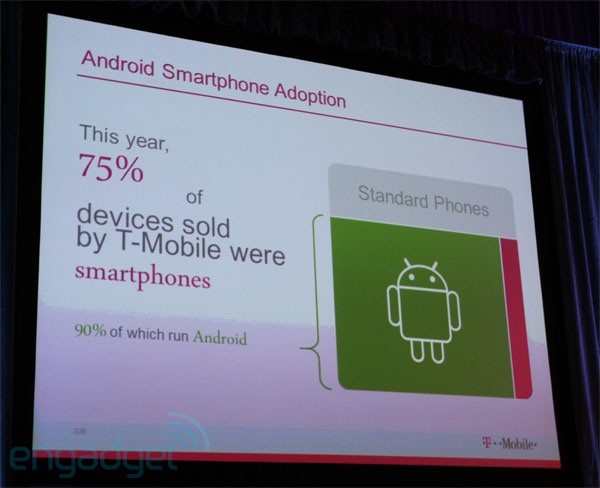
T-Mobile’s network is 75% smartphones and 90% of those are Android. That means more than 2/3rds of the devices sold by T-Mobile are Android. That is a big number. Remember T-Mobile has a million iPhones on its network but those weren’t sold by T-Mobile.
It’s litigation day as Apple and Samsung battle it out in courts the world over. In a two-day hearing which began this morning in Australia a judge asked for more time to study Apple’s claims, resulting in a brief Galaxy Tab 10.1 launch delay until the end of the month. Meanwhile, the first round of hearings is underway in The Hague over Samsung’s accusations that Apple’s iPad and iPhone infringe on Samsung’s wireless patents. The Korean company is seeking a ban on those products in The Netherlands.
Apple is represented by Rutger Kleemans (Freshfields) while Samsung’s legal counsels are headed by Bas Berghuis (Simmons & Simmons). Per information sourced from Webwerld editor Andreas Udo de Haes on Twitter and this Nu.nlreport, Apple says Samsung is seeking a 2.4 percent charge of chip price for every patent. Apple has called those demands “simply excessive”. Sounds to us like Apple might have awoken the beast. Apple says because the two parties are still negotiating a licensing agreement of sorts, granting an injunction would be premature.
The Mac maker’s legal sharks stress Apple is buying its components from Intel and Infineon, hence no need for royalties to Samsung. Interestingly, Apple’s lawyers also explicitly stated that iOS devices sold in Europe do not use Qualcomm silicon found in CDMA versions of iPad and iPhone. Apple also said Samsung changed the license to Qualcomm to exclude Apple. In a nutshell, Apple’s argument is that Samsung’s technology and patents are already incorporated in Intel’s chipsets.
Samsung obviously disagrees and argues Apple has more than ten component suppliers and is obscuring them purposefully in order to make determining which components infringe on Samsung’s patents that much harder. Apple launched the iPhone in Holland back in 2008 without securing the necessary licenses, the lawyers for Samsung said. Apple denied Samsung’s claims and said Samsung, its parts supplier, wouldn’t demand a license until 2010 because Apple was an important customer. According to this Guardianarticle, the Apple account is worth fourth percent of Samsung’s total business…
Apple in August secured a temporary ban on Samsung’s planned Galaxy Tab 10.1 release in Australia. Today is the first day of a two-day hearing over the matter and Federal Court Justice Annabelle Bennett said she needed more time to dive into Apple’s claims before she ruled on Apple’s request for an injunction.
Bennet observed that “technology moves very quickly”, adding that “it would be in both sides’ interest to have this matter finalized quickly”. The development could further push the launch of the Galaxy Tab 10.1 in the country. Per Bloomberg:
At today’s hearing, Apple focused on one alleged patent infringement, relating to the touch screen technology of the iPads. Samsung had agreed not to fight Apple’s claim that the Galaxy 10.1 uses zoom technology that infringes its patent.
Meanwhile, it’s business as usual for Apple’s fierce competitor from Korea, which counts the Mac maker as its biggest customer. Just as they announced channel shipments of ten million Galaxy S II smartphones worldwide (and expecting to ship as much tablets in 2011), Samsung in Korea took the wraps off the Galaxy S II HD LTE which features a native 720p display and fourth-generation LTE radio technology. Samsung also raised stakes in the legal spat with Apple by threatening to go after the yet unannounced iPhone 5 in both Korea and Europe as soon as Apple put the handset on sale. More importantly, the company has made an important ally in Verizon Wireless in the United States which voiced support for Samsung in the Apple case. Also… Expand Expanding Close
Bloombergreports that Samsung is expecting to sell 5 times as many tablets as it did in 2010.
The company is on track to raise sales of tablet computers by more than five times this year from 2010 as it planned, J.K. Shin, head of Samsung’s mobile-phone division, said at a media briefing in Seoul today.
Samsung said it had sold 2 million Galaxy Tabs (plus a marginal number of Windows 7 Tablets?) as of January 2011. It had given estimates as low as 1.5 million for the 4th quarter of 2010, the only quarter it sold tablets last year.
That means Samsung believes it can sell 7.5 million – 10 million tablets this year. Is that good news? Expand Expanding Close
If all of the rumors are true, Amazon has a 7-inch “media tablet” that runs a forked version of Android and will connect to all of Amazon’s services, including its Appstore, Movies, TV, Music and of course eBooks. It won’t be true multi-touch but the rumored price is half of the iPad’s (just like the screen) at $250. Who is making this for Amazon? Foxconn of course.
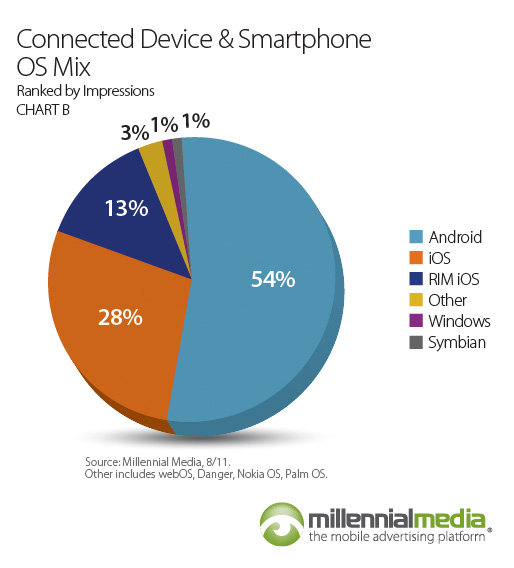
If Google and Apple were to merge, their respective Android and iOS mobile software would seize well over three-quarters of the world’s platform share in smartphones, per latest Millennial Media’s “Mobile Mix” mobile device usage share report. Separately, Android and iOS held 54 percent and 28 percent share in August. Millennial now includes data from smartphones, tablets, e-readers and gaming devices so direct comparison to their smartphone-focused July study is meaningless.
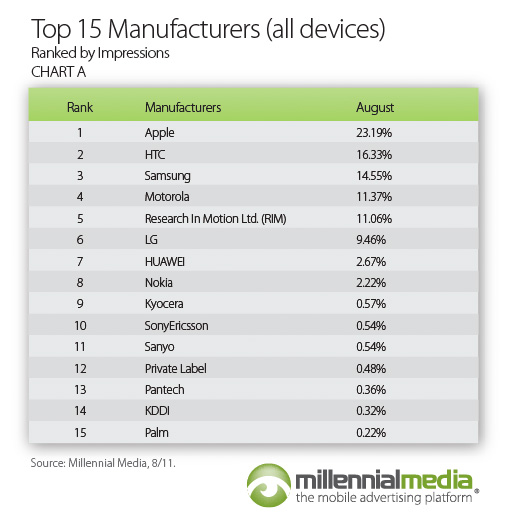
Apple continued to be the leading device manufacturer on our network in August, representing 23% of the Top 15 Manufacturers impression share (Chart A). Apple iPhone maintained the number one position on the Top 20 Mobile Phones ranking with 13% of the impression share.
Nearly one-third of devices on all carriers used wireless hot spots. Verizon Wireless and Sprint had 18 and 14 percent carrier mix, respectively, followed by T-Mobile USA and AT&T with eight percent each. Games, music and entertainment remain the most popular app categories. iOS represented 41 percent of the app platform mix and Android 49 percent. On Android, News apps rose by 26 percent month-over-month. Go past the fold for a bunch of pretty charts and more explanation.
Apple’s embattled iPhone has had tough time competing against the legions of Android handsets that have flooded the market. That shouldn’t come as a surprise: Carriers are promoting inexpensive Android devices left and right and they are literally everywhere. But how satisfied Android and iPhone users are with their handsets? According to a study of 515 smartphone owners conducted by USB Research (viaGigaOM), iPhone is “sticky” like no other phone, with an average retention rate of 89 percent.
It is falling rapidly for other vendors, though, and the next nearest hardware is HTC with a retention rate of 39 percent and 28 percent for Samsung. Android phones in general are at 55 percent. Nokia and Research in Motion are sinking really fast. The former saw its retention rate drop from 42 percent in March 2010 to just 24 percent and the latter dropped from 62 percent to 33 percent.
The survey may not be terribly accurate due to a small sample size, but it helps understand market trends. People are obviously happy with their iPhones and a large portion of users will happily stay within the Apple ecosystem. USB concludes:
Demand for iPhone, iPad and MacBook Pro remains robust, with a leading ecosystem that creates sticky demand.
Truth be told, Android’s low stickiness could be due to its users being more comfortable changing handset manufacturers. Another interesting nugget that bodes well for Apple: Nearly one-third (31 percent) of polled Android users have plans to switch to an iOS device in the future. Also important, more than half the smartphone switchers are in the market for an iPhone while only one in ten iPhone users plan on defecting to other platforms.
As part of the Senate Judiciary hearings today, former former FTC official (and new Google employee) Suzanne Michel, testified under oath today that Google, Microsoft and Yahoo all bid to become the default search engine on iOS’s Mobile Safari Web Browser. As we know, Google won, and as we can infer, Apple get’s some revenue from Google for making it its default search engine. As we know from Apple being Apple, the quality of the search results was probably as big a part of the decision as the relatively small bits of revenue.
But as part of the testimony, Michel said briefly (before she was cut off) that 2/3rds of mobile search comes from Apple iOS devices. That’s pretty interesting considering the share of Android devices in the market. But not altogether surprising considering the web browser market share which includes those millions and millions of iPads.
The Korea Timesreports that Samsung “is seeking a complete ban” on the iPhone 5 sales in Korea – even before the handset is even released, let alone officially announced. Local carriers KT and SK Telecom have so far sold about 3.1 million iPhones in the country. The paper quotes an unnamed Samsung senior executive:
Just after the arrival of the iPhone 5 here, Samsung plans to take Apple to court here for its violation of Samsung’s wireless technology related patents. For as long as Apple does not drop mobile telecommunications functions, it would be impossible for it to sell its i-branded products without using our patents. We will stick to a strong stance against Apple during the lingering legal fights.
Another Samsung executive is “quite confident” about “a big breakthrough” provided Samsung wins in Germany, adding that “so will other envisioned efforts against such products as the iPhone 5”. The report goes on to mention that iPhone sports an LG Display-made screen, LG Innotek’s eight-megapixel camera, Samsung-made NAND flash and A5 chip and an NFC chip for wireless payment.
The twist in this case, of course, is the fact that Apple is Samsung’s biggest customer, buying displays, NAND flash memory and custom-built A4 and A5 chips for its products. It has been reported that Samsung may soon lose its contract as Apple turns to rival TSMC.
The manufacturing relationship means Samsung gets information about the innards of Apple’s non-released devices months before the actual manufacturing ramp up. This early access to Apple’s designs could have led Samsung to move with the iPhone 5 ban in Korea ahead of Apple’s official launch. On the other hand, Apple did not accuse Samsung yet of abusing its manufacturing contract to rip off Apple’s upcoming devices with its own products.
According to Brand Finance, a London-based research firm, Apple is now second to Google in brand value after a 33% increase to overtake IBM, Microsoft, Wal-Mart, and GE for the first time. The firm attributes Apple’s success to “innovative design, loyal consumer base and well-executed marketing activities.”
Google, sitting in the top spot with a brand value of almost $48.3 billion was up 9% among the top 30 U.S. brands analyzed by the Brand Finance. Other top companies other than Apple and Google all seen a significant drop including Microsoft down 9% to $39 billion, and IBM and AT&T both experiencing decreases from the year previous. Expand Expanding Close
Android is the dominant smartphone platform pretty much everywhere, but nowhere is Google’s lead more evident than in Taiwan, the country traditionally on the bleeding edge of technology. According to the Asian trade publication DigiTimes which cited the latest data from IDC, the 990,00 smartphones accounted for half the 1.97 million cell phones shipped in Taiwan during the second quarter of this year.
Taiwan will probably become the first country where all phones will eventually become smartphones as shipments of feature phones dropped 17 percent sequentially and 32 percent annually: As for Android:
Android-based smartphones accounted for over 70% of all smartphones sold in Taiwan in the second quarter, followed by iOS and Symbian models, the data showed.
Mind you, this isn’t the Android-iOS monopoly any more, this is a Windows-type monopoly and it’s unfolding in Taiwan before our very eyes. Makes you wonder if that’s a sign of things to come elsewhere in the world. The gap between Android and iOS in Taiwan is unheard-of. And with just 30 percent of smartphones divided between iOS and Symbian, Apple’s platform is likely far behind Android in Taiwan. Of course…
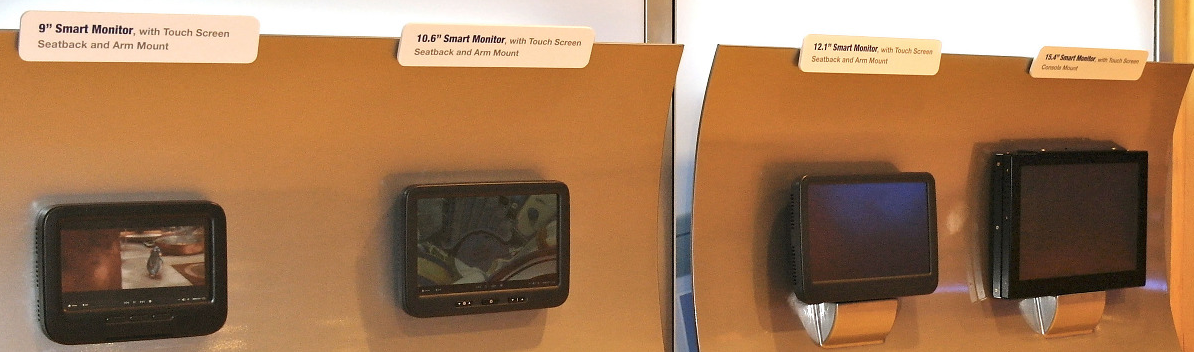
Australian Business Traveler is reporting that Boeing has selected Android as the exclusive operating system for the entertainment system in the new 787 Dreamline aircraft. Boeing will use Android to provide flyers with music, video, and airline specific apps that will be embedded through touchscreen panels on the back of the headrest, built by Panasonic.
First class and business seats will have non-touchscreen panels, because they will be much larger, but will feature hand-gesturing — which is a prototype as of now.
Luckily, the touchscreen panels in coach will have wider viewing angles and will be less reflective of light than airplane screens that you see today. Also capacitative sensors will replace resistive touch.
For those of you who use laptops on airplanes, you’ll be thrilled to know the 787s will include laptop power sockets and USB ports on the menu for economy seats. Chromebooks, anyone?
There have already been 820 orders of the new 787 Dreamline aircraft, so the number of people that will be open to Android will be significant.
This is a Samsung-branded Windows 8 tablet Microsoft is giving away to BUILD attendees today. Wanna take bets on possible actions from Apple? Go past the break for unboxing clips. Image courtesy of MobileTechWorld
The latest in the ongoing patent saga involving Apple, Google, Motorola and Samsung includes an unexpected twist as Samsung goes after iPhone and iPad with a complaint filed before a Paris district court in July. The filing alleges infringement of Samsung’s three technology patents, reportsAFP. The first hearing is expected in December of this year.
Meanwhile, patent expert Florian Müller notes on his blog FOSSPatents that Apple has filed motions to temporarily halt two Motorola lawsuits until Google completes its $12.5 billion acquisition, which shook the technology world last month. Put simply, Apple argues Motorola waived its rights to sue when it transferred patents to Google. Apple wrote:
To further its pending acquisition by Google, Motorola has surrendered critical rights in the patents-in-suit, such that Motorola no longer has prudential standing to pursue this action. According to the publicly-filed Merger Agreement, Motorola has ceded control of the most basic rights regarding the patents-in-suit
As you know, Google has transferred some of the Motorola patents to HTC, in addition to the ones acquired from Palm and Openwave Systems. HTC then used those patents to counter-sue Apple. Back to Apple vs. Samsung…
Financial Timestoday opined that Samsung needs to hit the reset button, predicting a licensing agreement of sorts provided Apple succeeds in blocking Galaxy products in the U.S. next month. Contrary to the reports, the publication thinks “Apple is restricted from taking its chip business to Samsung’s rivals in Taiwan because Samsung offers a complete package of components that other firms cannot match”. However, there are indications that Apple’s been lowering Samsung orders for some time and it’s widely believed the company is eager to take its silicon business to TSMC beginning next year.
Chrome and Android, the two crucial weapons in Google’s assault on mobile and desktop, are showing no signs of stopping. We already reported today that Android passed iOS globally. When it comes to browsing the web, Google’s Chrome zoomed past the 25 percent mark for the first time this weekend, ConceivablyTechobserved. More precisely, Chrome grabbed 25.02 percent share this past Sunday, per StatCounter Global Stats data.
The software has been growing rapidly, registering global market share of 18.29 percent in April, 19.36 percent in May 2011, 20.65 percent in June and 22.14 percent in July. Apple’s Safari grew marginally, adding just 0.02 percentage points to its 5.17 percent share in July. The latest StatCounter data, which may not be representative of the entire market, really spells trouble for Mozilla’s Firefox. Mozilla’s browser used to be the preferred alternative to Microsoft’s market-dominating Internet Explorer not that long time ago. How times change…
Firefox’s share is declining five times faster than Internet Explorer’s, indicating that Chrome is slowly but steadily chipping away at Firefox’s market position, which is now within spitting distance. Firefox scored a 27.49 share for the month of August versus 41.89 percent for Internet Explorer. The fact that only 14.5 percent of web users, or 54 percent of Firefox users, have upgraded to Firefox 6 is another indicative of shifting tides as Google gains significant ground in the web browsing space.
Google also benefits from the silent updating mechanism, a computer process that sits in the background to automatically keep your Chrome installation up to date, without any intervention on your part. Did the latest StatsCounter numbers surprise you? The writing has been on the wall for some time.
Anandtech has published some interesting findings based on their extensive Samsung Galaxy S II review. It’s the first smartphone to use the graphics processing unit based on the Mali-400 core from ARM Holdings, a fables chip maker from the UK. In fact, Samsung has engineered and manufactured its own system-on-a-chip solution for the handset.
They call it the Exynos 4210 and it combines a dual-core Cortex-A9 CPU core and the aforementioned Mali-400 GPU sporting four cores. The resulting performance, says Anandtech, is comparable to Texas Instruments OMAP 4 chip that incorporates Imagination Technologies’ PowerVR SGX540 GPU core. However, the quad-core 1.2GHz Exynos 4210 probably won’t hold a candle to iPhone 5, which will likely carry the same dual-core processor-GPU combo as the iPad 2’s 1GHz A5 chip:
Samsung implemented a 4-core version of the Mali-400 in the 4210 and its resulting performance is staggering as you can see above. Although it’s still not as fast as the PowerVR SGX 543MP2 found in the iPad 2, it’s anywhere from 1.7 – 4x faster than anything that’s shipping in a smartphone today.
Interestingly, and per the GL Benchmark seen in the above image, the Exynos 4210 is more than twice as fast compared to the Galaxy Tab 10.1 that runs Nvidia’s Tegra 2 chi. It’s also nearly four times speedier than iPhone 4’s 800 MHz A4 chip which has the PowerVT SGX535 GPU core. However, the 4210 falls short in the triangle throughput department.
The publication this this could be a big disadvantage over the iPad 2’s A5 processor that clocks nine times the graphics performance of the original iPad’s A4 chip. Triangle throughput is important in graphics-intensive games and will become key in “future games that may scale along that vector rather than simply increasing pixel shader complexity”. The video of Anandtech’s Samsung Galaxy S II review is right after the break.
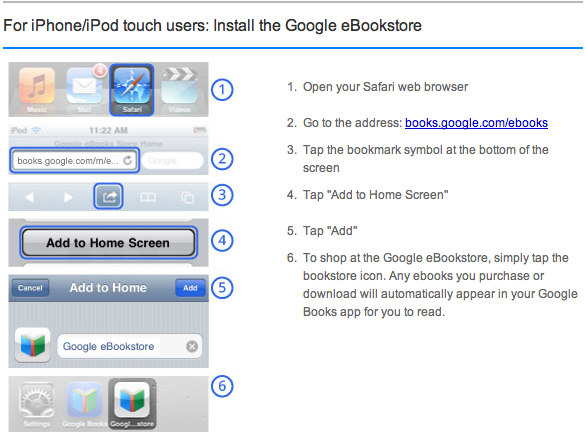
Google has just notified Google Books users via email that they can now purchase books through Google’s eBookstore website. This workaround comes after Apple shut off Google’s in-app book store on the Google Books app — available on the iTunes App Store. As seen in the image sent with the email, Google suggests you add this website to your iOS device’s homepage. Email from Google:
PLEASE NOTE: IF YOU DO NOT USE THE GOOGLE BOOKS APP FOR YOUR IPAD, IPHONE, OR IPOD TOUCH, YOU CAN DISREGARD THIS MESSAGE.
Dear Google eBooks customer,
We are writing to let you know about important changes to your Google Books app for your iPad, iPhone or iPod touch. Due to Apple’s new policies, you can no longer shop for Google eBooks within the app.
But don’t worry, you can install the Google eBookstore on your iOS device using the easy steps in this email, and continue to buy the books you want quickly and easily. For further assistance and more detailed, step-by-step, visual instructions, please visit our Help Center article or you can contact us.
Japanese carrier Docomo sold 100,000 Galaxy S II phones in the first three days and today they launched an LTE version of the Galaxy Tab tablet.
Apple’s patent infringement claims against Samsung now include twelve courts in nine countries on four continents. Reutersreported this morning that Apple is now formally suing Samsung in Japan and seeking to block sales of Samsung phones and tablets in the country:
Apple has filed a suit with the Tokyo District Court seeking the suspension of sales of Galaxy S and its sequel S II smartphones and the Galaxy Tab 7 in Japan, according to sources close to the matter. The first hearing was held on Wednesday, the source said.
The iPhone maker is seeking 100 million yen, or approximately $1.3 million, in damages. Apple previously had filed four complaints before the Tokyo District Court, according to patent expert Florian Müller. Coincidentally, Japan is also another high-revenue market for Apple. Other countries where Apple took Samsung to court include Germany, U.K., U.S., Australia and more.
Samsung’s Galaxy S has outsold the iPhone in Japan last year. In July of this year, Samsung announced sales of three million Galaxy S II phones in 55 days, the successor to the popular Galaxy S handset. Samsung is also the world’s #2 smartphone maker, after Apple. The Korean company surprised investors by deciding against divulging sales of phones and tablets in the face of growing competition with Apple. Android-based handsets and iPhones together hold well over three-quarters of the Japanese market for smartphones, forming a duopoly which is present in pretty much every other market where Google and Apple compete are locked in the battle for smartphone supremacy.
Apple is projected to sell 86.4 million iPhones worldwide in 2011 and its iPad is dominating the post-PC world with approximately two-thirds of all tablets sold worldwide. In an interesting twist, court in Australia recently advised the Cupertino, California-headquartered gadget giant to divulge iPad 2 sales figures in the U.S. and U.K. if the Samsung sales blockade is to hold. In a nutshell, judge wants proof that the similarities between Samsung’s Galaxy Tab 10.1 tablet and iPad 2, which had been first brought to light by Apple, have in fact hurt iPad 2 sales.
Last week Apple successfully banned the new Galaxy Tab 7.7 from the IFA show in Germany. Samsung will also cease to market that device in the country until its legal dispute with Apple is resolved. Samsung, also Apple’s supplier of memory chips, processors and other components, considers litigation with Apple as “destiny”, their CEO Choi Gee-sung told reporters in Korea last week:
The latest in the ongoing legal dispute between Apple and its key components supplier, Samsung, comes via Bloomberg which reported this morning that Apple may be pushed into revealing iPad 2 sales numbers in England and America if the company is to increase chances of the Samsung Galaxy Tab 10.1 blockage in Australia:
Apple Inc. may have to reveal iPad and iPad 2 sales figures in the U.K. and U.S. to improve its chances of barring Samsung Electronics Co. from selling the Galaxy 10.1 tablet computer in Australia, a judge said. Apple’s claim that the Samsung tablet’s release in Australia will hurt iPad sales may carry little weight if it doesn’t provide the numbers, Federal Court Justice Annabelle Bennett said in Sydney Federal Court today. ‘Unless Apple puts on evidence showing the impact in the U.S. or U.K., I can’t draw any positive assumptions,’ Bennett said.
Apple sought an injunction on Samsung’s tablet in Australia until the patent spat is resolved. Apple is claiming that the obvious similarities between Samsung’s family of Galaxy smartphones and tablets are hurting their sales. Apple in prior court documents referred to Samsung as the “copyist”. Recently, Samsung in America asserted Apple ripped off the iPad design from the Stanley Kubrick 1969 film “2001: A Space Odyssey” to argue Apple’s patents should be invalidated under prior art. Judge Bennett would leave it up to Apple to determine whether or not it would be willing to provide court with sales figures. Whichever way you look at it, that’s an interesting twist in this litigation…
[youtube=http://www.youtube.com/watch?v=5q9w0dxosTE] (We got a look at the Tab 7.7 before it was pulled)
Apple won a pretty significant victory today in its attempts to block Samsung from selling its iPad competitor products in Germany and in greater Europe. This week’s IFA show is a CES-like pan-European event which showcases new consumer products from just about everyone except Apple.
Most of the buzz this year however is around two of Samsung’s new products, the Galaxy Tab 7.7 and the Galaxy Note 5.3. Both have 1280×800 SuperAMOLED Displays and run Android 3.2 but the Tab falls under the line of products that Apple is trying to block and is currently under a set of injunctions in various parts of the world.
Interestingly, Samsung was originally showing the 7.7 devices to reporters with “not for sale in Germany” stickers attached. However last night, Samsung started removing the devices from the floor and covering up the advertisements like the product never existed (below).
It appears that Apple got Samsung to block the whole Tab line. The Tab 7.7 is much smaller than the iPad weighing only 334 grams, yet has a higher resolution screen – so it appears that Apple’s injunction is very broad.
Samsung, Apple’s closest rival in tablet computers, pulled the just-unveiled Galaxy Tab 7.7 out of the IFA consumer- electronics show in Berlin after a Dusseldorf court on Sept. 2 granted Apple’s request to ban sales and marketing of the product, James Chung, a Seoul-based spokesman for Samsung, said by telephone today.
“Samsung respects the court’s decision,” Chung said, adding that the company believes it “severely limits consumer choice in Germany.” Samsung will pursue all available options, including legal action, to defend its intellectual property rights, he said.
It will be interesting to see what direction this goes. Will Apple be able to successfully block Samsung’s (and others’) tablets for sale across the world? There is some concern that if Apple doesn’t win in these cases, damages to Samsung could be significant.
Like politics, smartphone wars come down to two major parties – Google and Apple – embroiled in a never-ending fight for consumers, especially those who have not made up their mind as to which operating system they’d like in their next smartphone. According to July 2011 data from Nielsen survey, “these ‘undecideds’ will be the ones device makers will be hoping to win over”. Interestingly, the Late Adopters among likely smartphone upgraders are the ones most likely to be undecided about their next phone platform.
The research firm discovered that forty percent Americans aged 18+ now have smartphones. Android leads the pack with a forty percent OS platform share and iOS came in second with 28 percent. Compared to Nielsen’s June 2011 study, Android grew its share by one percentage point while iOS growth fell flat. The BlackBerry platform lost one percentage share and now stands at nineteen percent.
Of those buying a new smartphone next year, one third would opt for an iPhone and another third would go Android. This leaves other manufacturers outside the Android-iOS duopoly to fight for the remaining 33 percent of buyers.
Android, however, is the preferred platform of choice for the earliest of early adopters:
Among those who say they are usually the first to embrace new technologies, “Innovators” or the earliest of early adopters, Android leads as the “Next Desired Operating System” – 40 percent for Android compared to 32 percent for iOS. (Survey respondents were asked several questions to determine their attitudes toward new technologies.)
Samsung has released an official media statement (via Gizmodo) regarding their ongoing legal spat with Apple related to their Galaxy Tab 10.1 tablet. The company is quick to point out the court did not issue an “injunction against the sale of the GALAXY Tab 10.1” like many have reported, but rather Samsung voluntarily delayed the launch “pending the court’s decision in the week commencing September 26, 2011”.
It will definitely be interesting to see how this case plays out in the coming months. Especially with Samsung excepted to launch new variations of the Galaxy Tab at this year’s IFA. Full statement from Samsung below, if you’re interested: Expand Expanding Close
comScore has just released their ‘U.S. Mobile Subscriber Market Share’ report for the three month period ending in July. The report once again sees Apple’s market share increasing, this time up 1 percentage point to capture 27% of the market. This is in comparison to Google, who came in at an impressive 15% increase to top the chart at 41.8% market share. They are of course followed by the usual suspects, RIM in third at 21.7% (down 5%), and Microsoft at 5.7% (down 1%).
Apple’s market share among mobile OEMs is also on the increase, growing 1.2% to capture 9.5% of the market. Of course, Samsung (who also increased 1%), still dominates among OEMs with 25.5% of the market. LG comes in at second with 20.9%, followed by Motorola, and Apple. Expand Expanding Close
Samsung on Monday promised to challenge Apple’s copyright infringement claims in Australia. Specifically, news agencies report, the Korean consumer electronics maker said today it “will continue to actively defend its right to launch the Samsung Galaxy Tab 10.1 in Australia”. Reutersreports that the company confirmed plans to delay the Galaxy Tab 10.1 launch in Australia until after a court ruling in late September on its ongoing legal spat with Apple. Furthermore, Samsung will file a counterclaim with the Australian court in the coming days, seeking to invalidate Apple’s patents plus another one asserting a patent infringement on Apple’s part:
Today, Samsung informed the Federal Court of Australia it intends to file a cross claim against Apple Australia and Apple Inc regarding the invalidity of the patents previously asserted by Apple and also a cross claim against Apple regarding violation of patents held by Samsung by selling its iPhones and iPads
According toThe Sydney Morning Herald, a hearing before the Australian court is due September 26 and 29 and Samsung agreed “not to sell or advertise” the tablet before September 30. The article also mentions the possibility of a high-profile testimony by both parties:
Apple and Samsung returned to court this afternoon, with Samsung agreeing not to sell or advertise the Galaxy Tab 10.1 before September 30. Apple will detail the specific patents involved in the case by this Friday and will provide a more comprehensive statement of facts by September 5. Samsung will provide points in answer by September 16, with the case going to a formal hearing on September 26 and 29. It was indicated today that top executives and inventors from both Apple and Samsung may appear in person or over video link to explain their patents.
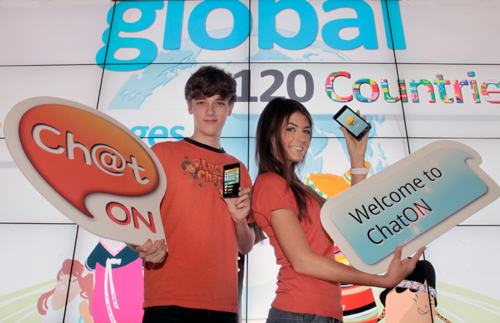
Samsung is getting into the proprietary messaging format game with a new product called ChatOn it announced today. The service will roll out on its Bada, Android and even feature phones and will extend to competing platforms like Blackberry and iOS. The service will run over IP and allow users to send text, images, and hand-written notes, as well as chat in groups and share video clips.
The new service, called ChatON, will be available from October and preinstalled in Samsung’s feature phones as well as smartphones running on its own bada operating system and Google’s Android software, it said.
Samsung’s partner Google has a similar Talk/Voice feature already installed on Android devices so it isn’t immediately clear which will take precedence. All of these services are collectively eating at the SMS revenue that carriers have been squeezing out of their customers for a decade. Apple’s iMessage is set to go live with the general release of iOS 5, also likely in October.
Speaking of the iOS maker, Apple was able to successfully block Samsung from releasing it’s ‘modified’ Australian Galaxy Tab in Australia it was reported this evening… Expand Expanding Close