Anticipating Android backers will face legal hurdles as Apple now has the upper hand in its case against HTC (here and here), Google has stepped up and bought more than a thousand IBM patents for an undisclosed sum. The news was first reported by the blog SEO by the Sea and picked up byThe Wall Street Journal. The search company might use IBM inventions as a leverage against pending lawsuits that indirectly involve its Android software.
Google failed to outbid the Apple-led consortium which paid $4.5 billion for Nortel’s treasure chest of more than 6,000 patents covering wireless technologies, among them crucial inventions related to fourth-generation cellular networks. The new patent deal is in line with Google’s focus on snapping up patent portfolios left and right in creating a “disincentive for others to sue Google”, as noted on their official blog back in April. The 1,030 granted patents Google bought from IBM cover varied technologies, including…
It is no secret that Google TV failed to hit the ground running as the notion of having to buy another box for their TVs fell on deaf ear with the general public. It is no surprise then to find out that Google TV boxes are not selling very well, just like the Apple TV (picture below). What we didn’t know is how bad the situation is for the search giant’s pet project. TIMNpoints at a prepared statement from Logitech, the maker of Google TV-powered Revue box, in which the company acknowledged “very modest sales” of the product in the June quarter:
Sales of Logitech Revue were slightly negative during the quarter, as returns of the product were higher than the very modest sales. We believe the significantly lower everyday price for Logitech Revue, reduced from $249 to $99, will generate improved sales.
Google on its part will update the Google TV project with Honeycomb code later this summer, adding the ability to download and run apps on your television. But despite the aggressive price cut which will cost Logitech $34 million in one-time charges and the fact that the Revue now price-matches the $99 Apple TV, ordinary consumers will still be avoiding set-top boxes in droves, regardless of a brand.
Apple on its part could tackle the market with a rumored full-blown television set with the Apple TV functionality built-in. Apple’s op-chief Tim Cook recently in a conference call with Wall Street analysts re-iterrated Apple’s stance that the Apple TV box remains “a hobby” for the company. The comment jibes with Steve Jobs’s argument from the Wall Street Journal’s D8 conference last year when he said set-top box makers like Apple and Google faced a go-to market problem, calling the television market “balkanized” (full quote and video below the fold).
Research firm Nielsen chimed in today with a survey that puts Apple as the leading handset maker in the United States whilst Android is portrayed as the top mobile operating system in the country. Those findings follow a recent analysis which had Apple overtaking Nokia to become the world’s leading smartphone vendor in July, also corroborated by IDC figures. According to Nielsen’s June data, Google’s Android remains the nation’s top phone platform with a 39 percent of the country’s consumer smartphone market. Apple’s iOS follows with 28 percent and BlackBerry maker Research In Motion continues to bleed share, down to 20 percent in the second quarter of 2011. Windows Mobile and Windows Phone combined grabbed nine percent, webOS and Palm OS were barely a blip with two percent, as was Nokia’s dying Symbian OS.
Apple on the other hand is the top smartphone maker in the United States that controls 28 percent of the market (excluding iPods and iPads). That’s partly “because Apple is the only company manufacturing smartphones with the iOS operating system”, Nielsen argues. HTC shares second spot with Research In Motion with a fourteen percent share of Android devices and six percent of Windows Phones for a total of 20 percent share of the whole market, same as the BlackBerry maker. HTC is also the nation’s leading Android and Windows Phone vendor with 14 percent and six percent share, respectively. No wonder Apple is suing HTC and seeking to ban import of their phones into the US…
IMS Research put out a study estimating that some 420 million smartphones will be sold worldwide in the 2011 calendar year, or 28 percent of all handsets sold. The survey portrays Apple as making huge gains in the space, buoyed on the sales of 18.65 million and 20.34 million iPhones in their last two quarters – enough to garner a 19 percent share of the global smartphone market. Combined with Nokia’s slumping sales, Apple emerged as the world’s leading smartphone maker.
It remains to be seen whether Samsung, which is due to report its earnings Friday, will beat Apple’s smartphone sales (some say it will). IMS noted the fact that the company grew their share of global smartphone market from three percent in the first quarter of 2010 to 13 percent in the first quarter of this year. Samsung, as you know, sells phones powered by Google’s and Microsoft’s software in addition to their own operating system for feature phones, Bada. IMS’s Analyst Josh Builta says this of LG:
LG, despite being the third largest OEM in the world, has offered a fairly limited smartphone portfolio in recent years, a factor that resulted in the company reaching less than a three percent share of the total smartphone market in 2010.
However, Nokia’s fall surprised even the most seasoned watchers and is unheard of in this industry. Nokia, the Finnish phone giant, lost 16 percentage points of its smartphone market share, going from a 40 percent share last year to 24 percent in the first quarter of 2010. They shipped 16.74 million smartphones in the June quarter – a 34 percent annual decline – versus Apple’s 20.34 million units – a 134 percent annual increase. Nokia also killed Symbian and is only shipping the well-received but short-lived MeeGo-powered N9 to select markets. Here’s how the analyst described Nokia’s problem:
Clearly one of the key dynamics of the mobile handset competitive environment in recent years has been the inability of many traditional market leaders to recognize and adjust to the growing smartphone tier. The reasons for these failures vary and include everything from poorly designed and manufactured devices, unsatisfactory user interfaces, and portfolios that don’t offer products with a differentiating feature. These lapses have created opportunities for newer entrants to the market, which they have aggressively pursued.
Research In Motion fell from 20 percent to 15 percent in the same period, mind you. IMS sees one billion smartphones by 2016 as average selling prices drop and vendors release more inexpensive handsets. Smartphones then will account for one of every two mobile handsets sold, the research firm concludes.
Much has been said about a rumored Amazon tablet so far. It should be based on Android, we are told, and Asian source have chimed in with their share of leaks, the latest being that Taiwanese contract manufacturers have begun producing the gizmo, presumably for a Fall launch. But will you take the plunge? That’s what research firm Retrevo set out to figure out in a July study stemming from polling over a thousand online individuals in the US. Key takeaway: Amazon tablet must be really affordable if it’s to hit the ground running.
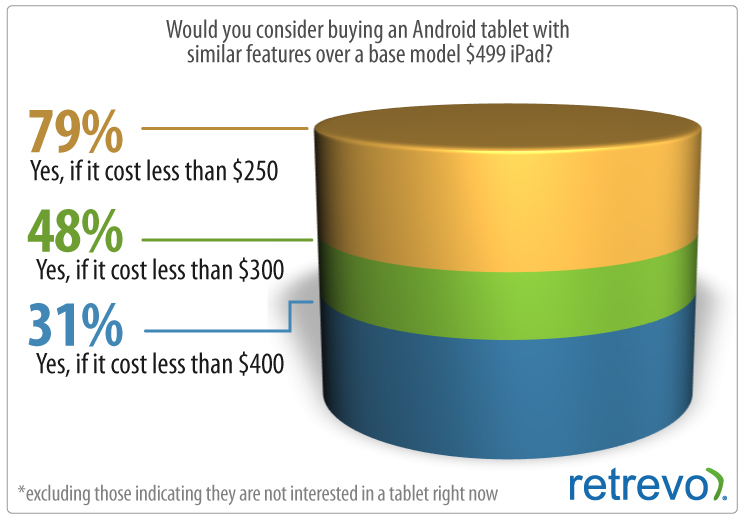
Asked whether they’d consider buying any Android tablet with similar features over a base model $499 iPad, more than three-quarter respondents, or 79 percent, said “Yes, if it cost less than $250”. Amazon is rumored to be skipping on some tablet features in order to keep production costs down, like use a less expensive touch panel which can only detect two fingers at once.
Of course, Amazon knows how to build gadgets like Kindle and make them less expensive over time. The tablet, however, they’d have to price aggressively from day one as Apple pretty much set the starting price at $499. Nearly half the respondents would choose an Android tablet over an entry-level $499 iPad if it was priced less than $300 and nearly one in three would go Android with a sub-$400 device.
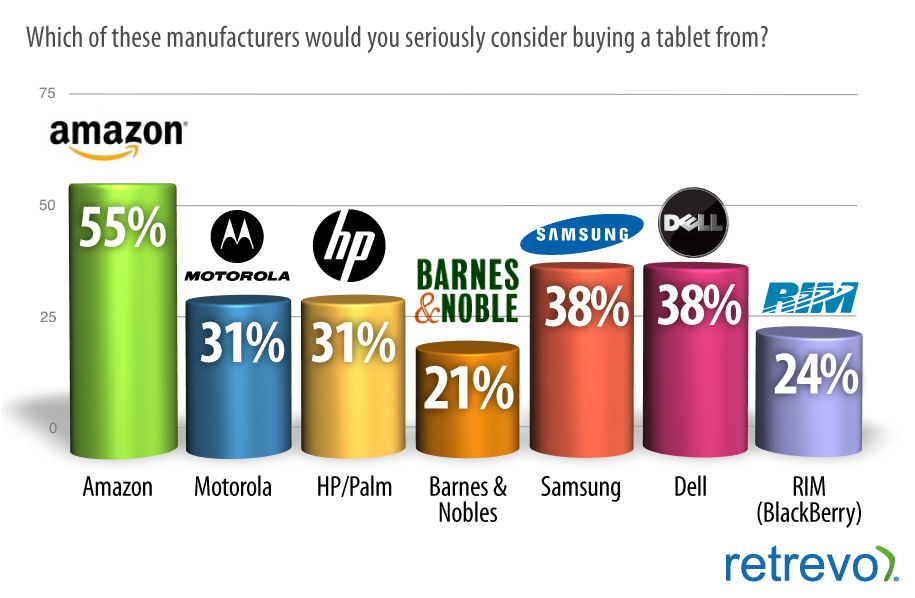
In a blow to other tablet makers, including brands such as Motorola, Samsung, Research In Motion, Hewlett-Packard and others, a whopping 55 percent would seriously consider a tablet from Amazon. This highlights the power of ecosystem which has turned Apple’s tablet into a smash hit. Amazon too has its own app store, music store, movie store and other digital stores in the cloud, bound to create a compelling user experience in the familiar environment from a trusted name in online retail. More food for thought and pretty charts right below…
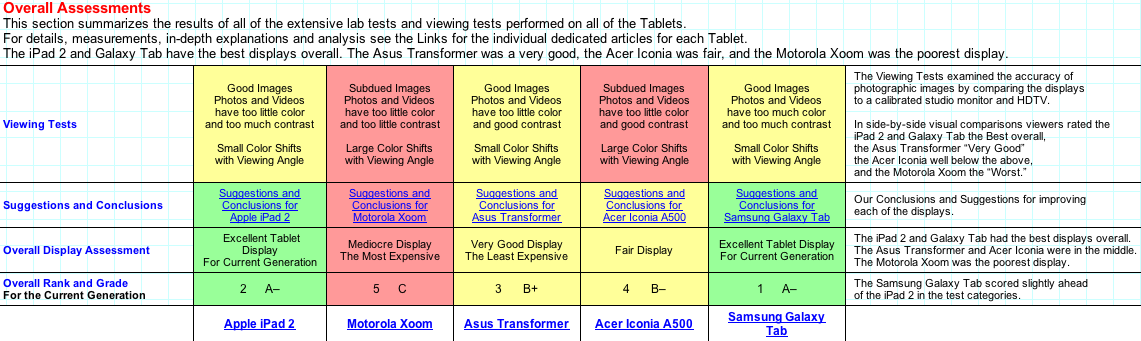
While the iPad 2 display easily outperformed all of the previous Android Tablets, with the new Galaxy Tab 10.1, Samsung has delivered the first Android Tablet with an impressive, potentially outstanding display, but then ruined it by turning up the color level to obnoxious levels – apparently in an effort to overcompensate and blatantly standout from the other mobile LCD displays that have subdued color. But in the case of color, too little is a lot better than too much…
As a result the iPad 2 still delivers the best color picture quality and accuracy of all of the Tablets, even though its colors are somewhat subdued. As things stand, based on all of the display tests, the iPad 2 and Galaxy Tab 10.1 are reasonably close in performance in most categories, so it’s almost a tie, but the Galaxy Tab is ahead more often than the iPad 2, so the Galaxy Tab is the Winner, by a nose…
Perhaps most interesting was that the Motorola Xoom, which is the official Google Honeycomb tablet, came in last behind Asus and Acer.
CBROnlinerelays a new Strategy Analytics report that spells another victory for Google as its mobile bazaar is projected to become bigger than Apple’s App Store in terms of items available before the end of the next year:
According to Strategy Analytics’ new application storefront forecast the Android Market is poised to overtake the Apple App Store in quarterly volume by the end of 2012.
This shouldn’t be a problem considering that Google’s Android Market is getting additional assistance from third-party app stores such as the Amazon Appstore for Android, GetJar, Nook and others. Apple as of July 7 reported 425,000 apps on the App Store that have been downloaded 15 billion times on 200 million iOS devices, generating $3.6 billion in revenues. A week later Google said Android Market saw six billion downloads across the 130 million Android devices sold to date and more than 500,000 device activations per each day.
Paid downloads on mobile app stores should drive nearly $2 billion per quarter by the end of next year, the research firm said. “Applications are a multi-billion dollar industry on their own and are playing an increasingly important role in the phone purchase process, and play a key role in augmenting platform stickiness, after the operating decision has been made”, says the report.
Due to their wide variety of popular Android devices, Samsung “may have” surpassed Apple in smartphone sales according to Boston-based Strategy Analytics. In Q2 2011 Samsung is estimated to have sold between 18 – 21 million smartphones, while Apple sold 20.3 million iPhones, and Nokia sold 16.7 million. Certainly, they are at least #2.
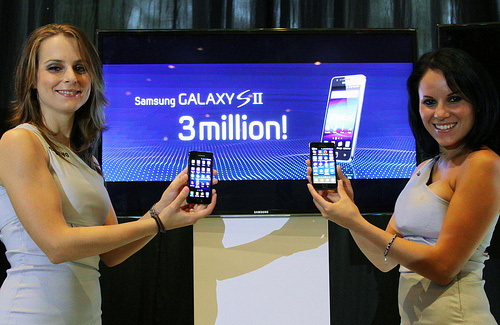
Much of Samsung’s success is credited to sales of the Galaxy S II which has been booming overseas.
It’s far from official that Samsung has surpassed Apple, but at any rate they’re becoming a close competitor. We can’t wait to look at these numbers again when the Galaxy S II hits U.S. shores, but then again, the iPhone 5 is reportedly on its way too.
Research firm Strategy Analytics discovers that shipments of Android-driven tablets are finally beginning to make a meaningful impact on the overall tablet market. Yes, Android slates are making their presence known, even though iPad is still king of the hill. According to the research firm’s survey, June quarter tablet shipments topped 15.1 million units, a material increase over the 3.5 million units from the year-ago period. Apple seized the #1 slot with 9.25 million iPads the company reported for the June quarter, representing a 61.3 percent share of the tablet market overall.
At the same time, Android tablets have gone from 2.9 percent market share in June 2010 to 30.1 percent in June 2011, a surprising 27.2 percentage points increase based on sales of 4.55 million units. In the year-ago quarter Apple enjoyed a 94 percent share, so iPad’s 33 percentage points drop is substantial no matter how you look at it. GSM Arenaobserves that “in terms of market share, the iOS lead in the past quarter is nearly three times smaller than it was in the same period of last year”.
Google’s executive chairman Eric Schmidt has gone on the offensive and bashed Apple over patent infringement claims the company had filed against high-profile Android backers such HTC and Samsung. In what could be viewed as an effort to sway the public perception, he launched a nasty attack speaking at Google’s Mobile Revolution conference in Tokyo. To Schmidt, Apple’s taking rivals to court sends a strong signal, that of the lack of innovation and jealousy:
The big news in the past year has been the explosion of Google Android handsets and this means our competitors are responding. Because they are not responding with innovation, they’re responding with lawsuits. We have not done anything wrong and these lawsuits are just inspired by our success.
Schmidt re-iterated sales of 135 million Android phones since 2008 and highlighted more than 550,000 daily activations that exclude tablets and non-smartphone devices, which is up from 400,000 a day in May. He said Google will support HTC’s legal battle against Apple’s copyright accusations, but wouldn’t elaborate.
Whether or not Apple’s legal pressure stems from jealousy is up for debate, of course. Cynics might argue Schmidt’s comment draws from nervousness on Google’s part because Android backers are increasingly discovering hidden costs as Microsoft and Apple emerge as holders of patents crucial to Google’s mobile operating system. Apple’s victory over HTC may set what RBC Capital Markets analyst Mike Abramsky painted as a high royalty precedent for Android devices that could further shrink the already slim margins on Android phones.
As if that wasn’t enough, Microsoft is already taking money from five Android vendors for patent protection, including HTC which is said to pay five bucks each time it ships an Android handset and General Dynamics Itronix. Microsoft is also understood to have targeted Samsung, seeking royalties in excess of hundreds of millions of dollars annually. The Cupertino, California-headquartered gadget giant quoted Steve Jobs in a statement announcing the HTC lawsuit March last year:
Then Google CEO Eric Schmidt shares the stage with Steve Jobs at the January 2007 iPhone unveiling. The times of happiness would abruptly come to an end amid Android whispers, culminating with Apple announcing Schmidt’s resignation from its board August 3, 2009.
Shares of the Taiwanese Android phone maker HTC fell 6.5 percent this morning following the ruling by the International Trade Commission (ITC) that the company violated two patents held by Apple. The company’s shares have been pretty much free-falling throughout last week. The agency’s commissioners still have to support the ruling, but investors are already panicking over fears that the ruling will favor the California-based gadget maker. This, in turn, would open doors to ITC’s ban on imports of HTC’s phones into the United States. In response to the crisis, HTC announced a share buy back program worth up to $760 million in an attempt to stabilize its share price and restore investor confidence, reportsFinancial Times:
The attempt to prop up HTC’s share price appeared to have little effect as the stock fell below HTC’s minimum purchase price of T$900 to close down 3.9 per cent at T$871. The sell-off highlights investor fears that the legal battle could have wider implications for the competitive balance between Apple and Google Android-based phonemakers like HTC, Samsung and Motorola.
HTC is thought to have recently acquired S3 Graphics for $300 million in a bid to secure a stronger ground in its legal dealings with Apple, which filed its patent infringement complaint against the Taiwanese company back in March 2010. Apple accused HTC of violating up to twenty patents related to the iPhone’s hardware, software and its user interface. ITC recently ruled in favor of S3 Graphics, deciding the iPhone maker infringed on two patents held by S3 Graphics. They also acquired a portfolio of 82 patents from US-based ADC Communications for $75 million and signed an Android protection pact with Microsoft. HTC is expected to use all of this in the hope of relieving some of the pressure from Apple’s legal sharks. If ITC decides to ban import of HTC phones into the US and the company does not reach a timely settlement with Apple, its stock price could free-fall further.
What HiFi is reporting that Android has surpassed the iPhone as the top smartphone in the UK, coming from a market research group called Kantar Worldpanel. The growth is due in part to first time smartphone users, not necessarily those switching between platforms. In June alone, Android rose almost 35%, while the iPhone fell almost 12%. We’re assuming much of Android’s success is from the Galaxy S II, who has seen tremendous sales in Europe as well as Android’s numerous, cheap, offerings. Expand Expanding Close
Google gave all employees moving into the Zurich office apples with the Google logo engraved.
Source: Webilus.fr
It is hard to escape the buzz flying around Google+, the search monster’s latest social thing. It raised red flags at Facebook where Mark Zuckerberg summoned a hastily organized news conference that fell on def ears with general public. The presser was a classic case of over-promising and under-delivering as Zuckerberg’s “awesome announcement” turned out a yet another dull unveiling of way overdue features, such as group chat and Skype integration. But who would have though just a month ago that Google would put the fear of God into Facebook with what many consider an unusual take on social networking?
Nobody saw it coming when co-founder Larry Page took the reigns April 4 from Eric Schmidt. What a difference a few weeks make. An invite-only service closed for public in two weeks since launch signed up more than ten million users. And when it opens for everyone later this year, the hundred million milestone will be well within reach. Page, who once famously called Steve Jobs a liar, put the pedal to the metal from his first day as CEO by tying executive bonuses to their contributions to the company’s social strides. The move quickly earned him notoriety among tech watchers and his own employees.
But unlike Mark Zuckerberg – who may try to be, but is certainly no Steve Jobs on stage (see why in the below YouTube clip) – Page has notably been keeping low profile while cunningly taking clues from Apple’s iconic leader. We were told about “moon shots”, to the dismay of many watchers (this author included). Page was stiffing innovation and focusing too much on corporate bureaucracy, many cried…
The Wall Street Journal is reporting Amazon will be selling a tablet by October, to compete with Apple’s iPad. While the details are sketchy as of now, WSJ is saying the tablet will have a 9-inch screen and will run Android. Oddly enough, the tablet will not feature a back camera. Lastly, Amazon won’t be building the tablet themselves, but will outsource to a manufacturer in Asia.
Amazon’s tablet will have a roughly nine-inch screen and will run on Google’s Android platform, said people familiar with the device. Unlike the iPad, it won’t have a camera, one of these people said. While the pricing and distribution of the device is unclear, the online retailer won’t design the tablet itself. It also is outsourcing production to an Asian manufacturer, the people said. One of the people said the company is working on another model, with Amazon’s own design, that could be released next year.
There will also be two eReaders before Christmas, one touch and one at a significantly reduced cost. Along with the tablet in October, there is word that we can be seeing another tablet designed by Amazon themselves in 2012. Expand Expanding Close
TechCrunch is reporting that Google is hiring numerous amounts of lawyers in order to acquire more patents. Currently Google only owns 701 patents, a very small number for such a large company. In contrast Microsoft was awarded 3,121 patents just last year. Google will continue to get slammed with lawsuits if they don’t acquire more patents.
On its Job page, Google is listing six open positions involving patents . TechCrunch points one out:
For example, the strategic patent licensing and acquisitions manager evaluates and values potential patent acquisition and licensing opportunities, and negotiates these deals (a.k.a. finds more patents for Google).
Perhaps Google will go after Richard “Chip” Lutton Junior, the chief patent counsel that just left Apple yesterday.
Now that Android has become the leading mobile platform in the US and other key markets around the world, developers are taking notice and some no longer prefer releasing their apps on iOS first, followed by Android. For some, it’s a question of Android’s installed user base, the pace of the platform’s growth and the fact that ad-supported free model on Android matches the App Store’s 99-cent economy. For others like WhitePages, the decision comes down to cutting out a middleman in order not to be forced to spend time, resources and money on a lengthy approval process.
According to Ina Fried over at the Wall Street Journal’s All Things D blog, WhitePages’ new Localicious app will be released on Android first. Apple’s approval process “is just too difficult to time a launch around”, Fried writes, noting the iPhone maker’s stringent approval process had delayed the launch of a reverse phone lookup app from WhitePages for two months, a far cry from the Apple-advertised “95 percent of the apps are approved in two-weeks time”. WhitePages’ op-chief Kevin Nakao tells the blog:
I think we are going to see a lot of people start to ship Android first. You cant be held hostage. Marketing an application becomes increasingly important given the number of apps that are being published. Since apps can still get tied up in the iOS approval process, it makes this marketing planning almost impossible.
UPDATE [July 13, 2011, 10:20am Eastern Time]: Google itself is now advising developers to target Android first. According toMacWorld UK, Google Ventures partner Rich Miner is telling app developers funded by the Google-backed project that they focus on Android and then roll out apps on iOS later.
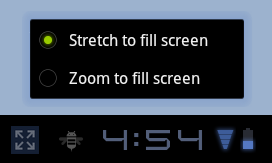
While most apps size up well on most of Android’s tablets and larger smartphones, the Android team has announced a new feature that will allow users to size apps that won’t quite fit their screen. Any Android app on the Market that doesn’t target a larger screen through code will get this new feature.
To enable this functionality, developers need to add one line of code: android:xlargeScreens=”true”.
If a larger screen target can’t be found, Android will enable the feature in the bottom right of the device. Users can either select “stretch to fill screen” or “zoom to fill screen”. Since larger 1080P Google TVs run Android, this is a great feature to have. Also, does this help or hurt Android fragmentation? Expand Expanding Close
Nearly three-quarters of Android sales in Britain during a twelve-week period ended June 12 came from people upgrading from so-called feature phones to their first smartphone. In addition, only 1.8 percent of new Android sales came from iOS users jumping ship, a Kantar Woldpanel ComTech survey reveals. The research didn’t take into account corporate sales or contracts and was based on extensive interviews with up to one million consumers in Europe alone.
Android has grown its share of total US handset market to 9.2 percent in June of this year, up over just one percent a year ago. The platform had a 45.20 percent share of the entire smartphone market in the country, while iOS fell from 30.6 percent share in June 2010 to 18.3 percent share in June 2011. A big part of this was price: Apple’s is among the priciest consumer smartphones and only 45 percent contracts offer the device for free versus 90 percent for Android phones.
The fall of iOS came as a result of the overall UK market growing at a faster pace than iPhone sales, which have been overshadowed for the past two months as Samsung’s Galaxy S II smartphone emerged as the best-selling smartphone. In the US, Android and iOS had 57 percent and 28.7 percent market share last month, respectively. Android is clearly victorious in Germany, France, Italy, Spain, Australia and Japan, where the platform enjoys a whopping 64.7 percent share of the smartphone market versus 27.7 percent for iOS.
Kantar analysts predict that by this time next year smartphones would account for nearly 50 percent of the overall handset market, thanks to more and more feature phone owners dumping their devices for smartphones. This is not unexpected because trends hint that eventually all phones will become smartphones. Other phone vendors are experiencing sharp declines around the world, especially Symbian which has been bleeding share as Nokia fights for survival.
In case you didn’t notice, tech headlines recently are all about patents. Be it the ongoing case of patent troll Lodsys which is now suing The New York Times Company and five other firms that previously sued Lodsys (bringing the number of defendants to 33) or Microsoft going after Samsung and signing Android patent protection pacts with five more vendors or the Apple led-consortium winning a crucial $4.5 billion bid for Nortel’s patent trove – you name it, the blogosphere is all over it.
HTC is now joining the craze with the news that they will snap up graphics vendor S3 Graphics from Via Technologies. The transaction valued at $300 million is about – you guessed right – patents. A total of 235 patents and pending applications will change hands once regulators approve the deal (VIA’s and HTC’s boards of directors already have). The patent agreement should help HTC protect themselves from future patent litigation from rivals. There’s also this:
On July 1, a U.S. International Trade Commission judge ruled that Apple infringed on some of the claims contained in two S3 Graphics patents. Judge E. James Gildea found that Apple infringed on U.S. Patent No. 6,658,146 directed to systems and methods for compressing images and U.S. Patent No. 6,683,978 directed to image data formats, both of which belong to S3 Graphics.
HTC has been trying to escape Apple’s lawsuits since March of last year, when Apple took the Taiwanese handset maker to court over an alleged breach of twenty patents pertaining to the iPhone hardware, software and user interface. With this acquisition, HTC may be out of trouble as both firms now have what the others want – intellectual property – even with HTC bringing a lot less to the negotiating table…
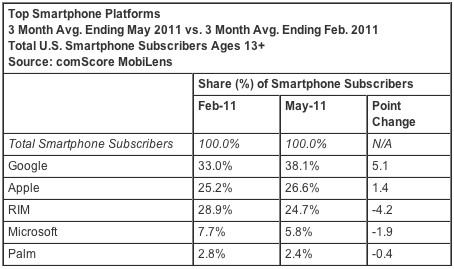
The Android train keeps chugging along with the comScore showing a 5.1 point increase in total US Android use in the Feb-May Quarter putting the OS at 38.1% of the total US smartphone market. Apple also gained, though less spectaculary with 1 percentage point improvement, coming in at 26.6%. Android head Andy rubin said last month that Android activations had grown to over half a million a day worldwide.
For the other guys, it wasn’t a happy quarter. RIM continues its slide down to a under quarter of all US smartphone purchases, while Microsoft and webOS risk being bundled into the “other” category as their marketshare continues to erode into almost nothing.
Active-matrix organic light-emitting diode, or AMOLED, is a display technology from Samsung which has so far been limited to their high-end devices such as the Galaxy S series smartphones. It has worked out well for the Korean firm: They’ve been advertising the crispness and sharpness AMOLED enables as the hardware feature setting apart their smartphones from Apple’s iPhone 4 which employs a regular LCD display with in-plane switching (IPS) technology. Even though iPhone 4’s Retina Display-marketed LCD IPS display sports wide viewing angles and crisp 960-by-480 pixel resolution, it falls behind the AMOLED technology which features vivid colors, true blacks, high brightness and low power consumption.
All those wonderful goodies are said to be adopted by “numerous mobile phone vendors” in the second half of this year, reportsDigiTimes. The publication explains that Samsung Mobile Display “has began production of AMOLED panels with the 5.5G production lines in May to further increase the penetration of AMOLED panels”. Samsung and its carrier partners have been making a lot of noise with the Super AMOLED Plus display featured on the Galaxy S II smartphone.
For example, the company aired a series of television commercials focused on the Super AMOLED Plus display alone. The Korean Heraldasserted in May that Apple might use AMOLED in iPad 3, but it’s unclear why Samsung would enable its rival to tap the one distinct hardware feature that differentiate their products from Apple’s gadgets.
[youtube=http://www.youtube.com/watch?v=788MeU_msMI]
The venerable Amazon tablet has inched one step closer to reality with the news that the company has begun sourcing parts for a rumored tablet. According toDigiTimes, a Taiwanese trade publication, Amazon is hoping to ship some two million units in September, in time for the holiday shopping season:
Amazon reportedly has held talks with TPK Holdings, Wintek, HannStar Display and J Touch for the supply of touch panels, indicated the sources, noting that Amazon targets to ship four million tablet PCs before the end of 2011.
However, Apple is pressuring the supply chain considerably. The Cupertino, California company reportedly plans to ramp up iPad 2 manufacturing to twelve million iPad 2 units for the third quarter, up from an estimated 6-7 million units in the second quarter and the 4.9 million iPads Apple shipped during the first quarter. Because of this, the Amazon tablet could be facing serious constraints, the report notes.
The story corroborates a previous report from the same publication calling for a September-August launch. The rumor-mill talk is that the online retail giant will introduce a plethora of Android-driven mobile devices, possibly even a smartphone. Amazon’s boss Jeff Bezos wouldn’t reveal anything beyond dropping hints and teasing us to “stay tuned”.
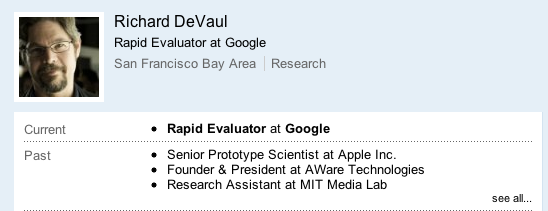
Richard DeVaul, a PhD. scientist from MIT with a focus on building wearable technologies, was snared from Apple this month by Google. At Apple he was rumored to be working with SVP of Industrial Design, Jonny Ive in Apple’s secret labs building the next big thing.
Besides his having knowledge of the inter-workings of Apple, it is also interesting that DeVaul is a hardware person who has focused on building wearable products for the past decade. Google has been a software company for all of its existence, but more and more it appears that it will enter the hardware business…but probably in smart accessories rather than phones.
Stanford professor and iPhone Camera app developer Marc Levoy is going to Google for two years according to his Stanford bio page:
I will be on part-time leave of absence from June 2011 through June 2013, to pursue a project at Google.
This stint at Google won’t be his first. He co-designed the Google book scanner and launched Google’s Street View project.
Levoy’s current interests include light fields, optical microscopy, and computational photography – meaning computational imaging techniques that extend the capabilities of digital photography. Levoy’s recent research focuses on camera applications.
My research has recently focused on making cameras programmable. One concrete outcome of this project is our Frankencamera architecture, published in this SIGGRAPH 2010 paper. To help me understand the challenges of building photographic applications for a mobile platform, I tried writing a cell phone app myself. The result is SynthCam. By capturing, tracking, aligning, and blending a sequence of video frames, the app makes the near-pinhole aperture on an iPhone camera act like the large aperture of a single-lens-reflex (SLR) camera. This includes the SLR’s shallow depth of field and resistance to noise in low light. The app is available for $0.99 in the iTunes app store. I don’t expect to get rich from this app, but I learned a lot by writing it, and yes – seeing it appear in the app store was a thrill. Here are a few of my favorite reviews of the app: MIT Technology Review, WiReD.