Motorola



This is my next has unveiled an Android device heading to Sprint, which is said to be a beefed up Motorola XPRT with a dual-core processor. The device is code named the Motorola Pax, and is looking very Blackberry esque with its portrait keyboard. Besides the dual-core processor, the Pax is also believed to include Sprint’s new CDMA 1X Advanced push-to-talk system. There is no word on pricing or availability. Check out another shot after the break.

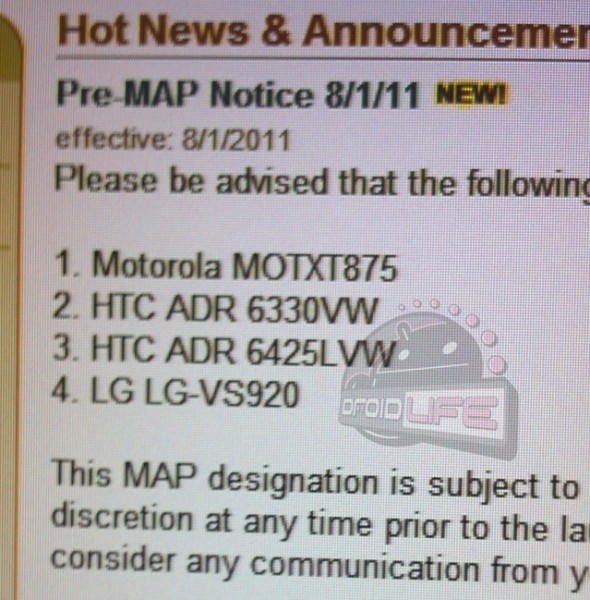
Is Verizon preparing to launch the HTC Vigor, Droid Bionic, and two other mystery Android devices? If speculation stemming from a leaked pre-MAP (minimum advertised price) list is to be believed, the carrier is readying four new Android devices for launch including two HTC, one LG, and a Motorola.
DroidLife speculates the third device listed on the MAP memo, “HTC ADR6425”, is the rumored HTC Vigor, which, thanks to an anonymous NenaMark benchmark test, is rumored to sport a 1.5GHz dual-core Snapdragon processor, 720p resolution display, and an Adreno 220 GPU.
The “LG-VS920” is most likely the successor to the LG Revolution, as the first-gen Revo was labeled with model number “LG-VS910”.
Less is known about the other mystery devices. The “Motorola MOTXT87” is thought by many to be the new DROID Bionic announced at CES and slated to launch in September. When it comes to the last device listed, the “HTC ADR6330”, your guess is as good as any.
Whether or not any of these devices will launch before the September Bionic launch is yet to be determined. We will keep you posted as more info becomes available…

For those of you waiting for the rumored August 4th release date of the Droid Bionic, will have to wait just a wee-bit longer. During their earnings call today, Motorola’s CEO Sanjay Jha announced the Droid Bionic will launch in September. Jha didn’t comment the AT&T Droid Bionic we’re hearing about.
The Bionic was announced at CES in January. Motorola has held off the release for sometime due to issues with the device. Check out a hands-on of the Bionic after the break.

Motorola Mobility reported June quarter earnings today, nearly hitting Wall Street estimates with the reported GAAP net loss of $56 million, 19 cents a share. Revenues for the quarter topped $3.3 billion and non-GAAP earnings were nine cents a share. One of the noteworthy highlights includes shipments of 400,000 Xoom tablets, although the company wouldn’t divulge actual sell-through numbers. Xoom shipments amount to some 2.65% June tablet market share, per Strategy Analytics’s cumulative figures.The company also shipped eleven million mobile devices in total, including 4.4 million Android smartphones. Analyst Tomi Ahonen wrote on Twitter that Android shipments amount to an eight percent market share, making Motorola “8th biggest smartphone maker and 5th biggest Android”.
Xoom aren’t bad at all, actually a bit higher than the 300,000 units investors were expecting. Furthermore, the Xoom, Motorola’s inaugural Honeycomb tablet, arrived to market with little or no support from third-party developers plus devices from rivals ensued soon thereafter. Motorola benefited from an expanded distribution of the Atrix 4G smartphone and Motorola Xoom tablets in Latin America, China, Korea and Europe. They also rolled out four new smartphones in China. Moving forward, the company previously pledged to launch ten new devices in 2011 with Sprint, including Motorola Photon 4G which launches this weekend. Other tidbits right below…
Research firm Nielsen chimed in today with a survey that puts Apple as the leading handset maker in the United States whilst Android is portrayed as the top mobile operating system in the country. Those findings follow a recent analysis which had Apple overtaking Nokia to become the world’s leading smartphone vendor in July, also corroborated by IDC figures. According to Nielsen’s June data, Google’s Android remains the nation’s top phone platform with a 39 percent of the country’s consumer smartphone market. Apple’s iOS follows with 28 percent and BlackBerry maker Research In Motion continues to bleed share, down to 20 percent in the second quarter of 2011. Windows Mobile and Windows Phone combined grabbed nine percent, webOS and Palm OS were barely a blip with two percent, as was Nokia’s dying Symbian OS.
Apple on the other hand is the top smartphone maker in the United States that controls 28 percent of the market (excluding iPods and iPads). That’s partly “because Apple is the only company manufacturing smartphones with the iOS operating system”, Nielsen argues. HTC shares second spot with Research In Motion with a fourteen percent share of Android devices and six percent of Windows Phones for a total of 20 percent share of the whole market, same as the BlackBerry maker. HTC is also the nation’s leading Android and Windows Phone vendor with 14 percent and six percent share, respectively. No wonder Apple is suing HTC and seeking to ban import of their phones into the US…
 .
.
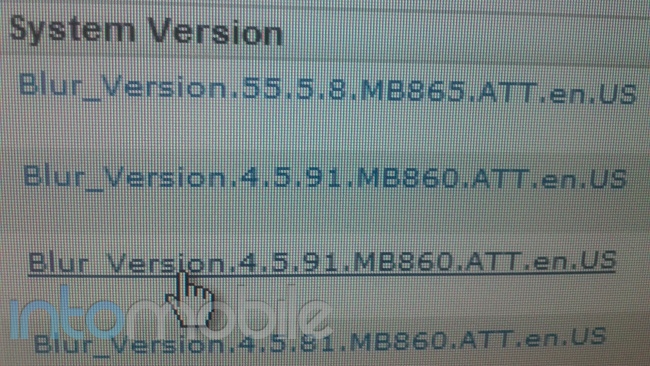
IntoMobile is reporting an AT&T varient of the Verizon Droid Bionic might just be on its way. If you don’t know what you’re looking for the above image doesn’t exactly tell you much. IntoMobile explains:
The small code following the version number is what to look for. You can see three mentions of the MB860 and one of the MB865. Well, a quick Google search for MB865 will return results for the Motorola Atrix 4G but if you do a search for MB865, you’ll get results for the Droid Bionic.
The GSM Bionic will likely be a slightly bigger version of AT&T’s popular Atrix. The Atrix already has the qHD display and dual core processor. It also got a Gingerbread update this weekend.
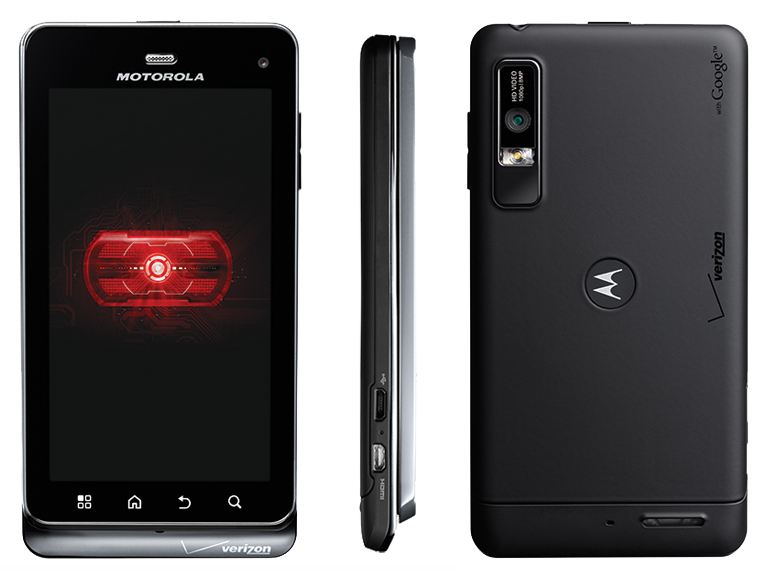
A bunch of Droid 3 reviews hit the web today, and most conclude that the Droid 3 isn’t looking too hot. The Droid 3 is Motorola’s second iteration of the original Droid, which some might say is the reason Android is where it is today. The Droid 3 is available on Verizon Wireless, packing a 1 GHz dual-core processor, QWERTY keyboard, 8-megapixel shooter, 4-inch display, and Android 2.3. You can snag the Droid 3 for just a mere $60 (plus activation). So what’s the verdict?
The Droid 3, with its top-notch keyboard and high-end specs (save for its 3G radio), is a phone we wouldn’t mind using on a regular basis, but we’re sensing something grander lurking just beyond the horizon.
Motorola DROID 3 review spoiler: this phone is the biggest piece of shit
This is my next is reporting an upgraded Defy, dubbed Defy+, is on its way to AT&T. The Defy is currently over at T-Mobile and is a very compact Android device, which can suffer punishment like being dropped and dunked in water. So obviously, a Defy+ excites us. What doesn’t excite us? That heaping serving of Motoblur
The Defy+ is sporting 850 / 1900 / 2100 HSPA bands which would make it appropriate for AT&T and Canadian carriers. The device’s specs are pretty similar to the original Defy’s, but the Defy+ features Android 2.3.3 and a 1GHz OMAP 3620 upgraded processor. Being dubbed with the ‘+’, we assume this device will be improved in some way. There’s no information on pricing or availability.
Expand
Expanding
Close


(Triumph on the left, Virgin Optimous Center and Samsung right)
Let’s get this out of the way first: I like Virgin Mobile. The Sprint prepaid subsidiary offers plans that work well for me because I don’t use a lot of voice minutes – specifically, their Unlimited Data/Text Minutes plan which just unfortunately went up from $25/month to $35/month for 300 minutes of talk. Virgin also doesn’t put too much trash on top of Android and the phones they sell don’t have manufacturer overlays on them either. You almost get a Google phone, though one here that is left back on Froyo.
If anything slows Virgin down, my major gripe has been their lack of diversity in phones and specifically at the high end in Virgin’s lineup. Until now, they’ve offered a small anemic Samsung Slider and a very solid but economical LG Optimus V (which I reviewed at Fortune).
That all changed today with the release of the Motorola Triumph (manual- PDF), a slim 4.1-inch screen candy bar with a 1-GHz Processor and front and back cameras. The device is handsome and coated with a soft rubber feel that certainly improves the grip. How does it perform?
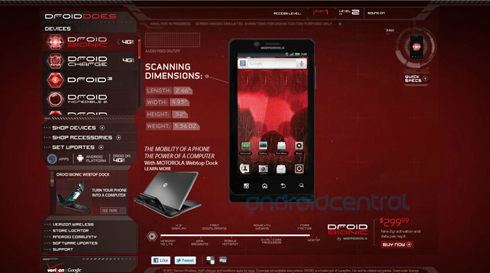
We certainly knew Motorola’s Droid Bionic was on its way to Verizon, but a price was uncertain until now. Android Central has found Verizon’s unreleased Droid Does product page for the Bionic that shows the 4G device at $299 on a two year contract. Ouch! Still no release date, but we’re shooting for early August. Make sure to check out the specs after the break.
If you are a mid/high-end Android lover in the US, but want unlimited data and don’t want to pay high monthly fees, it is hard to beat the Motorola Triumph. It hits a lot of sweetspots:
The best news is that it is hitting Best Buy ahead of its supposed July 20th launch date. Reddit users (via Phandroid) are reporting on walking into the stores right now and picking them up.
The Optimus V launch was the same with people picking them up before the launch at Radio Shack.
You can buy it online here.
Expand
Expanding
Close
Motorola’s Droid 3, now being offered in a Verizon BOGO scheme, has been torn apart by our friends over at iFixit. The latest incarnation of the Droid family (at least until the Droid Bionic arrives this August), packs some serious bang for your buck. Running on a a dual-core 1GHz OMAP processor from Texas Instruments, the handset sports a four-inch qHD display, a five-row slide-out full QWERTY keyboard and an eight-megapixel back camera that can record 1080p clips. The Droid 3’s dual-core 1GHz ARM Cortex A9 processor with 512MB RAM is clearly an improvement over an ARM Cortex A8 core from the original Droid and Droid 2. Unfortunately, iFixIt notes, Motorola paid no attention to the repairability of the handset because “you still have to take apart the whole phone in order to access the display and glass, a procedure hampered by Torx screws and glue that are used to hold everything together”, prompting them to give the Droid 3 a mid-pack 6 out of 10 repairability score.
While the Droid 2 World edition has a SIM card tray in select markets, the Droid 3 includes one by default, making it easy to use the phone internationally. “This SIM enables the Droid 3 to be used almost anywhere in the world”, reads the analysis. Other noteworthy design choices by Motorola: screws and latches are hidden beneath labels (good for the looks, bad for servicing the device), a hole through the motherboard allows sound to pass through for better transmission to the outside of the phone and a five-row slide-out QWERTY keyboard gives you more control, even with the keys feeling “cheaper in quality than the original keyboard”. The innards include an Atmel MXT224E capacitive touchscreen controller – the same chip powering touch-based input on the Samsung Galaxy Tab – a Qualcomm MDM6600 baseband chip for HSPA+ speeds of up to 14.4 Mbps, another Qualcomm-branded chip (PM8028) that works in conjunction with the MDM6600 to provide wireless data connection, 16GB of SanDisk-branded NAND flash, a Hynix memory controller and more.
Disconnecting the eight-megapixel rear camera (left) and removing the motherboard (right)
BOGO, an acronym for “Buy-One-Get-One”, is a marketing tactics some (perhaps iOS fans) are adamant helped boost daily Android activations to over 550,000 handsets. The strategy is again at play at Verizon Wireless, the nation’s leading carrier which put Google’s platform on the map with the original Droid. And now, less than two weeks since the Droid 3’s arrival on the Verizon Wireless network, the carrier is offering the device in a hard-to-resist BOGO deal, reports The Phone Arena. You can take advantage of the offer at Verizon’s web site.
The reason? We’ve heard that there is another 4-inch slider coming to Verizon, but with some LTE’s in the very near future.
The carrier is also taking sign-ups for the Droid Bionic, a Motorola LTE phone which could launch August 4. The Gingerbread-powered Droid 3 features a four-inch qHD display, a slide-out full QWERTY keyboard, a back camera that can record 1080p clips, all thanks to a dual-core 1GHz OMAP processor from Texas Instruments. It costs $200 after a two-year service agreement or $460 contract-free. Would-be buyers should remember that Verizon no longer offers unlimited data plans.

Rooted OS Cyanogenmod has hit 506,046 users according to its stats page. The half-million number comes from 378,4440 official installs and 127,606 unofficial installs. With the amount of Android phones out there, we’re pretty surprised at how low this number is. The top devices include:
- HTC Desire 70,630
- HTC EVO 4G 39,654
- Motorola Defy 28,956
- Nexus One 26,707
- Motorola Droid 21,335
Verizon has launched a sign-up page for their upcoming Motorola LTE phone, the Droid Bionic. The Bionic was announced at CES in January, but had some flaws that needed ironing out. On the sign-up page Verizon says the phone will be available this summer (which is half over already). We reported August 4th could be the launch date — could this still be the case? Head over to Verizon to sign-up and get updates, or just stick to 9to5Google.
According to “industry sources” who spoke to Taiwanese trade publication DigiTimes, Google is about to release Android Honeycomb 3.2 to select tablet makers at the end of July or early August:
Google is expected to release its Android 3.2 OS to production partners at the end of July or early August, according to industry sources. Asustek has indicated it will launch Android 3.2-based tablets soon, while Huawei Technologies also said it will roll out a 7-inch Android 3.2 tablet in the third quarter.
Meanwhile, CNET confirms that Google is already pushing out the Honeycomb 3.2 update to the Motorola Xoom, hoping to bring the software to other tablets “in the near future”.
Android 3.2 is a minor update that will improve hardware acceleration and bring optimization for Qualcomm’s Snapdragon processors that power many top-selling Android smartphones and tablets. The software update will also bring improvements in Google-created apps, including Movie Studio, Movies, Music and Widget. It will also have a new compatibility mode for apps called zoom-to-fill. “Imagine viewing your app at the size of a phone screen then zooming in about 200 percent,” Google explains on the Android Developers blog. And as we explained earlier, this Honeycomb version also takes into account the popular seven-inch tablet form factor, which continues to be in abundance…
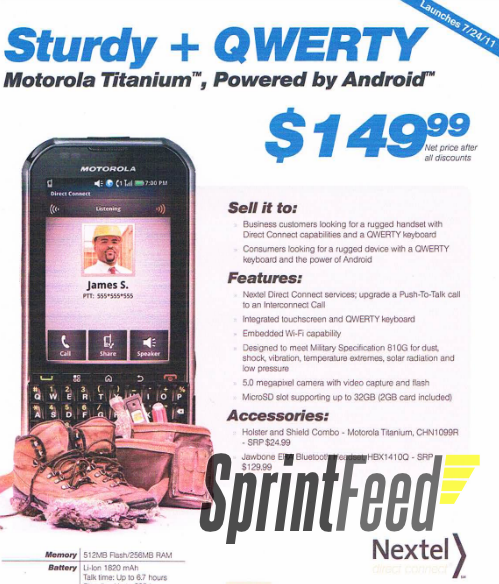
Motorola’s answer to the rugged business phone is the Motorola Titanium, announced with the Xpert over two months ago. We never heard an official release date from Sprint, but SprintFeed is reporting that the Titanium will launch July 24th on Sprint’s network, for $149. The body style of the Titanium reminds us of the Droid Pro, packing a full QWERTY keyboard. Other features include a 5-megapixel camera, 2GB microSD, Wi-Fi, and..
Android 2.1…
WTF..That’s Original Droid two year old vintage software people!
In the flyer above it says the device meets “Military Specifications 810G”, being able to withstand dust, shock, vibration, solar radiation, and low pressure (and recent Android updates).
A feature that we believe could be a great selling point is Nextel’s push-to-talk. The service industry relied on push-to-talk on Nextel’s older phones, and the Titanium could bring it back. We look forward to seeing how this device will work in the field.
Motorola’s Droid 3 has been specc’d and benchmarked well before its June 17 China debut. Three weeks later, Verizon Wireless brings the latest and greatest Droid smartphone to America. A quick reminder: The Droid 3 runs the latest Android 2.3 Gingerbread version, has a four-inch qHD display at 960-by-540 pixel resolution, a slide-out QWERTY keyboard, an eight-megapixel camera with 1080p video capture and a speedy dual-core 1GHz OMAP processor from Texas Instruments. Key thing: It’s available both with the usual two-year wireless contract for $200 and without a contract for $460, direct from Verizon Wireless here. And don’t forget that Verizon no longer offers unlimited data plans. Full release below.
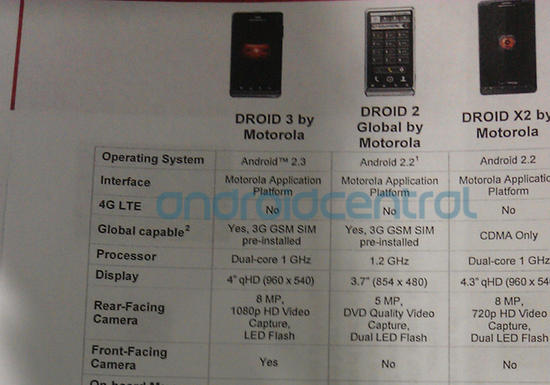
Android Central has gotten their hands on a table showing the Droid 3, Droid 2, and Droid X2 side-by-side. The Droid 2 and Droid X2 are already out on Verizon, but the image above sheds light on what the Droid 3 will be. There isn’t a release date quite yet; we know it’s coming to Verizon at the very least.
The Droid 3 will be sporting Honeycomb, a 4-inch touchscreen, 1GHz dual-core processor, 8MP rear-facing camera, and front facing-camera. The image above also reveals this will be a world phone. We’ll keep you updated about when this phone will drop.
Expand
Expanding
Close
As far as AT&T is concerned, the Atrix is about the best Android Smartphone you’ll find (no disrespect to the monsters Infuse and Inspire). In my February Fortune Review I called it the new”King of the Androids” for its qHD display and dual core processor while still being smaller than a Galaxy S. A lot has happened since then
Today, 9to5toys.com posts one heck of a deal:
With activation of a new 2-year contract, Amazon Wireless offers the Motorola Atrix 4G Smartphone for AT&T Wireless for 1 cent with free shipping. That’s $50 under our April mention and the lowest total price we’ve seen for this phone. (It’s also a current price low by $100.) Sales tax is added where applicable. Features include a 4″ 960×540 color touchscreen, 1GHz dual-core processor, 5-megapixel camera, 720p video capture, microSD card slot, 16GB internal memory, 802.11n wireless, Bluetooth 2.1 +EDR, Adobe Flash 10, USB 2.0 connectivity, and Android 2.2 OS (FroYo). A $36 activation fee applies.
An image leaked yesterday by The Pop Herald suggests a possible successor to the Motorola Droid Pro, which Sprint marketed as the XPRT. In a nod at business users, the yet-to-be-named device packs in a physical QWERTY keyboard, in addition to both capacitive touchscreen and buttons, a possible Sprint 4G WiMax network connectivity and Android 2.3 Gingerbread out of the box:
According to the tipster, the next QWERTY Motorola smartphone is curvier compared to the Motorola XPRT. The tipster added that the physical QWERTY keyboard of the unannounced phone was slightly modified, now with a “smile pattern,” compared to XPRT’s “ruler pattern.”
Considering that Sprint began offering the business-centric XPRT on June 5 of this year, full six months following its November 18, 2010 debut on the Verizon network, here’s to hoping we won’t have to wait that long for this handset.
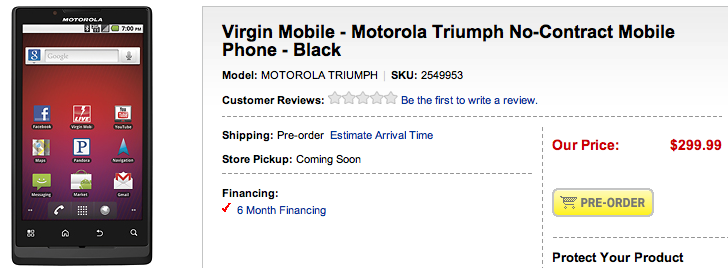
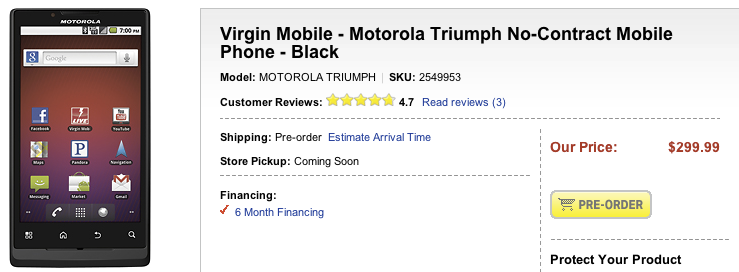
Best Buy just threw up their Motorola Triumph page complete with $299 retail price and anticipated delivery date between July 19 and July 26.

First of all, this is a solid, high end Android phone. It has a 4.1″ screen, fast processor and runs an almost stock Android 2.2 with all of the trimmings…
Expand
Expanding
Close
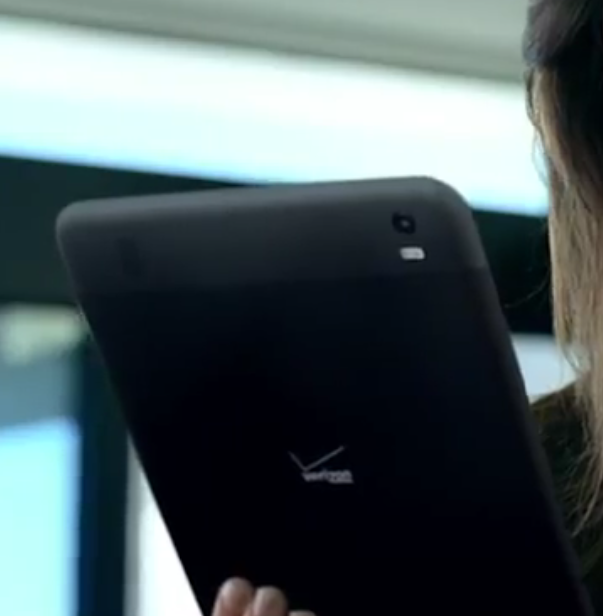
Is Motorola pulling a “Samsung” and going back to the drawing board with their XOOM, prettying and slimming it to match Apple’s iPad 2? The Verizon ad (screenshot above, video below) seems to suggest just that. Hopefully that channel inventory is ready to move because who is going to buy a XOOM now that a thinner version is coming down the pike?
Full video below (via Droid Life):
Expand
Expanding
Close
Motorola’s Droid, the successful smartphone family which put Android on the map, this year enters its third-generation incarnation with the anticipated Droid 3. Surprisingly, Motorola Mobility chose to launch the handset in China under the Milestone 3 moniker, which is a non-US name for the Droid.
Per Motorola’s press release, the handset known as the XT883 will be carried by China Telecom, the country’s CDMA wireless operator. The Android 2.3 Gingerbread device runs on China Telecom’s Surfing 3G cellular network and WiFi networks and supports Android World Phone capabilities in more than 200 countries. The innards are quite beefy…