It feels like this is another step in the tablet optimization direction with the columns being reduced to one.
I am not sure that I’m a fan of this. [Techno-Net via googlesystem]


It feels like this is another step in the tablet optimization direction with the columns being reduced to one.
I am not sure that I’m a fan of this. [Techno-Net via googlesystem]
From 9to5Toys.com:
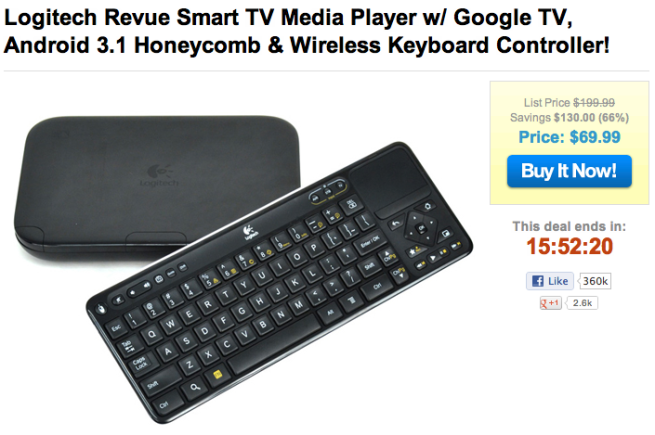
1SaleaDay has the Logitech Revue for $69.99 with $4.99 shipping today only. That’s $30 off current price and less than one third of the original $229 retail price. The Logitech Revue got an update to Google’s latest TV software. This one comes with a full sized keyboard and trackpad.

YouTube, in conjunction with Dell, is streaming music from the Jazz Fest in New Orleans all weekend.
The broadcast will combine live music from across the next three days with pre-recorded highlights from last weekend.
It may be Jazz Fest by name, but it’s not entirely jazz by nature. The diverse lineup this weekend includes Bon Iver, Tom Petty, Trombone Shorty, Grace Potter & The Nocturnals, My Morning Jacket and many more. We’re adding artists all the time, so check-out the official Jazz Fest channel for the latest schedule.
The stream begins at 12pm PT today and runs through 6pm this Sunday. Enjoy!
This is a special guest post written by Steven Troughton-Smith. Follow him on Twitter or his blog.
When Google first showed off Android, the company showed it running on a device very similar to Blackberries or Nokia E-class devices of the time. This device was the Google Sooner—an OMAP850 device built by HTC with no touchscreen or Wi-Fi. This was the Android reference device…and the device Google originally built the OS on.
[youtube http://www.youtube.com/watch?v=1FJHYqE0RDg]
Recently, I got access to a Google Sooner running a very early version of Android. With all the recent information coming out of the Oracle vs. Google trial, I thought it would be interesting to take you on a brief tour of the OS. The build of Android this is running was built on May 15, 2007, which is four months after the iPhone announced. The first M3 version of Android announced in November 2007, and Android 1.0 did not come until a year later….
You’ve been warned. This barrel roll is probably more your speed.
From 9to5Toys.com:
 .
.
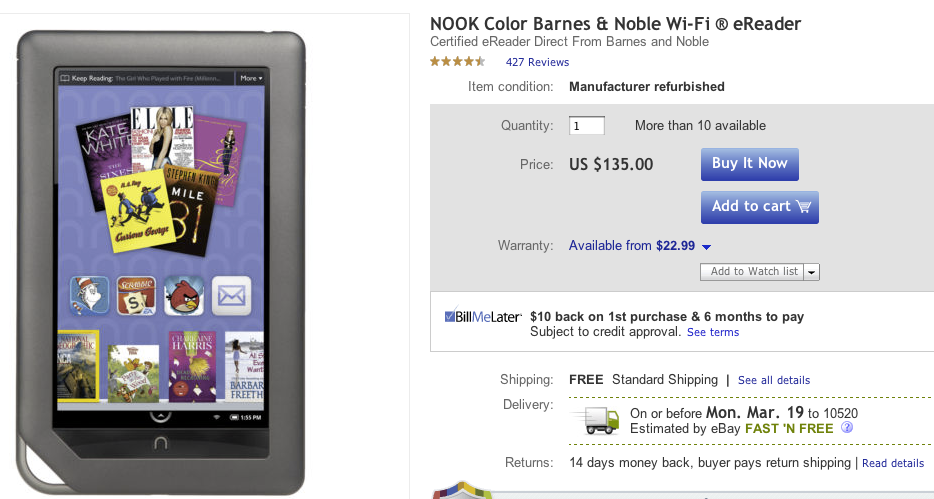
Barnes and Noble via Ebay Daily Deal offers a refurbished version if its Nook Color Tablet for $135 with free shipping. That is $65 off the new price, and it is about the lowest price we have ever seen for a name brand Android tablet. It showcases a 7-inch 1024-by-600 LED-backlit color touchscreen LCD display with extra-wide viewing angles for reading books, magazines, and newspapers in color. Other features of this Google Android-based eBook reader / tablet include 802.11n wireless (with free access in Barnes and Noble stores), 8GB internal memory, microSD card slot, eBook lending, MP3 audio and MP4 video playback, Pandora, and more. A 1-year Barnes and Noble warranty applies.
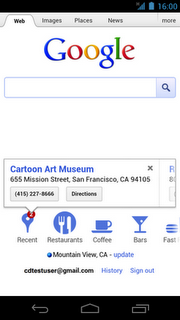
Google rolled out a handy new feature yesterday to its mobile search page on Android and iPhone smartphones that provides access to the list of past places-related search queries. According to a post over at the official Google Mobile blog, the new Recent icon “shows information about places you have recently searched for on any of your devices.” You must be logged in to your Google Account when searching for places (such as the Cartoon Art Museum in San Francisco). Web History must also be enabled. Users can swipe to the right to see more icons for other categories of places.
Next time you are heading to a place you have recently searched for, no need to worry if you can’t remember the address or phone number. Just go to Google.com on your smartphone and tap on the “Recent” icon.
This improvement also allows you to research places of interest on your desktop and view them later while on the go— without having to bookmark or email places’ URLs to yourself. One thing to keep in mind: This information about your previously searched places will be available under the Recent icon for about a day, Google said. This handy new feature is the first in a series of enhancements aimed at unifying search experience across devices.
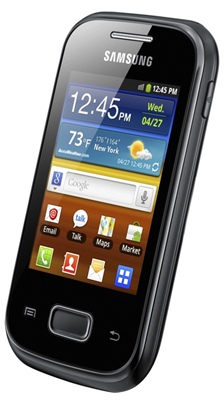
Samsung today announced its latest addition to the Galaxy device lineup, the Galaxy Pocket smartphone seen on the right. As the name suggests, this Android 2.3 Gingerbread device easily fits into your pocket as it is just 12mm thin and weighs only 97 grams.
The diminutive phone packs a 2.8-inch QVGA 240-by-320 pixel resolution display, 832MHz processor, 3GB user memory (expandable to 32 gigs via MicroSD cards), built-in FM radio, and runs Samsung’s upgraded TouchWiz user interface. On the connectivity front, the Galaxy Pocket supports Bluetooth 3.0, Wi-Fi wireless networks, and 3G HSDPA 3.6Mbps cellular networks.
The included social features cover Samsung’s Social Hub and the downloadable ChatON cross-platform communication service. The Galaxy Pocket will be available in Italy starting from March and will gradually roll out to Europe, CIS, Latin America, Southeast and Southwest Asia, the Middle East, Africa, and China. No price points, model numbers, or United States availability information were released at press time.
Spec sheet is above the fold.

According to latest data released on the official Android blog, Android 2.3 Gingerbread and the latest Android 4.0 Ice Cream Sandwich both gained during a 14-day period ending March 5, 2012. Ice Cream Sandwich, the latest and greatest Android version found on the Galaxy Nexus device, is rising slowly. Although, its growth remains hindered by both limited availability of the announced ICS devices and slow roll out of ICS updates to existing devices. It is worth noting that the numbers represent only active Android devices that accessed Android Market in the past 14 days.
Ice Cream Sandwich (Android 4.0) powered 1.6-percent of all active devices in the past 14 days, a 0.5-percent increase. Gingerbread (Android 2.3) also grew to 62 percent, up from 58.6-percent in February, which likely due to a greater number of inexpensive and entry-level Gingerbread handsets hitting the market. Froyo (Android 2.2.) still accounts for one-quarter of all active devices. Éclair (Android 2.1) fell to 6.6-percent, and Donut (Android 1.6) and Cupcake (Android 1.5) together accounted for 1.2-percent of active devices.
Google also said in a blog post that Android apps could now be larger than 50 megabytes in size.
More information is below.
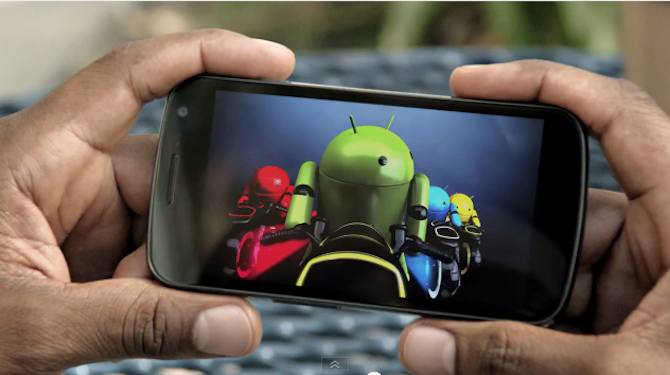
Apple’s latest cunning move in its Holy Crusade against Android involves getting a court order to force Google, the maker of Android software, to produce documents detailing the Android roadmap and its proposed $12.5 billion acquisition of handset maker Motorola Mobility. It was not immediately clear what data Apple was exactly seeking to uncover. This is notable, because Apple is actually going after Google with this request. It is the first direct in the ongoing legal war considering Apple fought Google by proxy in the past.
According to Bloomberg, U.S. Circuit Judge Richard A. Posner ruled yesterday based on a patent lawsuit Apple filed in 2010 against Motorola that both Motorola and Google must spill relevant information to Apple, as “the Android/Motorola acquisition discovery is highly relevant to Apple’s claims and defenses.” Motorola, of course, opposed the request, offering the following argument.
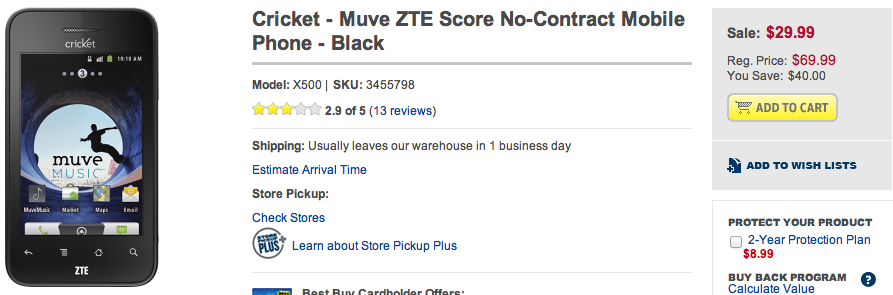
If you still do not own an Android phone and cannot afford one of them high-end superphones, this is one of the best deals we have seen to date. Over at Best Buy, the Muve ZTE Score smartphone from Cricket Wireless can be yours in exchange for only $29.99. How sweet is that? That’s your fully unsubsidized price for a contract-free Android handset—down from its regular $69.99 price point. Keep in mind that $30 is what people pay to AT&T each month for their 3GB smartphone tethering plan.
Just because it is cheap does not mean it is worthless. Quite the contrary, the Muve ZTE Score runs Android 2.3 and has a 3.2-megapixel camera, 3.5-inch HVGA capacitive touchscreen, 4GB microSD card, and a little QWERTY keyboard with that nice clicking feel to it. It also does Wi-Fi, Bluetooth, and 3G connectivity. It is your most affordable ticket into the Android world, even if you only intend on using it as a machine to run Android apps. Moreover, it is only 4-months-old.
http://vimeo.com/37918278
Software giant Microsoft took to video sharing service Vimeo to disseminate its new commercial promoting the Internet Explorer 9 browser. Tentatively named “A More Beautiful Web,” it features a soundtrack by Alex Clare and fast-paced (albeit a tad amateur-looking) MTV style editing. Both treats are not usually associated with neither the Microsoft brand nor the company’s dull television advertising.
While watchable, it does not hold a candle to Google’s memorable Chrome advertising. The 60-second video highlights the browser’s headlining features, such as hardware-assisted canvas rendering, high-definition video playback, rich web apps like Chillingo’s “Cut the Rope” game, and more.
Two important observations here:
1. The commercial was a Vimeo exclusive at post time— despite Microsoft’s official presence on YouTube, including the Internet Explorer team’s channel. It is interesting that Microsoft chose to tap a rival video sharing service and not leverage the world’s most popular destination for online video to get the word out. An anti-Google move, cynics might say.
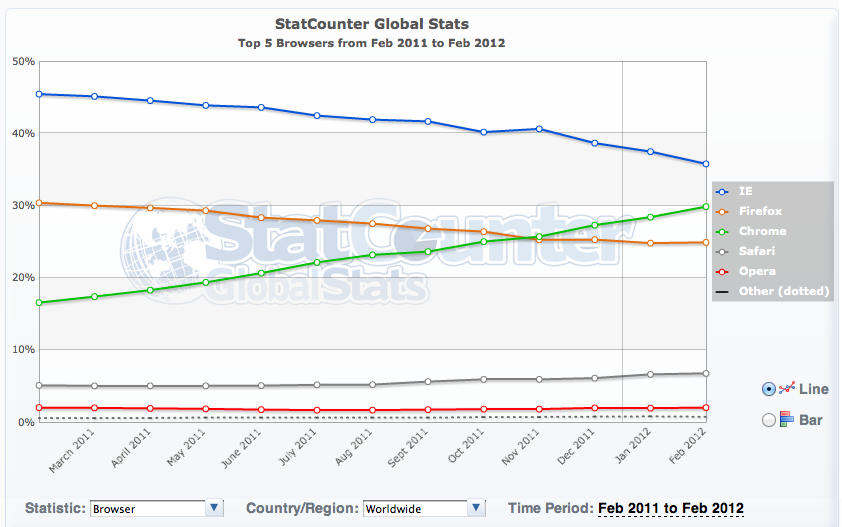
2. Per data from StatCounter (see the chart below), the Windows maker’s possible motivation to bypass YouTube likely includes Internet Explorer’s continuous downward spiral. It has been a trend, not a temporary hiccup. Last summer, Google’s Chrome claimed one-fifth of the worldwide market for browsers and is now No. 2 in some key markets that traditionally favor Microsoft’s product.
Microsoft appeared late to the party and has lost momentum in browser innovation that now almost exclusively belongs to Google and —in small part— to Apple and its Safari browser. If it were not for big businesses’ reluctance to upgrade to a more modern browser, Internet Explorer would already be severely beaten in browser wars.
The writing has been on the wall for quite some time, indeed.
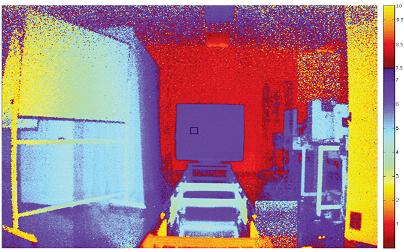
A sample range image taken by Samsung’s new CMOS sensor
Samsung Electronics, a South Korea-based consumer electronics conglomerate, is right on track to début commercially feasible flexible displays within a year and has taken the wraps off a new CMOS sensor for smartphones and tablets that can capture depth information and the usual RGB color data.
According to OLED-Display.net, Samsung Mobile Display confirmed it would begin mass production of flexible AMOLEDs in 2012. The firm will add two new production lines to build flexible OLED displays. Samsung executives previously confirmed plans to build phones and tablets featuring flexible display technology some time this year with spokesman Robert Yi going on the record about the matter:
The flexible display, we are looking to introduce sometime in 2012, hopefully the earlier part. The application probably will start from the handset side.
As for the sensor, go past the fold for additional information.
[youtube=http://www.youtube.com/watch?v=tZkU-GEZ72s]
Expand
Expanding
Close
[slideshow]
The OnLive Desktop app launched today on Android Market and costs $5, just like its iOS counterpart that released about three weeks ago. Tapping the power of the cloud and leveraging OnLive’s streaming technology that powers its on-demand gaming service, the OnLive Desktop app puts a Windows 7 virtual machine right at your fingertips and on an Android tablet. You also get access to Microsoft Office applications and 2GB of free cloud storage. The app requires Android 2.3 and is tested on the Acer Iconia Tab A500, Asus Eee TF101, Motorola Xoom, Samsung Galaxy Tab 8.9, 10.1, and HTC Jetstream.
The release notes are below.
[youtube=http://www.youtube.com/watch?v=Ui1SzY6OZDk]
I am a huge fan of National Geographic’s documentaries on the narcotics industry, especially shows like “Drugs, Inc.” and “Banged Up Abroad.” To be perfectly clear, I am enjoying them for educational purposes only. Now, touching on this age-defining question, Versus from Intelligence2 teamed with Google to bring a debate on the drugs industry to its users.
It is chaired by BBC newsreader and presenter Emily Maitlis and will also feature WikiLeaks founder Julian Assange, British tycoon Richard Branson, English entertainer Russell Brand, the former presidents from Mexico and Brazil, and others.
It is the first in a series of global debates in co-operation with Versus that will occur through Google+ Hangouts and stream on YouTube. A post over at the official Google blog said the first motion up for debate is: “It’s time to end the War on Drugs.” You can join the hangout on Google+ here.
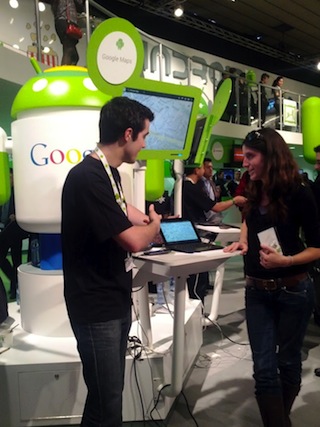
The Android team announced today in a post over at Google+ that Google’s mapping service on Android won the Best Consumer Mobile Service Award at the Mobile World Congress show in Barcelona, Spain. For mobile users, the Google Maps mobile app, including Google’s other location and mapping offerings, is a reason alone to get an Android handset as many would not be able to get around without it. Though Apple also has a native iOS Maps app that taps into the Google Maps backend, and Google itself provides a surprisingly capable web app, Google Maps for mobile looks and works best on Android smartphones. Perhaps not surprisingly, the latest and greatest Maps features début on Android first. For example: Advanced (and free) turn-by-turn GPS navigation for driving, and walking and public transit directions with 3D views that integrate nicely with Google’s other location-based services like Latitude and Places.
In case you were wondering, the Device Manufacturer of the Year award went to Samsung, which also got the Best Smartphone award for the Galaxy S II. New features in Google’s location-based products are now introducing regularly. The latest update to the Google Maps for Android app brought improved transit navigation and more accurate positioning and indoor maps. Google has a nice interactive overview of Google Maps for newbies here.
Expand
Expanding
Close
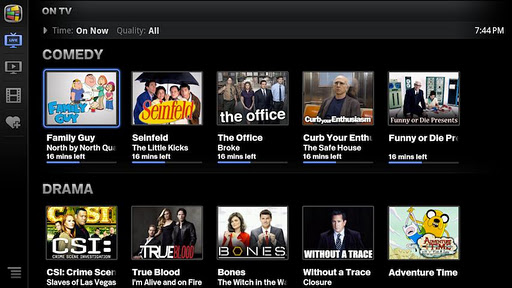
Google and its partners do not divulge Google TV sales data. This makes figuring just how many Sony Google TV units and Logitech Revue boxes there are in the wild anyone’s guess. According to GigaOM, less than a million of Google TV 2.0 devices by Sony and Logitech are in active use. The publication came to this number by observing Google’s own install data in Android Market for the Movies & TV app for the Google TV platform. This program is part of the Google TV 2.0 software update, so it gives a clue on the number of Google TVs:
The active install base for this app, according to Google’s Android Market, currently is 500,000 to 1 million. The same is true for all the other apps that come pre-installed with Google TV, which suggests that the number of Google TV devices that are currently being used by consumers is less than 1 million.
There is a problem with GigaOM’s logic, however, as it is assuming everyone updated to the Google TV 2.0 software. The update is available to all Google TV 1.0 devices, but many folks might not have upgraded. They either do not care or their set-top box is sitting in the trashcan not being used at all…
Expand
Expanding
Close
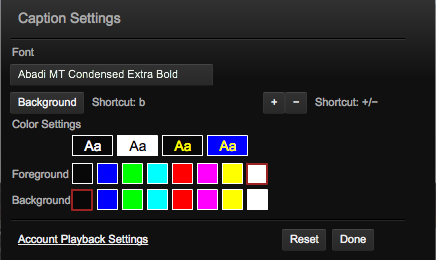
YouTube is bringing new capabilities to its popular captioning feature, according to today’s blog post by the search engine giant. The company added Japanese, Korean, and English language to auto-captioning and transcript synchronization features. Captions and subtitles are now supported in 155 different languages. Movies and Shows information finally show available subtitle languages, and users can now search for memorable quotes in closed captions.
This is accomplished by adding “, cc” to any search or clicking Filter > CC after searching to only see results with closed captions. The CC icon in the bottom-right of the video player now lets you change the font size or colors for captions. YouTube now supports broadcast captions for precise positioning and styling (check out this demo) in various industry formats, such as .SCC, .CAP, EBU-STL and closed captions created for TV or DVDs or those in MPEG-2 files with CEA-608 encoding…
[slideshow]
If you are not attending the Mobile World Congress 2012 show now underway in Barcelona, Spain until March 1 but want to stay on top of the latest trends in mobile, worry not as Google just released the official MWC app for Android devices. Called “Android MWC” and available as a free download from Android Market, this useful little program lets you check out Google Mobile apps featured at the show, retrieve information on the company’s featured partners and events, browse booth and partner maps, check out videos, use the Android Pin checklist to keep track of your Android pins and more.
Release notes are after the break.
[youtube=http://www.youtube.com/watch?v=Lz5u_2dQzkA]
Samsung Electronics joined forces with Angry Birds maker Rovio in a partnership that will see the two companies market Samsung’s mobile devices and Rovio’s upcoming game Angry Birds Space. A new trailer released featuring Angry Birds Space on Samsung’s Galaxy Note ahead of the game’s official launch announcement on March 8. Angry Birds Space is due to hit iOS, Android, PC, and Mac on March 22.
It is interesting that Rovio also partnered with NASA for rights to use its famous Moon landing footage in an Angry Birds Space teaser (included after the break). The deal is a nice fit for the South Korean consumer electronics conglomerate that rose to become the leading Android vendor. Samsung is also looking to expand its presence in the gaming space, if a patent filing discovered by Patent Bolt is anything to go by.
[youtube=http://www.youtube.com/watch?v=FBYMDs_RFeI]
Handset maker Motorola Mobility may have found itself in an uneasy place as both Microsoft and Apple are attempting to block its $12.billion sale to Google, but the company’s marketing department is as vigorous as ever. With this week’s spotlight on the latest mobile developments showcased at Mobile World Congress 2012 in Barcelona, Spain, the Razr-maker published three provocative clips on its YouTube channel.
The videos pit the iPhone 4S-exclusive Siri feature against Android Voice Actions running on three different handsets: The Atrix 2, Photon 4G and Electrify. In each instance, Siri runs notably slower (and therefore less useful) than Android Voice Actions on Motorola’s devices.
Both Android Voice Actions and Siri need a network connection to upload audio samples of spoken queries. The cloud does the rest–speech recognition, parsing your query and beaming down the results. With that said, the performance gap that these clips highlight stems from the faster 4G networking on Motorola’s devices and has little to do with the type of processor, the amount of memory and other hardware features.
Two more clips are right below.
Chip maker Qualcomm today introduced three new Gobi modem chipsets at Mobile World Congress in Barcelona, Spain and an improved version of the Snapdragon S4 chip for high-end smartphones. The 28-nanometer third-generation MDM8225, MDM9225 and MDM9625 support both LTE-Advanced and dual-carrier 84Mbps HSPA+ Release 10 cellular networks (perhaps fitting in T-Mobile USA’s 2012 plan). If that’s not speedy enough: The MDM9225 and MDM9625 can go all the way up to 150Mbps, because they support LTE Category 4 with carrier aggregation technology.
All three pieces of silicon are backwards compatible with today’s popular standards, including EV-DO Advanced, GSM, TD-SCDMA, FDD and TDD. The MDM8225 chipset supports UMTS-only devices, the MDM9225 chipset supports LTE and UMTS devices, and the MDM9625 chipset supports LTE, UMTS and CDMA2000 devices. All three chipsets will begin sampling in Q4 2012. Compared to Qualcomm’s previous MDM9x15 series (see below the fold), the new chips offer a reduction in power consumption and overall board area that allow for smaller devices with longer battery life.
Qualcomm also launched today an improved version of the Snapdragon S4 system-on-a-chip that powers about 340 mobile devices. It has notably faster graphics, supports Windows 8, includes dedicated hardware to accelerate Windows and fully supports the top game engines in the industry from Unity, Epic and others.
More on the new Snapdragon S4 “Pro” chip and full press releases are after the break.
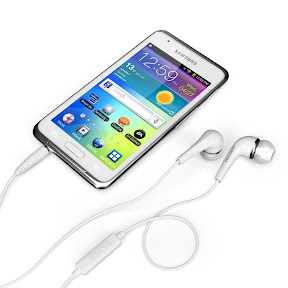
Samsung Mobile today took the wraps off the Galaxy S Wi-Fi 4.2—its latest addition to the Galaxy-branded media player lineup. A missing link between the 4-inch and 5-inch Galaxy Player, the Galaxy S Wi-Fi 4.2 is just 8.9mm thin and sports a 4.2-inch 800-by-480 pixels LCD display with premium IPS technology offering wide viewing angles. There is a VGA-class videoconferencing camera on the front and a two-megapixel camera on the back.
The gizmo is powered by a gigahertz chip with 512MB RAM, packs in 8GB/16GB storage, and it has a MicroSD slot for up to 32GB storage through memory cards. Connectivity features include Bluetooth 3.0 and Wi-Fi 802.11 b/g/n. Software-wise, the Galaxy S Wi-Fi 4.2 runs Android 2.3 Gingerbread and Samsung’s TouchWiz user interface.
It is essentially an entertainment/gaming/PMP device, because the Galaxy S Wi-Fi 4.2 comes preloaded with Samsung Apps, Hubs, a Smart TV remote control program and premium EA games. The South Korean company did not reveal pricing or availability details, but if history is an indication, its price will likely compare to Apple’s current-generation iPod touch that starts at $199. The introduction of the Galaxy S Wi-Fi 4.0 further solidifies Samsung’s strategy calling for a variety of screen sizes across its mobile lineup that now includes Android smartphones, media players and tablets offered in a wide variety of sizes extending from the smallest 3.2-inch to the 10.1-inch flavor.
