Apple

See All Stories

Amazon prepping Android-powered tablets for “hundreds less” than Apple’s iPad

Site default logo image

According to the New York Post (via BGR), Amazon is getting ready to launch their rumored Android-powered tablets with a price tag “hundreds less” than Apple’s current $499 base model iPad 2. “Hundreds less” sounds a lot like $299.

The devices, expected to launch sometime in October, will more than likely be the result of the entry-level tablet codenamed “Coyote” and it’s pro-model counterpart the NVIDIA T30 Kal-El powered “Hollywood”. We told you about these devices back in May, which will most likely be powered by a highly customized Amazon version of Android (bringing with it Amazon services like the Appstore, Kindle eBook store, Amazon Videos, music and possibly brought together by the Cloud Drive).

Amazon is clearly prepping a huge move into the tablet market. We reported this week that the company signed up a third touch panel supplier, and that was after recently becoming the second largest buyer of tablet-related parts – without yet having released a tablet.

Expand
Expanding
Close

Vic Gundotra: Steve Jobs asked me to fix the yellow gradient of the Google icon on iPhone

Site default logo image

<

Joining other reactions on the web to Steve Jobs’ sudden resignation as the CEO of Apple yesterday, Google’s vice president of engineering Vic Gundotra recalled on Google+ a particular Sunday in January 2008 when Apple’s boss asked him to call his home. The reason? The Google logo on the iPhone:

So Vic, we have an urgent issue, one that I need addressed right away. I’ve already assigned someone from my team to help you, and I hope you can fix this tomorrow. I’ve been looking at the Google logo on the iPhone and I’m not happy with the icon. The second O in Google doesn’t have the right yellow gradient. It’s just wrong and I’m going to have Greg fix it tomorrow. Is that okay with you?

The following day, the world’s greatest product developer followed-up with an email message with the subject “Icon Ambulance”, directing Vic to work with Greg Christie to fix the icon. MacRumors dug up the Google logo icon back from those days, shown below. Of course, Steve Jobs’ penchant for calling people in the middle of the night is legendary. Gondotra acknowledges that “it was customary for Steve to call during the week upset about something”. A 2004 Bloomberg interview quotes Jobs’ approach to product design and calling unexpected ad hoc meetings:

Innovation comes from people meeting up in the hallways or calling each other at 10:30 at night with a new idea, or because they realized something that shoots holes in how we’ve been thinking about a problem. It’s ad hoc meetings of six people called by someone who thinks he has figured out the coolest new thing ever and who wants to know what other people think of his idea.

Vic, who is in charge of engineering at Google and as such had been in direct competition with Apple’s former boss on multiple fronts, has more praise for Jobs’ leadership qualities:


Expand
Expanding
Close

Samsung cites Stanley Kubrick’s ‘2001: A Space Odyssey’ as prior art argument against iPad design

Site default logo image

You may have heard about “prior art”. In patent law, prior art is basically all information made available publicly before a date which might be relevant to a patent’s claims of originality. Hence, if any invention can be described in prior art, its patent can be invalidated. Samsung is resorting to some pretty sci-fi (literally!) arguments in its legal spat with the Cupertino gadget maker, having gone as far as citing Stanley Kubrick’s ‘2001: A Space Odyssey’ movie as prior art against Apple’s tablet.

The finding, discovered by intellectual property expert Florian Mueller on his blog FOSS Patents, stems from page two of an exhibit Samsung filed with the U.S. District Court for the Northern District of California. The document reads:

Attached hereto as Exhibit D is a true and correct copy of a still image taken from Stanley Kubrick’s 1968 film “2001: A Space Odyssey.” In a clip from that film lasting about one minute, two astronauts are eating and at the same time using personal tablet computers. The clip can be downloaded online at http://www.youtube.com/watch?v=JQ8pQVDyaLo. As with the design claimed by the D’889 Patent, the tablet disclosed in the clip has an overall rectangular shape with a dominant display screen, narrow borders, a predominately flat front surface, a flat back surface (which is evident because the tablets are lying flat on the table’s surface), and a thin form factor.

The prior art claim is in Samsung’s defense against Apple’s motion for a preliminary injunction. The company recently claimed in a Dutch court that Apple doctored Galaxy smartphone images.

Cross-posted on 9to5Mac.com


Expand
Expanding
Close

Google could fight Apple with just 18 of Motorola’s 17000+ patents

Site default logo image

You probably know by now that Google’s move to acquire Motorola Mobility for $12.5 billion was seen as one specifically focused on acquiring their more than 17,000+ patents, many of which are thought to be key in protecting Android from other smartphone makers (Apple and Microsoft) in court. However, according to a report from Bloomberg, only 18 of those patents will be essential in fighting patent-infringement related cases against, namely, Apple.

According to CEO of ICAP Patent Brokerage Dean Becker (“global leader in intellectual property brokerage”) Google only needs a few of the 17000+ patents to protect it’s mobile IPs, he added:

“There are a lot of sweet patents in that portfolio…”- Dean Becker, ICAP Patent Brokerage 

The patents cover a little bit of everything that we’ve come to expect from a smartphone; touch-screen gestures, antenna designs, location-based services, email,etc. Among some of the more notable patents that will certainly provide value when protecting Android include one from 2001 that details disabling a “touch sensitive” display that detects a user’s head in relation to the device to prevent accidental input (sound familiar?), another shows a feature that would allow users to control when their location data is sent over a network via GPS (lack of these types of features were recently the subject of debate at a senate judiciary hearing in May where Apple and Google were questioned on their practices in relation to user location data). Other noteworthy patents include one related to increasing data storage for users and others that detail features we see in most modern smartphones.

Motorola, even before being acquired by Google, was and still is involved in mobile related legal issues. Most recently Apple filed patent-infringement complaints with the ITC in October, and also sued the company in civil court for “a pattern of unfair, deceptive and anticompetitive conduct”. Claims which also mirror those of Microsoft. Motorola seems to be confident in their patents, however, by going after Apple in lawsuits on three separate occasions and filing their own complaint with the ITC.

Expand
Expanding
Close

Mozilla wants web apps to compete with native iOS and Android apps

Site default logo image


Apple and Google are clearly the two front-runners competing for market share in the mobile world, which is why it’s no surprise we think of iOS and Android when we think of apps. With the growth of the smartphone industry also came the resurgence of native apps (thanks largely in part to Apple’s App Store which still dominates the space). However, Mozilla hopes that web apps will soon mature to provide a comparable experience for end users and an even better alternative for developers.

“We are aiming at providing all the necessary APIs to build a basic HTML5 phone experience within the next 3-6 months”

While Chrome OS has shown promise, it isn’t the only browser-based platform planning on entering the web app space… If Mozilla has its way, developers can use the results of their new WebAPI project to build an “HTML5 phone experience” that’s compatible across all operating systems (whether it’s Android, iOS, Windows Phone, etc).

A report from CNET claims Mozilla has plans for the APIs to “interact with a phone’s dialler, address book, contacts list, and camera”, essentially giving you access to the same functionality of native apps but directly in your device’s browser.

The WebAPI project certainly isn’t trying to create a full-blown operating system. However, working hand in hand with Mozilla’s Boot to Gecko project, which aims to build a “complete, standalone operating system for the web”, it could create a potentially compelling alternative to Google’s browser-based Chrome OS.

It appears that Mozilla is serious about the project, as a report from CNET claims they’re in the process of hiring full time programmers and plan to have the basics in place by February.
Expand
Expanding
Close

Apple submits more doctored images in Samsung case to courts in Netherlands

Site default logo image

According to a report from Dutch publication Webwereld (via Computerworld), Apple has once again submitted doctored evidence related to their claims of design patent-related infringement by Samsung, this time to a court in Netherlands. This further supports claims by Bas Berghuis of Simmons and Simmons (Samsung’s lawyer) that Apple has been “manipulating visual evidence, making Samsung’s devices appear more similar to Apple’s.”

“It surprises me that for the second time incorrect presentations of a Samsung product emerge in photographic evidence filed in litigation,” said Mark Krul, lawyer and IP law specialist at Dutch firm WiseMen. “This is not appropriate and undermines Apple’s credibility both inside and outside the court room.”

If you aren’t up to speed with the legal disputes between Apple and Samsung in Europe… a court in Germany already granted a preliminary injunction halting sales of Samsung’s Galaxy tab 10.1 tablet in the EU (which has been since lifted pending an appeal). We already heard about Apple manipulating images in that case related to the iPad and Galaxy tab. This time, however, the report claims Apple doctored images of the Samsung Galaxy S smartphone in comparison to the iPhone 3G.

Apparently the changes made the Galaxy S appear smaller than it actually is to closer resemble the dimensions of the 3G, which is odd given the fact Computerworld reports Apple has confirmed the Galaxy S does include “some non-identical elements, such as the slightly larger dimensions.” This supports the idea that Apple isn’t trying to secretly submit this evidence to the courts. Many have noted a German court’s decision to grant Apple with the original preliminary injunction on the Galaxy tab didn’t take the doctored images into account. In fact, patent expert Florian Mueller noted “the court’s decision was based on both Apple’s motion and Samsung’s pre-emptive opposition pleading” and also stated “Samsung is in a legally weak position against Apple. If Samsung wants to inspire confidence, it has to understand that half the truth is sometimes tantamount to a whole lie.”

While the cases in Europe are receiving the majority of media attention, there are also lawsuits pending between the two companies here in the U.S. A report from EdibleApple outlines the case in which Samsung appears to be trying to stall, while Apple pushes for a mid 2012 trial for patent related claims filed by both companies.

Apple explains :  
Expand
Expanding
Close

Who has the most patents? Google’s patent portfolio strengthens thanks to Motorola, but still falls short

Site default logo image

It’s no secret patent-related legal disputes have become the subject of most media coverage lately…Whether it’s Apple halting sales of Samsung’s tablets, HTC going after Apple, or Google snatching up Motorola to beef up their patent portfolio, it’s clear the company with the most patents will have an advantage over others in the legal proceedings that we’re bound to continue encountering down the road. This is why we’re intrigued by the graphic above (via GigaOM) from mobile analyst Chetan Sharma charting the number of issued patents (in the US and Europe) between 1993 and 2011.

While these estimates of mobile communications related patents don’t take the quality of patents into account (which is obviously a huge factor in determining their long-term value), you can see from the breakdown below that Nokia and Samsung top the list, with the other expected players including IBM, Microsoft, Sony, Motorola, and Intel following.

Noticeably far down the list is Apple, the one company who seems to have had more success than others fighting patent-related issues recently. Again, these numbers in no way represent the quality of patents and the ability for companies to protect their IPs in the courtroom… which is also a good indication that perhaps we should be looking more closely at the quality of patents rather than the sheer number.

Expand
Expanding
Close

Google, the accidental hardware company?

Site default logo image

The smoke has cleared on Google’s $12.5B purchase of Chicago-based Motorola and now that almost everyone has had a chance to speak, I think we’re starting to understand what went down.

Google purchased Motorola (MMI) for $12.5B, a 63% premium over its weekend closing price.  Motorola, however, has around $3B in cash and securities, which makes the real purchase a slightly more reasonable $9.5B for Google.  For instance, if Google wanted to slice and dice Motorola, they’d take the cash and patents and sell off the cable box and device divisions for a couple billion dollars each and come away with about what they would have paid for Nortel – and get double to triple the patents. On sheer numbers of patents alone, it seems like a good buy. Obviously some patents are worth more than others.

If the deal doesn’t go through, Google owes Motorola $2.5B for the trouble, so Google is dead serious about this play.

But back to what Motorola does: They have IP, they make smartphones, they make tablets and they make cable top boxes.  It seems like almost too good a setup for Andy Rubin’s Android to just want to sell off piecemeal.

But did Google want to pick up a hardware company?  I reported earlier this year that the Android Hardware division that Andy Rubin had started up with former Danger Co-founders had intentions to build physical devices, not just Operating Systems.

That scale is what attracted and the former Danger founders to get the band back together, with their goal being to build the hardware and features they want to see show up in new Android devices. It’s not enough for Google to just provide Android software to carrier — now they hope to influence what handset makers build, too.


Expand
Expanding
Close

Kodak Rumored To Be Starting Its Own Patent Auction

Site default logo image


According to the Wall Street Journal, Kodak has started the process of auctioning off some or all of its lucrative patents. Kodak’s demise is well documented as the once $30B company has seen its market cap slide to around $800m as the digital imaging company has continuously lost share to competitors. According to the WSJ one potential bidder is “a large, strategic buyer in the wireless industry looking to use the patents for defensive protection.”

This news comes on the tails of this past Monday’s acquisition of Motorola Mobility by Google for a whopping $12.6B in cash. Google has long been rumored as potential suitors of multiple patent-holding companies such as InterDigital, Kodak and of course Motorola Mobility. If these Kodak patents do sell, they will not gather nearly as high of a price as the Motorola deal, but could likely see Kodak’s stock take a nice move up.  This morning’s news of one analyst saying Kodak’s patents could be worth 5x the company’s market cap sent shares up more than 25% and are currently up more than 5% in after hours trading on the latest Wall Street Journal news.  Meanwhile, InterDigital saw a pop in its shares today as another rumor was swirling that an auction will take place after Labor Day weekend and that there are multiple interested parties.
Expand
Expanding
Close

TNM does Steve Jobs reaction to Google’s acquisition of Motorola

Site default logo image

[youtube=http://www.youtube.com/watch?v=8R3V9qjzD40]

The $12.5 billion acquisition of handset maker Motorola has spurred an intense debate on the web as to what Google might do with the company and whether or not it could affect Apple negatively. Unfortunately for us tech watchers, neither Apple nor its boss – who’s been on a medical leave of absence since January – have reacted publicly thus far. Heck, even Microsoft voiced its opinion. Taiwan based Next Media Animation took it upon themselves to illustrate how Apple’s head honcho might react to the deal and what it could possibly mean for you and me. The YouTube description teases:

Motorola was once at the forefront of mobile communications, but has lost its way. Meanwhile, one-trick pony Google is desperately searching for a second act.

Check out the full animation embedded above or watch it on YouTube.


Expand
Expanding
Close

Galaxy Tab 10.1 drops to $430 at MacMall

Site default logo image

From 9to5toys.com:

.

MacMall has a new Samsung Galaxy Tab 10.1 for $429 with free shipping. That’s a few hundred off of retail and a pretty solid price for the king of the Android tablets. This wireless-only Android tablet (no 3G connectivity) features a 10.1″ 1280×800 touchscreen LCD, 16GB memory, 802.11n wireless, Bluetooth, built-in GPS, 2-megapixel front camera, 3-megapixel rear camera, Android 3.1 OS (Honeycomb), and more.
Expand
Expanding
Close

Apple may have provided wrong evidence in European Samsung case

Site default logo image

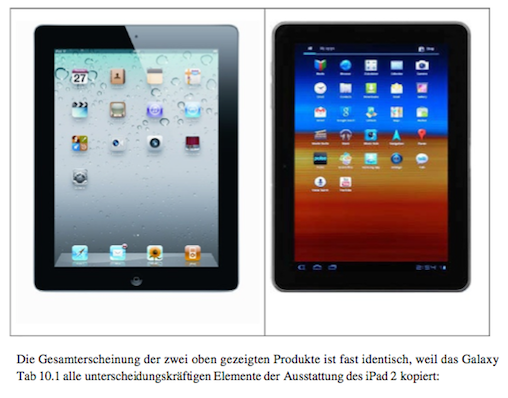
In their case against Samsung in many European countries, Apple may have provided wrong evidence to the judge. As found by a Dutch IDG publication called Webwereld.nl, Apple has provided photoshopped images of a Galaxy Tab side-by-side an Apple iPad 2.

The image above was found on Page 28 of the German legal documents, showing the Galaxy Tab and iPad 2, and Apple saying that the “overall appearance” of two products is “practically identical.” But what’s funny is that’s not really what the Galaxy Tab looks like..

The image that Apple’s lawyers provided is cropped and the aspect ratio is distorted. Samsung’s official measurement for the aspect ratio is 1.46, but in the image above it is 1.36. This leaves the bottom actually 8% wider than it really is. This photoshop maneuver made the Galaxy Tab appear more like the iPad, Apple’s actual argument, than it really is. The iPad’s aspect ratio is 1.30. Now, it’s up in the air if Apple’s lawyers did this on purpose or not. (via Computerworld)

Check out an image with measurements after the break:


Expand
Expanding
Close

Google didn’t actually want the Nortel patents, just drove up the price

Site default logo image

Newsweek Technology Editor Dan Lyons makes some great points this morning regarding Google acquiring Motorola Mobility for $12.5 billion. First he talks about TechCrunch MG Siegler’s remarks that Google made themselves “look like huge asses in retrospect”. Lyons pretty much says Siegler’s opinions were just foolish. Lyons also makes an interesting point that Google most likely didn’t actually want the Nortel patents, they were just driving up the price for Apple and Microsoft with their PI (3.14 billion) bid.

And today it all makes sense. Google just sandbagged its rivals. The whole thing was a rope-a-dope maneuver. Google never cared about the Nortel patents. It just wanted to drive up the price so that AppleSoft (those happy new bedmates) would overpay. Today, with the Motorola deal, Google picks up nearly three times as many patents as AppleSoft got from Novell and Nortel. More important, Google just raised the stakes in a huge way for anyone who wants to stay in the smartphone market.

In the end of things, Google is earning 3 times the patents than they would have in the Nortel deal, but for three times the price. One last word from Lyons:


Expand
Expanding
Close

Browse Google+ on the desktop with Tab for Google+

Site default logo image

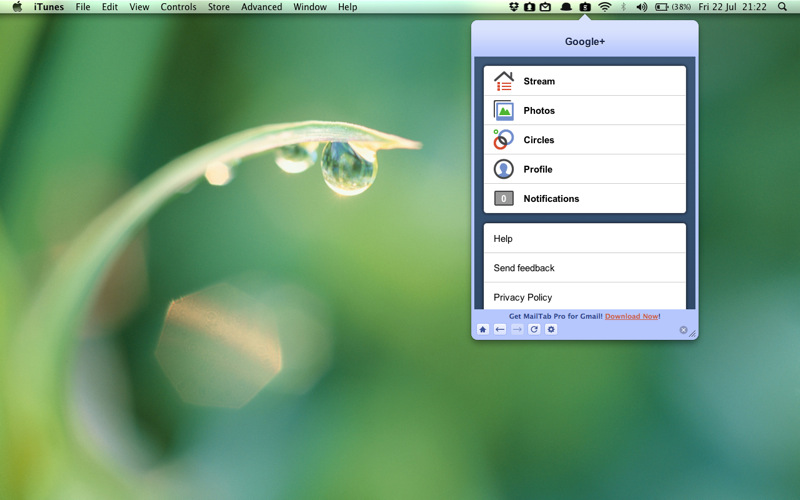
Tab for Google+ is an app available on the Mac App Store that brings Google+’s web functionality to the Mac desktop. The app is available for free and offers just about every feature plus.google.com offers — except Hangouts. Upon logging in via your Google account, you’ll be greeted with the main sections of the app: Streams, Photos, Circles, Profile and Notifications.

The sections follow suit with the functionality of the website. Streams and Photos curates content from the people you’re following. Circles allows you to see your list of circles and the content coming in from each specific one. Lastly, Notifications let’s you know what’s going on with your account.

Of course, this application won’t replace Google+’s website, rather it’s just a nice app that sits in your applications bar to view while you work. Perhaps if the website is more your thing, check out Google+ for Mac which is essentially just a browser window. We’re hearing the developer is working to make it native though. Check out another screenshot after the break:

Download Tab for Google+ Download Google+ for Mac


Expand
Expanding
Close

Updated: Samsung Responds… Apple stops Samsung Galaxy Tab 10.1 distribution in European Union

Site default logo image

Update: Samsung has issued the following statement (via TNW) addressing the court’s decision to grant Apple the preliminary injunction:

Samsung is disappointed with the court’s decision and we intend to act immediately to defend our intellectual property rights through the ongoing legal proceedings in Germany and will continue to actively defend these rights throughout the world.

The request for injunction was filed with no notice to Samsung, and the order was issued without any hearing or presentation of evidence from Samsung.

We will take all necessary measures to ensure Samsung’s innovative mobile communications devices are available to customers in Europe and around the world.

This decision by the court in Germany in no way influences other legal proceedings filed with the courts in Europe and elsewhere.

Reports are coming in that Apple has been granted a preliminary injunction for the entire European Union (excluding Netherlands) that will halt distribution of Samsung’s Galaxy Tab 10.1. This comes on the heels of a postponed launch of the device in Australia due to a lawsuit with Apple. If you’ve been in the market for an Android-based tablet, you might have to grab one of those new Vizio tablets or wait for the rumored Kal-El Honeycomb powered “Motorola Kore”.

The decision by the Regional Court of Dusseldorf in Germany to block sales of the device comes after a judge sided with Apple on claims that Galaxy Tab copied key design components related to the iPad 2. While Samsung can appeal the court’s decision sometime in the next month, the Telegraph’s Shane Richmond is quick to point out it would be heard by the same judge. Apple is also said to have a separate lawsuit filed in the Netherlands as well.

Samsung had this to say in a recent statement about their legal disputes with Apple:

“Samsung believes that there is no legal basis for this assertion. We will continue to serve our customers and distributors and the sale of Samsung products will be continued.”

And Apple has made their stance on the situation clear…

Expand
Expanding
Close

comScore: Android ranked as top smartphone platform with 40.1% market share

Site default logo image

Today comScore posted their latest smartphone market share report showing Google’s Android as the top smartphone platform for the three-month reporting period ending in June 2011, up 5.4 percent from the previous March 2011 report.

78.5 million people in the U.S. owned smartphones during the three months ending in June 2011, up 8 percent from the preceding three month period. Google Android ranked as the top smartphone platform…

A close second to Android is, of course, Apple with 26.5 percent market share, up 1.1 percent, followed by RIM at 23.4% down 3.7 percentage points since March. ComSCore also posted the top mobile OEMs based on the same reporting period with Android manufacturers Samsung, LG, and Motorola topping the list, which also shows Android’s dominance in the current smartphone market.

Expand
Expanding
Close

Samsung airs new adverts pitching “thinner, lighter, faster” Galaxy Tab

Site default logo image

[youtube=http://www.youtube.com/watch?v=CyJIbTVEkp8]

Samsung is showing no signs of downplaying their tablet marketing amid the ugly patent spat with Apple. On Thursday the company aired a trio of new adverts that pitch its Galaxy Tab tablet as being “thinner”, “lighter” and “faster”, presumably compared to the market-leading iPad. The “Lighter” commercial brags about the Galaxy Tab weighing in “at a dainty 565 grams – as light and portable as they come“. iPad 2 weighs in at 601 grams.

The “Thinner” advert says their tablet “does what other tablets can only dream of”, underscoring “the sleek design you’ve come to expect of all Samsung Galaxy Tabs”. iPad 2’s profile measures 8.8mm versus 8.6mm for Samsung’s device. Interestingly, design is one of the treats Apple said Samsung “slavishly copied” from them.

The “Faster” commercial touts Galaxy Tab’s processors capable of “handling even the largest of video files with ease” and making “buffering a relic of the past”. Go past the fold to check out the remaining two Galaxy Tab commercials.


Expand
Expanding
Close

Survey: More than one in three non-iPad tablets in 2011

Site default logo image

A Digitimes Research survey of tablet shipment expectations for 2011 indicates that Apple will retain its lead by a large margin, but also signals the Cupertino, California firm’s share of the tablet market dropping as Android vendors have begun flooding the marketplace with non-Apple tablets in various forms, shapes, sizes and price points. The report says shipments are expected to surpass 65 million this year, up more than 200 percent from 2010. “While Apple remains the dominant player with its iPad line, other major vendors have looking to gain traction in this booming market”, the report notes.

Some 40 million tablets should be sold between June and December, with Apple growing 76 percent compared to H2 2010 and clearing 25.5 million units in H2 2011. This compares to 15.65 million non-Apple tablets predicted in the second half of 2011, a 65 percent increase versus the first half of 2011. This puts Apple’s H2 2011 share of the tablet market at 61 percent versus 39 percent for all other vendors combined. This isn’t bad at all, but it’s worth noting that Apple’s choke hold grip on the tablet market is easing as consumers face tablet choices other than iPad. Research firm Strategy Analytics pegged Apple’s share of the tablet market in the June quarter at 61.3 percent, while Android tablets have gone from 2.9 percent market share in June 2010 to 30.1 percent in June 2011. Also…


Expand
Expanding
Close

Samsung officially postpones Galaxy Tab 10.1 launch in Australia, citing Apple lawsuit

Site default logo image

Samsung today issued the following statement announcing its planned Galaxy Tab 10.1 launch event in Australia has been postponed, citing legal spat with Apple (via Gizmodo):

In light of the current legal proceedings by Apple Inc. against Samsung Electronics Australia, Samsung regrets to announce it will be postponing its media launch event, scheduled for 11th August 2011, for the Samsung Galaxy Tab 10.1.

The company will announce a new date for the Galaxy Tab 10.1 media launch event “as soon as practicable”. It’s another PR blow for Samsung Mobile which has thus far confused the press with inconsistent messages about the Australia situation…


Expand
Expanding
Close

To hedge the risk, Samsung exploring InterDigital patents (Apple, Google and everyone else, too)

Site default logo image

Over the past few weeks, the patent arms race has been accelerating and the latest comes in a Bloomberg story that has old frenemies – Apple, Google and Samsung – locked in a fight for InterDigital’s patent portfolio. Samsung is said to be interested the most in InterDigita’s intellectual property their CEO claims is “stronger” than the 6,000 Nortel patents the Apple-led consortium recently acquired for $4.5 billion. People familiar with the matter tell the publication Samsung has been “approached to make a bid”:

Samsung is looking at the patents along with Apple Inc. (AAPL), Google Inc. (GOOG) and other potential bidders, said the people, who asked not to be identified because the talks are private. InterDigital, which holds patents related to mobile technologies used to transfer information, said last month that it hired bankers as it considers a sale.

InterDigital’s patent portfolio covers technology for high-speed cellphone networks “now used by the world’s biggest handset makers”, including Apple’s iPhone as well as BlackBerry and Android phones. The portfolio includes 8,000 patents in total and is estimated to be worth $5 billion or more. “To hedge the risk, Samsung could go ahead with bidding, although they may have to pay a big premium”, says  Shinyoung Securities Co. analyst Lee Seung Woo…


Expand
Expanding
Close

Kodak considering sale of patent involved in Apple lawsuit

Site default logo image

In January of 2010, Kodak sued  Apple and RIM for infringing on their patent to preview photographs. The lawsuit is still going on, but today Wall Street Journal is reporting that Kodak is currently looking to sell 10% of their patent portfolio, which includes the patent Apple and RIM are bring sued for.

The 1,100 patents include patents covering  capturing, storing, organizing and sharing digital image. WSJ credits the sale to Kodak’s loss in profit over the last two quarters.

Chief Executive Antonio Perez has been using Kodak’s intellectual property as a means of funding the company’s long and expensive transformation. In 2008, Mr. Perez put forth a goal to generate between $250 million and $350 million a year from Kodak’s patent portfolio.

Google is fresh off acquiring 1,000 patents from IBM and is likely still in a buying mood as it battles everyone from Oracle to Microsoft to Apple-by-proxy in the courts.  Apple, who outbid Google for the Nortel patent portfolio is obviously on the offensive.

Corss-posted from 9to5Mac.

Samsung: Our Galaxy Tab 10.1 will be available in Australia “in the near future”

Site default logo image

In response to media reports that it has halted planned sales of the Galaxy Tab 10.1 in Australia until Apple lawsuit is resolved, Samsung Australia has stepped forward and shed some light on the matter. The company clarified via the official statement published by Ausdroid.net that a court injunction involves a Galaxy Tab 10.1 variant that the company “had no plans of selling” in Australia whatsoever.

They re-iterate plans to launch a version for the Australian market “in the near future”. It is not clear from the statement whether or not said version will hit the market regardless of the outcome of the Apple lawsuit in the country. The company does stress that “this undertaking” will not affect availability of their smartphones and tablets around the world. Here’s Samsung’s statement in its entirety:

Apple Inc. filed a complaint with the Federal Court of Australia involving a Samsung GALAXY Tab 10.1 variant that Samsung Electronics had no plans of selling in Australia. No injunction was issued by the court and the parties in the case reached a mutual agreement which stipulates that the variant in question will not be sold in Australia. A Samsung GALAXY Tab 10.1 for the Australian market will be released in the near future. This undertaking does not affect any other Samsung smartphone or tablet available in the Australian market or other countries. Samsung will continue to actively defend and protect our intellectual property to ensure our continued innovation and growth in the mobile communication business.

CNN has confirmed authenticity of the statement. 9to5Google has contacted Samsung Mobile seeking clarification and will updated the post accordingly when we hear back from them. We suggested that the very fact Samsung has bowed to Apple in Australia could be viewed either as their concession to Apple ahead of a possible settlement or a major setback in their legal spat with the Cupertino, California gadget maker. FOSS Patents’ Florian Mueller concurs and points out that “if Samsung believed that the US version of the Galaxy Tab 10.1 doesn’t infringe any of Apple’s rights, it would have defended itself as a matter of principle”.

Cross-posted on 9to5Mac.com


Expand
Expanding
Close

University of Southern Mississippi to offer 1,000 Galaxy Tabs to Honors College students

Site default logo image

[youtube=https://www.youtube.com/watch?v=OJBgALfs1hI]

Samsung, Blackboard and the University of Southern Mississippi are teaming up to bring 1,000 students free Galaxy Tab 10.1s…

The University of Southern Mississippi is piloting up to 1,000 Galaxy Tab 10.1 devices to be distributed to selected Honors College, McNair Scholars, Southern Style and Gulf Coast students. The goal of this mobile initiative is to provide students with privately funded tablets focused on enhancing access to education. These tablets, loaded with Blackboard Mobile™ Learn, will fundamentally change the educational experience by giving students and educators mobile access to their courses, syllabi, content, e-textbooks, grades, schedules, emergency notifications and much more.

Press Release follows:
Expand
Expanding
Close

Samsung agrees not to sell Galaxy Tab 10.1 in Australia until Apple lawsuit is resolved

Site default logo image

Update: Samsung issued a statement and a “workaround”

In a surprising turn of events to anyone following the ongoing Apple vs. Samsung spat, Bloomberg reported this morning that Samsung has agreed to temporarily cease sales of the Galaxy Tab 10.1 tablet until their legal dispute with Apple is settled or they win court approval:

Apple Inc. escalated a patent dispute against Samsung Electronics Co. and won an agreement that the South Korean company won’t sell the newest version of its tablet computer in Australia until a lawsuit is resolved. Samsung, based in Suwon, South Korea, agreed to stop advertising the Galaxy Tab 10.1 in Australia and not to sell the device until it wins court approval or the lawsuit is resolved.

It’s interesting because Samsung was advertising the Galaxy Tab 10.1 launch in the country since July 20. Still, carriers Vodafone and Optus both hinted at plans to offer the device to their Australian customers “soon”. Samsung’s decision came as a lawyer for Apple sought an injunction before Federal Court Justice Annabelle Bennett in Sydney, claiming Samsung’s tablet infringes ten Apple patents. With that in mind, Samsung’s clearly on the defensive here. Apple also wants wants to “stop Samsung from selling the tablet in other countries” and Samsung’s conceding to Apple may have set an important precedence for other countries. Of course…


Expand
Expanding
Close