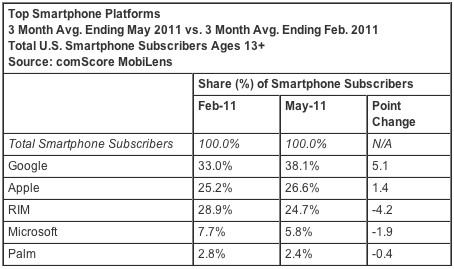
The Android train keeps chugging along with the comScore showing a 5.1 point increase in total US Android use in the Feb-May Quarter putting the OS at 38.1% of the total US smartphone market. Apple also gained, though less spectaculary with 1 percentage point improvement, coming in at 26.6%. Android head Andy rubin said last month that Android activations had grown to over half a million a day worldwide.
For the other guys, it wasn’t a happy quarter. RIM continues its slide down to a under quarter of all US smartphone purchases, while Microsoft and webOS risk being bundled into the “other” category as their marketshare continues to erode into almost nothing.
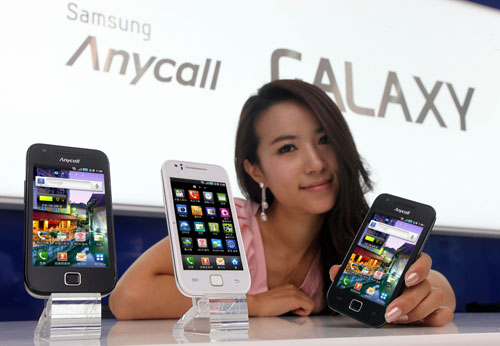
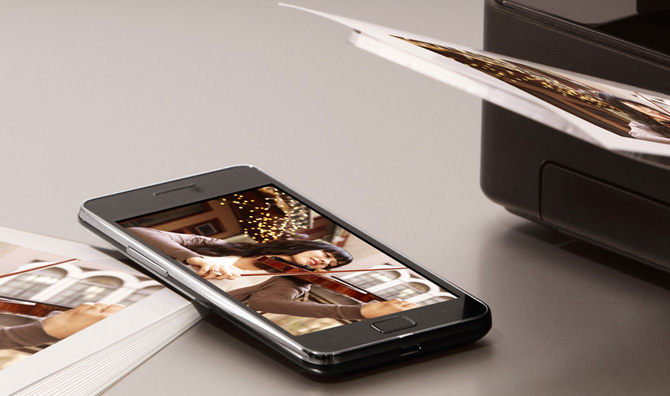
Active-matrix organic light-emitting diode, or AMOLED, is a display technology from Samsung which has so far been limited to their high-end devices such as the Galaxy S series smartphones. It has worked out well for the Korean firm: They’ve been advertising the crispness and sharpness AMOLED enables as the hardware feature setting apart their smartphones from Apple’s iPhone 4 which employs a regular LCD display with in-plane switching (IPS) technology. Even though iPhone 4’s Retina Display-marketed LCD IPS display sports wide viewing angles and crisp 960-by-480 pixel resolution, it falls behind the AMOLED technology which features vivid colors, true blacks, high brightness and low power consumption.
All those wonderful goodies are said to be adopted by “numerous mobile phone vendors” in the second half of this year, reportsDigiTimes. The publication explains that Samsung Mobile Display “has began production of AMOLED panels with the 5.5G production lines in May to further increase the penetration of AMOLED panels”. Samsung and its carrier partners have been making a lot of noise with the Super AMOLED Plus display featured on the Galaxy S II smartphone.
For example, the company aired a series of television commercials focused on the Super AMOLED Plus display alone. The Korean Heraldasserted in May that Apple might use AMOLED in iPad 3, but it’s unclear why Samsung would enable its rival to tap the one distinct hardware feature that differentiate their products from Apple’s gadgets.
[youtube=http://www.youtube.com/watch?v=788MeU_msMI]
The venerable Amazon tablet has inched one step closer to reality with the news that the company has begun sourcing parts for a rumored tablet. According toDigiTimes, a Taiwanese trade publication, Amazon is hoping to ship some two million units in September, in time for the holiday shopping season:
Amazon reportedly has held talks with TPK Holdings, Wintek, HannStar Display and J Touch for the supply of touch panels, indicated the sources, noting that Amazon targets to ship four million tablet PCs before the end of 2011.
However, Apple is pressuring the supply chain considerably. The Cupertino, California company reportedly plans to ramp up iPad 2 manufacturing to twelve million iPad 2 units for the third quarter, up from an estimated 6-7 million units in the second quarter and the 4.9 million iPads Apple shipped during the first quarter. Because of this, the Amazon tablet could be facing serious constraints, the report notes.
The story corroborates a previous report from the same publication calling for a September-August launch. The rumor-mill talk is that the online retail giant will introduce a plethora of Android-driven mobile devices, possibly even a smartphone. Amazon’s boss Jeff Bezos wouldn’t reveal anything beyond dropping hints and teasing us to “stay tuned”.
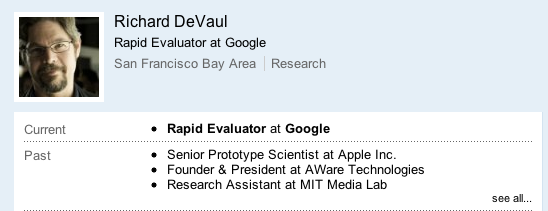
Richard DeVaul, a PhD. scientist from MIT with a focus on building wearable technologies, was snared from Apple this month by Google. At Apple he was rumored to be working with SVP of Industrial Design, Jonny Ive in Apple’s secret labs building the next big thing.
Besides his having knowledge of the inter-workings of Apple, it is also interesting that DeVaul is a hardware person who has focused on building wearable products for the past decade. Google has been a software company for all of its existence, but more and more it appears that it will enter the hardware business…but probably in smart accessories rather than phones.
Stanford professor and iPhone Camera app developer Marc Levoy is going to Google for two years according to his Stanford bio page:
I will be on part-time leave of absence from June 2011 through June 2013, to pursue a project at Google.
This stint at Google won’t be his first. He co-designed the Google book scanner and launched Google’s Street View project.
Levoy’s current interests include light fields, optical microscopy, and computational photography – meaning computational imaging techniques that extend the capabilities of digital photography. Levoy’s recent research focuses on camera applications.
My research has recently focused on making cameras programmable. One concrete outcome of this project is our Frankencamera architecture, published in this SIGGRAPH 2010 paper. To help me understand the challenges of building photographic applications for a mobile platform, I tried writing a cell phone app myself. The result is SynthCam. By capturing, tracking, aligning, and blending a sequence of video frames, the app makes the near-pinhole aperture on an iPhone camera act like the large aperture of a single-lens-reflex (SLR) camera. This includes the SLR’s shallow depth of field and resistance to noise in low light. The app is available for $0.99 in the iTunes app store. I don’t expect to get rich from this app, but I learned a lot by writing it, and yes – seeing it appear in the app store was a thrill. Here are a few of my favorite reviews of the app: MIT Technology Review, WiReD.
Yonhap News is reporting that 10 million units of Android smartphones have been sold in South Korea. South Korea’s biggest carrier, SK Telecom Co, has a whopping 6.18 million Android subscribers under its belt. KT Corp. is following second with 2.06 million, and LG Uplus Corp hosts 1.86 million and is following with the third spot. The 10 million Android smartphones makes up for 70% of South Korea’s phone market according to the report. Apple’s iPhone, by comparison, has 2.5 million iPhones in the South Korea market on its dominant carrier. Figures weren’t yet available for SK Telecom.
South Korea is of course the home turf of big Android makers Samsung Electronics Co., LG Electronics Inc. and Pantech Co.
Who said Apple has to dominate the tablet market? As of now they are, but that doesn’t mean things can’t change. According to CNet, Apple shipped 4.7 million tablets last quarter. But hot…err warm… on their heels, Samsung has shipped 850,000 units – and that’s without the newly launched Galaxy Tab 10.1. Following a close third, and could even overtake Samsung, Acer shipped 800,000 units that same quarter. This is promising news for a diverse tablet market.
There’s no reason why Apple can’t become a minority player by the end of the year. Just these two companies alone have a third of Apple’s share. There is also Motorola, ASUS, LG, HTC and even the Nook by Barnes and Noble. Expand Expanding Close
Samsung has issued a statement regarding claims of high-level talks with Apple concerning an ongoing legal dispute involving flagship mobile devices from both firms. A company spokesperson toldV3.co.uk yesterday:
We are unaware of any meetings or discussions between the two sides over this matter.
The comment follows a report by Reuters which asserted that US district judge Lucy Koh told both parties during a Friday hearing to get their act together and come to an amicable solution. Apparently, Apple’s legal counsel Harold McElhinny told judge that Apple and Samsung executives are involved in talks. It’s obvious one of the parties is not telling the truth. This cat-and-mouse game is beginning to point at a possible settlement because neither party would benefit from dragging each other through the mud in a multi-year lawsuit. Plus, Samsung is Apple’s key supplier after all…
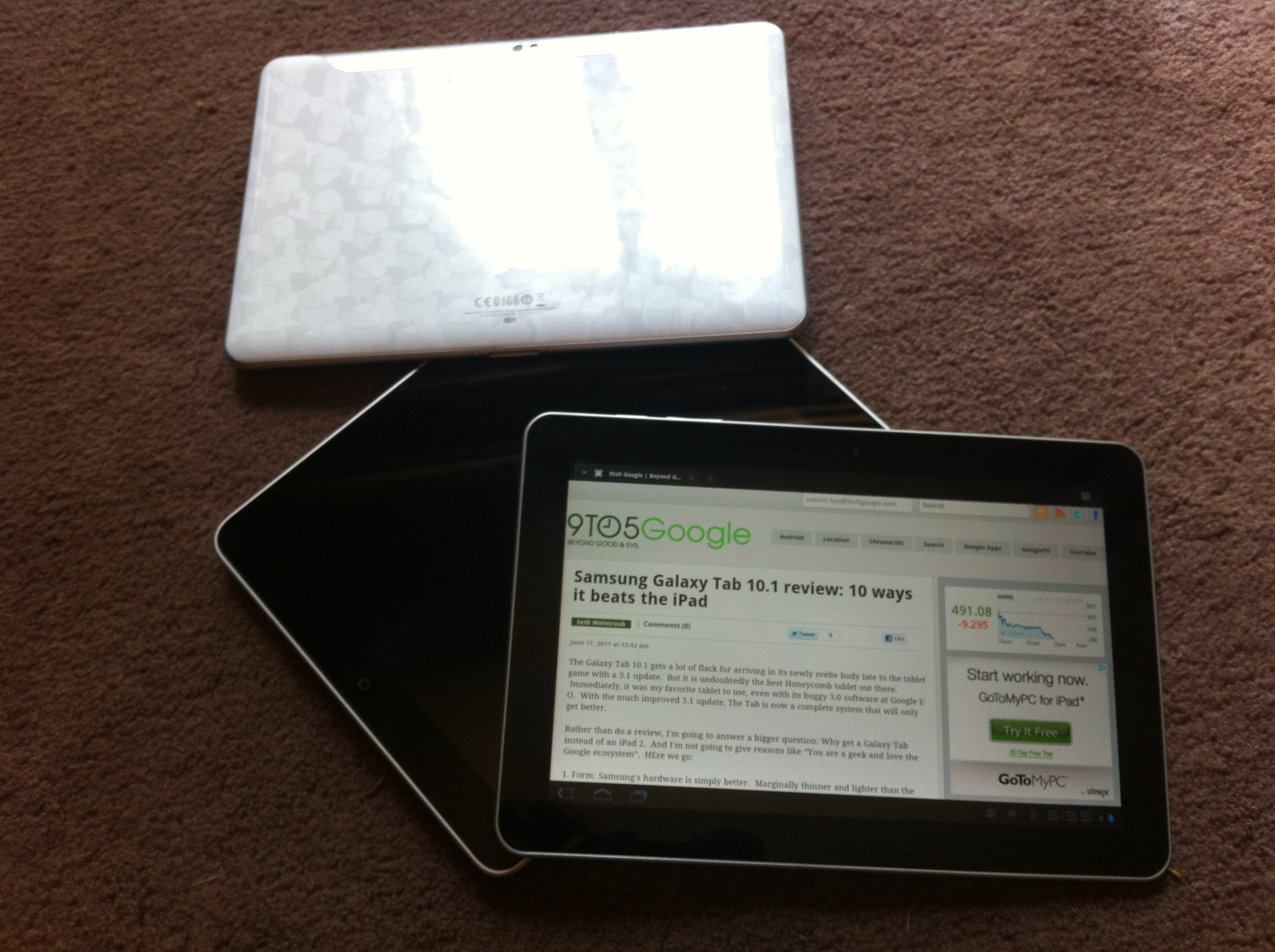
The Galaxy Tab 10.1 gets a lot of flack for arriving in its newly svelte body late to the tablet game with a 3.1 update. But it is undoubtedly the best Honeycomb tablet out there. Immediately, it was my favorite tablet to use, even with its buggy 3.0 software at Google I/O. With the much improved 3.1 update, The Tab is now a complete system that will only get better.
Rather than do a review, I’m going to answer a bigger question: Why get a Galaxy Tab instead of an iPad 2. And I’m not going to give reasons like “You are a geek and love the Google ecosystem”. Here we go:
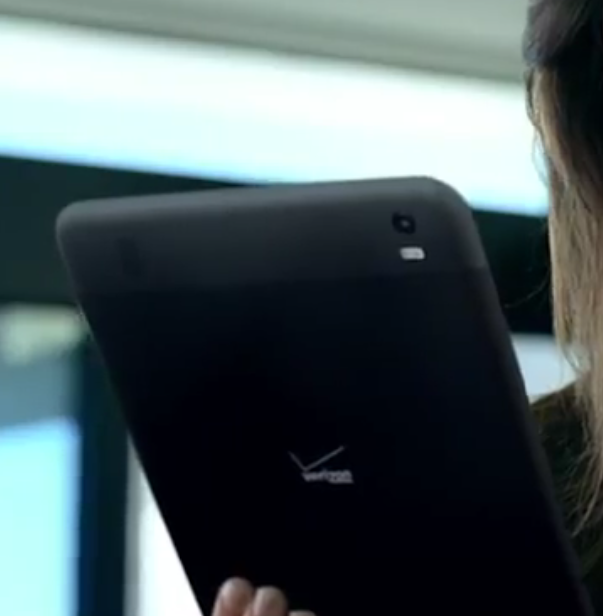
Is Motorola pulling a “Samsung” and going back to the drawing board with their XOOM, prettying and slimming it to match Apple’s iPad 2? The Verizon ad (screenshot above, video below) seems to suggest just that. Hopefully that channel inventory is ready to move because who is going to buy a XOOM now that a thinner version is coming down the pike?
Apple is applying more oomph to copycat claims against its key supplier Samsung. Just days after it wrote in court documents that Samsung was “harassing us”, Apple yesterday amended the filing with more intellectual property rights against more products – even re-phrasing accusations more strongly. The legal maneuver comes on the eve of today’s court hearing where the judge will decide about granting each party access to the other’s unreleased products. FOSS Patentsspotted the updated complaint:
The original complaint specifically accused the following products of infringement: “the Samsung Captivate, Continuum, Vibrant, Galaxy S 4G, Epic 4G, Indulge, Mesmerize, Showcase, Fascinate, Nexus S, Gem, Transform, Intercept, and Acclaim smart phones and the Samsung Galaxy Tab tablet.”
The amended complaint accuses all of the above plus the Droid Charge, Exhibit 4G, Galaxy Ace, Galaxy Prevail, Galaxy S (i9000), Gravity, Infuse 4G, Nexus S 4G, Replenish, Sidekick, Galaxy Tab 10.1, and Galaxy S II (aka Galaxy S 2). It also specifies the accusation against “Showcase” products, naming the Showcase i500 and Showcase Galaxy S.
Per rephrased wording, Samsung “has been even bolder” than other companies by putting out “products that blatantly imitate the appearance of Apple’s products to capitalize on Apple’s success”. The company claims that the F700 released in 2007 was the first Samsung phone to “copy the clean flat clear surface of the Apple iPhone Trade Dress and the Apple iPhone/iPhone 3G/iPhone 4 Trade Dress”. Apple also points out that its products and brand have been featured in credible newspapers and magazines and even points out the #1 position it took in the BrandZ index. In Apple’s words, this is why iPhone is an iconic product:
With an IDC-estimated 10.8 million units shipped during the first quarter of this year, Samsung files as the world’s fourth-largest smartphone vendor, behind Nokia, Apple and BlackBerry maker Research In Motion. However, the rising popularity of Samsung’s feature phones and dumb handsets powered by their own operating system called Bada has helped the Korean phone maker capture the #2 slot in terms of all handset units shipped globally.
Samsung was outdone only by Nokia in the first quarter. According to IDC’s Worldwide Mobile Phone Tracker, Samsung shipped 70 million handset units during the first quarter of this year versus the 108.5 million Nokia phones. With 18.7 million iPhones Apple came in fourth, behind LG Electronics which shipped 24.5 million handsets. That was last quarter…
The global handset landscape is going to alter rapidly by the June quarter’s end, predicts Japanese research firm Nomura. Their analyst was quoted as saying that “Nokia looks set to relinquish its smartphone crown (in unit terms) to Samsung and Apple”. This means, their analyst argues, that Nokia will be #3, with Samsung and Apple taking the #1 and #2 slots, respectively. Mind you, Nokia has been the world’s top handset maker since 1996…
WebKit – an Apple-developed, open-sourced rendering platform – is picking up steam on desktop. On laptop and desktop computers, WebKit-powered browsers are closing in on Mozilla’s Firefox, which is the world’s second most-popular browser. Look no further than Net Applications’ numbers derived by monitoring more than 40,000 websites in their network (see above chart). Adding May 2011 web usage share numbers for Safari (7.28 percent) and Chrome (12.52 percent) brings us to the combined 19.8 percent market share.
That’s just shy of one fifth of all desktop browsing, putting WebKit within spitting distance of Firefox’s 21.71 market share. Trends do not favor browser vendors who have been pretty much bleeding market share to Google and Apple in past months. Chrome and Safari have managed to grow their user base over the past couple of months at the expense of Mozilla’s Firefox, Microsoft’s Internet Explorer and Opera Software’s Opera. A StatCounter survey supports those findings (see below). Why is Mozilla failing?
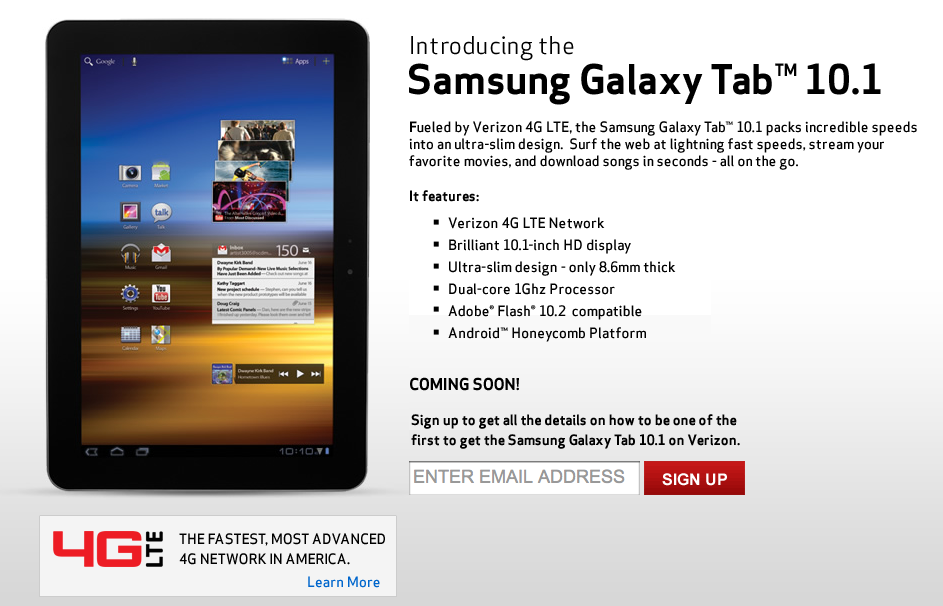
Thant didn’t take long. Verizon just announced that it too will have a thin Galaxy Tab 10.1. But this one will still be as thin and carry LTE 4G hardware.
The Asus Padfone has inspired what appears to be a cottage industry of phone-docking tablets in the making. Take a new docking accessory from ECS. Code-named Trinity, it’s the result of joint efforts by ECS and its partner ICE Computer. Unlike the Padfone which is a real tablet, the ECS solution is an intelligent docking station that can house various smartphone brands. It takes your phone’s video and outputs it via HDMI to the built-in display which is of the same 9.7-inch variety and 4:3 format as the iPad’s.
You also get an SD card slot, two USB ports and a front-facing camera. It’s a cross-platform play of sorts due to its ability to work with and house multiple smartphone brands, from Apple’s iPhone to Windows Phone and Android smartphones. Best of all, the gizmo should work with future iOS devices – including iPhone 5 – using “simple upgrades”. Expect the Trinity to hit the market in the fourth quarter costing $200 or less. Go past the break for a video introduction. via ITProPortal
On the possibility of Apple dropping Google Maps (we’ve heard they aren’t): Mayer says there are 200 million active users of Maps and in June more people will use them on mobile than the desktop. (Although at 100 million iPhones out there, an Apple exodus would put a monster dent in those numbers. Also, new Google Mobile Maps (not iOS) use vector tiles which can be up to 100 times smaller files than the traditional bitmap tiles.
Also, location is getting better as more data is input (learning), especially in big cities like New York with check-ins helping out.
Finally, she expects phones to know what you want before you ask, called ‘serendipity’ or ‘zero-click’.
” Strategy Analytics ranked Samsung the #1 Android tablet maker and the world’s #2 tablet company behind Apple in Q1 2011. It took them a month to sell a millionth Galaxy S II smartphone in Korea and brag about it on their Flickr account with the above image.
Samsung is content on releasing more Android tablets despite that pending legal spat with Apple, which is accusing them of stealing the iPad’s and iPhone’s design, software features and hardware engineering with the Galaxy-branded tablets and smartphones. The Wall Street Journal quoted this morning Samsung’s J.K. Shin who underscored his company’s determinacy to release more Honeycomb tablets this year as they “continue to work with Android on future tablets”. Their senior vice president of sales and marketing Younghee Lee added:
Android is the fastest-growing platform and the market direction is headed toward Android so we’re riding the wave. When there is a market need for our own software, we will consider it but that’s not our plan at the moment.
Samsung also says it’ll continue offering tablet PCs in multiple screen sizes as a way of distinguishing themselves from Apple. Asked to comment on that pending lawsuit with Apple, Shin responded:
With Apple’s purchase of two mapping companies over the last couple of years – Poly9 and Placebase – many have speculated that iOS 5 will finally be the iOS release where Apple moves from a Google Maps backend to an Apple backend. Multiple job postings on Apple’s official site backed up this speculation and even Apple promised some under-the-hood maps tweeks for their next-generation iPad, iPhone, and iPod touch operating system.
Now, sources have told 9to5Google that although Apple is working to improve the iOS Maps application, iOS 5 will not bring an Apple developed maps service and Google Maps is still in. Besides Apple’s purchase of both Placebase and Poly9, some speculated that Apple is building their own maps service to either compete with Google or step away from their input into iOS.
Apple began the process of distancing themselves from Google when former Google CEO Eric Schmidt resigned over “conflict of interest.” Apple has also added Microsoft’s Bing as a Safari search option and will be competing with Google head-to-head with their upcoming cloud-based music service. Those who enjoy Google Maps should not fear iOS 5, though, and hopefully Apple is working to implement turn-by-turn directions or something else to improve their maps application without changing the backend. Expand Expanding Close
Samsung’s Galaxy S, arguably the most successful consumer smartphone powered by Google’s software, has outsold Apple’s baby for the first time in Japan where the iPhone has been a huge hit. The achievement has enabled Samsung to climb on the list of Japan’s top handset makers to the fourth slot, ahead of local vendors NEC, Casio and Kyocera. Furthermore, Android has flown by iOS in just three quarters and Android smartphones are now outselling iOS smartphones in the country. That’s the gist of a Strategy Analytics survey of Japan’s smartphone market based on first quarter shipments. Their director Neil Mawston explains in an InfoMobilestory:
Strategy Analytics believes that the healthy demand for the Android-powered Galaxy S at NTT DoCoMo drove Samsung growth in Japan. Samsung is the main player behind surging Android smartphone sales, followed by Sharp. Japan had always had a unique competitive landscape, but is now looking more and more like any other advanced smartphone market in the world as Android has flown by iOS in just three quarters.
Gartner is out with their first quarter 2011 mobile phone market survey. The results are astounding. The first quarter belonged to Google and everyone else was reduced to extras in an Android show. Both Apple and Google grew their respective share of the smartphone market, estimated at 100.8 million quarterly units – nearly double the 54.5 million units from the year-ago quarter. Smartphones grew 85 percent and cut into sales of regular handsets, accounting for almost one quarter (23.6 percent) of the 427.8 million handsets shipped during the first quarter.
Predictably, Android was the leading smartphone platform in the first quarter of 2011. And here comes your mind-boggling takeaway: More Android-powered smartphones were sold during the first quarter than the combined sales of Apple’s iPhone, RIM’s BlackBerrys, Microsoft Windows Phone smartphones and vendors belonging to the Other OS category. And that is worldwide, mind you. Go ahead, do the math yourself (the below table).
It’s fascinating that Microsoft and Symbian combined had three percentage points lower market share than Android. Also, while Apple doubled iPhone sales, they barely gained any marketshare. This just shows that Android is gobbling up market share at a rapid pace, eating pretty much everyone’s lunch in the process…
Nvidia CEO Huang Jen-Hsun blamed slow sales of Android slates to a multitude of factors ranging from the lack of expertise at retail, sub-par marketing, higher price points and software. Extending the opinion, Asian sources from notebook vendors warn that lack of content is to blame for weak demand for Android slates. It’s the software, stupid, they argue, reportsDigiTimes.
The sources pointed out that most of the applications that are executable on Android 2.x are turned out to be un-executable on Android 3.0, while any application that can run on iPhone can be directly transfer to iPad for execution. Since there are only limited applications specifically designed for Android 3.0, it has significantly lagged demand of Android 3.0-based tablet PC.
“Apple would have achieved a much bigger market share than it already has if the player decided to wait”, the source admitted. Android 3.1 should resolve all those issues when it becomes available in the second half of this year, the source concluded. Most apps designed for Android 2.x smartphones apps either don’t scale well or “turn out to be un-executable on Android 3.0”, the source noted, blaming poor demand for Honeycomb tablets on a limited number of tablet-specific software experiences. Apple, of course, is employing quite the opposite tactics focused on promoting apps tailored to the iPad.
Looks like a guy in the above image has a Samsung Galaxy Tab 10.1 hooked up to his MacBook Air. I bet he’s manually dropping some files from the Mac notebook to his brand spanking new tablet, which is easy because Android devices mount as external USB storage.
That’s pretty much everything he can do, though. That is, unless he was using Eltima Software’s SyncMate, an all-around syncing application for the Mac. It’s been around for ages and in most recent version they added support for Android devices. Read on…
It doesn’t get any better than this folks. Dan Lyons, who has a contentious relationship with Bursten’s Jim Goldman (especially from his days as a CNBC reporter, above) busted the mystery Google smear campaign wide open. It turns out, it wasn’t Apple and it wasn’t Microsoft trying to smear Google. It was Facebook.
I won’t spoil it but knowing how much Lyons loves Jim Goldman, he must be in hog heaven right now. Expand Expanding Close
It’s a familiar scene. MacBook-toting journalists, bloggers and guests providing Apple with omnipresence and free advertising at rivals’ events, thanks in large part to the glowing Apple logo on the well-designed notebook family. Who knows, this time next year some of these folks might carry around machines with the Google logo on them if there’s any substance to the whispers of subscription-based Chrome OS notebooks. Check out seven additional Apple sightings below the fold and meet us in comments.
Check out the sticker: “My other computer is a data center”. Touche.