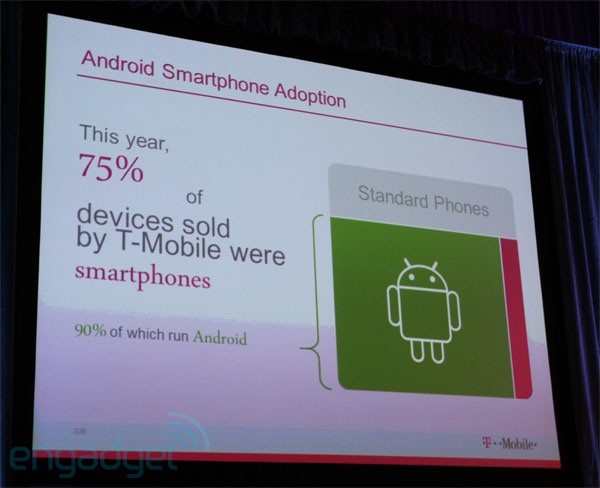
T-Mobile’s network is 75% smartphones and 90% of those are Android. That means more than 2/3rds of the devices sold by T-Mobile are Android. That is a big number. Remember T-Mobile has a million iPhones on its network but those weren’t sold by T-Mobile.
Spotify, a popular music streaming service from Sweden, arrived in the United States mid-July on an invite-only basis. Today, Spotify goes live for everyone nationwide, no invitation required. Users can now sign up for an account at Spotify.com and use a mobile app for Android or iPhone to stream music over wireless and cellular networks to their phones, tag songs for offline viewing, favorite tracks, share them with friends and more. What’s best, you needn’t sign up for a paid Spotify account. Thanks to a new partnership with Facebook that Mark Zuckerberg announced at the yesterday’s developer conference (more in the clip below), anyone signing up with their Facebook account gets six months of unlimited listening. What happens when the six-month free period expires?
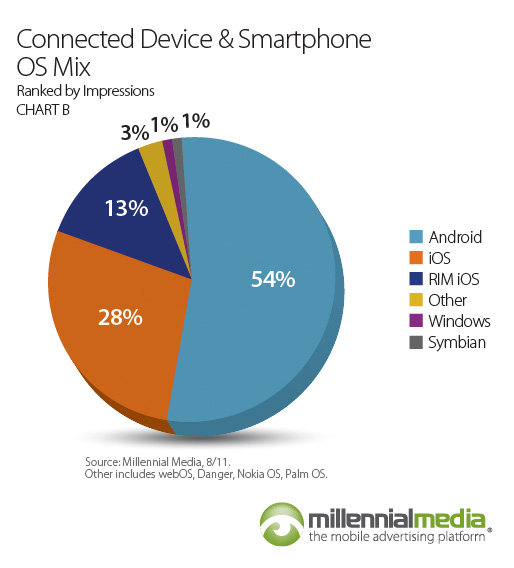
If Google and Apple were to merge, their respective Android and iOS mobile software would seize well over three-quarters of the world’s platform share in smartphones, per latest Millennial Media’s “Mobile Mix” mobile device usage share report. Separately, Android and iOS held 54 percent and 28 percent share in August. Millennial now includes data from smartphones, tablets, e-readers and gaming devices so direct comparison to their smartphone-focused July study is meaningless.
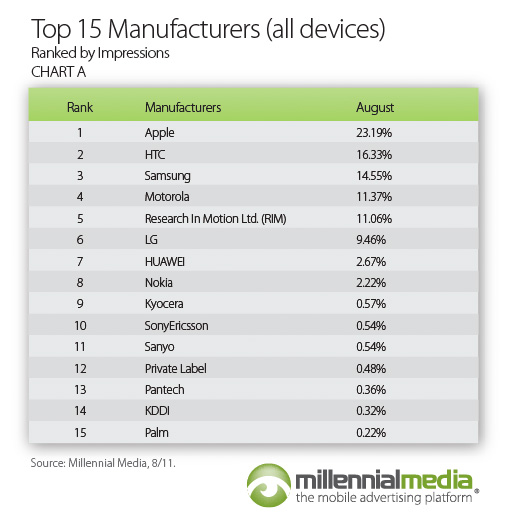
Apple continued to be the leading device manufacturer on our network in August, representing 23% of the Top 15 Manufacturers impression share (Chart A). Apple iPhone maintained the number one position on the Top 20 Mobile Phones ranking with 13% of the impression share.
Nearly one-third of devices on all carriers used wireless hot spots. Verizon Wireless and Sprint had 18 and 14 percent carrier mix, respectively, followed by T-Mobile USA and AT&T with eight percent each. Games, music and entertainment remain the most popular app categories. iOS represented 41 percent of the app platform mix and Android 49 percent. On Android, News apps rose by 26 percent month-over-month. Go past the fold for a bunch of pretty charts and more explanation.
As part of the Senate Judiciary hearings today, former former FTC official (and new Google employee) Suzanne Michel, testified under oath today that Google, Microsoft and Yahoo all bid to become the default search engine on iOS’s Mobile Safari Web Browser. As we know, Google won, and as we can infer, Apple get’s some revenue from Google for making it its default search engine. As we know from Apple being Apple, the quality of the search results was probably as big a part of the decision as the relatively small bits of revenue.
But as part of the testimony, Michel said briefly (before she was cut off) that 2/3rds of mobile search comes from Apple iOS devices. That’s pretty interesting considering the share of Android devices in the market. But not altogether surprising considering the web browser market share which includes those millions and millions of iPads.
The first mention of a social news app from Google came in a Google+ post yesterday by tech watcher Robert Scoble. He wrote:
I heard from someone working with Google that Google is working on a Flipboard competitor for both Android and iPad. My source says that the versions he’s seen so far are mind-blowing good.
The news prompted AllThingsD’s Kara Swisher to dig for more clues. The service is code-named Propeller, Swisher learned:
Google is indeed working on rolling out the new product, which is currently called Propeller. Sources said Propeller is apparently one of a number of new socially focused announcements Google is prepping, including new apps.
The app should launch in the near future because Facebook is also unveiling a social publishing platform of its own next week. It was not immediately clear at the time of this writing how Propeller ties with Google+, if at all. Given the company’s strong social focus and the fact that Propeller is being described as a social news app, it would seem logical to incorporate at least Google+ sharing features.
9to5Google learned from people familiar with the project that Propeller will boast a prettified interface, as is a norm with its high-end rivals Flipboard and Pulse. Publishers will be able to package their content for distribution right within their web browser, using a dedicated web app. Layout options are said to include multiple layouts to target various tablet and phone brands, including iPhone and iPad. Navigation capabilities will include individual articles, table of contents, as well as browsing custom-made sections that curate multiple articles. Images, video and other rich media types are also at disposal.
IDC has just released their second quarter results for tablet and eReader shipments as well as an updated forecast for the remainder of 2011. While Apple continued to dominate with 68.3% of the global market during Q2, IDC expects Apple’s share to fall as vendors bring competitive Android devices to market later this year and early next.
The study reports second quarter tablet shipments worldwide increased 88.9% (303.8% year over year) citing robust demand for the iPad 2 and sales of 9.3 million units, leading the firm to raise its estimates for the remainder of 2011 from 53.5 million units to 62.5 million.
According to a new report from comScore detailing the top smartphone platforms for mobile gamers, Android takes the top sport with approximately 30% of the market among 65.1 million mobile subscribers for the three month period ending July 2011. This in comparison to the roughly 21% held by Apple’s iOS.
The 65.1 million smartphone users included in the research played at least one game in the past month, just under 68% of which were using smartphones to do so. This accounts for approximately 27.8% of the entire U.S. mobile market. Interestingly, while Android was able to top the chart for total number of gamers, gaming on Apple’s iPhone seems to be reaching a larger portion of it’s user base with 61.7% of all users in contrast to 57.4% of Android users. Expand Expanding Close
Per latest StatCounter Global Stats data, Google’s software platform in August 2011 passed iOS worldwide to rank as the world’s #2 mobile operating system. showing no signs of stopping, Android gained ground at the expense of pretty much every other platform, including Research In Motion’s BlackBerry OS, Symbian OS and Apple’s iOS. Of course, stats can be deceiving and phone makers have been boosting Android’s numbers with dirt cheap handsets and BOGO promotions. Let’s not forget that StatCounter base their data on web usage stats obtained from a network of participating sites so the survey does not necessarily paint a representative picture of the whole market.
That being said, Android was trumped only by Symbian OS, which lost 1.46 percent of market share since June 2011. Symbian OS in August grabbed 32.12 percent market share versus 20.6 percent for Android and 19.41 percent for iOS for the month of August. While Apple’s mobile operating system had pretty much held ground during the June-July period, it dropped 0.62 percentage points between July and August.
In the same period of time, BlackBerry OS declined by 0.64 percentage points. Samsung’s own Bada software for feature phones took 6.04 percent market share in August. Interestingly, Microsoft’s Windows Phone doesn’t even blip on the global radar and is probably tucked away under the ‘Unknown’ category which claimed a 5.72 percent share.
Google has just released a HTML 5 optimized Music Beta player for the mobile web, announced via Twitter. Upon first launching the webpage, Google asks for the allowance of 25mb to be stored on your device. After, you are presented with a full run down of all of the artists you uploaded to the service. Once you have selected a preferred song, you are taken to a “Now Playing” page. Yes, if you haven’t realized already it works a lot like the music.app. This feels so sleek!
Like politics, smartphone wars come down to two major parties – Google and Apple – embroiled in a never-ending fight for consumers, especially those who have not made up their mind as to which operating system they’d like in their next smartphone. According to July 2011 data from Nielsen survey, “these ‘undecideds’ will be the ones device makers will be hoping to win over”. Interestingly, the Late Adopters among likely smartphone upgraders are the ones most likely to be undecided about their next phone platform.
The research firm discovered that forty percent Americans aged 18+ now have smartphones. Android leads the pack with a forty percent OS platform share and iOS came in second with 28 percent. Compared to Nielsen’s June 2011 study, Android grew its share by one percentage point while iOS growth fell flat. The BlackBerry platform lost one percentage share and now stands at nineteen percent.
Of those buying a new smartphone next year, one third would opt for an iPhone and another third would go Android. This leaves other manufacturers outside the Android-iOS duopoly to fight for the remaining 33 percent of buyers.
Android, however, is the preferred platform of choice for the earliest of early adopters:
Among those who say they are usually the first to embrace new technologies, “Innovators” or the earliest of early adopters, Android leads as the “Next Desired Operating System” – 40 percent for Android compared to 32 percent for iOS. (Survey respondents were asked several questions to determine their attitudes toward new technologies.)
comScore has just released their ‘U.S. Mobile Subscriber Market Share’ report for the three month period ending in July. The report once again sees Apple’s market share increasing, this time up 1 percentage point to capture 27% of the market. This is in comparison to Google, who came in at an impressive 15% increase to top the chart at 41.8% market share. They are of course followed by the usual suspects, RIM in third at 21.7% (down 5%), and Microsoft at 5.7% (down 1%).
Apple’s market share among mobile OEMs is also on the increase, growing 1.2% to capture 9.5% of the market. Of course, Samsung (who also increased 1%), still dominates among OEMs with 25.5% of the market. LG comes in at second with 20.9%, followed by Motorola, and Apple. Expand Expanding Close
Ever wished you could run your favorite iOS app on your Mac? What about your Windows machine or Android device? If creators of new Kickstarter project iEmu reach their funding goals, it may be possible sooner than you think.
iEmu is a new project based on the open-source QEMU emulator, currently accepting donations through Kickstarter, that aims to emulate the S5L8930 chipset used in iPhone 4 and first-gen iPads. It will support a number of platforms including “Linux, Windows, Mac, mobile platforms such as Android, and even on iOS itself”.
The goals of iEmu? Well the end goal is an emulator capable of running “most iPad/iPhone apps” that even supports peripherals like the compass, accelerometer, and GPS. It would also “be extended with plugins for custom iOS exploration” and able to be reflashed in iTunes. Expand Expanding Close
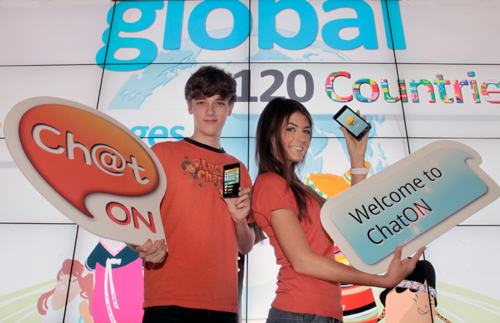
Samsung is getting into the proprietary messaging format game with a new product called ChatOn it announced today. The service will roll out on its Bada, Android and even feature phones and will extend to competing platforms like Blackberry and iOS. The service will run over IP and allow users to send text, images, and hand-written notes, as well as chat in groups and share video clips.
The new service, called ChatON, will be available from October and preinstalled in Samsung’s feature phones as well as smartphones running on its own bada operating system and Google’s Android software, it said.
Samsung’s partner Google has a similar Talk/Voice feature already installed on Android devices so it isn’t immediately clear which will take precedence. All of these services are collectively eating at the SMS revenue that carriers have been squeezing out of their customers for a decade. Apple’s iMessage is set to go live with the general release of iOS 5, also likely in October.
Speaking of the iOS maker, Apple was able to successfully block Samsung from releasing it’s ‘modified’ Australian Galaxy Tab in Australia it was reported this evening… Expand Expanding Close
AllThingsD is reporting this evening that Google will shutdown Slide, a company they acquired for $200 million last year. All of Slide’s products will be shutdown — except Prizes.org (via TechCrunch). While the rest of the Slide team will continue to work at Google, Slide’s found Max Levchin is leaving. A Google spokesperson told AllThingsD:
“Max has decided to leave Slide and Google to pursue other opportunities, and we wish him the best. Most of the team from Slide will remain at Google to work on other opportunities.”
Before being shutdown by Google, the Slide team was hard at work on Photovine, a photo sharing app that was released by Google just one week ago. The app was focused on sharing photos specific to a certain category, or vine, with the community. Sadly, Photovine will receiving the axe over the next few months — along with Slide’s other products like Disco and Pool Party. So why would Google kill off a part of their company that released something just a week ago.. and paid $200 million for?
Updated: Slide’s official blog post has gone up. Continue after the break..
You probably know by now that Google’s move to acquire Motorola Mobility for $12.5 billion was seen as one specifically focused on acquiring their more than 17,000+ patents, many of which are thought to be key in protecting Android from other smartphone makers (Apple and Microsoft) in court. However, according to a report from Bloomberg, only 18 of those patents will be essential in fighting patent-infringement related cases against, namely, Apple.
According to CEO of ICAP Patent Brokerage Dean Becker (“global leader in intellectual property brokerage”) Google only needs a few of the 17000+ patents to protect it’s mobile IPs, he added:
“There are a lot of sweet patents in that portfolio…”- Dean Becker, ICAP Patent Brokerage
The patents cover a little bit of everything that we’ve come to expect from a smartphone; touch-screen gestures, antenna designs, location-based services, email,etc. Among some of the more notable patents that will certainly provide value when protecting Android include one from 2001 that details disabling a “touch sensitive” display that detects a user’s head in relation to the device to prevent accidental input (sound familiar?), another shows a feature that would allow users to control when their location data is sent over a network via GPS (lack of these types of features were recently the subject of debate at a senate judiciary hearing in May where Apple and Google were questioned on their practices in relation to user location data). Other noteworthy patents include one related to increasing data storage for users and others that detail features we see in most modern smartphones.
Motorola, even before being acquired by Google, was and still is involved in mobile related legal issues. Most recently Apple filed patent-infringement complaints with the ITC in October, and also sued the company in civil court for “a pattern of unfair, deceptive and anticompetitive conduct”. Claims which also mirror those of Microsoft. Motorola seems to be confident in their patents, however, by going after Apple in lawsuits on three separate occasions and filing their own complaint with the ITC. Expand Expanding Close
In the battle for mobile supremacy, Apple and Google are winning as competitors continue to lose ground, finding it increasingly difficult to compete with the strong iOS and Android ecosystems (can you say ‘duopoly’?), per latest survey from the NPD Group. The results came by tracking U.S. consumers aged 18+ who reported purchasing a mobile phone and exclude corporate purchases. In the June quarter, iOS grabbed 29 percent of the U.S. smartphone share versus Google’s 52 percent share. Both tech behemoths have grown their platform share at the expense of BlackBerry maker Research In Motion.
RIM’s been on a serious decline amid poor sales and delays related to their QNX-based superphones. Their BlackBerry OS software share fell to just eleven percent in the U.S. Meanwhile, Hewlett-Packard’s webOS is in a state of limbo as the world’s leading computer maker announced intentions to exit the hardware business. Microsoft’s Windows Phone 7 and Windows Mobile grabbed five percent of the market each.
The emerging prepaid market is the next battelground for iOS and Android. Google, however, has the first mover advantage here… Expand Expanding Close
Google’s photo-sharing social network Photovine (previously invitation-only) is fresh out of beta, open to all users, and ready to install to your iPhone, iPad, or iPod touch as an iOS app.
Photovine is a fun way to learn more about your friends, meet new people, and share your world like never before. It all starts with what we call a photovine: a group of photos around a single, shared caption. Start a new vine with a photo and caption of your own or add your photo/take on someone else’s vine.
Many are comparing the service to Instagram, or a photo-centric version of Twitter. Some are also pointing out it looks quite similar to Piictu. Essentially, users upload photos that can then be grouped thematically to create what is known as a “vine”. While you can follow other users and receive their content directly in a personal feed, all images appear to be shared publicly either through your profile or the vine in which the image is included. You then also have the option of sharing individual photos or vines directly to Twitter or Facebook (no Google+ support?).
The application is the work of the Slide team, a social-media start up acquired by Google last year. Its not clear yet how much of a focus Photovine will be for Google, but the Slide team has released a number of apps recently and seem to be getting support from Google to carry on with their projects. As of yet the service only has an iPhone app, but presumably there’s Android support on the way and some type of integration with Google+. Expand Expanding Close
Google has just pushed an update for the official Google+ app for iOS, bringing with it support for iPad and iPod touch, two devices the app was previously unavailable for, among a few other features including aggregated circle add notifications, huddle settings, and the usual “Performance and stability improvements”.
You should be able to update the app now via the App Store or swing by iTunes and grab the new version now. We’ll keep you posted with any other discoveries we might make in this latest update.
Research firm Nielsen chimed in today with a survey that puts Apple as the leading handset maker in the United States whilst Android is portrayed as the top mobile operating system in the country. Those findings follow a recent analysis which had Apple overtaking Nokia to become the world’s leading smartphone vendor in July, also corroborated by IDC figures. According to Nielsen’s June data, Google’s Android remains the nation’s top phone platform with a 39 percent of the country’s consumer smartphone market. Apple’s iOS follows with 28 percent and BlackBerry maker Research In Motion continues to bleed share, down to 20 percent in the second quarter of 2011. Windows Mobile and Windows Phone combined grabbed nine percent, webOS and Palm OS were barely a blip with two percent, as was Nokia’s dying Symbian OS.
Apple on the other hand is the top smartphone maker in the United States that controls 28 percent of the market (excluding iPods and iPads). That’s partly “because Apple is the only company manufacturing smartphones with the iOS operating system”, Nielsen argues. HTC shares second spot with Research In Motion with a fourteen percent share of Android devices and six percent of Windows Phones for a total of 20 percent share of the whole market, same as the BlackBerry maker. HTC is also the nation’s leading Android and Windows Phone vendor with 14 percent and six percent share, respectively. No wonder Apple is suing HTC and seeking to ban import of their phones into the US…
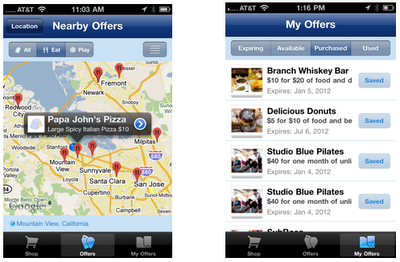
Google has released an update to their Shopper app conveniently giving users information on daily deals, including Google Offers. The update adds a “Offers” and “My Offers” tab at the bottom, along with the Shop tab you know and love. The Offers tab displays deals in map view that are available in your city. The deals you find can be saved in the My Offers tab for later use. Businesses can publish deals through Google Places. If Google Offers is available in your city you can redeem your purchased offers in the My Offers tab. Check out the update in the App Store. Expand Expanding Close
Research firm Strategy Analytics discovers that shipments of Android-driven tablets are finally beginning to make a meaningful impact on the overall tablet market. Yes, Android slates are making their presence known, even though iPad is still king of the hill. According to the research firm’s survey, June quarter tablet shipments topped 15.1 million units, a material increase over the 3.5 million units from the year-ago period. Apple seized the #1 slot with 9.25 million iPads the company reported for the June quarter, representing a 61.3 percent share of the tablet market overall.
At the same time, Android tablets have gone from 2.9 percent market share in June 2010 to 30.1 percent in June 2011, a surprising 27.2 percentage points increase based on sales of 4.55 million units. In the year-ago quarter Apple enjoyed a 94 percent share, so iPad’s 33 percentage points drop is substantial no matter how you look at it. GSM Arenaobserves that “in terms of market share, the iOS lead in the past quarter is nearly three times smaller than it was in the same period of last year”.
What HiFi is reporting that Android has surpassed the iPhone as the top smartphone in the UK, coming from a market research group called Kantar Worldpanel. The growth is due in part to first time smartphone users, not necessarily those switching between platforms. In June alone, Android rose almost 35%, while the iPhone fell almost 12%. We’re assuming much of Android’s success is from the Galaxy S II, who has seen tremendous sales in Europe as well as Android’s numerous, cheap, offerings. Expand Expanding Close
Now that Android has become the leading mobile platform in the US and other key markets around the world, developers are taking notice and some no longer prefer releasing their apps on iOS first, followed by Android. For some, it’s a question of Android’s installed user base, the pace of the platform’s growth and the fact that ad-supported free model on Android matches the App Store’s 99-cent economy. For others like WhitePages, the decision comes down to cutting out a middleman in order not to be forced to spend time, resources and money on a lengthy approval process.
According to Ina Fried over at the Wall Street Journal’s All Things D blog, WhitePages’ new Localicious app will be released on Android first. Apple’s approval process “is just too difficult to time a launch around”, Fried writes, noting the iPhone maker’s stringent approval process had delayed the launch of a reverse phone lookup app from WhitePages for two months, a far cry from the Apple-advertised “95 percent of the apps are approved in two-weeks time”. WhitePages’ op-chief Kevin Nakao tells the blog:
I think we are going to see a lot of people start to ship Android first. You cant be held hostage. Marketing an application becomes increasingly important given the number of apps that are being published. Since apps can still get tied up in the iOS approval process, it makes this marketing planning almost impossible.
UPDATE [July 13, 2011, 10:20am Eastern Time]: Google itself is now advising developers to target Android first. According toMacWorld UK, Google Ventures partner Rich Miner is telling app developers funded by the Google-backed project that they focus on Android and then roll out apps on iOS later.
Nearly three-quarters of Android sales in Britain during a twelve-week period ended June 12 came from people upgrading from so-called feature phones to their first smartphone. In addition, only 1.8 percent of new Android sales came from iOS users jumping ship, a Kantar Woldpanel ComTech survey reveals. The research didn’t take into account corporate sales or contracts and was based on extensive interviews with up to one million consumers in Europe alone.
Android has grown its share of total US handset market to 9.2 percent in June of this year, up over just one percent a year ago. The platform had a 45.20 percent share of the entire smartphone market in the country, while iOS fell from 30.6 percent share in June 2010 to 18.3 percent share in June 2011. A big part of this was price: Apple’s is among the priciest consumer smartphones and only 45 percent contracts offer the device for free versus 90 percent for Android phones.
The fall of iOS came as a result of the overall UK market growing at a faster pace than iPhone sales, which have been overshadowed for the past two months as Samsung’s Galaxy S II smartphone emerged as the best-selling smartphone. In the US, Android and iOS had 57 percent and 28.7 percent market share last month, respectively. Android is clearly victorious in Germany, France, Italy, Spain, Australia and Japan, where the platform enjoys a whopping 64.7 percent share of the smartphone market versus 27.7 percent for iOS.
Kantar analysts predict that by this time next year smartphones would account for nearly 50 percent of the overall handset market, thanks to more and more feature phone owners dumping their devices for smartphones. This is not unexpected because trends hint that eventually all phones will become smartphones. Other phone vendors are experiencing sharp declines around the world, especially Symbian which has been bleeding share as Nokia fights for survival.