Apple

See All Stories

Almost comical, unintended consequence of of Apple’s patent win: Your manufacturer/carrier might actually update your Android phone

Site default logo image

Something funny just hit me. Samsung’s “pure Google” Nexus S phone was hit with a number of software infringements in the Apple trial. This is not Samsung…this is core Google Android. However, according to patent attorney Nilay Patel who now works at The Verge, these software infringements are only for older versions of Google’s Android OS.

[tweet https://twitter.com/reckless/status/240117223828619264]

So, phones with Android 2.x are infringing on Apple’s IP. Therefore, if they are upgraded to Android 4.1, they do not infringe? By that logic, carriers and manufacturers will be forced to upgrade their handsets or else face IP infringement charges. How are they doing at upgrading so far? Google’s own market share numbers from earlier this month show a small sliver of Android 4.1 devices out there.

.

Perhaps this verdict is a huge win for Android-device holders. If the verdict in this Apple case forces Android manufacturers (and carriers) to update their devices or face stiff infringement penalties, clearly the Android customer comes out ahead.

Expand
Expanding
Close

Samsung announces new Galaxy Player 5.8 ahead of IFA

Site default logo image

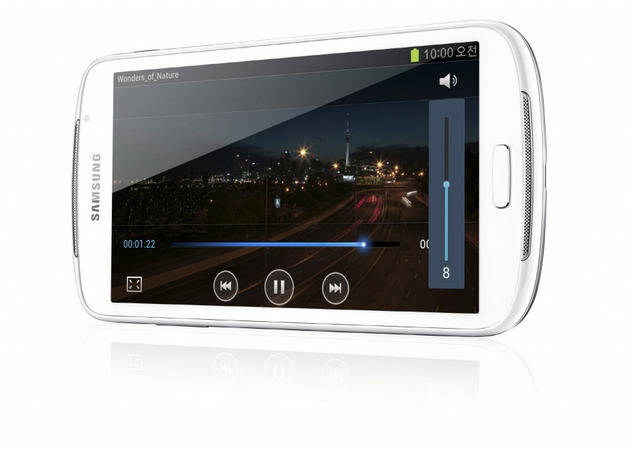
Ahead of IFA beginning later this week, South Korean-based Samsung announced a new personal media player for its line of 3.6-inch, 4-inch, 4.2-inch, and 5.0-inchers. In a press release this morning, Samsung unveiled the new Galaxy Player 5.8 that rocks a humongous 5.8-inch display with a resolution of 960-by-540 LCD. The company has not given any details on launch or pricing, but it told us the device also packs Android 4.0 Ice Cream Sandwich, Samsung’s infamous TouchWiz UI, a 16GB or 32GB storage option, microSD slot, front VGA camera for video conferencing, and modest 2,500mAh battery.


Expand
Expanding
Close

Google’s attempt to block U.S. imports of iPhone and iPad thwarted as ITC remands investigation of one patent

Site default logo image

Following the verdict in the Apple vs. Samsung trial today, where Samsung was found guilty of infringing various Apple patents related to the case, Apple is also coming out a winner, at least temporarily, in Google/Motorola’s attempt to block imports of iPhones and iPads to the United States.

In late June, we told you about Google’s attempt to block U.S. imports of iPhones and iPads based on a previous ruling that Apple infringed on one standard-essential Motorola patent. The initial ruling was under review by the ITC, which has power to block U.S. imports of Apple devices from Asia, with a decision expected at a hearing scheduled for today.

The ITC has now concluded its review (via paid blogger FossPatents), finding no violations for three of the four patents in the initial suit (including the one mentioned above), but remanded an investigation on a fourth, non-standard essential patent to Judge Thomas Pender. The result? According to FossPatents, there might be a violation and import ban related to the patent, but a remand and ITC review could take up to a year:

Expand
Expanding
Close

Site default logo image

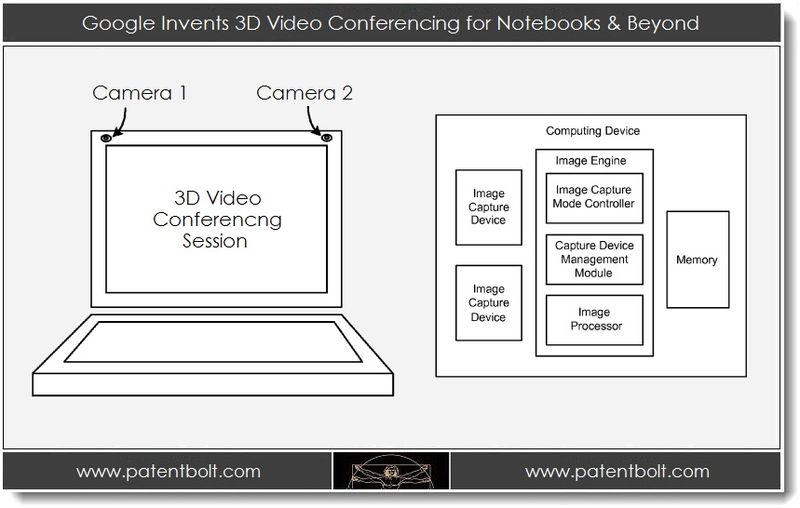
USPTO publishes Google patent for 3D video conferencing on a laptop

The U.S. Patent and Trademark Office published a patent application from Google that illustrates the search giant is developing technology for a computing device, such a laptop, that will boast dual cameras with 3D video conferencing as the main function.

Patent Bolt explained:

  • Google’s specific example goes like this: the computing notebook with the dual cameras could be used by a first user to produce a stereoscopic image of, for example, the first user during a video conference session when while in the notebook’s stereoscopic mode. In some instances, the stereoscopic image could be displayed locally and/or sent to a remote computing device via the video conference session.
  • If a second user joins the video conferencing session in the same room as the first user, the notebook could be changed from a stereoscopic mode to that of a multi-image mode so that separate images of the first user and the second user could be used during the video conferencing session.

It is worth noting stereoscopy is otherwise known as 3D imaging. Most stereoscopic techniques present two offset images independently to the left and right eye of the viewer, but the brain combines them to give the perception of 3D depth.

Patent Bolt further contextualized the multi-image mode:

  • In Google’s example of this invention used in a video conferencing context, two people in one office could be both using the same notebook during the conference for the sake of simple communications. They could be sitting across the table from each other with one camera facing one participant and the other camera pointed to the back of the notebook to view the second participant. The party on the other end of the conference would simply see two side-by-side boxes on their screen as if the individuals were actually sitting side by side. For home users it could be handy application when there’s only one household notebook.

Get the full report and more images at Patent Bolt.


Expand
Expanding
Close

Site default logo image

Google, Samsung join Apple and other adversaries to buy Kodak patents, perhaps signaling intent to curtail litigation

It must be a cold day in Hell. Google and Samsung are consorting with Apple, LG Electronics, and various ventures and firms to bid as a group on Kodak’s intellectual property.

Kodak filed for bankruptcy protection in January, according to The Wall Street Journal, and it is looking to auction its patents to raise money for surviving a Chapter 11 court protection. Kodak could barter all 1,100 digital photography-based patents or end the auction without a deal, as the company announced it would name the winning bidders on Monday but eventually pushed the deadline upon talking with creditors.

The Wall Street Journal explained:

  • Negotiations and the bidding group’s composition are fluid, the people said. If the consortium reaches a deal to buy some or all of Kodak’s patents, they would essentially be kept out of any one company’s hands and could prevent consortium members from using them in litigation against each other. A deal, however, could also attract attention from federal antitrust regulators.
  • A deal for the entire portfolio—one of many options under discussion— could fetch more than $500 million based on recent negotiations, people familiar with the process said. That is well above opening bids when the auction started last week, but far below the $2.2 billion to $2.6 billion Kodak at one point said the patents could be worth.
  • In a statement Thursday, Kodak said discussions with buyers are active and that it isn’t ready to announce a result. The company added that it might decline to sell some or all of the patents, depending on how the auction progresses.

Photography and cameras are obviously a main feature of mobile devices. Competitors in the tech arena have joined forces in the past to snatch up attractive patents, but The Wall Street Journal noted it is “unusual for them all to join the same camp.”

Patent law whiz Michael Carrier, of Rutgers University in Camden, said the companies would not suffer antitrust issues if the tech giants commit to licensing on reasonable rates. Otherwise, an action such as dividing the patents without sharing the rights to use them could likely meet legal trouble down the road.

Get the full report at The Wall Street Journal.

This article is cross-posted on 9to5Mac.


Expand
Expanding
Close

Site default logo image

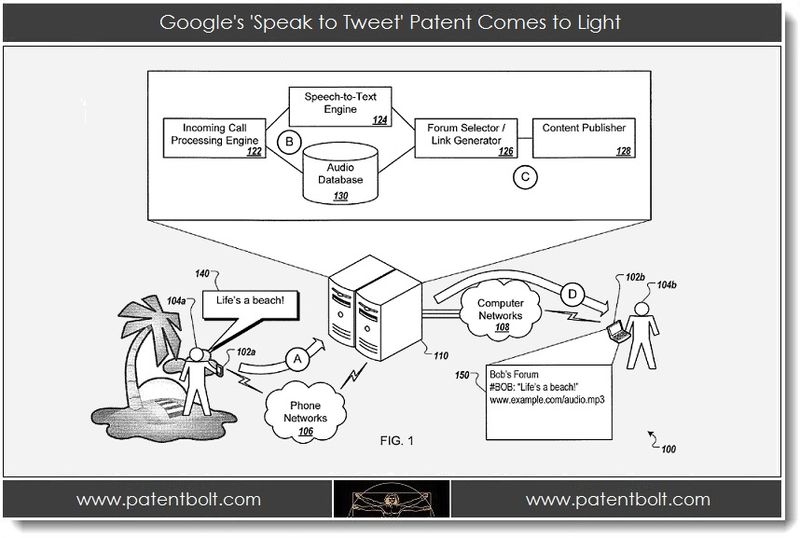
USPTO publishes Google’s ‘Speak to Tweet’ patent

The U.S. Patent and Trademark office just published a Google patent for “Speak to Tweet,” which is a service that allows users to communicate on Twitter by dialing an international phone number and then leaving a tweet by way of voice message. Google developed “Speak to Tweet” in response to the 2011 Egyptian revolution Internet shutdown.

Patentbolt explained:

In January 2011 Google acquired a small company called SayNow. Google, with the assistance of their newly acquired SayNow team worked night and day with Twitter so as to quickly develop a product called “Speak to Tweet.” The service was developed to help people stay connected in times when they were unable to find a viable Internet connection. The inspiration for this application was born during the Egyptian revolution. As a reaction to protests in Cairo, the Egyptian government shut down the Internet throughout that country on January 26, 2011. Technically, Speak to Tweet (or speak2tweet) is a communications service that allows users to leave a “tweet” on Twitter by calling a designated international phone number and leaving a voice message. Recently, the US Patent Office published the patent that’s behind the Speak to Tweet service.

Head of the Google Cultural Institute Steve Crossan originally filed the patent application in Q1 2012. Check it out here.

[Image via Patentbolt]


Expand
Expanding
Close

Site default logo image

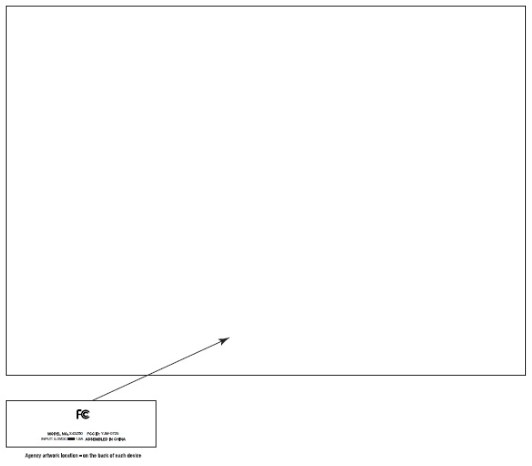
Report: FCC clears Amazon’s next Kindle Fire with larger display, possible fall release

Label

Amazon’s next-generation Kindle Fire could land in the fall with a larger display.

At least that is what Nate Hoffelder of The Digital Reader reported after receiving a tip about a new Kindle Fire clearing the Federal Communications Commission yesterday:

A friend of mine has tipped me to an anonymous set of FCC documents which were posted yesterday. They don’t show any useful detail, but they do lead somewhere interesting. Like Amazon’s past FCC submissions, this paperwork belongs to a new front company. This time around the company is Harpers LLC.

Hoffelder did not find any details in the FCC filing beyond the eReader’s label, but he reviewed the dimensions given and said it looked like a 9.7-inch or 10-inch tablet:

The general screen geometry is likely going to be 4:3 (like the iPad), and not widescreen like many Android tablets. And since some of the hidden parts of the FCC paperwork will be revealed in December, this device will clearly be launched this fall.

The original Kindle Fire is a version of Amazon’s popular Kindle eReader. It announced in September 2011 with a color 7-inch multi-touch display and a forked version of Google’s Android operating system.

Go to The Digital Reader for the full report. 

[FCC— OET Exhibits List]


Expand
Expanding
Close

Teens flock to YouTube for music consumption over iTunes and other mediums

Site default logo image

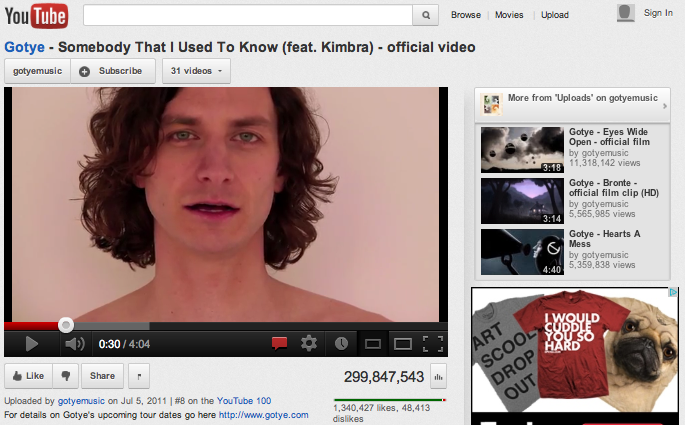
The majority of American teens prefer YouTube to iTunes, radio, online radio, and CDs when it comes to finding and listening to music.

Approximately two-thirds of 18-and-younger U.S. teenagers, according to a “Music 360” survey from research firm Nielsen (via The Wall Street Journal), claimed they sidestepped other music-listening mediums for Google’s video-sharing platform.

YouTube snagged 64 percent of 13-to-17 year olds, while radio came in second at 56 percent. iTunes held 54 percent, with CDs and Pandora rounding the top five at 50- and- 35 percent respectively.

The Wall Street Journal noted young folks regard YouTube as a “de facto free music service,” but adults do not take full advantage of the site’s complimentary content. The survey showed 67 percent of them actually preferred radio for music consumption, but another 61 percent still gave CDs a whirl. Meanwhile, YouTube stole 44 percent, Pandora landed the No. 4 spot at 32 percent, and iTunes sat at fifth with 29 percent.


Expand
Expanding
Close

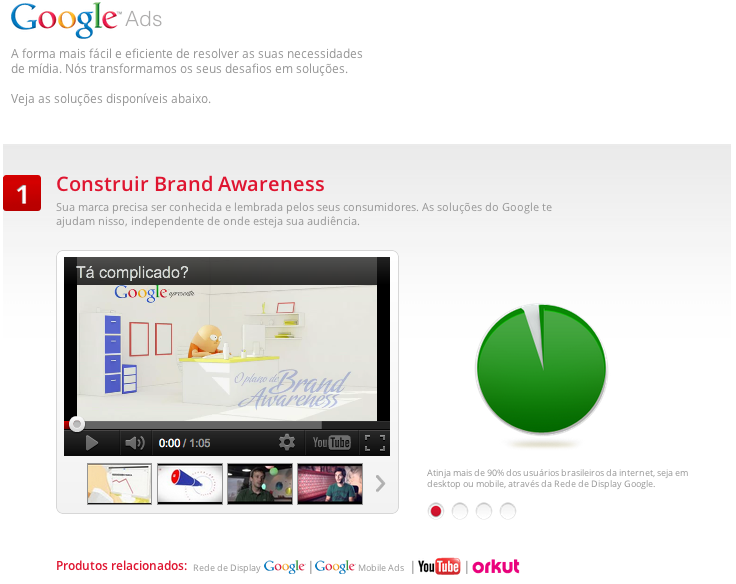
Google launches clever Google Ads campaign with animated commercials in Brazil (Videos)

Site default logo image

Google is using witty animation to enlighten folks in Brazil about the conditions of online advertising and how its service helps streamline those operations.

The Internet giant recently hosted five animated videos on YouTube as part of a Brazil-based campaign for Google Ads products. According to TheNextWeb (via Brainstorm9), agencies Pepper Melon and Ño Empire co-created the farcical advertisements that focus on brand awareness, audience engagement, efficient technology use, target selection, and new product launches.

The commercials are in Brazilian Portuguese with English subtitles, check ’em out:


Expand
Expanding
Close

Site default logo image

It’s official: Google agrees to pay record $22.5M FTC fine in Safari bypass dispute

We reported last week that the Federal Trade Commission voted to fine Google $22.5 million for violating browser security settings in Safari, but now Google has agreed to pay the record-setting amount and finally settle its dispute.

According to the press release (via MarketWatch): 

  • Google to pay $22.5 million to settle FTC dispute
  • SAN FRANCISCO (MarketWatch) — Google Inc. GOOG +0.27% Thursday agreed to pay a $22.5 million penalty to settle a dispute with the U.S. Federal Trade Commission. The FTC said the penalty stems from charges that Google misrepresented users of Apple Inc.’sAAPL +0.13% Safari Web browser after saying it wouldn’t place tracking “cookies” or serve targeted ads to Safari users. The FTC said Google’s actions violated and earlier privacy settlement between the FTC and Google. Google shares were up less than 1% at $643.63 in early trading Thursday.

The allegations against Google began in February, when the search engine and other ad companies were caught bypassing Safari security settings to install tracking cookies on devices and computers without consent.

“The record setting penalty in this matter sends a clear message to all companies under an FTC privacy order,” said FTC Chairman Jon Leibowitz in another presser. “No matter how big or small, all companies must abide by FTC orders against them and keep their privacy promises to consumers, or they will end up paying many times what it would have cost to comply in the first place.”

It is worth noting that the hefty fine roughly equals five hours of revenue for Google based on Q2 2012 sales.

The FTC’s full press release is below.

This article is cross-posted on 9to5Mac.


Expand
Expanding
Close

Site default logo image

IDC: Samsung and ASUS are gaining, but iPad still owns over 2/3rds of the tablet market

According to the latest data from IDC, four of the top five worldwide vendors eyed shipment increases year-over-year and solid growth in Q2 2012.

Global tablet shipments hit 25 million units, with a 66.2-percent year-over-year increase, while Apple’s iPad set a shipment record in Q2 2012 by jumping from 11.8 million units shipped in Q1 2012 to 17 million.

Samsung sits at second place with 2.4 million units shipped, which is an increase from 1.1 million units in Q2 2011, and ASUS notably almost tripled its amount of units shipped from a year ago. Interestingly, shipments of the Google/ASUS-branded Nexus 7 are not a part of these totals.

Get the full breakdown at IDC.

This article is cross-posted at 9to5Mac.


Expand
Expanding
Close

Site default logo image

Benchmarks reveal ‘strong storage performance’ for 16GB Nexus 7

AnandTech ran the 16 GB Nexus 7 through the Android version of its standard SSD tests using Androbench, and the in-depth results indicate the Google-branded tablet boasts “strong storage performance.”

The performance highlights:

  • — Sequential read speed at 19.8 MB/s (slower than 8 GB model, 32 GB Motorola Xyboard 10.1, and 16 GB Samsung Galaxy Nexus).
  • — Sequential write speed at 10. 47 MB/s (faster than 8 GB model, 16 GB Samsung Galaxy Nexus, and 16 GB Asus Transformer Pad 300).
  • — Random read performance at 7. 79 MB/s (faster than 8 GB model, 16 GB Samsung Galaxy Nexus, and 16 GB Asus Transformer Pad 300).
  • — Random read performance at 0.46 MB/s (faster than 8 GB model, 16 GB Samsung Galaxy Nexus, and 16 GB Asus Transformer Pad 300).

AnandTech’s Anand Lal Shimpi said the difference in IO performance “isn’t significant enough to push you towards the $250 Nexus 7 if you don’t need the extra space,” but he told folks to consider the 16 GB model an “added benefit.”

Get the full report at AnandTech.


Expand
Expanding
Close

Google cancels consumer launch of Nexus Q via email to preorder customers

Site default logo image

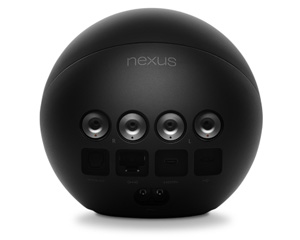
Google just sent an email to customers who pre-ordered the Nexus Q to announce it will postpone the consumer launch of its media-streaming device.

The Nexus Q originally received a mid-July shipping time, but Google apparently decided to go back to the drawing board over “initial feedback from users.”

Google is apologizing to those who pre-ordered the $299 Nexus Q by sending them a free one. The U.S.-made device is akin to an Android- and Google services-compatible Apple TV, but it does not run apps.

Google’s email is below.


Expand
Expanding
Close

Apple vs. Samsung: Opening Statements in the (Patent) trial of the century

Site default logo image

Apple and Samsung appeared in a San Jose federal court today, where U.S. District Judge Lucy Koh presides, to give opening statements starting at 9 a.m. PST.

Apple filed the first suit in this monumental case in April 2011. The Cupertino, Calif.-based company claimed Samsung infringed its patents by “slavishly copying” its iPhone. Samsung, a South Korea-based Company, promptly countersued.

This is one of the important cases to go to trial among a slew of other litigations on smartphone patents. If Apple wins, Samsung could suffer a financial blow and the ability to sell its infringing products in a large market. If Apple loses, its “thermonuclear war” against Android smartphone manufacturers could essentially wither away as Samsung collects royalty fees.

This morning’s most notable highlights are below (continually updated).


Expand
Expanding
Close

Samsung readying 11.8-inch 2560-by-1600 Galaxy Tab this year reveal court docs

Site default logo image

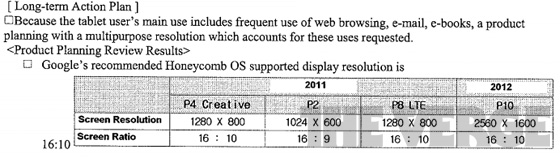
This Apple vs. Samsung trial is turning into a treasure trove of information on the two companies, with the latest bit of information being that Samsung is readying a 11.8-inch Galaxy Tab with an incredible 2,560-by-1, 600 pixel resolution. That is a 30-inch monitor brought down to the size of a netbook display, and it is somewhere between the screens on a retina MacBook Pro and a Retina iPad. This mega-tablet is labeled “P10” on slide 83 of Samsung’s presentation, so it has no one but itself to blame for this premature announcement.

A rough calculation on the size is just slightly bigger than the screen of the smaller MacBook Air. I will admit that I would love to try one of these out. And, before you go blaming Samsung for stealing Apple’s Retina invention, remember that Samsung makes the displays in Apple’s Retina iPad. Therefore, it has just as much right as anyone. As for the look and feel of the Tab, that is for the courts to decide.

(via the Verge)
Expand
Expanding
Close

Apple ‘beat Samsung to the punch’ on AuthenTec purchase

Site default logo image

News broke earlier today that Apple is buying mobile security company AuthenTec for $365 million. The company makes the majority of its money from fingerprint sensors and various security tools. AuthenTec also made a deal just last week with Samsung to implement its VPN technology in some of its Android devices. Many have speculated why Apple decided to make the purchase, and some point to the possibility of using AuthenTec’s technology in a future wallet solution. A report from ZDnet’s Larry Dignan offers another reason: simply to “beat Samsung to the punch.” Citing a report from analyst Richard Shannon, who recently said AuthenTec’s technology would be critical to Samsung, Dignan explained:


Expand
Expanding
Close

Site default logo image

Samsung says Apple stole iPhone design from Sony

With Apple and Samsung’s jury trial slated to kick off in a federal district court in San Jose, Calif., this Monday, AllThingsD points us to trial briefs where Samsung’s lawyers argued Apple’s inspiration for the original iPhone CAD drawings and designs were inspired by a Sony product:

Right after this article was circulated internally, Apple industrial designer Shin Nishibori was directed to prepare a “Sony-like” design for an Apple phone and then had CAD drawings and a three-dimensional model prepared. Confirming the origin of the design, these internal Apple CAD drawings prepared at Mr. Nishibori‘s direction even had the “Sony” name prominently emblazoned on the phone design, as the below images from Apple‘s internal documents show..

Soon afterward, on March 8, 2006, Apple designer Richard Howarth reported that, in contrast to another internal design that was then under consideration, Mr. Nishibori‘s “Sony-style” design enabled “a much smaller-looking product with a much nicer shape to have next to your ear and in your pocket” and had greater “size and shape/comfort benefits.” As Mr. Nishibori has confirmed in deposition testimony, this “Sony-style” design he prepared changed the course of the project that yielded the final iPhone design.

The article referenced above is from a 2006 interview with Sony designers that appeared in Businessweek.

Report: Samsung says removal of Google’s universal search on UK Galaxy S III was ‘inadvertent’

Site default logo image

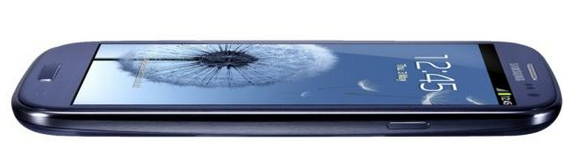
The blogosphere recently swelled with speculation as to why Samsung removed Google’s universal search function from its premiere Galaxy SIII smartphone, but a new report today revealed the ousting was simply “inadvertent.”

AndroidCentral first revealed the problem: 

  • There’s a new over-the-air update rolling out for the international Samsung Galaxy S III (aka Galaxy S3 GT-i9300) this evening. The OTA message identifies it as a “stability update,” but what it also does is remove local (on-device) search functionality in the phone’s built-in Google Search app. The new version — XXBLG6 — is a relatively recent build, having been cooked just a few days ago on Jul. 20. A new baseband version, XXLG6, is also included, but we haven’t noticed any other changes thus far.
  • Following legal action by Apple, which temporarily resulted in the Galaxy Nexus being banned in the U.S., Samsung has taken to pre-emptively disabling the ability to search within on-device data (like contacts and applications) on some U.S. Galaxy S3’s. However, the decision to kill local search on the unlocked international model — which isn’t sold in the U.S. — is a little perplexing, not least because Apple has yet to challenge Sammy over local search in the EU or UK, where the GT-i9300 is sold.

Samsung just confirmed to TechRadar, however, that the removal of search functionality on the U.K. version of the Galaxy S III had nothing to do with a legal action by Apple. The mysterious occurrence, which stopped the ability to search for files, contacts, and apps through the built-in Google Search widget, was apparently unintentional.

According to Samsung:

“The most recent software upgrade for the Galaxy S III in the UK included the inadvertent removal of the universal search function. Samsung will provide the correct software upgrade within the next few days.”

A new update will roll out over the next few days to fix the problem.


Expand
Expanding
Close

Site default logo image

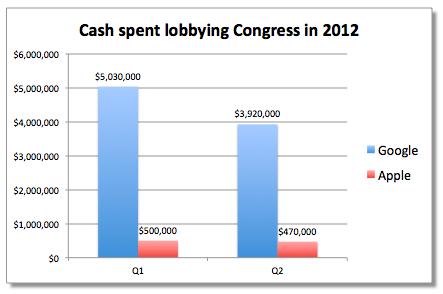
Report: Google shells out over $5M lobbying in Q2, while Apple barely spends $500K

The congressional lobbying disclosure reports for Q2 2012 are available, and Google is far ahead of Apple in terms of money spent lobbying.

Fortune’s Philip Elmer-DeWitt reported that “Google has outspent Apple nearly 10 to one,” and he noted which bills Apple is giving the most attention:

The list is long, and it ranges from the Do Not Track Kids Act of 2011 to “issues related to the transportation of batteries.” Given the latest kerfuffle about Apple’s temporary withdrawal from the Electronic Product Environmental Assessment Tool program a couple weeks ago, I was interested to see “EPEAT” on the list.

Google also took an active interest in environment, with its specific lobbying issues pertaining to “renewable energy policies.”

Google’s report is here, while Apple’s report is here.

This article is cross-posted on 9to5Mac.


Expand
Expanding
Close

Samsung plans a big non-phone Galaxy announcement for August 15

Site default logo image

We just received an invite from Samsung Electronics America to “Save the Date” for a major Galaxy announcement. This business division is not to be confused with Samsung Telecommunications America that handles mobile phones.

What could it be?

We are hoping the Samsung Galaxy Camera lands, but it will likely be a tablet or TV.

SAVE THE DATE

August 15, 2012

10:00AM EST

Please join Samsung Electronics America for a major announcement and unveiling of the newest GALAXY device. An exclusive press conference will take place where full details will be disclosed.

An invitation with details will follow soon.

Thank you.

More as it comes in.
Expand
Expanding
Close

Motorola Xoom does not violate iPad design patent, rules German court

Site default logo image

A German court ruled this morning that the Android-powered tablet does not violate the patented look of Apple’s tablet. The Duesseldorf court discarded one claim by the Google-owned manufacturer, however, about the iPad’s design patent being inapplicable.

FoxBusiness explained:

  • Apple initially sued Motorola for allegedly infringing three iPad designs with the Xoom. It sought to have the device banned across Europe.
  • Although the judges ruled Motorola’s Xoom doesn’t infringe on the iPad, the court rejected a counterclaim brought by Motorola alleging the iPad’s design patent is invalid, a spokesman for the court said.
  • As the court ultimately rejected both parties’ claims, it ordered Apple to pay two-thirds of costs and Motorola to pay a third, the spokesman added.
  • […] During two hearings prior to the ruling, the presiding judge had indicated the court was leaning in Motorola’s favor. Judge Johanna Brueckner-Hofmann said in March that the court considered the evenly bent back and shaped edges on the front of the Xoom tablet sufficient to give the product individual character.

Apple is also suing Motorola in a Mannheim court for allegedly breaching a patent on multi-touch enabled devices.

Get the full report at FoxBusiness.


Expand
Expanding
Close

NBC Olympics to live stream games on mobile devices with two Adobe-powered apps [Video]

Site default logo image

[youtube=http://www.youtube.com/watch?v=uNLh85pKLw4&feature=player_embedded#!]

NBC just unveiled two Adobe-powered mobile apps for its 2012 London Olympics coverage.

The NBC Olympics Live Companion app will act as a second display for stats and other details so users have a full bevy of data to compliment their television-watching experience. Meanwhile, the NBC Olympics Live Extra app will pipe live-streaming video to on-the-go users. It can handle multiple camera angles, social features, and the ability to seamlessly switch between both Olympics apps.

The free apps will launch today on both Apple’s App Store for iOS devices and the Google Play Store for Android smartphone and tablets. They will also support “TV Everywhere” authentication with cable providers for unlimited access to all the premium content. Users simply need to login to their pay-TV subscription to tap into 3,500 hours of Olympic events.

“To make it as easy as possible, you only need to go through the sign-in once and won’t have to “re-authenticate” every time you want to watch a live event,” explained Adobe on its Digital Media Blog. “For the first time in Olympics history, mobile apps will give you the opportunity to view live broadcasts of all Olympic events in the palm of your hand.”

NBC Olympics is also using Adobe technologies to serve ads, measure and monetize content, and provide digital analytics in both apps.

This article is cross-posted on 9to5Mac.

The press release is below.


Expand
Expanding
Close

Sustrans and Google Maps launch cycling routes in UK [Video]

Site default logo image

[youtube=http://www.youtube.com/watch?v=1bFdNFTq8Vw&feature=player_embedded]

Sustrans, a British charity promoting sustainable transport, just announced that it partnered with Google to bring cycling routes to United Kingdom-based Google Maps users.

Greener-minded Americans are quite familiar with the biking icon and its bevy of alternative transit routes, but now U.K. fans of the popular mapping app can plan their cycling trips, navigate bike lanes, and time routes on both smartphones and computers. For those unfamiliar, Google Maps offers worldwide mapping technology, directions and local business information to mobile and desktop users by way of satellite and street-level imagery and user-contributed content.

“We know how popular cycling is in London and the rest of the UK, especially ahead of a busy summer, which is why we are thrilled to bring cycling directions to Google Maps. Thanks to Sustrans, we now have thousands of miles of trails and routes, as well as bike lanes and recommended streets for cities across the country,” said Google UK Geospatial Technologist Ed Parsons.

“We’ll continue to add new trail information and urge commuters to swap their car for a bike as they can now find a convenient route that makes use of dedicated bike tracks and avoid hills whenever possible, Parsons added.

The new feature goes live today, and Sustrans is celebrating the launch with its own video, called “Lucy’s Cycling Treasure Hunt” (above).

The press release is below.


Expand
Expanding
Close