Stay up to date on news from Google headquarters. Be the first to learn about plans for Android, Google Plus, Google Apps, and more!
Stay up to date on news from Google headquarters. Be the first to learn about plans for Android, Google Plus, Google Apps, and more!

Google just acquired social media marketing company Wildfire.
AllThingsD reported “people familiar with the transaction” estimate Google bought the social ad business for $250 million, “plus earnouts, employment agreements, etc.”
Wildfire currently serves 16,000 customers, including 30 of the top 50 brands, and it reportedly raised $14 million since founding in 2008. Google will likely merge Wildfire into its ever-expanding social and advertising services to better entice marketers into buying either traditional or display ads for a variety of platforms— even direct rival Facebook.
Both companies took to their respective blogs today to confirm the buyout (below).

As first reported by Chrome Story, owners of newer Chromebooks and Chromeboxes might soon get their hands on more cloud storage…for free. According to references discovered in Chromium OS code, the storage increase will most likely come soon in the way of Google Drive Google currently makes 5 GB available free to users for storing files and documents.
According to the code reference “553 GDATA_WELCOME_TITLE_ALTERNATIVE: ‘Get 100 GB free with Google Drive’,” it sounds very likely that users will be able to receive 100 GB of cloud storage for free. That is definitely useful, especially considering most Chrome OS devices only have 16 GB of local storage. We will let you know when the 100 GB goes official.

[protected-iframe id=”016966f59b9b1a83e76afccc1a4627d7-22427743-18874939″ info=”http://live.wsj.com/public/page/embed-D841AA1C_4DE4_4746_94F0_482A75583F54.html” width=”650″ height=”288″ frameborder=”0″ scrolling=”no”]
After announcing it would invest around $100 million in original TV quality content for YouTube last year, Google added almost a 100 new channels offering high-quality content. Today, we get some updates on the progress of the project from a report in The Wall Street Journal. According to WSJ’s sources, advertisers already committed over $150 million in ads on the channels for this year alone. Google also plans to throw another $200 million at the effort going forward. Google will also apparently fund content for international viewers:
YouTube plans to expand its channels initiative to Europe by funding a couple dozen video channels for British and French viewers by next year, according to people familiar with its initiative.
[tweet https://twitter.com/Spotify/status/230264584282447874]
In addition to announcing that the service is now up to 15 million active users and 4 million paying subscribers worldwide, Spotify also announced today that it is rolling out the radio streaming feature (previously only available on iOS) to Android. Same as the iPhone version, the feature provides ad-free radio streams for premium subs and ad-supported streams for free accounts. Unfortunately, the free streams are U.S. only at the moment. You can also save songs from radio streams to a “Liked from Radio” playlist.
What’s in this version:
There’s a great new radio experience in Spotify. Now you can discover and save music on the go! If your station plays a song you really like, save it with a single tap.
New: Start a radio station based on your favorite playlist, genre, album, artist or song.
New: Personalize your radio stations by voting songs up or down.

Capstone Investments‘s Rory Maher this morning had some reflections in the wake of Google’s announcement last Thursday that it plans to offer free Internet service in some parts of the U.S. and paid packages with access up to a gigabit per second.
Writes Maher, it looks like Google is planning nationwide availability given an ad the company has put up for a sales person to sell the service to businesses on a nationwide basis. Maher thinks building a network coast to coast would be too expensive, so probably Google would seek to “barter” fiber: “We believe in most markets Google will likely build in outlying areas where fiber capacity is limited and barter with other fiber providers to build the capacity to serve an entire market. We believe this could cut construction costs significantly.”
BI noted that this would cost nearly $400 billion—significantly ahead of Google’s war chest allotment.
Whatever Google needs to do to make this happen is totally worth it. I have taken to looking at Zillow’s Kansas City pages, noting the $1,000’s plus charge for Gigabit in NYC would quickly offset the cost. Does anyone know how good the pizza is in Kansas City?

An interesting post appeared on Reddit today about an upcoming movie on two 40-something interns trying to become successful at an Internet company, but, more intriguingly, the film’s plot supposedly has Google ties.
The Reddit poster claimed his college transformed into a “Vince Vaughn/Owen Wilson movie called ‘The Internship’ where they play Google interns.” A quick glimpse at the comments revealed the picture is shooting at Georgia Tech in Atlanta, Ga.
According to the college’s website, set preparations for the movie will begin this week, “with production scheduled to wrap up on Aug. 24.” Adam Carlson of Creative Loafing, an Atlanta-based entertainment blog, reported earlier this month that he also spotted the film crew in town with Google:
- As it turns out, I showed up as the crew was beginning prep on an outdoor sequence across the street from the Studios, which would include both a fire hydrant specially painted red and a Google bus.
- The scenes indoors probably had a Google connection, too, […] a Coke machine had been installed on a top floor with a Google banner across it, covering the logo.
- Maybe Owen and Vince — who play out-of-work salesmen reinventing themselves with a tech firm internship — were meant to be at Google? No one would confirm, but the very humid, very Atlanta weather didn’t feel much like California.
A gallery is below.
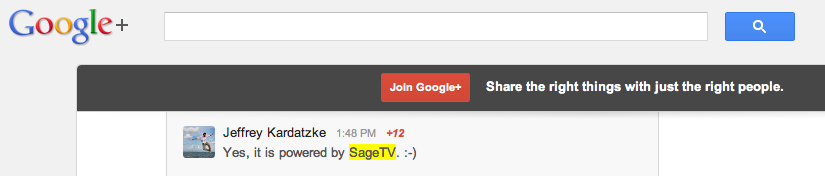
SageTV’s founder just revealed in a Google+ comment that Fiber TV is powered by his former company’s technology.
SageTV essentially provided a television interface for DVR, music, and photographs, with the ability for users to create and control the media center from multiple devices. In June 2011, SageTV CTO and founder Jeffrey Kardatzke announced that Google acquired his company, and SageTV products have no longer been available for purchase since.
Google launched its Gigabit Google Fiber Internet and TV service in Kansas City this afternoon. The Mountain View, Calif.-based Company spent a lot of time demoing its “100 times faster” Internet service, but the majority of the demo was for Fiber TV. The service will give access to YouTube, DVR, on-demand libraries, and Netflix.
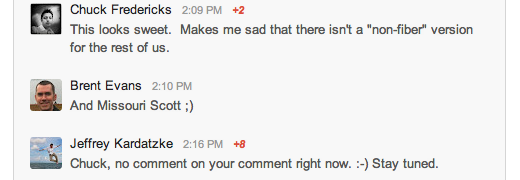
While Fiber TV is only available to “Fiberhoods” in Kansas City at the moment, Kardatzke told Google+ folks to “stay tuned” (below).

The blogosphere recently swelled with speculation as to why Samsung removed Google’s universal search function from its premiere Galaxy SIII smartphone, but a new report today revealed the ousting was simply “inadvertent.”
AndroidCentral first revealed the problem:
- There’s a new over-the-air update rolling out for the international Samsung Galaxy S III (aka Galaxy S3 GT-i9300) this evening. The OTA message identifies it as a “stability update,” but what it also does is remove local (on-device) search functionality in the phone’s built-in Google Search app. The new version — XXBLG6 — is a relatively recent build, having been cooked just a few days ago on Jul. 20. A new baseband version, XXLG6, is also included, but we haven’t noticed any other changes thus far.
- Following legal action by Apple, which temporarily resulted in the Galaxy Nexus being banned in the U.S., Samsung has taken to pre-emptively disabling the ability to search within on-device data (like contacts and applications) on some U.S. Galaxy S3’s. However, the decision to kill local search on the unlocked international model — which isn’t sold in the U.S. — is a little perplexing, not least because Apple has yet to challenge Sammy over local search in the EU or UK, where the GT-i9300 is sold.
Samsung just confirmed to TechRadar, however, that the removal of search functionality on the U.K. version of the Galaxy S III had nothing to do with a legal action by Apple. The mysterious occurrence, which stopped the ability to search for files, contacts, and apps through the built-in Google Search widget, was apparently unintentional.
According to Samsung:
“The most recent software upgrade for the Galaxy S III in the UK included the inadvertent removal of the universal search function. Samsung will provide the correct software upgrade within the next few days.”
A new update will roll out over the next few days to fix the problem.
[youtube http://www.youtube.com/watch?v=6uZVqPuq81c]
Google plans to make a “special announcement about Google Fiber and the next chapter of the Internet” at 12 p.m. EST.
The company revealed earlier this week that it would launch the “100 times faster than broadband” Internet service today in Kansas City.
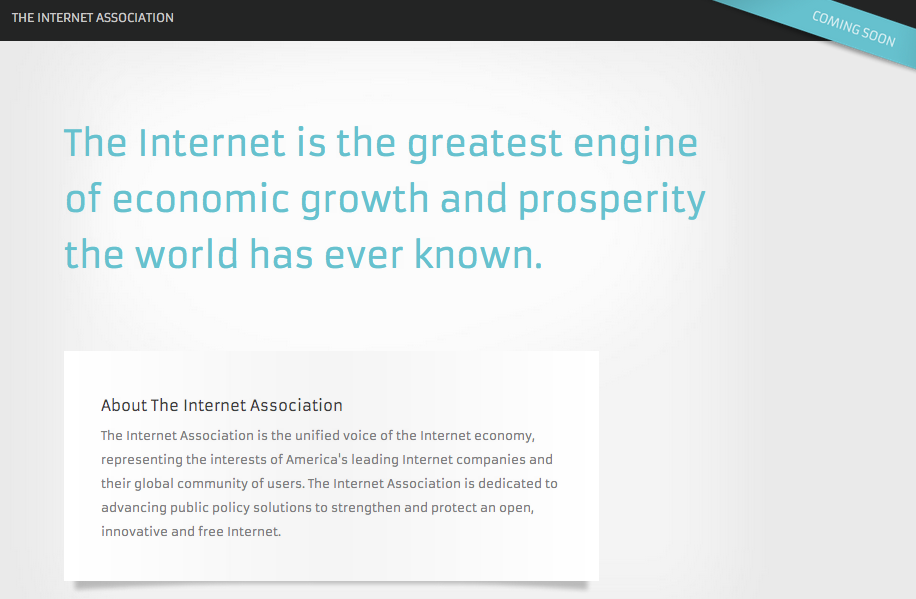
The world must be ending—because Google, Facebook, Amazon, and eBay just united for a cause.
The Web’s leading giants apparently formed an “Internet Association” to lobby on Capitol Hill. The Washington Post first detailed the alliance, which former Congressional guru Michael Beckerman leads, while it further noted a full list of parties is not yet known. An anonymous source told the publication, however, that the above four companies are the most notable members.
Beckerman most recently served as deputy staff director to the U.S. House Energy and Commerce Committee, and he boasts more than 12 years in Washington under his belt.
“The Internet must have a voice in Washington,” explained Beckerman in a press release (PDF). The Internet Association, which officially launches in September, aims to act as the Web’s executive voice.
Google is already copiously betted in various lobbying issues. 9to5Google even reported earlier this week that the folks in Mountain View spent over $5 million lobbying in Q2 2012.
[youtube=http://www.youtube.com/watch?v=cEMqxcfIqp4&feature=player_embedded]
Google just unveiled its “YouTube Creator Space” in London.
The high-tech studio will essentially allow YouTubers to create premium content for Google’s video-sharing platform. They will have access to technical equipment, and other YouTube content producers, which will undoubtedly encourage quality videos based on fresh, collaborative ideas.
“We’re delighted to announce that in the next few weeks we’ll be opening the doors to our new creator space, housed in the offices of Google London’s Soho office,” announced the company on its YouTube Creator Hub channel.
According to the above video’s description:
Our partners from all over Europe, Middle East and Africa will be able to book time in the space to create and collaborate with other creators, learn new techniques, as well as gaining access to state-of-the-art audio visual equipment, to help them generate great new content for their channels. The creator space is complete with the latest equipment such as DSLRs and cinema cameras, two studios including a green screen and fully staffed editing suites.
The YouTube Next Lab, which is a team “focused on accelerating the growth and development of channels and creators on YouTube,” will oversee the London studio.
A new report from The Wall Street Journal today, citing an SEC filing, noted Google has put an exact value on the patents acquired in its purchase of Motorola Mobility. In the filing, Google claimed “patents and developed technology” acquired in the deal were valued at $5.5 billion—less than half of the $12.4 billion Google paid for the company.
Google also broke down the rest of the purchase price in the SEC filing:
Expand
Expanding
Close
You may already be aware that Google search provides a calculator that offers answers to queries, such as 2+2 directly, from the main search results page. As pointed out by a reader, Google recently updated the calculator search functionality, and it now provides a full HTML5 scientific calculator for these types of search queries. The features work with voice—except for on mobile devices, as they do not have access to the full scientific calculator presented on desktops.
Earlier this month, Google started to roll out a similar widget on its search page for unit conversions, like inches to centimeters. Now, unit conversion queries are presented with the live unit conversion tool (pictured below) that allows you to switch between units of measurements for temperature, length, mass, speed, digital storage, and much more.
We knew the U.S.-made streaming device would ship sometime in July to those who preordered, but today Nexus Q is officially in stock on the Google Play store. It is shipping in “3-5 business days” to U.S. customers. Nexus 7 certainly had a good start. It sold out at several retailers, but many are skeptical the $299 media streamer will do as well.
Expand
Expanding
Close
Google and the European Commission consented to the “outlines of a settlement” today, according to The Financial Times (via SearchEngineLand), which, if inked, would spare the search engine from official antitrust charges.
Europe’s premier competition watchdog has long accused the Mountain View, Calif.-based Company of abusing its dominance to suppress opponents in the market. Google previously said it would make company-wide changes to avoid a legal battle and expensive fines, and it seems the most recent outcome of those discussions is a new settlement draft of which the details are currently unknown. The rough deal reportedly also extends to a contentious matter that surfaced late in the talks—mobile search.
 Joaquin Almunia, the European Union’s vice president of the European commission responsible for competition, sent a letter to Google Executive Chairperson Eric Schmidt in May. The letter detailed the antitrust investigation into Google’s search practices, and it offered the search engine a chance to remedy its “abuses” by settling.
“I have just sent a letter to Eric Schmidt setting out these four points. In this letter, I offer Google the possibility to come up in a matter of weeks with first proposals of remedies to address each of these points,” said Alumnia.
[youtube=http://www.youtube.com/watch?v=OQkC3C73Rk0&feature=player_embedded]
We told you last month that the Vizio Co-Star received a $99 price tag, but the set-top box is now officially available for pre-order starting today.
Those who are interested in the Google TV-streaming box can go to www.vizio.com/costar to pick it up. It is exclusively sold on Vizio’s website for $99.99 USD with introductory free-shipping while supplies last. The current estimated shipping date is pegged around August 14.
The Co-Star goes beyond the typical Google TV experience by providing a skinned user-interface with an HTML5 Chrome browser, Netflix, Amazon Instant Video, iHeartRadio, and OnLive built-in. The box even comes with a dual-sided Bluetooth remote that boasts a full QWERTY keyboard and a touchpad.
Vizio took to its blog today to make the announcement:
- VIZIO Co-Star Available for Pre-order Today
- We are happy to announce that the VIZIO Co-Star is available for pre-order today. Visit VIZIO.com to pre-order the Co-Star for $99.99 (US) and take advantage of the limited-time offer of free shipping.
- The VIZIO Co-Star turns any HDTV into the ultimate smart TV. With 1080p and 3D support; Co-Star offers the distinct advantage of connecting to a cable or satellite box. This feature allows viewers to enjoy full screen web browsing with Adobe® Flash® Player and HTML 5, access to entertainment apps such as the OnLive® Game Service, Netflix®, YouTube® and more3 without switching inputs or remotes thanks to the universal touchpad remote with keyboard.
- The VIZIO Co-Star is the first stream player to offer video games on demand. Through OnLive,® users can demo, watch and play hundreds of top-tier video games directly from the “cloud,” eliminating the need for an independent game console. In addition, the VIZIO Co-Star offers popular apps such as Amazon Instant Video, YouTube®, iHeartRadio and more – all available for download through the Google Play Store.
The Vizio Co-Star’s first commercial—which debuted yesterday—is atop.
The press release is below.
[youtube=http://www.youtube.com/watch?v=Ezn1ne2Fj6Y&feature=player_embedded]
Google just took to its official Lat Long blog to wish Landsat a “Happy 40th Birthday” and make its surface imagery live for the entire world to enjoy.
The revered satellite program essentially collects continuous images of the Earth to help smart folks, like scientists and researchers, make knowledgeable decisions on the economy and environment. Google Earth Engine has made Landsat’s data available to such experts anywhere in the world, but now it wants to give the public access.
Googler Eric Nguyen explained:
- We’re working with the USGS and Carnegie Mellon University, to make parts of this enormous collection of imagery available to the public in timelapse videos of the Earth’s surface. With them you can travel through time, from 1999-2011, to see the transformation of our planet. Whether it’s deforestation in the Amazon, urban growth in Las Vegas or the difference in snow coverage between the seasons.
- […] In 2008, the USGS opened access to the entire Landsat archive for free. Google Earth Engine makes it possible for this data to be accessed and used by scientists and others no matter where they are in the world.
A highlighted timelapse video is below:
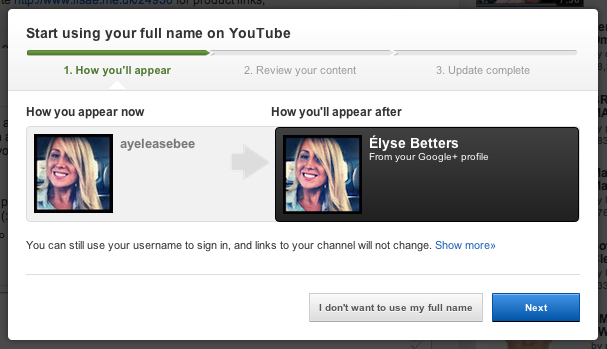
As BetaBeat first noticed, Google is attempting to peel back the anonymity cloak that surrounds YouTube.
The search engine, which seems to dabble in all things Web, mobile, and tech, now displays a pop-up box to YouTubers who try to leave a video comment. The notice prompts users to start surfing the video-sharing platform with their full name instead of a username or pseudonym.
Google appears to crop names from Google+ profiles, which is likely a byproduct of the Google+ integration from last year that required all YouTubers to login with their Gmail account credentials.
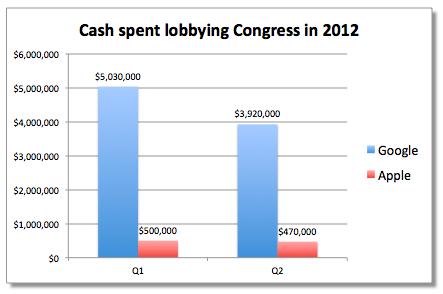
The congressional lobbying disclosure reports for Q2 2012 are available, and Google is far ahead of Apple in terms of money spent lobbying.
Fortune’s Philip Elmer-DeWitt reported that “Google has outspent Apple nearly 10 to one,” and he noted which bills Apple is giving the most attention:
The list is long, and it ranges from the Do Not Track Kids Act of 2011 to “issues related to the transportation of batteries.” Given the latest kerfuffle about Apple’s temporary withdrawal from the Electronic Product Environmental Assessment Tool program a couple weeks ago, I was interested to see “EPEAT” on the list.
Google also took an active interest in environment, with its specific lobbying issues pertaining to “renewable energy policies.”
Google’s report is here, while Apple’s report is here.
This article is cross-posted on 9to5Mac.
HTC plans to push Android 4.1 Jelly Bean to its popular line of One smartphones. HTC Global Online Communications Manager Jeff Gordon issued the following statement to The Verge:
“We know HTC fans are excited to get their hands on Google’s latest version of Android. At this point in time, we can confirm that we have plans to upgrade our HTC One X, HTC One XL and HTC One S to Jelly Bean. Please stay tuned for more updates regarding device upgrades, timing and other details about HTC and Jelly Bean.”
It is worth noting the One V is missing from the company’s update list.
[youtube=http://youtu.be/M3iCAlQMUv4?t=28m10s]
SearchEngineLand’s Danny Sullivan detailed today how Yahoo is not doing so hot with its Microsoft search deal and may soon go searching—no pun intended— for a new partner (a.k.a. Google) if performance doesn’t get better.
Yahoo’s new CEO, Marissa Mayer, a former top-tier Google Search exec, could encourage a partnership between the two polar search engines. On the other hand, Mayer brings a completely new level of knowledge to the fledging Yahoo due to her 13 years in Search with Google, so she could just help Yahoo to revamp Search with improved monetization.
Sullivan predicts some “hard renegotiating between Yahoo and Microsoft, with Google used as a cattle prod for Yahoo to shock Microsoft with.” Of course, we will have to wait and see whether Microsoft delivers on its search promises or if Yahoo will jump ship and snag a Google Search alliance—with Mayer leading the charge.
According to SearchEngineLand:
- Of course, Yahoo can’t walk away [from Microsoft] without finding another partner, and it has a real shortage of choices. There’s no one left in the US with the proven ability to deliver search queries at the volume Yahoo would demand.
- Ask.com? It’s largely outsourced to Google these days. Blekko? I’m sure it would love the job, but there would be a huge scaling-up challenge and, I’d say, much more work to do on the relevancy front. Maybe Yandex or Baidu could make a bid?
- It won’t be Yahoo. Yahoo has lost too much key search talent and hasn’t kept its core search technology up-to-date. When it gave itself over to Microsoft, Yahoo really left itself without a “Plan B.”
- My post from earlier this week, Ironically, Search Might Be Less A Priority At Yahoo As Google’s Marissa Mayer Takes The Helm, gets into these issues more — as well as the one realistic alternative to Microsoft. Google.
[youtube=http://www.youtube.com/watch?v=amuKO83W1c4&feature=player_embedded]
Google announced on the Google Fiber blog today that it will launch the “100 times faster than broadband” Internet service on July 26 in Kansas City. We do not know a lot about what to expect, but a Google Fiber-branded set-top box of sorts did make its way through the Federal Communications Commission in June. We will keep you posted later this month when Google reveals more about its Google Fiber plans for Kansas. Until then, you can sign up to get the latest announcements:
Google Fiber is coming to to Kansas City on July 26. We appreciate your help and support, and we feel privileged to be part of the Kansas City community. For updates on our project, please sign up for our mailing list and look out for an announcement on July 26 at http://google.com/fiber.
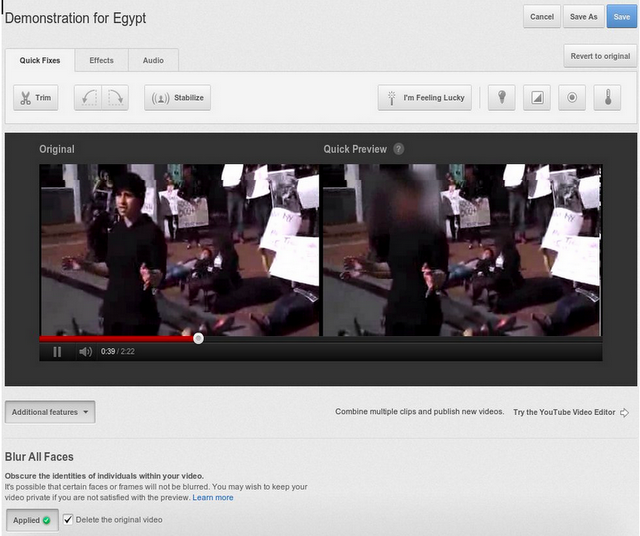
YouTube just launched a face-blurring feature for when “footage requires anonymity.”
The new addition to the video-sharing platform is self-explanatory. It is a tool that allows users to muddle faces in videos with just the click of a button.
“Whether you want to share sensitive protest footage without exposing the faces of the activists involved, or share the winning point in your 8-year-old’s basketball game without broadcasting the children’s faces to the world, our face blurring technology is a first step towards providing visual anonymity for video on YouTube,” explained the official YouTube Blog.
To blur faces: Go to Additional Features under Video Enhancements, and then click the “Apply” button below Blur All Faces. Users can see a preview before publishing, and a new copy is created with the blurred faces when saved. Users have the option to delete the original video.
YouTube warned that the tool is an “emerging technology,” so Face Blur may have difficulty auto-detecting faces.
Get the full breakdown at the official YouTube Blog.
In a blog post on the official Google Africa blog today, the company announced it created Gmail SMS. It is a new service that will allow users to send and receive Gmail messages via SMS. Rolling out first in Ghana, Nigeria, and Kenya, Google explained the feature would hopefully make Gmail even more accessible to users who often find themselves without an Internet connection:
You can now send and receive emails as SMS messages using your mobile phone, regardless of whether or not your phone has an internet connection, like Wifi or 3G. Gmail SMS works on any phone, even the most basic ones which only support voice and SMS.
Gmail SMS automatically forwards your emails as SMS text messages to your phone and you can respond by replying directly to the SMS. You can control the emails received by replying with commands such as MORE, PAUSE and RESUME. Additionally, compose a new email as an SMS and send to any email address recipient – who will find your message in the right email conversation thread!
Receiving Gmail messages via SMS will be free, but your standard SMS rates will apply for replying to messages and everything else. Google has instructions for how to sign up for the new service on its blog.
Expand
Expanding
Close