It turns out that his hobby 9to5Mac.com blog was always his favorite and in 2011 he went full time adding his Fortune Google followers to 9to5Google.com and adding the style and commerce component 9to5Toys.com gear and deals site. In 2013, Weintraub bought one of the Tesla’s first Model S EVs off the assembly line and so began his love affair with the Electric Vehicle and green energy which in 2014 turned into electrek.co.
In 2018, DroneDJ was born to cover the burgeoning world of drones and UAV’s led by China’s DJI.
From 1997-2007, Weintraub was a Global IT director and Web Developer for a number of companies with stints at multimedia and branding agencies in Paris, Los Angeles, New York, Sydney, Hong Kong, Madrid and London before becoming a publisher/blogger.
Seth received a bachelors degree in Industrial and Systems Engineering from the University of Southern California with a minor in Multimedia and Creative Technology in 1997. In 2004, he received a Masters from NYU’s Tisch School of the Art’s ITP program.
Hobbies: Weintraub is a licensed single engine private pilot, certified open water scuba diver and spent over a year traveling to 60 cities in 23 countries. Whatever free time exists is now guaranteed to his lovely wife and two amazing sons.
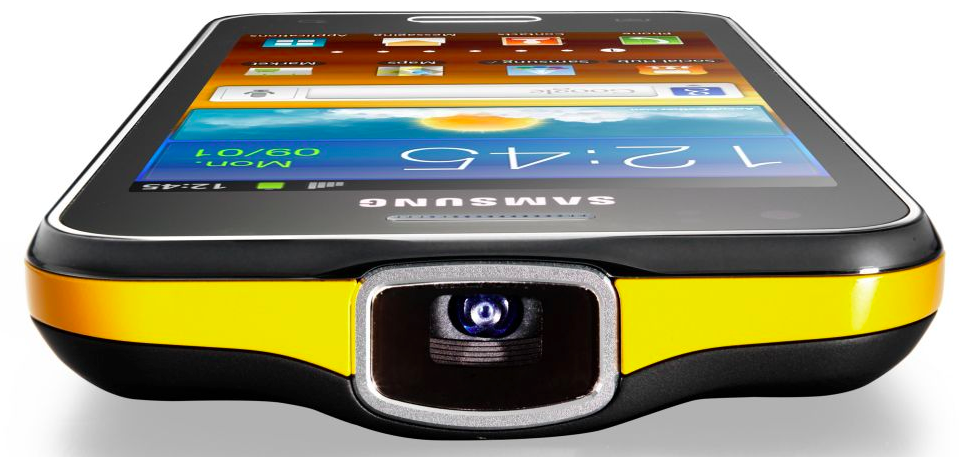
Samsung Beam unveiled at IFA 2010, but it got real today with some updated specs. The short version is that it is a Galaxy S running Android 2.3 with a huge 2000mA battery and a 15 Lumen pico WVGA projector (up from Android 2.1/1600mA/8 Lumens).
The writing is on the wall…. literally. As seen above, you have the 10.1 Galaxy Note, previously rumored to run the S-Pen application, and this image all but seals the deal. Samsung previously let slip a little reference in its press materials, but this evidence looks irrefutable.
I was not a huge fan of the Note’s stylus in my review, but let’s just say it is growing (on me).
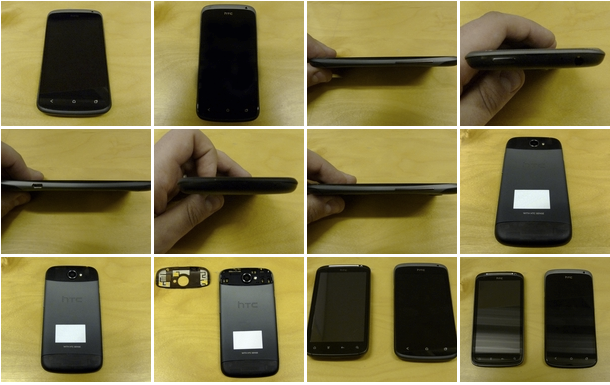
The HTC 1’s unveiling is not for another day, but pretty much everything is already out in the open.
FullGSM got its hands on the specs (below), and IT portal got a look at the hardware. Notables include a 1.5GHz quad-core Tegra 3 processor under the hood, and it seems to have as good an 8-megapixel-backlit camera as money can buy on a smartphone. The 4.7-inch 720P display is not going to sit well with those concerned about the growth of Android phone size. This thing also features a Google Wallet compatible NFC chip, but it conspicuously lacks LTE.
In addition, it is relatively light for a HTC phone. It comes in at 130 grams and a modest 9.3-mm thickness.
I absolutely love the new page that showcases some of the more unique and wonderful shots the “9 eyes” of Google’s Streetview cars capture. Named after the nine cameras on each car, the website reminds us there is beauty everywhere—or that a billion camera shots by a billion monkeys is bound to turn up some winners…
In what seems to confirm our earlier reports, (here and here), The New York Times’ Nick Bilton offered more information today on the Heads Up Display Glasses that Google is building. Some of the new bullet points are as follows:
The glasses are not designed for constant wear; although, Google expects the nerdiest users to wear them a lot. However, they will be more like smartphones—used when needed.
Internally, the Google X team is actively discussing the privacy implications of the glasses, and the company wants to make sure that people know if someone wearing a pair of glasses with a built-in camera is recording them.
One of the key people involved with the glasses is Steve Lee, a Google engineer and creator of the Google mapping software Latitude.
The other key leader on the glasses project is Sergey Brin, Google’s cofounder, who is currently spending most of his time in the Google X labs.
On a personal note, I think this will be the most exciting technology product release this year.
As Jason Kincaid pointed out, Groklaw did a thorough post on the state of the Oracle Java suite. The short version: Oracle will be lucky to get $100 million let alone the $6 billion it was originally after.
Oracle has told the court it wishes to withdraw its last claim of the ‘476 patent, claim 14, no doubt having read Google’s letter to the judge asking for permission to file a motion for summary judgment of invalidity of claim 14. This is the last claim of that patent still in the case. The USPTO in December issued a final rejection of 17 of the 21 claims of this ‘476 patent, anyway, including all seven of the patent’s independent claims, and while Oracle has until February 20 to appeal, the handwriting is on the wall. Whatever it decides about an appeal, claim 14, and hence patent ‘476, is no longer in this litigation.
It is a long read, but the short is that Google has talented lawyers disassembling every one of Oracle’s claims bit by bit and proving there is little—if anything—legitimate.
Even if Oracle somehow gets the $100 million that is left over, there is no longer any concern for the fate of the Android platform. Expand Expanding Close
Coming on the heels of Samsung’s Galaxy Note, LG today is pushing its foray into the new Phablet market: The VU—a 5-inch 4:3 display device. The Vu will be shorter and wider than the Note due to the display ratio, and it seems to resemble the Nokia Lumia/older iPod Nano design.
LG today unveiled one of the most anticipated LTE devices, the Optimus Vu:. Equipped with LG’s advanced LTE and IPS display technology, the Optimus Vu: offers a unique combination of tablet-like viewing with smartphone portability. Running on a powerful 1.5GHz dual-core processor, 32GM internal memory and a large 2,080 mAh battery, the Optimus Vu: is a multimedia lover’s dream device.
“The Optimus Vu: was designed to maximize what customers could do with a smart-phone,” said Dr. Jong-seok Park, President and CEO of LG Mobile Communications Company. “By offering an optimal 4:3 ratio viewing experience, 5-inch display combined with superfast LTE technology, Optimus Vu: is just one example of what we can achieve when we combine our best technology with customer needs.”
Interestingly, this device is exactly one-quarter the size of Apple’s iPad with the same resolution. That means the screen resolution is likely the same as the likely upcoming iPad 3 with Retina Display.
One of the few downsides to the Galaxy Note was that it was hard to use in one hand. LG, making a wider version, will make it even harder.
The full-sized pictures and press release are below:
It is very easy to make a snap judgment on the 5.3-inch-screened Samsung Galaxy Note. Yes, it is significantly bigger than the smartphone you use now. It even makes the Galaxy Nexus seem petite in comparison.
The dimensions of the Note put it somewhere between the biggest smartphones you ever saw and the 7-inch tablet form factor made popular by Amazon, BlackBerry, Motorola, Samsung, and pretty much everyone else except Apple.
However, the Note makes and receives phone calls, so it is a phone and it should be judged as such, right? End of story?
That is where you are mistaken. The phone functionality on the Note is a tertiary function at best. I see it as more like a reason to not carry a phone as well as the Note in your pocket. With that said, for a growing number of people, myself included, the actual “phone part” of a smartphone is very low on my list for what I want to do with the device in my pocket.
I make or receive only a few calls per day, and most of those are while I am at home/office with Google Voice and a headset or home phone. Therefore, other things rank higher on what I want to do with a device like this:
Maps are becoming the most used and most important feature on my phone, except for secondary review websites like Yelp, TripAdvisor, etc. I get all of my travel lookups from the Maps.app. I do almost all of my turn-by-turn navigation and lookups on this device much more efficiently with its huge display and fast network connection.
The Web Browser is the most important app outside of Maps. I would love the Note to somehow get the Chrome Browser before Samsung gets around to upgrading it to ICS. Alas, the stock browser is still unbelievably fast/crisp.
Gmail/Calendar/Contacts. You know…work.
AIM, GoogleTalk, GoogleVoice, and other instant messaging.
Social: Twitter, Google Plus Facebook, etc.
Netflix, Pandora, YouTube, and other Music and Videos.
Various other apps, such as my bank’s check cashing app, WordPress, Kayak, and a bunch of Angry Birds-type games.
Without exception, I can do any of the above better on a 5.3-inch 720P display than on a typical smartphone display. The one caveat: (As you can see from the gallery) moving my mid-sized thumb from one side of the portrait screen to the other is a bit of a stretch when using it one-handed. This does not turn out to be a problem very often, though, perhaps only 5 percent of my time. This is not a one-handed device.
Therefore, the Note is about tradeoffs: Amazing, huge display = better experience vs. portability. In my particular use-case, I am happy to make the trade. Here are the details:
. It is hard to imagine why GOOG is down when news this exciting hits
Google began rolling out the red link redesign today to the Google Finance websites. It has not hit ours, but reader @tuanye is feeling it. The new design has made it most of the way across Google’s network.
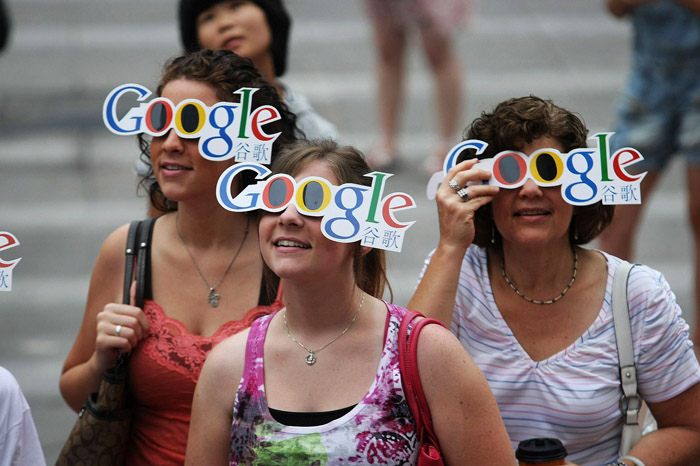
They are in late prototype stages of wearable glasses that look similar to thick-rimmed glasses that “normal people” wear. However, these provide a display with a heads up computer interface. There are a few buttons on the arms of the glasses, but otherwise, they could be mistaken for normal glasses. Additionally, we are not sure of the technology being employed here, but it is likely a transparent LCD or AMOLED display such as the one demonstrated below:
In addition, we have heard that this device is not an “Android peripheral” as the NYT stated. According to our source, it communicates directly with the Cloud over IP. Although, the “Google Goggles” could use a phone’s Internet connection, through Wi-Fi or a low power Bluetooth 4.0.
The use-case is augmented reality that would tie into Google’s location services. A user can walk around with information popping up and into display -Terminator-style- based on preferences, location and Google’s information.
Therefore, these things likely connect to the Internet and have GPS. They also likely run a version of Android.
Since then, we have learned much more regarding Google’s glasses… Expand Expanding Close
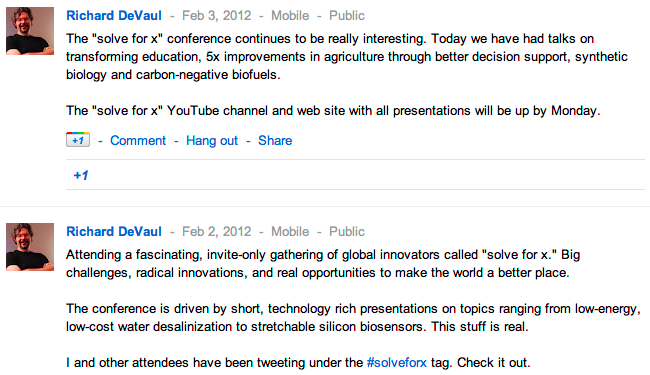
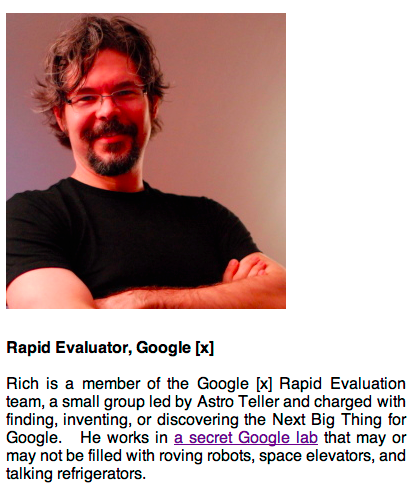
Google will set up a YouTube channel tomorrow officially revealing a “Solve for [x]” conference, according to the Google+ page of one of Google [x] chief scientists Richard DeVaul (from his bio page, right).
At first glance, it appears that the “Solve for [x]” private conference is part of the Google [x] secret labs.
It is not clear if the YouTube page of the conference and the talks will be made public but there is already a website called “We Solve for [x],” the show, and YouTube introduction:
Solve for X is a place where the curious can go to hear and discuss radical technology ideas for solving global problems. Radical in the sense that the solutions could help billions of people. Radical in the sense that the audaciousness of the proposals makes them sound like science fiction. And radical in the sense that there is some real technology breakthrough on the horizon to give us all hope that these ideas could really be brought to life.
This combination of things – a huge problem to solve, a radical solution for solving it, and the breakthrough technology to make it happen – is the essence of a moonshot.
Solve for X is intended to be a forum to encourage and amplify technology-based moonshot thinking and teamwork.
Samsung picked Bobby Farrelly, known for directing famous comedy films “There’s Something About Mary,” “Dumb and Dumber” and “Kingpin,” to direct his first ever TV commercial. The 90-second Galaxy Note Super Bowl commercial featured the infectious song “I Believe in a Thing Called Love” song by The Darkness, along with celebrity appearances by The Darkness’ lead singer Justin Hawkins, Australian supermodel Miranda Kerr, football star Brian Urlacher and pro-skateboarder Paul Rodriguez.
Apple lost its first significant patent battle today as it was forced to take 3G iPads and iPhone 3GS and iPhone 4’s off its virtual Apple Store shelves in Germany today.
The Mannheim Regional Court found Apple infringed a patent used to synchronize e-mail accounts. The ruling also allows Motorola Mobility to ask Apple for information about past sales and holds Apple liable for damages, Presiding Judge Andreas Voss said in delivering the ruling.
“The court has come to the conclusion that the wording of the patent does cover functioning that were at issue here,” said Voss. Apple “wasn’t able to convince the court that it isn’t infringing.”
The licenses at issue are supposedly “Fair, Reasonable, and Non-Discriminatory” (FRAND) patents that are considered industry standards. This follows a previous ruling in Motorola’s favor at the end of last year.
Perhaps not comical for German consumers (but certainly elsewhere) is that German courts have also banned a number of Samsung products, including its first stab at a tablet, based on Apple patent complaints. Soon their only option will be Motorola XOOMs :P.
The iPhone 4S, Apple’s current flagship device, remains on sale at the German Online Apple Store. It is not immediately certain why this device does not fit into Motorola’s complaint— maybe it is just too new and was not included as part of the original complaint. In addition, the 4S (and CDMA iPhone 4 and iPad 2) use Qualcomm chips while the banned devices use Infineon baseband, so it is possible Qualcomm has patents that indemnify its chips.
In a statement to Businessweek, Apple said:
“Apple believes this old pager patent is invalid and we’re appealing the courts decision,” company spokesman Alan Hely said in an e-mailed statement.
While some iPad and iPhone models are not available through Apple’s online store in Germany right now, customers should have no problem finding them at one of our retail stores or an authorized reseller. Apple is appealing this ruling because Motorola repeatedly refuses to license this patent to Apple on reasonable terms, despite having declared it an industry standard patent seven years ago.
Poking fun at Barak Obama’s recent Google hangout and the greater Google Plus, late night comedian Jon Stewart called Google Plus “that thing on top of Gmail that you can’t make go away”.
CNBC took some time to talk to Eric Schmidt at Davos. Among the topics discussed was the stagnant economy in the West, which Schmidt sees as an opportunity for the Internet (though he also sees opportunities in better times).
In addition, a big trend for 2012 will be $60 to $70 smartphones— Google’s sweet spot. Phones from ZTE and others from China are already hitting those points.
Finally, Schmidt talked about Google’s Apps and its effect on businesses and the incumbent (Microsoft). Transcript follows:
Details are sparse at this moment but we have been informed that Google is gearing up to release a product called Google Interests, which will build off its Google Related product and others that suggest new products and services for users. The information we received is that Interests relies on the new Privacy Policy agreement that was announced today and will pull user data from Google’s various products to bring Internet users “stuff” they are interested in.
That is as much as we know. The product could be anything from a StumbleUpon clone to a serendipitous Android App. We have, however, been told to expect this sooner rather than later, and since we first heard about this morning— the Privacy Policy change has gone public.
We will give additional details as this story develops.
Google announced last night that it would be discontinuing a number of its services in the coming months because they “replicate other features, haven’t achieved the promise we had hoped for or can’t be properly integrated into the overall Google experience.”
Two things jump out at me regarding these closures:
Google is channeling its lab-like smaller products into features of Google Plus. It almost feels like if it isn’t Android or Search (both recently got heavy + integration), it will soon be part of Google Plus.
Larry Page is heeding the advice he got from Steve Jobs: “Figure out what Google wants to be when it grows up. It’s now all over the map,” read the biography of Jobs’ interaction with Page. Later, Jobs came to Page with a sharped-tongue warning that Google was making products, “That are adequate but not great. They’re turning you into Microsoft.” Page is now striving for greatness by putting “more wood behind fewer arrows”
Most notably for consumers, Picnik, the Cloud photo editing software, will be discontinued in April.
Picnik: We acquired this online photo editor in 2010. We’re retiring the service on April 19, 2012 so the Picnik team can continue creating photo-editing magic across Google products. You can download a zip file of your creations through Picnik Takeout or copy them to Google+. As of now, the premium service is free to everyone. Premium members will receive a full refund in the coming weeks.
We will likely see Picnik’s features reincarnated in Google Plus —where Google wants users to be storing photos anyway. Google did the same thing to Picasa late last year.
Google also announced that it will close Urchin Web Analytics, the company it bought in 2005 to make Google Analytics cloud service. Google kept the offline product available, but it will discontinue updates and sales, then subsequently direct customers to the Google product.
Urchin: helps businesses of all sizes measure their websites and online marketing. We’re fully committed to building an industry-leading online analytics product, so we’re saying goodbye to the client-hosted version, known as Urchin Software. New Urchin Software licenses will no longer be available after March 2012.
Google’s Skymap App project, which was started by some Pittsburgh Googlers in their 20 percent time, will now be Open Sourced and run out of nearby Carnegie Mellon.
A number of other services were also slated for termination…
We’re told this campaign will culminate in a Super Bowl advertisement next month. It’s always entertaining to see the big boys slug it out. Expand Expanding Close
AnandTech does its typical thorough job of reviewing the Galaxy Nexus and, as you can see above, there is an in-depth analysis of the mobile landscape. The conclusion was not much different from ours, however. Spoiler:
As far as Ice Cream Sandwich is concerned, it really is Android perfected. Everything is smoother, faster and nearly all of our issues with the OS have been addressed. ICS brings Android into 2012 and gives Google a great platform to begin to introduce new features going forward. Android is now very close to UI performance parity with iOS, which eliminates a major tradeoff you had to make in the past. If you were hoping for ICS to be iOS with a Google logo on it, you’ll be sorely disappointed. However if you’re a fan of Android and just wished it were smoother and more polished, Ice Cream Sandwich is what you’ve been waiting for.
Note that only the Wi-Fi version gets ICS. The 3G/LTE versions are coming shortly —we are assuming— due to radio issues.
It is still impressive of ASUS/embarrassing for Google/MOT that ASUS beat the Android tablet reference design to ICS. The press release is available below…
Specs and price are similar to past models, but these are much better looking with an aluminum shell and thinner profile.
Perhaps most interesting (and fitting to the mission of Chrome) is the Chrome Box. It is a Mac Mini-looking ChromeOS device with two separate outputs for lots of Web browsing on up to two monitors. You do not have to worry about losing an Internet connection on the ChromeBox because you are stationary and hard-wired to the Web. This is going to hit more of the target kiosk/corporate environment than the previous models of ChromeBook. Samsung would not give a price but mentioned the loss of a display and keyboard/trackpad could save customers around $100.
All three hit stores in April, and we will be looking for a demo.





 .
.