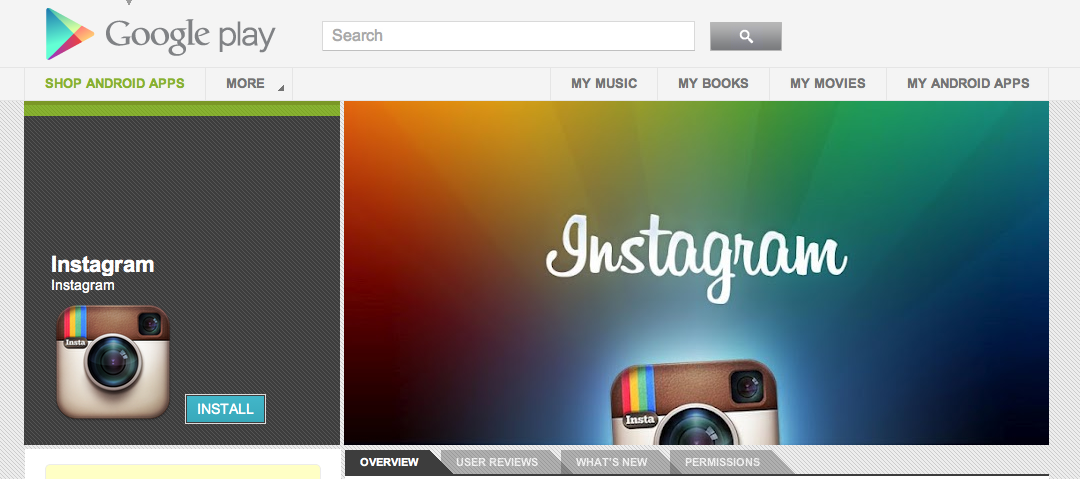
The widely popular “Instagram” iOS app is now available for Android devices at Google Play.
The iTunes-friendly version showcases 30 million users and holds Apple’s 2011 iPhone App of the Year crown. The Android community patiently waited for a Google variant, and now it can finally propel mobile snapshots to the retro days with snazzy filters and effects.
“Today, we’re excited to bring you Instagram for Android,” announced Instagram on its official blog. “We’ve been meticulous about translating the Instagram experience to the Android platform. The Android app offers an extremely familiar Instagram experience when compared to the iOS app.”
With iOS gaining roughly 30 percent United States marketshare as of Q4 2011 at the expense of RIM, Nokia and Microsoft, new numbers from Nielsen’s latest study show just how much of a duopoly the U.S. market has become. While noting about 50 percent of mobile subscribers in the U.S. are now smartphone owners, Nielsen gave a breakdown of how the two leading platforms continue to dominate as of February 2012: Expand Expanding Close
According to analytics service StatCounter, which measures billions of hits monthly across 3 million websites, Android now accounts for over 24 percent of mobile device usage in China—more than double the amount of iOS devices. The report of the top eight mobile operating systems in China shows Android usage spiked in February 2012 and took Android from 23.08-percent in January to 25.89-percent in February. Over the same period, iOS grew just one percent to 12.79-percent. While the month-to-month increase alone is not shocking, noteworthy is the fact Android came in at just 6.87-percent in October 2011. Meanwhile, iOS hovered around 12 percent since March 2011.
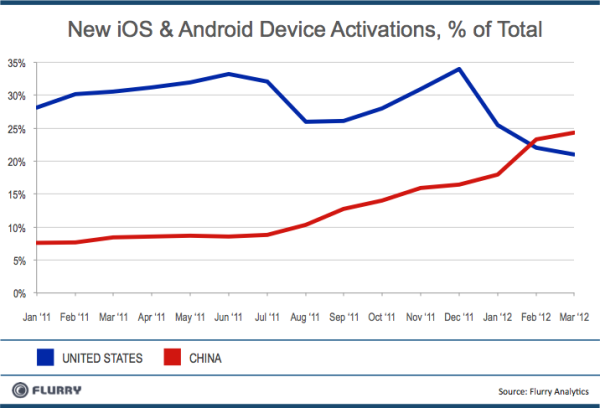
Apple is making a big push for its mobile devices in China this year, and the growth for both iOS and Android is obvious with China now the No. 1 country for activations on both platforms. In January 2011, China accounted for just 8 percent of total activations for iOS and Android. According to Flurry, China now accounts for 24 percent of activations as of March 2012 with the United States coming in at No. 2 with 21 percent.
China now holds the No. 1 spot for Android and iOS activations.
Mobile analytics firm Flurry released new data that depicted the Chinese market skyrocketing from No. 11 in 2011 to No. 1 for smartphone activation, thereby bumping the United States to No. 2.
The statistics are staggering: China accounted for 8 percent of Android and iOS activations in January 2011, while the United States held a big slice of the pie with 28 percent. The tables have turned, however, as China passed the U.S. and now boasts 24 percent of activations by March 2012 (end-of-the month projections included). Meanwhile, the United States slipped to 21 percent.
IDC just released its Q4 2011 report on tablet shipments and Apple continues to lead the market with 54.7-percent of global market share despite being down from 61.5-percent in the quarter before. Apple did increase shipments to 15.4 million units in Q4 (up from 11.1 million in Q3), but experienced an overall decrease in market share thanks to strong gains from Amazon’s Kindle Fire and other Android devices from competitors such as Samsung.
Kindle Fire is now the iPad’s biggest competitor with 16.8-percent of the tablet market due to 4.7 million units shipped during Q4, which is followed by Samsung with 5.8-percent of the market (up from 5.5-percent in Q3). IDC noted Apple’s results for the quarter represent “an increase of 110.5-percent from 4Q10.” The Nook Tablet from Barnes & Noble came in fourth, but it fell slightly to 3.5-percent of the market (from 4.5-percent the quarter before). Pandigital took the No. 5 spot, but it is down from 2.9-percent to 2.5-percent market share.
As for iOS vs. Android, IDC is expecting Android to overtake iOS for global market share by 2015 and noted that Android now has 44.6-percent of the market as of Q4 2011. That resulted in a decrease for iOS, which fell from 61.6-percent to 54.7-during the quarter. As we noted before, IDC’s report accounts for tablet shipments and not actual sales. We know Apple typically sells as many new devices as it can make, and the same cannot be said for devices shipped by all Android vendors. Research Director at IDC’s Mobile Connected Devices Tom Mainelli talked about the report:
The iPhone is great in many ways, but perhaps one of the best cases is in a medical emergency. KVALreported a 57-year-old Oregon man was suffering from a diabetic reaction while driving down a local highway. (Video link here.)
When two medical responders came to the scene and tried to assist the man, they ran into quite a language barrier. The man only spoke Chinese, but luckily, one of the responders knew to reach for his iPhone. He fired up Google Translate and was able to speak Chinese with the man to figure out his condition and give him the help he needed.
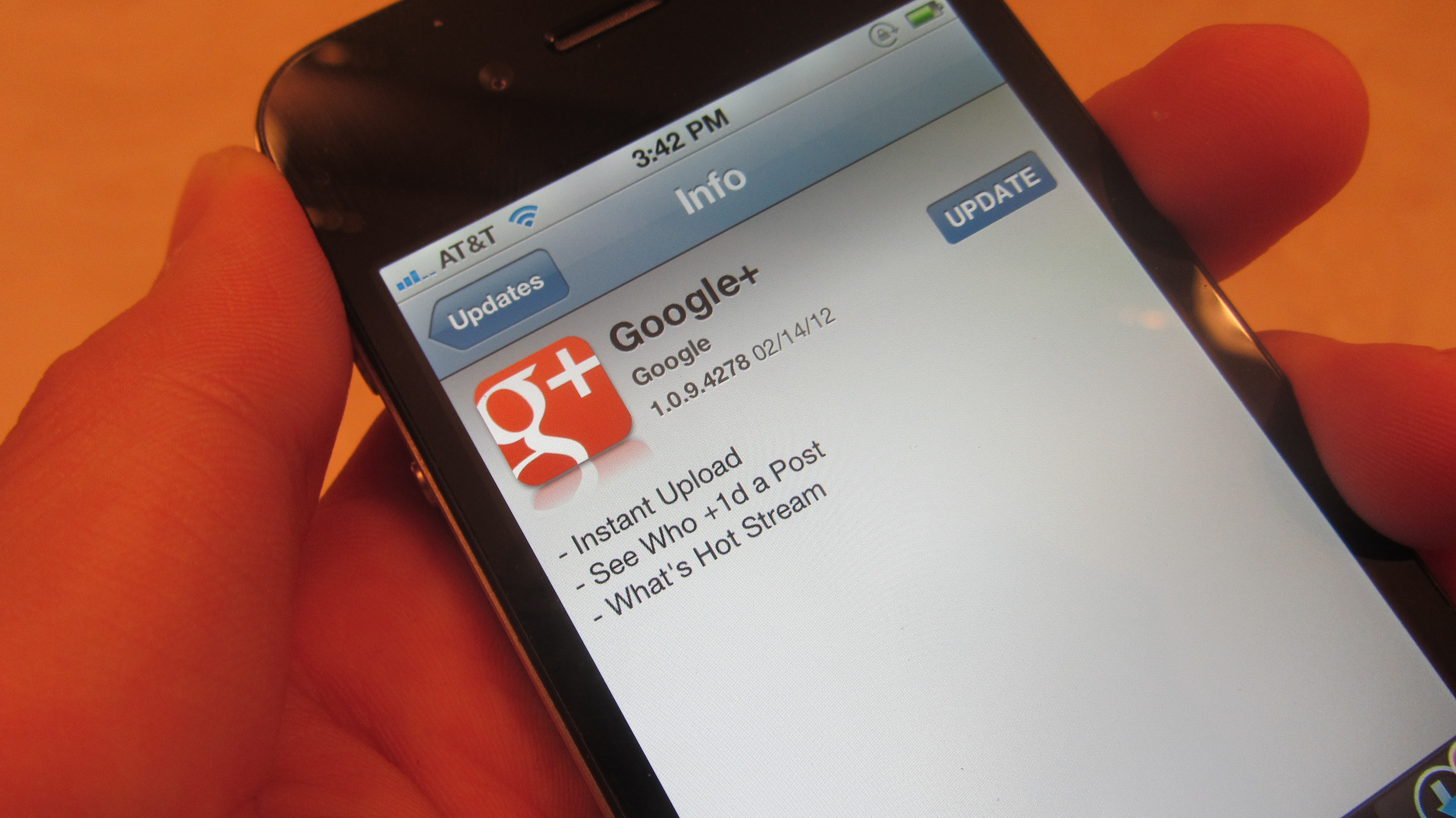
Google just released an update to its Google+ for iOS, bringing it to version 1.0.9.4278. Today’s update for the iOS app brings it up-to-par with the Google+ Android app, which was updated last week. The update brings three new updates: Instant upload of photos, you can see who +1d posts, and the new “What’s Hot” stream.
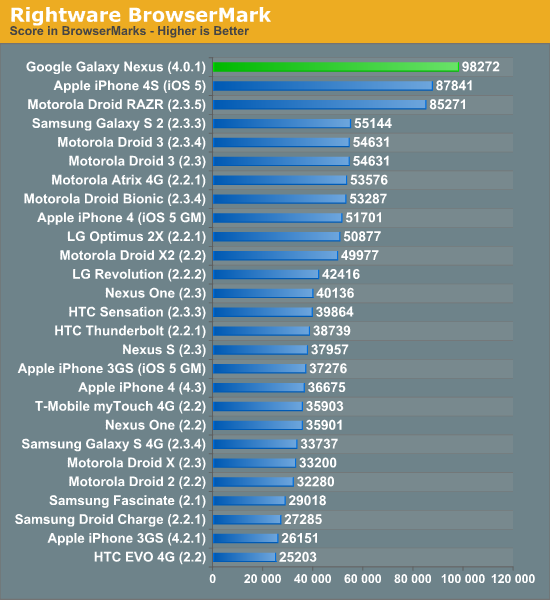
AnandTech does its typical thorough job of reviewing the Galaxy Nexus and, as you can see above, there is an in-depth analysis of the mobile landscape. The conclusion was not much different from ours, however. Spoiler:
As far as Ice Cream Sandwich is concerned, it really is Android perfected. Everything is smoother, faster and nearly all of our issues with the OS have been addressed. ICS brings Android into 2012 and gives Google a great platform to begin to introduce new features going forward. Android is now very close to UI performance parity with iOS, which eliminates a major tradeoff you had to make in the past. If you were hoping for ICS to be iOS with a Google logo on it, you’ll be sorely disappointed. However if you’re a fan of Android and just wished it were smoother and more polished, Ice Cream Sandwich is what you’ve been waiting for.
Nik Software, the company behind Snapseed, the popular image editing app for Apple’s iPhone and iPad, announced yesterday that it will “soon” port the program to Tegra-powered Android tablets running Ice Cream Sandwich for $5 a pop.
Nik Software President and CEO Michael J. Slater said:
We’re thrilled with the success and worldwide recognition of our popular mobile app and are excited to bring the Snapseed experience to Mac users for the first time. By bringing Snapseed to the Mac App Store, we’re able to quickly extend our reach to a worldwide audience of creative amateur photographers while offering our existing mobile users the fully-featured Mac experience they’ve been asking for.
Nik collaborated with Nvidia on the project so expect some snazzy visuals and smooth performance, which is the hallmark of the iOS version. Snapseed sports cool filters and tools like grunge, vintage and drama to make the best out of your photographs. The full list of features follows…
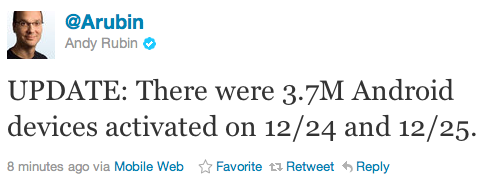
Title says it all. Andy Rubin just tweeted some more Android numbers and they are pretty impressive. In the two day Christmas period, 3.7 million Android phones were activated. Compare that to 1.4 million on an average two day period.
Another comparison: After 16 months without releasing a phone, Apple sold 4 million iPhone 4S’s in the first week of release.
Google has just started rolling out an update to the Gmail app for iPhone, iPad, and iPod touch with a few new welcomed features. First off, users now have the ability to set a custom signature for messages as well as a vacation responder. Both of those new features will be available via the gear icon at the top of the app’s new menu. The update also includes support for nested labels and the usual “bug fixes and UI improvements”.
A new Scribbles feature allows you to open a canvas, draw a picture or sketch with multiple colors, brush sizes and line elements, and attach it to a message within Gmail. Scribbles is available now in both the Gmail iOS app and Gmail mobile web app. Another notable and highly requested change is a new notification sound on iOS 5, making it easier to tell when you’ve received an email
Google also mentioned in their blog post that they are continuing to work on some of the most requested features from users including multiple login support, banner notifications, and a “send as” feature to mail send mail from multiple accounts within the app. Expand Expanding Close
OnLive has just announced (via TechCrunch) new mobile apps capable of accessing their cloud game streaming service previously only available to PC, Mac, and OnLive console owners. Launching in the US and UK first, 25 console titles have been ported to the smaller screen with touchscreen controls, and almost all 200 of the service’s library of console quality titles will be playable via the $50 OnLive wireless controller.
The OnLive service allows streaming of console quality games like Assassins Creed, L.A. Noire, and other titles typically reserved for consoles like the PS3, directly from the company’s servers. The service has received mixed reviews, mostly due to inconsistencies in performance. The same appears to be true for the mobile version, with early hands on reviews highlighting the same performance issues common on PCs. These are “console-class” games, but not always a console quality experience. It’s playable, but really laggy.
The free app should be launching in the Android Market any second now, and will still of course require that you purchase or rent the games. Fortunately, any purchased or rented content is instantly playable through any compatible device. As for supported Android devices, below is the complete list courtesy of TechCrunch (who also says the Kindle Fire is supported): Expand Expanding Close
Google’s Eric Schmidt recently took the stage alongside Android Product Management Director, Hugo Barra, at Le Web conference in Paris to talk Ice Cream Sandwich and the future of Android. Most of the interview and demo consisted of showing off some of the new flagship features of Android 4.0 Ice Cream Sandwich like face unlock, but the Google chairman also took some time to talk competition (via Cnet). While noting that Android is now ahead of iPhone by unit volume, price points, and number of vendors, Schmidt shared his thoughts on why he thinks developers will perfer Android to iOS in the near future:
Ultimately, application vendors are driven by volume, and volume is favored by the open approach Google is taking. There are so many manufacturers working to deliver Android phones globally. Whether you like Android or not, you will support that platform, and maybe you’ll even deliver it first.
When asked about iOS apps beating the Android versions of apps to market, he had high hopes that would change with Ice Cream Sandwich:
My prediction is that six months from now you’ll say the opposite.
Google has just pushed out an update to the Google+ iOS app compatible with iPhone, iPod touch, and iPad, bringing it up to version 1.0.7.2940 and introducing a few new features including full resolution photo uploads, search, and photo +1. Also included are the usual bug fixes and performance enhancements. As always, you can grab the update from the App Store now or download the free app if you haven’t already. Expand Expanding Close
Mobile advertising and data company Millennial Media is out with a new MobileMix report based on ad impressions across their network. The results are admittedly surprising considering Android’s seemingly unstoppable march: Google’s operating system did not grow in October compared to the summer period. All Android devices combined in October logged twice the ad requests of iOS gadgets, 56 percent versus 28 percent.
Both operating systems recorded same respective shares during the summer, although Android actually fell two percentage points in August before returning to its 56 percent share in October. As for the other players, Research In Motion’s BlackBerry OS did 13 percent ad requests while Symbian, Windows and Other each logged just one percent. In fact, the entire pie chart above is exactly the same as the summer 2011 chart. Also, relative data pitting Android vs. iOS echoes recent surveys by Nielsen and Gartner.
Of the top 15 device vendors, Samsung grew seven percent month-over-month and had six of the top 20 phones on the Millennial Media network. Interestingly, the Samsung Freeform, a feature phone, made the list of top 20 phones led by iPhone (it’s the first feature phone on their list since May 2011). Android devices represented 14 of the top 20 cell phones in October (15 devices in the summer period), with a combined impression share of 24 percent.
Apple remained the leading manufacturer on their platform and Android remained the top OS when combining Smartphone & Connected Device impressions. More surprising than that, nearly three-quarters of ad requests, or 71 percent, came from smartphones. The remaining 15 and 14 percent came from feature phones and connected devices. Other interesting takeaways right after the break…
The first Ice Cream Sandwich handset, the Galaxy Nexus, hit the UK this week (US launch coming soon) and AnandTechhas benchmarked the ICS/Galaxy Nexus combo vs. the iPhone 4S/iOS 5 combo. The Galaxy Nexus processor/GPU isn’t groundbreaking by any means, but the new software inside is certainly packing a punch beating iOS in a few key areas. As seen in the graph to the right, the Galaxy Nexus has a slightly faster tested browser than the iPhone 4S — a crucial day-to-day necessity for users.
The Galaxy Nexus also comes up with the win in JavaScript loading, bringing faster load times than the Droid RAZR and iPhone 4S. Don’t think the Galaxy Nexus is going to come away with everything, however. Both Apple’s iPhone 4S and iPad 2 outperform the Galaxy Nexus in GPU loading — which is limited by its slower SGX 540 underneath. That’s an important consideration for gaming.
The Galaxy Nexus’s hardware has been dubbed very smooth compared to older versions of Android. Google is activating 550,000 Android devices a day and is still behind iOS in total Activations at 200 million total. Head after the break for more graphs.
Following a lengthy interview in October where he gave us insight into the future of Android and Google’s view on iOS and Windows, Android’s head of user experience Matias Duarte sat down withThe Verge to discuss his work on Android and more specifically, Ice Cream Sandwich. During the interview Duarte elaborated on his competitor’s design choices, where he says iOS looks cartoonish and explains if it were “put on a website or magazine, you’d laugh at it, it would look childish”. Host Joshua Topolsky also calls him out for saying Windows Phone looks like “bathroom signage in an airport”, to which he didn’t comment.
Matias gave a few demos using a Galaxy Nexus, including one of live video chat effects like blurs and warps that alter your face in real-time. He also explained his view on photography features calling traditional features of point and shoot cameras such as white balance “crap”, saying “if it’s not immediately obvious, it’s something the machine should be taking care of for you”.
Nintendo president Satoru Iwata declared Apple and iOS as the “enemy of the future” back in 2010. Not only was he right, according to new estimates for the U.S. portable game software by revenue from Flurry Analytics, 2011 seen Nintendo’s grip on the market slide even further as iOS and Android games triple their marketshare from 20% in 2009 to 60% during 2011.
The graphic above shows U.S. revenue for Flurry’s portable gaming category- a category that now includes Nintendo DS, Sony PSP, iOS, and Android. As you can see, iOS and Android have together taken the lead from Nintendo with 58% of revenues in comparison to last year’s 34%. In comparison, Nintendo DS held 57% during 2010, while dropping to just 36% in 2011. Total US revenue jumped from $2.7 billion in 2009 to $3.3 billion in 2011.
When comparing combined game revenues of the two veterans– Sony and Nintendo– with the combined revenues of the two new guys– Apple and Google– 2011 will be the first year where the emerging platforms dominate with iOS and Android estimated to take in $1.9 billion in comparison to the DS and PSP’s $1.4 billion. That accounts for a $200 million drop for Sony and Nintendo and $1.1 billion increase for iOS and Android from 2010. Perhaps investors were right to urge Nintendo to begin developing iOS titles.
As for Nintendo, the company who captured approximately two-thirds of the market in 2009 has seen their “enemy of the future” demote them to just a third of the market. Sony clearly has some catching up to do, but is hard at work on highly anticipated new handheld devices for 2012. Expand Expanding Close
According to a study by research2guidance, the Android Market has exceeded 500,000 apps submitted and successfully published. The study shows with over 500,000 apps published in September 2011, the Android Market is not too far behind Apple’s App Store which has surpassed just over 600,000 apps. Research2guidane also discovered that Android developers on average publish more apps than iOS developers — a 3:2 ratio.
Interestingly, the Android Market has more removed apps after they’ve been published reports research2guidance. 37% of apps published to the Android Market were removed for various reasons, while 27% were removed from the iTunes App Store in September.
At any rate, Android is certainly gaining on iOS. But does any of this really matter? Isn’t about who has the apps that people actually need most, rather than the fart apps?
According to research firm Strategy Analytics (via Bloomberg), Google’s Android-based tablets gained market share in the iPad dominated tablet market during the third quarter, specifically led by new models from Samsung (presumably referring to the same Galaxy Tab family that is currently the focus of patent related litigation between Apple and Samsung).
The report claims Android was up from just 2.3 percent from the same three month period last year, to a 27 percent share of worldwide sales during the third quarter in 2011. The iPad’s market share during the same period reportedly fell from 96 percent to 67 percent. The research firm notes that Samsung’s Galaxy tablets currently account for 9 percent of the total tablet market.
There is also reason to believe Android’s growth on tablets will continue to grow into 2012, as the introduction of Android 4.0 Ice Cream Sandwich (the first Android OS specifically designed for both phones and tablets) could help tablet adoption among Android smartphone users. Strategy Analytics believes that Amazon’s Kindle Fire will also drive Android tablet sales, estimating the company will sell more than 15 million units by 2013.
In contrast to this obvious good news for the Android tablet market, which the WSJ’s Walt Mossberg recently described as having “flopped” in an interview with Google mobile chief Andy Rubin, there are conflicting stats for Android tabs in the enterprise. The recently released Good Technology Device Activations Report for Q3 2011 shows that when it comes to tablets in business, enterprise users are clearly choosing iPad over the alternatives, noting “iOS tablets represent over 96 percent of total tablet activations”. Their graphic (above) also speaks volumes. Expand Expanding Close
Following a slew of announcements from Google yesterday culminating with the unveiling of Android 4.0 Ice Cream Sandwich, the accompanying software development kit, Android Beam, the new People app, the panoramic camera feature and the Samsung Galaxy Nexus smartphone (among other things), The Verge has published an exclusive, lengthy interview with Android’s head of user experience Matias Duarte. It’s a highly recommended read with revealing details and interesting insider perspective on Google’s arguably the most propulsive property.
Some of the more noteworthy highlights:
Android Honeycomb, which was Duarte’s first big Google project following his departure from Palm after the company was acquired by HP, was a lot like “emergency landing”, he said. It’s a platform which has “a flexibility designed into it that you don’t have to worry about when you’re doing a completely integrated device”. And why Google refused to open-source Honeycomb? “On Honeycomb we cheated, we cut the corner of all that smaller device support”, adding this:
Honeycomb was like: we need to get tablet support out there. We need to build not just the product, but even more than the product, the building blocks so that people stop doing silly things like taking a phone UI and stretching it out to a 10-inch tablet.
People are fed up with “two decades of windows, and cursors, and little folder icons”, he says. The search company actually visited “shadow” users at their homes and workplaces to figure out how they interacted with mobile devices. What they found out was surprising: Android lacked emotional connection with its users who deemed the operating system overly complex. So they set out to build a wonderland of sorts, improving on Android’s typography by creating in-house a clean typeface for Ice Cream Sandwich dubbed Roboto. He then took a jab at Apple, calling the iOS design “juvenile” and likening it to web pages with “cartoony things hanging off a page”.
Samsung today announced in a blog post that its free instant messaging service named ChatON is rolling out worldwide. The service will first arrive to Samsung’s Bada-driven devices, Android smartphones and selected feature phones starting this month, via Android Market and Samsung Apps stores. They will release the app on other platforms “by the end of 2011”. The company wrote:
ChatON provides users with a simple way to keep in touch with friends and family anywhere in the world, regardless of device platform. It enables users to communicate in multiple ways, allowing multimedia content and animated messages, as well as more conventional instant messages, to be shared with friends and family.
As we told you, the ChatON service has been conceived as a proprietary messaging service for multiple mobile platforms. Similar to the BlackBerry Messenger and Apple’s iMessage – both of which support free instant messaging over a mobile IP connection – ChatON too supports text, images, group chat and video clips. Unlike rival IM platforms, ChatON also does hand-written notes, animated messages and social features allowing users to give their buddies so-called “Interaction Rank”. In addition, Samsung will be taking ChatON to competing platforms like Research In Motion’s Blackberry OS and Apple’s iOS, guaranteeing mass market appeal and cross-platform messaging.
According to a tweet by the official Google Voice Twitter account, Google has pulled the Voice for iOS app from the iTunes App Store. Google decided to pull the app due to its crashing on startup, which was introduced with iOS 5 (Couldn’t sort it out in 3 months of iOS5Beta?). Google says hang tight for the time being, because they’ll be updating/rereleasing the app again. Tweet:
Removed the iPhone app from the App store. We’ll have a new version for you ASAP with a fix for the sign in bug.