According to a new report from comScore detailing the top smartphone platforms for mobile gamers, Android takes the top sport with approximately 30% of the market among 65.1 million mobile subscribers for the three month period ending July 2011. This in comparison to the roughly 21% held by Apple’s iOS.
The 65.1 million smartphone users included in the research played at least one game in the past month, just under 68% of which were using smartphones to do so. This accounts for approximately 27.8% of the entire U.S. mobile market. Interestingly, while Android was able to top the chart for total number of gamers, gaming on Apple’s iPhone seems to be reaching a larger portion of it’s user base with 61.7% of all users in contrast to 57.4% of Android users. Expand Expanding Close
9to5Mac told you about Gamestop’s plans to begin selling new iPhones, iPads, and iPods after recently beginning to accept the devices as trade-ins. Now, it appears that the company also has plans to drop a branded Android-powered tablet of their own.
In an interview with Games Industry, president of Gamestop Tony Bartel claimed the company is already testing the tablet that will apparently launch with a selection of pre-installed games and dedicated gaming controller accessory. Although, he isn’t disclosing who exactly will be manufacturing the tablet. The company also reportedly has plans to offer games over-the-air with a cloud service of sorts.
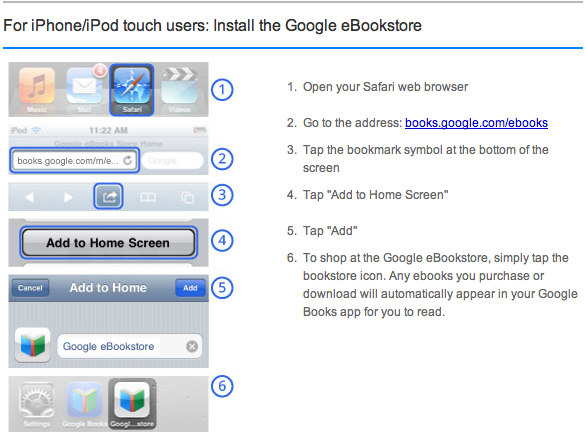
Google has just notified Google Books users via email that they can now purchase books through Google’s eBookstore website. This workaround comes after Apple shut off Google’s in-app book store on the Google Books app — available on the iTunes App Store. As seen in the image sent with the email, Google suggests you add this website to your iOS device’s homepage. Email from Google:
PLEASE NOTE: IF YOU DO NOT USE THE GOOGLE BOOKS APP FOR YOUR IPAD, IPHONE, OR IPOD TOUCH, YOU CAN DISREGARD THIS MESSAGE.
Dear Google eBooks customer,
We are writing to let you know about important changes to your Google Books app for your iPad, iPhone or iPod touch. Due to Apple’s new policies, you can no longer shop for Google eBooks within the app.
But don’t worry, you can install the Google eBookstore on your iOS device using the easy steps in this email, and continue to buy the books you want quickly and easily. For further assistance and more detailed, step-by-step, visual instructions, please visit our Help Center article or you can contact us.
According to the New York Post (viaBGR), Amazon is getting ready to launch their rumored Android-powered tablets with a price tag “hundreds less” than Apple’s current $499 base model iPad 2. “Hundreds less” sounds a lot like $299.
The devices, expected to launch sometime in October, will more than likely be the result of the entry-level tablet codenamed “Coyote” and it’s pro-model counterpart the NVIDIA T30 Kal-El powered “Hollywood”. We told you about these devices back in May, which will most likely be powered by a highly customized Amazon version of Android (bringing with it Amazon services like the Appstore, Kindle eBook store, Amazon Videos, music and possibly brought together by the Cloud Drive).
Amazon is clearly prepping a huge move into the tablet market. We reported this week that the company signed up a third touch panel supplier, and that was after recently becoming the second largest buyer of tablet-related parts – without yet having released a tablet. Expand Expanding Close
Earlier this week we reported the beloved Galaxy S II wouldn’t be launching on Verizon, after it is announced next Monday. A new report from the Wall Street Journal backs up or claim stating the Galaxy S II will launch on Sprint, T-Mobile, and AT&T — but not Verizon. Verizon confirmedWSJ’s report to TechCrunch, saying the Galaxy S II won’t be available for the time being.
At an event Monday at New York’s Time Warner Center, Samsung will announce it is selling the device starting in September on AT&T Inc., Sprint Nextel Corp. and T-Mobile USA’s networks, according to people familiar with the plans, but Verizon Wireless said it won’t offer the device.
The Galaxy S II has seen much success in Europe, and it should certainly do well in the U.S. Do well enough in fact that it might be the best contendor to the rumored launch of Apple’s iPhone 5 this October. We look forward to covering the event Monday, so check back to hear more.
In the battle for mobile supremacy, Apple and Google are winning as competitors continue to lose ground, finding it increasingly difficult to compete with the strong iOS and Android ecosystems (can you say ‘duopoly’?), per latest survey from the NPD Group. The results came by tracking U.S. consumers aged 18+ who reported purchasing a mobile phone and exclude corporate purchases. In the June quarter, iOS grabbed 29 percent of the U.S. smartphone share versus Google’s 52 percent share. Both tech behemoths have grown their platform share at the expense of BlackBerry maker Research In Motion.
RIM’s been on a serious decline amid poor sales and delays related to their QNX-based superphones. Their BlackBerry OS software share fell to just eleven percent in the U.S. Meanwhile, Hewlett-Packard’s webOS is in a state of limbo as the world’s leading computer maker announced intentions to exit the hardware business. Microsoft’s Windows Phone 7 and Windows Mobile grabbed five percent of the market each.
The emerging prepaid market is the next battelground for iOS and Android. Google, however, has the first mover advantage here… Expand Expanding Close
Apple and Google are clearly the two front-runners competing for market share in the mobile world, which is why it’s no surprise we think of iOS and Android when we think of apps. With the growth of the smartphone industry also came the resurgence of native apps (thanks largely in part to Apple’s App Store which still dominates the space). However, Mozilla hopes that web apps will soon mature to provide a comparable experience for end users and an even better alternative for developers.
“We are aiming at providing all the necessary APIs to build a basic HTML5 phone experience within the next 3-6 months”
While Chrome OS has shown promise, it isn’t the only browser-based platform planning on entering the web app space… If Mozilla has its way, developers can use the results of their new WebAPI project to build an “HTML5 phone experience” that’s compatible across all operating systems (whether it’s Android, iOS, Windows Phone, etc).
A report from CNET claims Mozilla has plans for the APIs to “interact with a phone’s dialler, address book, contacts list, and camera”, essentially giving you access to the same functionality of native apps but directly in your device’s browser.
The WebAPI project certainly isn’t trying to create a full-blown operating system. However, working hand in hand with Mozilla’s Boot to Gecko project, which aims to build a “complete, standalone operating system for the web”, it could create a potentially compelling alternative to Google’s browser-based Chrome OS.
It appears that Mozilla is serious about the project, as a report from CNET claims they’re in the process of hiring full time programmers and plan to have the basics in place by February. Expand Expanding Close
Google’s photo-sharing social network Photovine (previously invitation-only) is fresh out of beta, open to all users, and ready to install to your iPhone, iPad, or iPod touch as an iOS app.
Photovine is a fun way to learn more about your friends, meet new people, and share your world like never before. It all starts with what we call a photovine: a group of photos around a single, shared caption. Start a new vine with a photo and caption of your own or add your photo/take on someone else’s vine.
Many are comparing the service to Instagram, or a photo-centric version of Twitter. Some are also pointing out it looks quite similar to Piictu. Essentially, users upload photos that can then be grouped thematically to create what is known as a “vine”. While you can follow other users and receive their content directly in a personal feed, all images appear to be shared publicly either through your profile or the vine in which the image is included. You then also have the option of sharing individual photos or vines directly to Twitter or Facebook (no Google+ support?).
The application is the work of the Slide team, a social-media start up acquired by Google last year. Its not clear yet how much of a focus Photovine will be for Google, but the Slide team has released a number of apps recently and seem to be getting support from Google to carry on with their projects. As of yet the service only has an iPhone app, but presumably there’s Android support on the way and some type of integration with Google+. Expand Expanding Close
Historypin, a user-generated map displaying historical data of nearby locations (previously only available on Android devices), is now available as an iOS app for iPhone, iPad, and iPod touch. Created in partnership with Google by not-for-profit We Are What We Do, the app allows users to add their own historical photos by pinning them to a map, capturing historic moments as they happen, and creating replicas of historical images. The images are then shared with users requesting data for a specific location….
Historypin uses Google Maps and Street View technology to reveal the user-generated photos and data related to historical events that happened close to your current location. It does this by “overlaying them onto the live camera view”…essentially aiming to give you a live snapshot of what your surroundings looked like in the past.
Simply holding your phone up in the street will provide you with relevant nearby images. Selecting one of the images allows it to be overlaid onto the iPhone’s camera view. You can then fade between the image and your live shot for comparison, as well as pull up stories and data related to the image and your current location.
Full list of features and some shots of the app in action after the break… Expand Expanding Close
LinkedIn has announced a new HTML 5 optimized page for mobile browsers and updated iPhone and Android apps with 2-10X speed increases.
The new app is now focused around four key areas: Updates, Inbox, You, and Groups & More.
The Inbox will allow you to view your messages and invitations in one centralized location. The You area presents your profile, connections, and to share updates. Lastly, LinkedIn is now introducing their most requested feature Groups, into the app.
Interestingly, LinkedIn also announced their mobile platform is growing 400 percent year-over-year. Check it out in your mobile browser, or hit the download links below:
Google has just pushed an update for the official Google+ app for iOS, bringing with it support for iPad and iPod touch, two devices the app was previously unavailable for, among a few other features including aggregated circle add notifications, huddle settings, and the usual “Performance and stability improvements”.
You should be able to update the app now via the App Store or swing by iTunes and grab the new version now. We’ll keep you posted with any other discoveries we might make in this latest update.
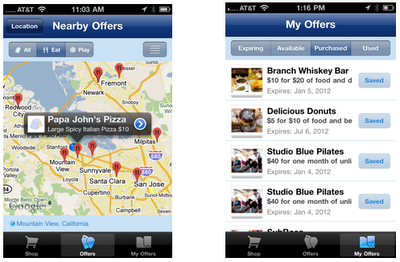
Google has released an update to their Shopper app conveniently giving users information on daily deals, including Google Offers. The update adds a “Offers” and “My Offers” tab at the bottom, along with the Shop tab you know and love. The Offers tab displays deals in map view that are available in your city. The deals you find can be saved in the My Offers tab for later use. Businesses can publish deals through Google Places. If Google Offers is available in your city you can redeem your purchased offers in the My Offers tab. Check out the update in the App Store. Expand Expanding Close
IMS Research put out a study estimating that some 420 million smartphones will be sold worldwide in the 2011 calendar year, or 28 percent of all handsets sold. The survey portrays Apple as making huge gains in the space, buoyed on the sales of 18.65 million and 20.34 million iPhones in their last two quarters – enough to garner a 19 percent share of the global smartphone market. Combined with Nokia’s slumping sales, Apple emerged as the world’s leading smartphone maker.
It remains to be seen whether Samsung, which is due to report its earnings Friday, will beat Apple’s smartphone sales (some say it will). IMS noted the fact that the company grew their share of global smartphone market from three percent in the first quarter of 2010 to 13 percent in the first quarter of this year. Samsung, as you know, sells phones powered by Google’s and Microsoft’s software in addition to their own operating system for feature phones, Bada. IMS’s Analyst Josh Builta says this of LG:
LG, despite being the third largest OEM in the world, has offered a fairly limited smartphone portfolio in recent years, a factor that resulted in the company reaching less than a three percent share of the total smartphone market in 2010.
However, Nokia’s fall surprised even the most seasoned watchers and is unheard of in this industry. Nokia, the Finnish phone giant, lost 16 percentage points of its smartphone market share, going from a 40 percent share last year to 24 percent in the first quarter of 2010. They shipped 16.74 million smartphones in the June quarter – a 34 percent annual decline – versus Apple’s 20.34 million units – a 134 percent annual increase. Nokia also killed Symbian and is only shipping the well-received but short-lived MeeGo-powered N9 to select markets. Here’s how the analyst described Nokia’s problem:
Clearly one of the key dynamics of the mobile handset competitive environment in recent years has been the inability of many traditional market leaders to recognize and adjust to the growing smartphone tier. The reasons for these failures vary and include everything from poorly designed and manufactured devices, unsatisfactory user interfaces, and portfolios that don’t offer products with a differentiating feature. These lapses have created opportunities for newer entrants to the market, which they have aggressively pursued.
Research In Motion fell from 20 percent to 15 percent in the same period, mind you. IMS sees one billion smartphones by 2016 as average selling prices drop and vendors release more inexpensive handsets. Smartphones then will account for one of every two mobile handsets sold, the research firm concludes.
What HiFi is reporting that Android has surpassed the iPhone as the top smartphone in the UK, coming from a market research group called Kantar Worldpanel. The growth is due in part to first time smartphone users, not necessarily those switching between platforms. In June alone, Android rose almost 35%, while the iPhone fell almost 12%. We’re assuming much of Android’s success is from the Galaxy S II, who has seen tremendous sales in Europe as well as Android’s numerous, cheap, offerings. Expand Expanding Close
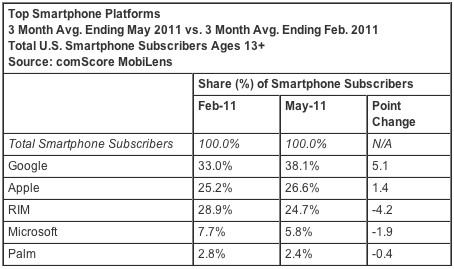
The Android train keeps chugging along with the comScore showing a 5.1 point increase in total US Android use in the Feb-May Quarter putting the OS at 38.1% of the total US smartphone market. Apple also gained, though less spectaculary with 1 percentage point improvement, coming in at 26.6%. Android head Andy rubin said last month that Android activations had grown to over half a million a day worldwide.
For the other guys, it wasn’t a happy quarter. RIM continues its slide down to a under quarter of all US smartphone purchases, while Microsoft and webOS risk being bundled into the “other” category as their marketshare continues to erode into almost nothing.
According to Google Employee Erica Joy, the Google + app is awaiting Apple’s approval in the App Store. It also sounds like it is a iPad univeral app. Hopefully it gets through quicker than Google Voice which took over a year to clear the gauntlet. Cross posted from 9to5google.com
At this point, it seems pretty obvious that Google means business with the Google Plus platform. Besides all of the other areas Plus has engulfed, it looks like Google is heading into the gaming realm. The following code snippet was found in the web page code
“have sent you invites and more from Google+ Games”
I see these things from time to time on 9to5Toys and wonder how the heck they can make any type of tablet with a 7-inch screen $90.
The one review it does get on Amazon sums it up pretty well:
While the unit does work. It’s slow, and sometimes the touchscreen is unresponsive to touch commands. I basically have to press really hard on the screen for it to take commands.
It does a poor job streaming video from youtube.
My Samsung Captivate, cell phone is faster than this unit.
Overall:
Pros: Works, great for web surfing low media content sites, great to use as a picture frame,
Cons: Slow, Touch screen not accurate/responsive.
So, it would appear that you are pretty much buying a photoframe with a battery and a resistive touch screen (enclosed stylus). Still, for $90…
The Facebook for Android app has been updated giving users the ability to upload video, see more story types in news feed, and browse Page walls, reports Inside Facebook. In this age, being able to post video is obviously a crucial feature. Users take videos everyday, especially on their smartphone, and want to share them with their friends. Lastly, when users browse to a Facebook Page they can view the Page’s wall to read news and updates.
Facebook for iPhone still has the upper-hand when it comes to features, but these updates are a step in the right direction. Expand Expanding Close
Richard DeVaul, a PhD. scientist from MIT with a focus on building wearable technologies, was snared from Apple this month by Google. At Apple he was rumored to be working with SVP of Industrial Design, Jonny Ive in Apple’s secret labs building the next big thing.
Besides his having knowledge of the inter-workings of Apple, it is also interesting that DeVaul is a hardware person who has focused on building wearable products for the past decade. Google has been a software company for all of its existence, but more and more it appears that it will enter the hardware business…but probably in smart accessories rather than phones.
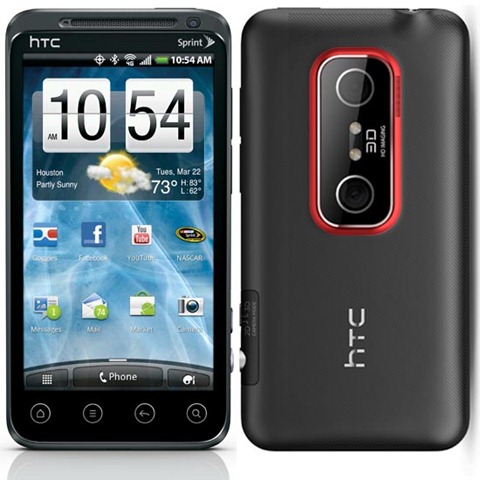
There is a lot on the line with Sprint’s new EVO 3D launch today. The EVO brand has now become the flagship Sprint Android device moniker and for more than a year, the EVO has been just about the most burly Android device you could get on the WiMAX 4G network.
Background:
The original EVO was a milestone in Smartphone development. When it was released, the Nexus One and Droid were the top of the Android heap and Apple was still selling the iPhone 3GS. The EVO was the first Android device with front camera, 8MP back camera, 4.3-inch display, 4G network access and a kickstand! Even the Apple guys’ heads were turning. I got an EVO 4G at Google I/O last year and have used it off and on since. Among other things, it has one of the best GPSes of any phone I’ve used, it is always first or one of the first carrier phones to get an Android OS update and it pioneered (sorry HD2) HTC’s line of 4.3 inch devices which are now on every carrier in the US in multiple forms (Incredible 2 and Thunderbolt on Verizon, Inspire 4G on AT&T, Sensation on T-Mobile).
So how does the EVO 3D stack up to the original as well as the top of the other flagship phones out there? Read on to find out:
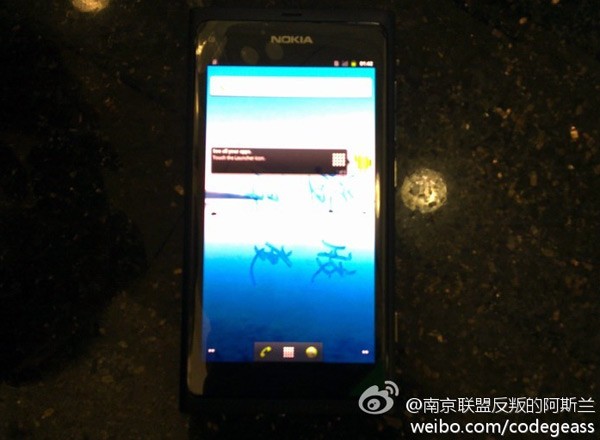
What if Microsoft didn’t decide to dump a boatload of cash on top of Nokia to take their OS and Nokia went Android? It appears that there might have been a skunkworks project in place to get the Android OS on Nokia’s devices if the images from Engadget and Weibo are any indication.
Either that, or some cheeky Nokia employee decided to put Android on their N9. Whichever reality you believe, it wold have been nice to have an N9 Android device, even if it looks like an oversized iPod nano.
Stanford professor and iPhone Camera app developer Marc Levoy is going to Google for two years according to his Stanford bio page:
I will be on part-time leave of absence from June 2011 through June 2013, to pursue a project at Google.
This stint at Google won’t be his first. He co-designed the Google book scanner and launched Google’s Street View project.
Levoy’s current interests include light fields, optical microscopy, and computational photography – meaning computational imaging techniques that extend the capabilities of digital photography. Levoy’s recent research focuses on camera applications.
My research has recently focused on making cameras programmable. One concrete outcome of this project is our Frankencamera architecture, published in this SIGGRAPH 2010 paper. To help me understand the challenges of building photographic applications for a mobile platform, I tried writing a cell phone app myself. The result is SynthCam. By capturing, tracking, aligning, and blending a sequence of video frames, the app makes the near-pinhole aperture on an iPhone camera act like the large aperture of a single-lens-reflex (SLR) camera. This includes the SLR’s shallow depth of field and resistance to noise in low light. The app is available for $0.99 in the iTunes app store. I don’t expect to get rich from this app, but I learned a lot by writing it, and yes – seeing it appear in the app store was a thrill. Here are a few of my favorite reviews of the app: MIT Technology Review, WiReD.
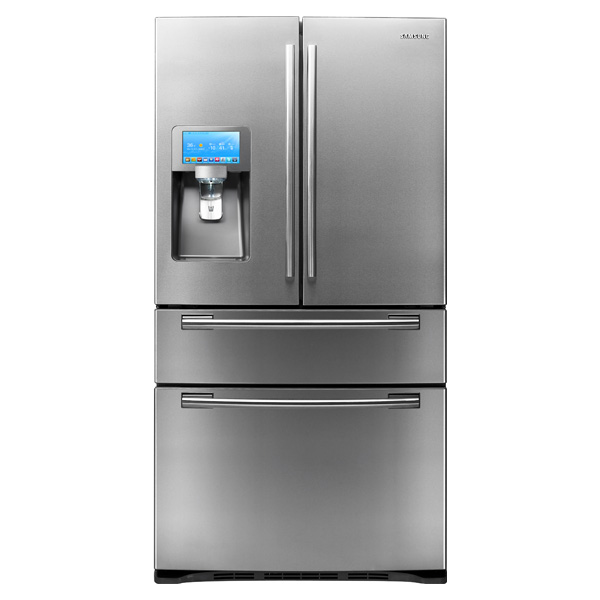
It seems like a no brainer. Samsung is building 8-inch screens into its refrigerator line. Of course it is going to use Android so you can have 200,00 apps on your Honeycomb fridge, right? Even HP picked Android to run its printers (at least until it picked up Palm) -Clearly Android is what everyone wants.
.
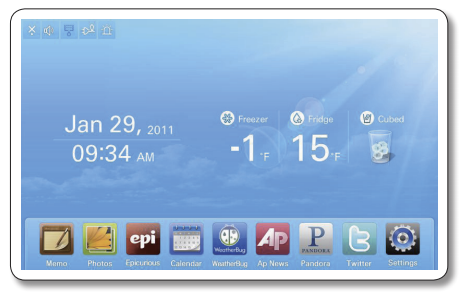
Nope, it looks like Samsung is using its own proprietary, non-Bada embedded OS. Likely due to stability concerns, Samsung went to something that Google doesn’t control. We’ve combed through the 4000 page user manual (PDF) and nary a mention of Android, though some screenshots seem to be reminiscent of its UI (below). Perhaps Samsung (or some hackers) will get Android on there in a future update. Expand Expanding Close