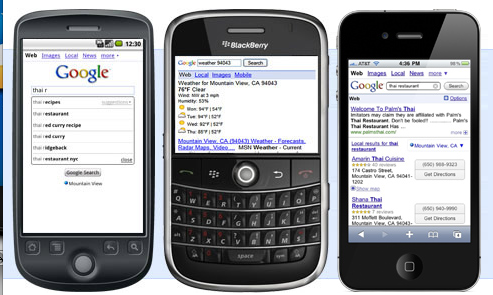
The new MasterCard-certified devices include the BlackBerry® Bold™ 9900 / 9790 and BlackBerry® Curve™ 9360 / 9380, HTC One X, Intel® Smartphone Reference Device, LG Viper™ 4G LTE, LG Optimus Elite, Nokia 603, Nokia Lumia 610 NFC, Samsung Wave Y, Samsung Galaxy mini 2, Samsung Galaxy S Advance, Samsung Galaxy Nexus (GT-i9250), Sony Xperia S, Sony Xperia P and Sony Xperia sola.
Google Wallet, the Android app that turns a smartphone into a wallet, stores a digital version of existing Citi MasterCard Cards with PayPass.
According to a report fromReuters, a judge in Mannheim ruled against Microsoft today in an ongoing patent dispute with Motorola Mobility by ordering the company to remove its Xbox 360 and Windows 7 products from German retailers. In response, Microsoft claimed that Motorola is unable to enforce the court’s decision due to a prior ruling granting Microsoft a preliminary injunction in a U.S. court:
“Motorola is prohibited from acting on today’s decision, and our business in Germany will continue as usual while we appeal this decision and pursue the fundamental issue of Motorola’s broken promise.”
Today’s ruling means Judge Holger Kircher has decided Microsoft broke contracts by using video-compression software covered in Motorola patents in its Xbox and Windows products. As noted by Reuters, the ITC last week ruled that Microsoft infringed on different Motorola patents covering both video compression and wireless technologies. European Union regulators have apparently started several investigations on how much Motorola charges competitors to license its patents because of the court’s decision and previous complaints from Apple, Microsoft, and others.
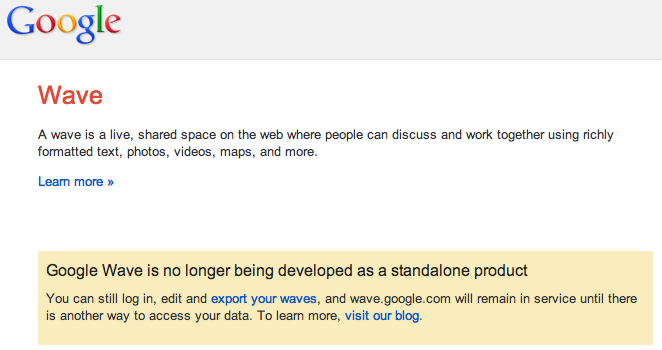
All the way back in 2010, Google announced that Google Wave was on its last leg, and then last November it said the web-based computing platform and communications protocol would become read-only, but today the service has been officially killed.
Well, users still have the rest of the day to export any important data. After tonight, however, all users must wave goodbye.
Verizon’s “Droid Does” campaign is back, but now the carrier has ditched the tentacle robot arm and synthesized automaton voice for a wholesome commercial that features a soothing voiceover with cute and giggly kids in the introduction, which is soon followed by panning scenes of hard-working and cheeky folks, who find Droid devices ever-so useful in their pleasant, daily lives.
The original “Droid Does” campaign launched Motorola’s first Droid and helped move Android into America’s mainstream vernacular in 2009. Check out the latest advertisement above for the Droid 4, Droid Razr, and Droid Razr Maxx, and then compare it to the old plugs hosted on this YouTube playlist (videos also below).
UPDATE: An LG spokesperson reached out to PCMagand denied allegations that the company is abandoning the Windows Phone platform:
“No, we are not giving up on Windows Phone. Although we don’t have another Windows device in the pipeline at this moment, that is simply because demand for Android devices is so strong. […] We’ve maintained since the beginning that LG will support whatever operating system consumers want but at the moment, our priority is to get our Android devices to a level where we feel we’ve covered all the bases, to use an American analogy.”
During last week’s Q1 2012 earnings call, LG hinted it is abandoning Windows Phone hardware production to focus on Android, and now a Korean newspaper attributes the move to underwhelming sales and claimed Microsoft’s chief is immediately meeting with the manufacturer in coming weeks.
Microsoft Korea spokesperson Lee Seung-yeon told The Korea Herald that LG is dumping Windows phones due to poor retail performance and said Windows Phones barely stole 2 percent of the global smartphone market share.
The report also suggested Microsoft’s CEO Steve Ballmer will attempt to remedy the split with LG during a May 22 visit to Seoul, Korea by engaging in business meetings with local industry representatives, including LG:
“’Ballmer, who will speak about the ‘new era of technology,’ will be staying for a day in Seoul,’ said a Microsoft Korea spokesperson Lee Seung-yeon. ‘We, however, don’t have the fixed details of his business meeting schedule as of now.’
An LG spokesman also said it is yet unaware of the meeting.
“Ballmer’s visit takes place shortly after LG Electronics’ executive said during an earnings conference session last week that the company is planning to focus on smartphones running on Google’s Android mobile operating system.”
LG makes a slew of Windows-based handsets, such as the Optimus 7.
The Redmond, Wash.-headquartered Corporation now has coverage for eReaders, smartphones, and tablets running Google’s operating system. Both parties admitted Microsoft would receive royalties from Pegatron; however, the agreement’s particulars were not disclosed.
Microsoft’s Corporate Vice President and Deputy General Counsel of Intellectual Property Horacio Gutierrez said the agreement with Pegatron reflects continued success of its Android licensing program by settling IP issues regarding Android OS and Chrome-powered devices in the marketplace.
While Greenpeace’s “How Clean is Your Cloud” report had not so great things to say about Apple, Amazon, and Microsoft’s use of coal energy in their data centers, Google was praised for its “comprehensive energy reduction plan”. The organization is urging consumers to contact the companies to convince them to change their approach to powering the cloud and read the 50-page report to learn more.
“Google has been the most open in the industry about the importance of increasing not only energy efficiency within the sector, but also the need to move our energy sources to renewable energy… Google has a comprehensive energy reduction plan that has resulted in its data centers using half the energy of the industry standard… Google’s commitment to using renewable energy as much as possible has set the bar for the industry.”
Many Google Glasses parody videos are swirling around the Web, but two Israeli-based filmmakers decided to up the ante with a take on “Battlefield 5.”
Nadav Pessach and Uzi Mor created the video above and hosted it on the “There is a Canal” YouTube channel. It features “Battlefield 5” in a much-idealized version of how some gamers expect Project Glass to one-day change the gaming industry. The Battlefield franchise is a series of FPS video games developed by the Swedish company EA Digital Illusions CE and published by Electronic Arts.
A leaked video suggests Microsoft’s world-renowned productivity suite will soon feature cloud-like options in an effort to curb Google Apps’ growing market share with its alternate offering.
The 30-second promo above is hosted on YouTube by Within Windows. It emphasizes “Office 15” as the suite’s newly re-branded name. It also focuses on the accessibility of the next iteration through remote access to documents, which is enabled by a normal sign-in procedure. The cloud options will tracks and store all of a user’s virtual papers in Microsoft’s cloud-based Sky Drive service.
Microsoft Office is dueling many cloud-based productivity suites, such as Google Apps, and it is steadily losing market share. The downward spiral even caused the once-great Word processing giant to embark on a smear campaign against Google, where it lambasted the Mountain View, Calif.-based Company as a shady advertiser with alternative motives.
Google already announced some big new enterprise partners adopting Google Apps this year, despite Microsoft launching its “Googlighting” smear campaign to promote its Office 365 alternative. In January, it signed its biggest deal with a single company by transitioning roughly 110,000 employees across 26 countries from Spanish bank BBVA to Google Apps. For governments, Colorado recently adopted the Google Apps for Government platform, and today Google announced on the Official Enterprise Blog that Edmonton has become the first major Canadian city to make the switch:
With iOS gaining roughly 30 percent United States marketshare as of Q4 2011 at the expense of RIM, Nokia and Microsoft, new numbers from Nielsen’s latest study show just how much of a duopoly the U.S. market has become. While noting about 50 percent of mobile subscribers in the U.S. are now smartphone owners, Nielsen gave a breakdown of how the two leading platforms continue to dominate as of February 2012: Expand Expanding Close
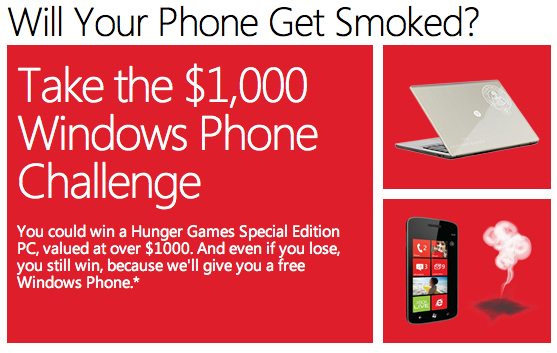
Skatter Tech’sSahas Katta wrote a blog post yesterday about his Windows Phone challenge experience and explained how he beat the contest using a Galaxy Nexus, but Microsoft employees withheld his prize “just because.”
Katta claimed he beat a “Get Smoked” Windows Phone challenge at the Santa Clara Microsoft Store yesterday. The assigned quest was to “bring up the weather of two different cities” faster than a competing Windows Phone user. Katta cold booted his smartphone as instructed, accessed his unlocked screen, and quickly viewed two separate weather widgets for San Jose and Berkeley that were luckily running on the device’s home screen.
Despite executing the task first, Katta was immediately told the Windows Phone “smoked” him:
I excitedly thought I won out of pure luck. However, I was quickly told that I lost. I asked for a reason and was told Windows Phone won because “it displays the weather right there.” That was rather unclear. I showed her my device which also was showing off the same information with two side-by-side weather widgets on the center home screen. After pressing for a better reason, I was told that Windows Phone won “just because.”
After trying to push for a real answer since I clearly won the contest by their rules, another Microsoft Store employee (possibly a manager) came by after noticing me asking more questions. Thinking on his feet, he quickly gave a ridiculous out-of-thin-air reason that I need to display the weather of different cities in different states and that “my phone could not do that”.
With Microsoft and numerous regulatory bodies nipping at Google’s heels and decrying the Internet giant of shady advertising practices and loose privacy standards, one would think the Mountain View, Calif.-based Company might lie low for a while.
Well, that is not the case: The Next Web reported on a Google patent today that introduced technology for analyzing the environmental conditions (or background sound) of phone calls. The action would essentially allow Google to exhibit advertisements based on the clamor its science heard.
The patent, called “Advertising based on environmental conditions,” described how the method recognizes signal outputs from environmental conditions using a sensor coupled with the remote device (such as a smartphone). Google would then serve personalized ads based on the data gathered. In other words, if Google noticed a NASCAR race in the background of a phone call, it would then promptly offer ads for motor sports…
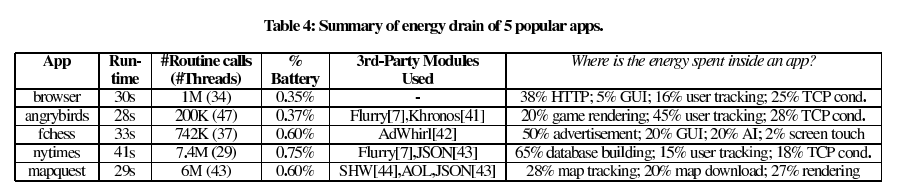
Ad-supported apps in Android smartphones are an immense energy suck.
According to a Purdue University study (PDF), which—interestingly enough—Microsoft helped research, third-party advertising in free Android apps deplete 65 percent to 75 percent of an app’s energy. The study said more than 50 percent of energy used for serving ads occurs during the “3G Tail.” In other words, energy continues to dole out after the process requiring power completes.
The researchers analyzed the energy squandering of 21 Android and Windows Mobile apps over a 3G connection, but the study only highlighted five Android apps (Angry Birds, the Android default browser, Chess Free, MapQuest, and The New York Times).
Google is reinventing its Web-search technique with direct information for queries to better maintain the majority market share.
The Wall Street Journalsaid Google aims to replace some Web links with summarized answers and facts. The search formula transition will roll out over the next few months as the search engine begins to merge relevant results with semantic search, which attempts to understand the meaning of words versus keyword identification. One source said the change could influence 10 percent to 20 percent of all search queries.
Under the new strategy, a search for “Mount Everest” will display key attributes, such as the mountain’s location, altitude, or geographical history, aggregated from Google-indexed websites. Longer queries might uncover a real answer instead of links to websites. For example, the question “What are the 10 largest mountains in the United States?” would subsequently reveal a list of mountains and not ambiguous links to various state parks or hikers’ fan pages.
Google’s top executive Amit Singhal told WSJ that the new search results are the product of hundreds of millions of “entities” stored in a database. The company’s Metaweb team of 50 engineers painstakingly gathered particulars on people, places, and things over the last two years to build an immense collection for associating different words through semantic search.
Google is designing a version of Chrome to run in touch-friendly Metro of Windows 8.
Windows 8 is the upcoming edition of Microsoft Windows and features a new Metro-style user-interface with input for touchscreen, mouse, keyboard, and pen. The platform’s Consumer Preview was just released Feb. 29.
A Google representative told Mashable that Chrome for Windows 8 is based on the desktop browser and not the Android form. The browser will highlight touch support to compliment the company’s interface principle that spans across many of its products and services, such as Xbox 360 and Windows Live. With that said, Chrome for Android indicates Chrome for Windows 8 might feature automatic syncing, swipe-able tabs, and a multitude of extensions.
“Our goal is to be able to offer our users a speedy, simple, secure Chrome experience across all platforms, which includes both the desktop and Metro versions of Windows 8,” announced a Google representative. “To that end we’re in the process of building a Metro version of Chrome along with improving desktop Chrome in Windows 8 such as adding enhanced touch support.”
Software giant Microsoft took to video sharing service Vimeo to disseminate its new commercial promoting the Internet Explorer 9 browser. Tentatively named “A More Beautiful Web,” it features a soundtrack by Alex Clare and fast-paced (albeit a tad amateur-looking) MTV style editing. Both treats are not usually associated with neither the Microsoft brand nor the company’s dull television advertising.
While watchable, it does not hold a candle to Google’s memorable Chrome advertising. The 60-second video highlights the browser’s headlining features, such as hardware-assisted canvas rendering, high-definition video playback, rich web apps like Chillingo’s “Cut the Rope” game, and more.
Two important observations here:
1. The commercial was a Vimeo exclusive at post time— despite Microsoft’s official presence on YouTube, including the Internet Explorer team’s channel. It is interesting that Microsoft chose to tap a rival video sharing service and not leverage the world’s most popular destination for online video to get the word out. An anti-Google move, cynics might say.
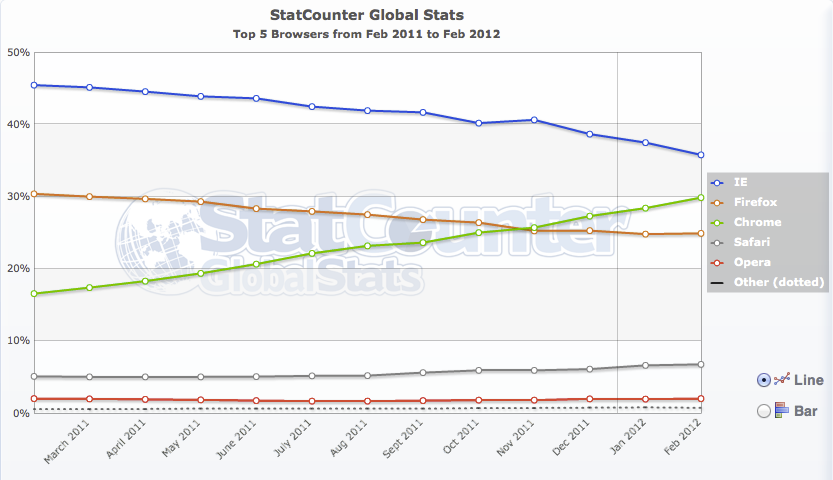
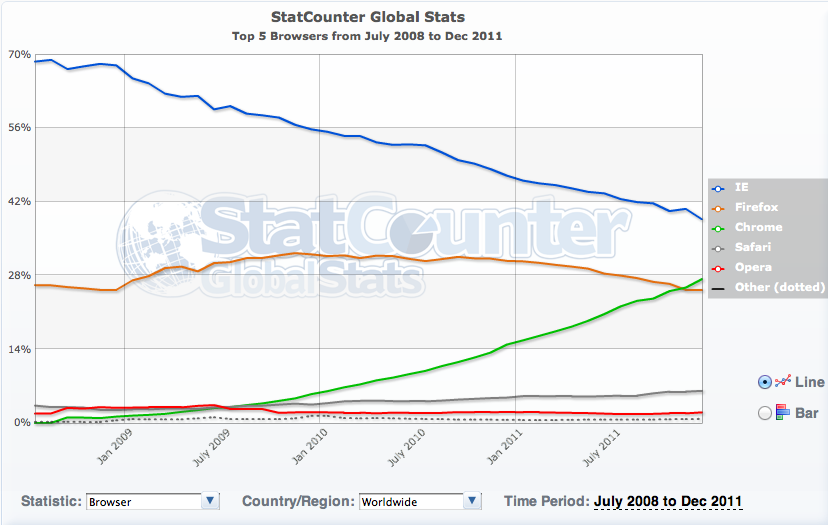
2. Per data from StatCounter (see the chart below), the Windows maker’s possible motivation to bypass YouTube likely includes Internet Explorer’s continuous downward spiral. It has been a trend, not a temporary hiccup. Last summer, Google’s Chrome claimed one-fifth of the worldwide market for browsers and is now No. 2 in some key markets that traditionally favor Microsoft’s product.
Microsoft appeared late to the party and has lost momentum in browser innovation that now almost exclusively belongs to Google and —in small part— to Apple and its Safari browser. If it were not for big businesses’ reluctance to upgrade to a more modern browser, Internet Explorer would already be severely beaten in browser wars.
Everyone knows that Google can dodge privacy features in Internet browsers, renounce third-party cookie policies, and supply personalized ads despite a user’s privacy setting. Privacy regulators, advocates and consumers alike have called upon Google and other advertising companies to abide by browser’s do-not-track policies, but Google already stepped to the plate with a solution for suspicious users that do not want to be tracked.
“Keep My Opt Outs” is a Chrome browser extension that blocks all cookies harvested for personalized ads. The evasive cookies under fire in the media essentially follow a user’s trail across websites to collect history for data reaping. The particulars help Google supply targeted advertisements. All Web browsers include a built-in setting to block this information-cropping process, but Google and other firms use a distinct code to disable the setting in Safari and Internet Explorer.
“Keep My Opt-Outs is an extension for users who aren’t comfortable with personalization of the ads they see on the web. It’s a one-step, persistent opt-out of personalized advertising and related data tracking performed by companies adopting the industry privacy standards for online advertising,” wrote Google on the Chrome webstore…
Google can now check the University of Pennsylvania off its ever-growing list of ivy leaguers wielding Google Apps for Education, because the school just announced a recent move from Microsoft’s Windows Live Hotmail to Gmail.
The Philadelphia-based private university ranks No. 5 in National Universities, according to U.S. News and World Report, and it joins over 60 other leading institutions from the nation’s top 100 to use Google Apps. Harvard College, Yale, and Brown University are a few of the more prominent schools to top Google’s list.
Penn changed services after studying student email trends:
“We just saw more than 50 percent of students forward emails from their Hotmail to Gmail accounts and thought it would be more convenient this way,” said Director of Social Sciences Computing and Student Technology Chris Mustazza to The Daily Pennsylvanian.
Microsoft requested European Union antitrust regulators to probe Motorola Mobility on claims that the United States phone manufacturer is blocking sales of Windows and Xbox products.
“Earlier today, Microsoft filed a formal competition law complaint with the European Commission (EC) against Motorola Mobility and Google,” wrote Microsoft’s Vice President and Deputy General Counsel David Heiner in a blog post this morning. “We have taken this step because Motorola is attempting to block sales of Windows PCs, our Xbox game console and other products.”
Microsoft’s post, “Google: Please Don’t Kill Video on the Web,” lambasted Motorola Mobility for not making industry standard patents available on reasonable and fair terms, and for using those patents to block competitors from shipping products.
The industry apparently agreed many years ago to define common technical standards for everyone to use and build compatible Wi-Fi and video products. However, Heiner contended, Motorola is backtracking on its word and attempting to use standard patents for “killing video on the Web.”
European regulators are moving early on Google antitrust probe, tellingReuters that a decision on a formal complaint against Google for misuse of its market position will be reached in late March, much sooner than expected. EU Competition Commissioner Joaquin Almunia told the news gathering organization late on Tuesday:
I will receive comments from the case team towards the end of the first quarter. I do not expect anything sooner. Let us see.
Since November of last year, 10 complainants such as Microsoft, VfT, Foundem, Deal du Jour, 1plusV and the Spanish Association of Daily Newspaper Publishers have filed complaints with the Commission, accusing the search giant of misusing its dominance in search. Google’s problem with EU courts could result in a multi-billion dollar fine, as had been the case with EU antitrust probes into Microsoft and Intel in the past. Expand Expanding Close
Microsoft is not stopping on its mission to sign patent licensing agreements with just about every Android vendor around from Samsung to Acer, and over 10 others. As of its latest agreement with LG, the company now collects royalties from over 70 percent of all Android smartphones sold in the United States. According to a deal with HTC inked in May, that figure could be as much as $5 per device sold. Now, Microsoft is apparently in talks with Pantech, South Korea’s third biggest smartphone vendor, for a similar licensing agreement.
Just a few years ago, Microsoft’s Internet Explorer owned the browser market with three quarters share and the only real alternative was Mozilla’s Open Source Firefox. However, in 2008, Google noticed Apple’s WebKit Browser engine and built their own Chrome browser. In late 2009, Chrome started to break out of the “other” category in StatCounter’s figures and started its rise to what will likely to be the world’s most used desktop browser in 2012.
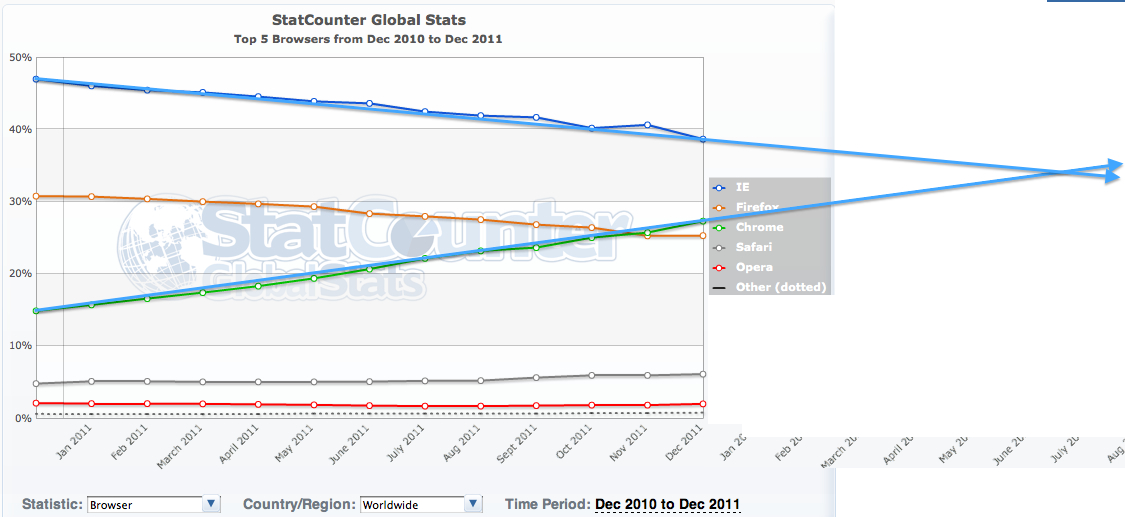
A few months ago, Chrome passed Firefox and if you look at the slope of the graph over time, it looks like Chrome’s rise is still accelerating. Even if it only grows at its 2011 rate and IE continues to fall at its 2011 rate, Chrome will pass Internet Explorer in late Summer 2012 according to Statcounter’s numbers. Below, I have extrapolated IE and Chrome’s 2011 numbers over the first half of 2012…


 According to