All the way back in 2010, Google announced that Google Wave was on its last leg, and then last November it said the web-based computing platform and communications protocol would become read-only, but today the service has been officially killed.
Well, users still have the rest of the day to export any important data. After tonight, however, all users must wave goodbye.
Twitter just announced on its blog that its Android client will get an update today with enhancements made to “discover, search and notifications.” The update does not appear to be live, but it will be available here when it is.
Included in the update is a new “Activity” stream within the Discover tab. The blog post explained:
With this update, you can see Activity on Twitter for iPhone and Twitter for Android. Activity is a stream of updates that shows which Tweets are favorited or retweeted by the people you follow and which accounts those people follow or add to lists… Activity appears below the redesigned stories in Discover. Now you can tap any story once to see Tweets about a particular trend or news article. You can then read the entire story or join the conversation by replying, retweeting or favoriting related Tweets.
Improvements to search include suggestions for spelling and related terms, and autocomplete for first and last names in the Connect tab.
The update also brings push notifications for Interactions like retweets, favorites, and follows, and settings to manage them. You will be able to get all these new features when the update lands on Google Play shortly. Expand Expanding Close
While many of the devices on the list have rumored or leaked release dates already, BGR claimed to have Verizon’s summer/fall roadmap that details flagship smartphones being launched later this year.
According to the report, Verizon Wireless will offer Samsung’s highly anticipated and much rumored Galaxy S3, which the company confirmed yesterday will pack its new 1.4GHz Exynos 4 quad-core processor. The report does not give a release date, but it speculated a summer release based on the roadmap.
Also apparently on the roadmap are multiple Motorola RAZR devices and a new 5-inch HTC device that appears to be a Galaxy Note competitor…
Google is constructing a data center in Council Bluffs, Iowa, which would bring the Mountain View, Calif.-based Company’s total investments in the town to nearly $1 billion.
According to the Associated Press, the search engine said the $300 million data center would add 50 new jobs to the area ranging from computer repair to logistics. Construction on the 1,000-acre project is slated to begin immediately; although, details regarding an end-date are not confirmed.
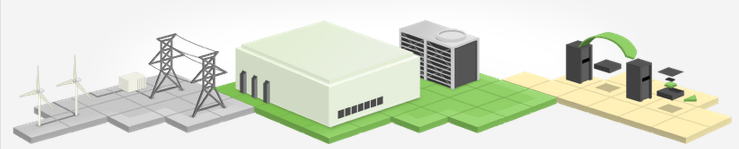
“Google’s secure data centers are some of the most energy efficient in the world,” explained Google on its Date Centers website. “Each year we save millions of dollars on energy costs, and we use renewable energy whenever we can.”
TmoNews discovered a T-Mobile-branded Samsung Galaxy Note, and then posted an entire gallery of pictures (above). There are no confirmed details on pricing or a release date as of this time. However, keep checking 9to5Google for more.
According to a report from Bloomberg, U.S. International Trade Commission Judge Thomas Pender has ruled in favor (PDF) of Motorola and claimed Apple’s devices infringe on one Android-related patent owned by the company. The ruling is only a partial victory for Motorola’s attempt to receive an injunction on iPhones and iPads, because the judge’s decision will still have to be reviewed before import blocks can be achieved:
ITC Judge Thomas Pender said Apple violated one of four Motorola Mobility patent rights. The patent relates to Wi-Fi technology. The judge’s findings are subject to review by the six-member commission, which has the power to block imports that infringe U.S. patents.
As for the Wi-Fi patent in question (# 6,246,697), Apple spokesperson Kristin Huguet told AllThingsD that Motorola refused to license its industry-standard technology on “reasonable terms”: Expand Expanding Close
As of the latest research from Nielsen, we know the United States smartphone market has quickly become an iOS/Android duopoly with 90 percent of devices on either one of those platforms. While smartphone usage in Japan is still at 1-in-5 mobile phone owners, new numbers from comScore today show Japan’s smartphone market is also quickly becoming dominated by Apple and Google. To be specific, 95.6-percent of smartphones in the country are Android or iPhone, and Apple has outgrown Google in the last three months while Android’s share remains steady.
With the 2012 Summer Olympics in London set to kick off in the coming months, official sponsor of the games Coca-Cola teamed with producer Mark Ronson to create an Android app called “Coca-Cola Olympic Games My Beat Maker.” As you might imagine, the app allows you to create your own beats, but it does so by letting you chop up the official Coca-Cola anthem for the London 2012 Olympic Games—”Anywhere in the World” by Ronson featuring Katy B.
My Beat Maker uses amazing technology to detect the movements of your phone and transform them into music so you can make your own beats!… Bust out your own loops and beats based on the official Coca-Cola® anthem for the London 2012 Olympic Games, Mark Ronson featuring Katy B’s Anywhere in the World, just from the motion of your phone.
T-Mobile’s launch of the HTC One S should be seen as the first real phone benchmark for 2012. That is good because 2011 was a bad year for both T-Mobile and HTC.
We have a bold new generation of devices from a beaten up manufacturer on a carrier that is just now emerging from the AT&T merger/breakup.
Without even turning the One S on, you will immediately marvel at the hardware. It is an incredible 7.8mm thin, which is significantly thinner than the thinnest Galaxy S2 or iPhone 4S. It is also 118g light, yet it is a metallic solid, owing to its unibody aluminum construction. With angular/rounded corners, it feels great in the hand and the dark Gorilla Glass on metal look is as nice of a design as you will find on any device. It has three capacitive buttons on the bottom, which we owe to the new Ice Cream Sandwich user-interface.
It is hard for me to imagine someone going into a T-Mobile store and coming out with anything else but this phone. Sure, the new Galaxies have slightly bigger screens, but this feels much more solid and has the same resolution. Moreover, last year’s HTC Sensation and Amaze feel like a grenades compared to the svelte HTC One S.
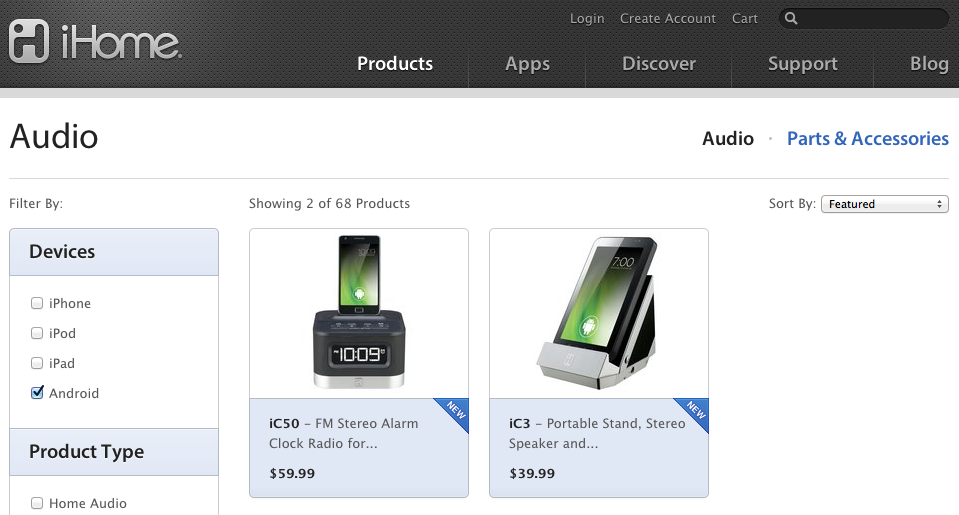
“The size of the worldwide Android audience and lack of current speaker options gives us a significant opportunity to introduce our products to a new group of consumers,” announced iHome’s Director of Marketing Evan Stein in a press release. “Our new SmartDesign products maintain the high quality and innovation that is synonymous with iHome.”
First up is the iC50 for Android smartphones. It is a $59.99 alarm/radio clock with a microUSB charging cable, stereo audio cable, and 3.5 mm plug:
Wake and sleep to radio (you can also wake to tone). Reson8® speaker chambers and EXB bass enhancement provide great sound that’s perfect for your music, games or apps. Works with iHome Sleep app (free download) to wake and sleep to your favorite music and advanced custom alarms. SmartSlide™ dock with custom micro USB cable for smartphone charging regardless of its charging port location/orientation. Also enjoy FM radio with digital tuning. A microUSB charging cable and stereo audio cable with 3.5 mm plug are included.
In February, the story broke that Google and other advertising companies were bypassing iOS Safari’s privacy settings and continuing to track users without their consent. Google quickly disabled its code responsible for the tracking after a story from The Wall Street Journal published, and Apple then claimed it was “working to put a stop” to the issue.
Now, a new report fromMercury News claimed the U.S. Federal Trade Commission is considering whether to fine Google over the incident. The decision is expected in the next 30 days:
The Federal Trade Commission is deep into an investigation of Google’s actions in bypassing the default privacy settings of Apple’s (AAPL) Safari browser for Google users, according to sources familiar with ongoing negotiations between the company and the government… Within the next 30 days, the FTC could order the Mountain View search giant to pay an even larger fine in the Safari case than the penalty the Federal Communications Commission hit Google with Friday, say the sources, who spoke on condition of anonymity.
The report is referring to Google being recently fined $25,000 by the FCC after it allegedly “deliberately impeded and delayed” an investigation related to Street View cars. The heart of the Safari bypassing investigation is whether the company is violating a previous privacy agreement made with the FTC following controversy over the failed “Buzz” service. The report claimed Google could face up to $16,000 per violation per day for violating the agreement. Google said to Mercury News today it would “cooperate with any officials who have questions” and explained making its +1 compatible on mobile Safari created the issue:
Stemming from reports earlier this week from National Defense Magazine, a Boeing spokesperson confirmed to Geekwire this morning that the aerospace and defense company is developing an Android device for the United States government security and defense markets:
“We are developing a trusted mobile device that will serve the US Government Defense and Security market, which require a higher level of security than is currently available in the commercial marketplace.”
According to the earlier reports from National Defense, Boeing Network and Space Systems President Roger Krone expects the device to launch later this year. He claimed the device would début at a lower price than similar encrypted and secure devices sold to government for upwards of “$15,000 to $20,000 per device.” The Boeing phone will not hit the mass market, but Android was selected and not proprietary software to meet demand from users wanting access to the apps and features they are familiar with in smartphones. It is dubbed “The Boeing Phone,” but no decisions have been made whether the device will ultimately carry the Boeing brand. Expand Expanding Close
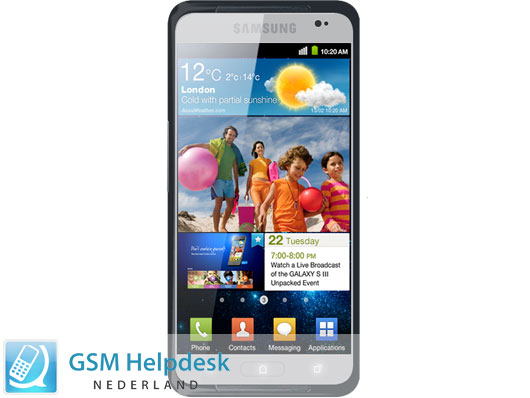
Samsung’s Galaxy S III will feature a home button under the display.
South Korea newspaper Korean Digital Daily (translated) added to the rumor machine today with sources that claim the upcoming smartphone will sport Samsung’s accustomed home button, despite much speculation claiming otherwise.
The Galaxy S III will even boast a five-column icon layout showcased in the Samsung Galaxy Note. This would help the device standout from other Android handsets, and the iPhone, which has maintained a four-column icon layout since its initial 2007 launch.
Ahead of its full quarterly report scheduled for April 27, Samsung Electronics today estimated its operating profits for the three-month period that ended in March. Estimated at 5.8 trillion won or $5.15 billion USD, that is nearly double the company’s results from the same quarter a year ago and up from the roughly 5 trillion won originally forecasted by analysts. While attributing the strong quarter to the Galaxy Note, the report fromReuters noted Samsung is “set to consolidate its market position with new products” over the next few months, including a “revamped Galaxy S” that will compete with Apple’s next iPhone: Expand Expanding Close
– Narrator introduction: Sprint was the first carrier with nationwide 4G, first with 3G, and it unveiled the first 3D phone.
Sprint CEO Dan Hesse takes the presentation stage floor:
– He talks about Sprint’s successful partnership with HTC and Evo.
– Showcases network vision, which is an initiative designed to give customers a better network coverage and experience.
– He mentions that Evo is an HD voice- capable phone. Mobile voice quality is crystal clear. Enhanced voice quality for Sprint stems back to fiber optic network days of Sprint’s heritage.
HTC President Jason Mackenzie takes the stage to unveil new Evo One:
– It has only been two years since both companies originally launched the HTC Evo flagship device.
– It was the first 4G smartphone to launch in the United States. This year represents a turning point for HTC, because it is delivering true hero products with beautiful designs, amazing cameras, and an authentic sound.
– HTC is not just all about specs; it believes experience is key.
– Evo One’s Sense 4 is faster, cleaner, and more intuitive than ever before for delivering a premium experience.
– Evo One boasts an amazing camera and awesome sound experience.
-Design is something HTC has always been serious about, and it is doubling down this year so phones look and feel great.
HTC Lead Designer Jonah Becker takes the stage to discuss the Evo One’s design:
– The Evo name stands for the very best. It features authentic material with meticulous attention to detail.
– The Evo One is crafted from aluminum, first given a black finish, and then the edge’s surface is cleaned of edge to bring a highlight to the device’s look.
– Design process discussed next (video demo): Red kickstand gives the Evo One an HTC look, but it also serves a purpose.
– The Evo One has a soft touch finish and blasted aluminum for texture, and then it undergoes a chemical etching process to create something new to industry without painting or coating.
– About 100 different machine cutters are used to create all the features and geometry needed in the HTC Evo One—and people notice. A much-better designed product. “It’s what I want in my pocket.”
– New Evo is also a high-end camera like an SLR, and the red ring around lens mimics high-end cameras, while the red band on the back reinforces the HTC brand.
– The aluminum gives the Evo One a precise feel, and an actual camera button gives it a real feel.
– It is also a multimedia powerhouse; hardware is just a passage to content.
– Crisp, rectangular phone mimics TV, and its kickstand lets you go hands free.
Sprint Product Chief Fared Adib takes stage to talk about camera features:
– The camera: True digital SLR in phone.
– The Evo One sports HTC image sense technology and dedicated imaging chip, with super fast camera startup and auto focus to allow four frames per second in a continuous shooting mode.
– Image sense f/2.4 lens with HDR and smart flash makes sure every picture is perfect, i.e., not too dark or too light.
– The Evo One takes videos and photos simultaneously without switching between modes. While shooting video, just click shutter button to snap a picture.
Sprint CEO and HTC President are back on stage to conclude presentation:
– The HTC Evo One has a focus on sound: Rich, authentic sound with Beats Audio by Dr. Dre.
– Evo One has a media manager to get sound from computer to phone, but the music hub also gives access to a user’s music in apps and all other places. Streaming options to car and TV are also available.
– HTC voice: In 2012, Sprint will serve 500 million voice minutes. Sprint’s beloved HD voice is the future of phone calls. It is possible through a combination of dual microphones, decoders, encoders, and networks for a richer sound.
– Demo video depicts reduced background sound very well. “Hearing is believing.”
– Key features: 2,000 mAh batter, 4.7-inch HD screen, and Snapdragon dual core processor, Beats Audio by Dr. Dre, Ice Cream Sandwich OS with Sense 4.0, and a 8-megapixel shooter and 1.3-megapixel camera.
The HTC Evo One will be available in the second quarter for $199.99. Pre-sale starts May 7.
Demonstration area opens:
– I played with the phone. It looks cool—feels sturdy and valuable, yet the screen is huge. I had trouble handling it, because I am use to the smaller iPhone. Snapping photos while recording video was excellent. The fast startup and auto focus was also impressive. Camera features are cool too: built-in vignette, panorama, HDR, face detection for group shots, and more. The HD voice demo was amazing, as well. It highlighted absolutely no background sound despite the noisy area. I think the HTC Evo One is a quality phone. There is nothing that stands out when it comes to the user interface, though, as it looks like a typical Android smartphone.
The first HTC Evo One reviews are starting to flood the gate before its official launch tonight and initial impressions indicate the device has both good and bad points.
An.droid-life.com said the smartphone is bulky, yet it boasts stellar-quality Beats Audio by Dr. Dre, Ice Cream Sandwich OS with Sense 4.0, and a 8-megapixel shooter and 1.3-megapixel camera worth drooling over.
Despite the praise, the reviewer noted the device “just feels like HTC’s same old thing.” The trimmed Sense and usual ICS experience seemed a bit ho-hum, but then he added that his time spent with the smartphone was limited so complete details are not possible at this time.
Following Nielsen’s latest survey that showed over 90 percent of United States smartphone buyers are choosing iOS or Android, research firm comScore today released its data of the top smartphone platforms and OEMs in the U.S. The survey included more than 30,000 people over a three-month period ending February 2012. It found Android was up 17 percentage points from a year ago with 50.1-percent of the U.S. smartphone market. In comparison, Apple’s 30.2-percent accounted for an increase of 5 percentage points from the same period a year ago.
According to comScore, Google passed the 50 percent milestone for the first time during February 2012. The numbers represent a 3.2-percentage point increase over previous three-month period for Google, and a 1.5-percentage point increase for Apple.
With iOS gaining roughly 30 percent United States marketshare as of Q4 2011 at the expense of RIM, Nokia and Microsoft, new numbers from Nielsen’s latest study show just how much of a duopoly the U.S. market has become. While noting about 50 percent of mobile subscribers in the U.S. are now smartphone owners, Nielsen gave a breakdown of how the two leading platforms continue to dominate as of February 2012: Expand Expanding Close
Google made less than $550 million in revenues for Android between 2008 and 2011, while making four times as much revenue during the same period with Apple products that employ Google services like Search and Maps.
According to The Guardian, the settlement offer provided yesterday by Google to Oracle depicted Android’s revenue streams. Settlement discussions ordered by Judge William Alsup were derailed when Oracle rejected Google’s low offer to pay royalties on Android if alleged patent infringements deem true in court.
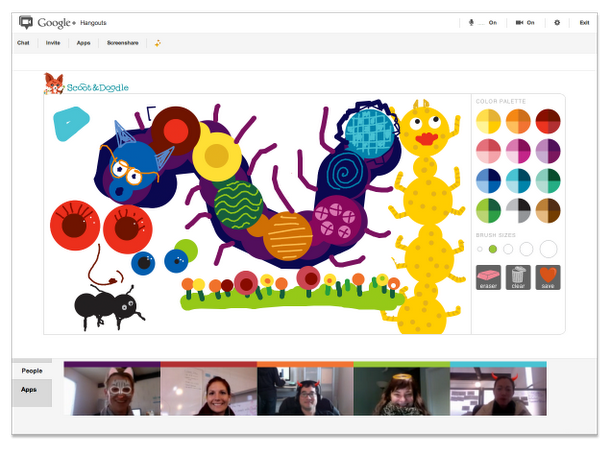
Just when the tech-world is seemingly about to explode with apps—apps for Android, apps for iPhone, apps for set-top boxes, apps for computers, apps for Facebook—Google adds to the bubbling pot with Google+ Hangout apps.
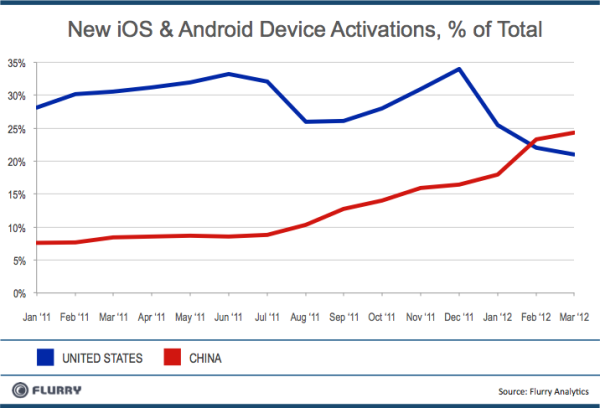
China now holds the No. 1 spot for Android and iOS activations.
Mobile analytics firm Flurry released new data that depicted the Chinese market skyrocketing from No. 11 in 2011 to No. 1 for smartphone activation, thereby bumping the United States to No. 2.
The statistics are staggering: China accounted for 8 percent of Android and iOS activations in January 2011, while the United States held a big slice of the pie with 28 percent. The tables have turned, however, as China passed the U.S. and now boasts 24 percent of activations by March 2012 (end-of-the month projections included). Meanwhile, the United States slipped to 21 percent.
According to a report from Bloomberg (via AllThingsD), the U.S. Federal Trade Commission subpoenaed Apple as part of its antitrust investigation of Google. There are not many details currently, but the report claimed the FTC is interested in Apple’s agreement with the company to use Google as its primary default search engine on iOS devices.
The agency’s request for documents includes the agreements that made Google the preferred search engine on Apple’s mobile devices, said the people, who weren’t authorized to speak publicly and declined to be identified. Google rivals such as Microsoft Corp. (MSFT) have criticized these agreements as anticompetitive.
Google rolled out a handy new feature yesterday to its mobile search page on Android and iPhone smartphones that provides access to the list of past places-related search queries. According to a post over at the official Google Mobile blog, the new Recent icon “shows information about places you have recently searched for on any of your devices.” You must be logged in to your Google Account when searching for places (such as the Cartoon Art Museum in San Francisco). Web History must also be enabled. Users can swipe to the right to see more icons for other categories of places.
Next time you are heading to a place you have recently searched for, no need to worry if you can’t remember the address or phone number. Just go to Google.com on your smartphone and tap on the “Recent” icon.
This improvement also allows you to research places of interest on your desktop and view them later while on the go— without having to bookmark or email places’ URLs to yourself. One thing to keep in mind: This information about your previously searched places will be available under the Recent icon for about a day, Google said. This handy new feature is the first in a series of enhancements aimed at unifying search experience across devices.

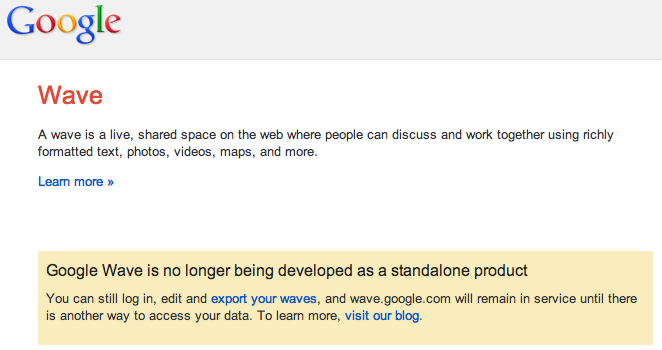
 All the way back in 2010, Google announced that Google Wave was on its last leg, and then last November it said the web-based computing platform and communications protocol would become read-only, but today the service has been officially killed.