Author

Avatar for 9to5 Staff

9to5 Staff

HTC: “Windows Phone 7 will give Android a run for its money”

Site default logo image


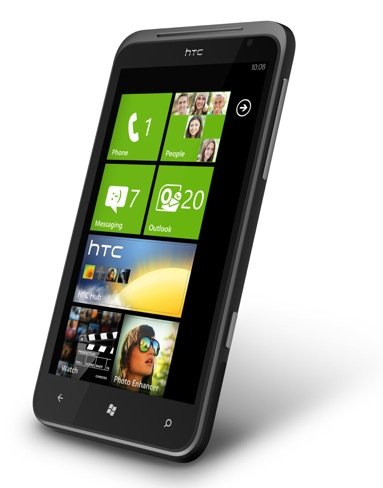
HTC is doubling down on Windows Phone. Pictured above: The HTC Titan, powered by Windows Phone 7.5 ‘Mango’ and arriving to AT&T this Fall.

HTC, the embattled handset maker from Taiwan and the second-largest smartphone vendor in the United States, is doubling down on Microsoft’s mobile platform, seemingly to reduce its reliance on Google’s Android software which has been under heavy fire lately from Apple, Microsoft and Oracle over patents. According to ZDNet Asia, a HTC manager for Singapore said during the Windows Phone 7.5 Mango launch event:

We believe that Windows Phone 7 will eventually be better than other platforms and will give Android a run for its money.

Melvin Chua, the manager, also noted that the Windows Phone platform already accounts for nearly one-third (30 percent) of HTC’s overall sales. This subtle hint points to a possible 180-degree turn for the company that made fortunes by making and selling Android phones. It’s not terribly surprising, though. Their chairwoman Cher Wang recently went on record, saying the company discussed internally a mobile operating system purchase. “We can use any OS we want”, she was quoted as saying.

Expand
Expanding
Close

The secret to Amazon Silk browser’s speediness? WebKit and SPDY.

Site default logo image

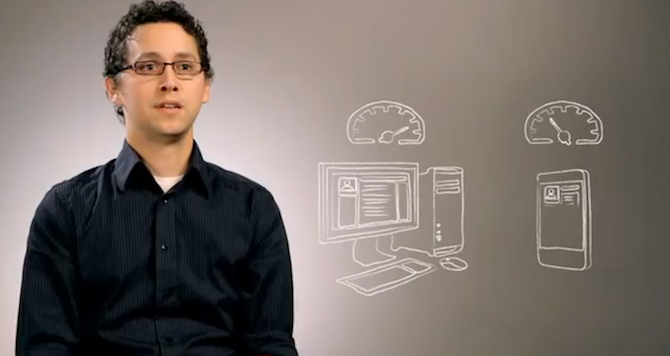
Amazon yesterday outed its Kindle Fire tablet, the lower-priced $79 Kindle and the new $99 Kindle touch. They also unveiled a brand new browser written exclusively for the Kindle Fire, dubbed Silk. There has been some concern among web developers about the browser’s rendering engine given how numerous web sites are optimized for the open-sourced WebKit rendering engine. According to a post by Mike Mainguy, a software architect with Lemans Corporation, the Silk browser does leverage WebKit as its rendering engine. Moreover, it also employs SPDY, Google’s optimized hypertext transfer protocol introduced in late 2009 as part of the search giant’s “Let’s make the web faster” initiative. It’s currently used in Chrome and now in Amazon’s Silk browser, too. Mainguy explains:

All told this isn’t as big a technological change at the front end and is more of a story about amazon trying to use their infrastructure to make the mobile browsing experience better.  Frankly, this is a scaled up and modernized version of what blackberry did years ago (are they still doing that?).

It appears that Amazon combined SPDY with Amazon Web Services to caches files and offload page rendering to the cloud, depending on workload. According to the Silk team:


Expand
Expanding
Close

Amazon announces Newsstand for the Kindle Fire tablet

Site default logo image

Just as we’re sorting through Amazon’s announcements related to their Kindle e-readers and the new Fire tablet, we spotted a press releasementioning Newsstand, an online store dedicated to the digital magazines and newspapers which have been optimized for the Fire’s seven-inch display. It’s pretty much like Apple’s upcoming Newsstand in iOS 5, only Amazon’s has more content. The company explains:

Hundreds of magazines and newspapers – including The Wall Street Journal, The New York Times, USA Today, Wired, Elle, The New Yorker, Cosmopolitan and Martha Stewart Living – with full-color layouts, photographs, illustrations, built-in video, audio and other interactive features are available from the new Kindle Fire “Newsstand.” Kindle Fire customers will enjoy an exclusive free three-month trial to 17 Condé Nast magazines, including Vanity Fair, GQand Glamour.


Expand
Expanding
Close

Amazon: “From Kindle, the Fire is born”

Site default logo image

[youtube=http://www.youtube.com/watch?v=jUtmOApIslE]
Kinda neat. The voiceover quotes French writer François-Marie Arouet Voltaire.

The instruction we find in books is like fire. We fetch it from our neighbors, kindle it at home, communicate it to others, and it becomes property of all.

And then, Amazon adds its own cheesy part: From Kindle, the Fire is born. Talk about pun intended.

The new Kindle Fire tablet costs $199 and ships November 15.

Also, amazon.com/kindlefire.


Expand
Expanding
Close

Amazon rolling out Silk, new web browser for the Kindle Fire tablet

Site default logo image

[youtube=http://www.youtube.com/watch?v=_u7F_56WhHk]
Amazon has just unveiled at a press conference in New York its inaugural seven-inch tablet and a new family of Kindle e-readers that now include the $99 Kindle Touch and the low-priced regular Kindle which retails for just $99. Seth Weintraub is on the scene and the latest information includes the news that Amazon will be rolling out its own brand new browser for the Fire tablet, named Silk.

The company set up a new blog for the Silk team and their first blog postexplains that Silk is “an all-new web browser powered by Amazon Web Services (AWS) and available exclusively on the just announced Kindle Fire. According to a promo clip included above, a “split browser” architecture (kinda similar to Opera’s Turbo mode) taps the Amazon cloud which caches files (limitless caching) and does the heavy-lifting, depending on workload. It’s a smart approach which offload page rendering to Amazon Web Services, resulting in faster page load times. And here’s what’s so smart about it, according to the Silk team:


Expand
Expanding
Close

Television commercial: The new $79 Amazon Kindle

Site default logo image

[youtube=http://www.youtube.com/watch?v=oMULBXflsWc]

While the new Kindle Fire tablet failed to impress folks who were hoping for an iPad killer, the $79 regular Kindle has gotten us excited because this thing is now within grasp of an average consumer and if history is an indication, sales should grow at an exponential rate. Conveniently, Amazon has a new television commercial to push the $79 Kindle into mainstream. Clearly they want you to view the device as the perfect holiday gift.  The new inexpensive Kindle is available today. Its touch-based counterpart named the Kindle Touch is arriving in time for Thanksgiving, priced at $99/$149 for WiFi/3G variant.


Expand
Expanding
Close

Amazon unveils new Kindle e-readers

Site default logo image


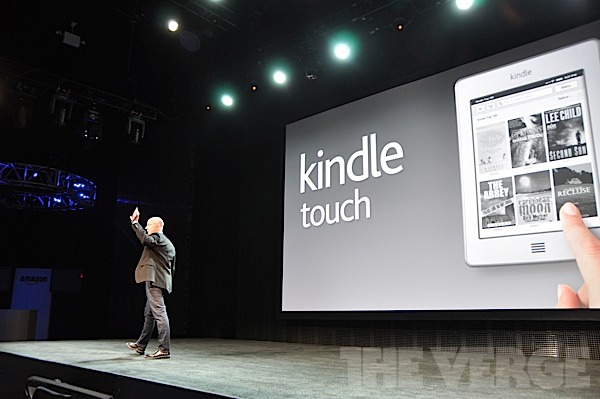
Image via The Verge

In addition to the new Kindle Fire tablet, Amazon has also re-shuffled their Kindle offering at a New York event this morning. Our Seth Wientraub is on the scene and has the latest info. Amazon CEO Jeff Bezos has just unveiled a brand new e-reader with a touchscreen. The device is aptly named the Kindle Touch and costs just $99 for the WiFi-only version or $149 if you want to use it over 3G cellular networks.

They are shipping it November 21, right before Thanksgiving, and taking pre-orders today. Perhaps more important than that is the news that the regular Kindle now costs just eighty bucks. Plus, they are shipping the $79 Kindle today.


Expand
Expanding
Close

Amazon’s $199 Kindle Fire: Seven-inch display, no camera & mic, 30-day free Prime trial

Site default logo image


Note: This is a mockup, not the actual Kindle Fire

Just as Amazon’s media event begins in New York, serving as a launchpad for their inaugural tablet, Bloomberg spoils the announcement by publishing key pieces of information about the device. It will be called the Kindle Fire, as rumored, and will cost just $199, which is a pretty big deal. The tablet has a seven-inch color display which responds to touch (just two fingersat once, though) and a “fresh and easy user interface” running on a forked Android version. Another biggie: The device will come with a 60-day free trial of Amazon Prime (a $79 a year value) membership.

Bad news: It has no cameras – not even a microphone. Heck, it even lacks 3G access so looks like the Fire will be a WiFi affair only. We’ll have more info soon as our own Seth Weintraub is on the scene in New York at Amazon’s press conference.

Chief Executive Officer Jeff Bezos is betting he can leverage Amazon’s dominance in e-commerce to pose a real challenge to Apple’s iPad, after tablets from rivals such as Hewlett-Packard Co. and Research In Motion Ltd. have fallen short. Sales of Amazon’s electronic books, movies and music on the device may help make up for the narrower profit margins that are likely to result from the low price, said Brian Blair, an analyst at Wedge Partners Corp. in New York.

The analyst observes what all of us have known for a long time, that the Seattle-based online retailer has the most compelling ecosystem to take on Apple’s iTunes juggernaut:


Expand
Expanding
Close

Microsoft signs Android cross-licensing agreement with Samsung

Site default logo image

Microsoft just announced a cross-licensing agreement with Samsung. Akin to their patent deals with other Android backers, this one will have Samsung pay per-device royalties for mobile phones and tablets running Android. Microsoft has in total eight cross-licensing agreements with Android backers Acer, General Dynamics Itronix, Onkyo, Velocity Micro, ViewSonic, Wistron, HTC and Samsung.

Microsoft explained in a blog post that the agreement “gives both companies greater patent coverage relating to each other’s technologies, and opens the door to a deeper partnership in the development of new phones for the Windows Phone platform”.

Did the software maker just say that Samsung will focus more on Windows Phone in the future? Per press release, Microsoft and Samsung “agreed to cooperate in the development and marketing of Windows Phone”. Could be just what Microsoft needs given their struggle to keep Nokia afloat. Patent expert Florian Mueller characterized the announcement on his FOSSPatents blog as “the most important Android-related intellectual property deal in its own right”, adding:

If Samsung truly believed that Google’s acquisition of Motorola Mobility was going to be helpful to the Android ecosystem at large, it would have waited until that deal is closed before concluding the license agreement with Microsoft. But Samsung probably knows it can’t rely on Google. It decided to address Android’s intellectual property issues on its own.

Samsung has circa 28,000 patents in the United States and more than 100,000 patents around the world. Curiously, Microsoft hasn’t targeted Apple’s iOS with its patents so far which leads us to believe that Oracle, Microsoft and Apple may be working together to derail Android or at least make it a pricey proposition for handset makers. Be that as it may, it is going to be interesting seeing how this Microsoft-Samsung patent protection affects the nine Apple vs. Samsung lawsuits in twenty countries around the world…


Expand
Expanding
Close

Rumor: Samsung looking to bring concept Galaxy Skin phone with flexible AMOLED display to market in 2012

Site default logo image

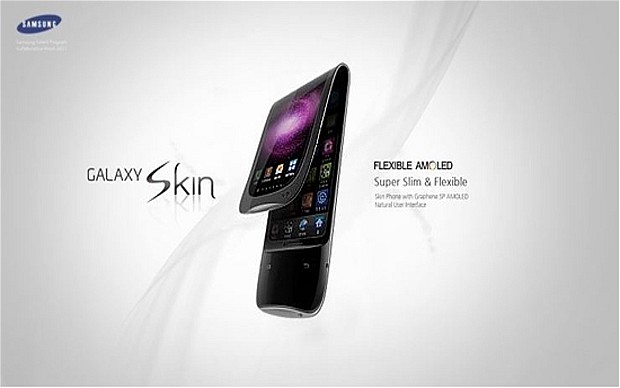
Phone concepts are quite often gorgeous to look at, but most (if not all) end up filed under the ‘Not Feasible’ drawer. Not for Samsung. The company set out on an ambitious project to design a sci-fi smartphone with a flexible AMOLED display. This is not a concept, mind you, but a real thing. The display can be bent around a cylinder with a one-inch diameter, allowing the phone to become a clock, a wrist-watch a mouse and so forth. It draws from an idea co-developed by Professor Haeseong J. Jee and designer Hye Yeon You. Samsung unveiled a prototype at the CES 2011 show in Las Vegas and today International Business Times claims it is coming in 2012:

The ground-breaking feature of the futuristic device is that it is flexible and can take various shapes. The displays are rollable, bendable and can even survive blows from a hammer. It is the first of its kind and is set to mold a new definition for smartphones. Samsung previously confirmed the production of flexible AMOLED displays that may debut in the second quarter of 2012.

The AMOLED display itself uses plastic polyimide substrate instead of glass, allowing for high flexibility. Other features of the so-called Galaxy Skin smartphone are said to include an eight-megapixel camera with Auto Focus, Self Shot, Action Shot, Panorama Shot, Stop Motion and Add Me features, a 1.2GHz CPU with 1GB of RAM and apparently a future Android version code-named Jelly Bean.

Consider these stats more of a reference that the actual hardware features set in stone because, you know, it’s just a concept (until it hits the market) and we all know where great concepts usually go – to the Island of Misfit Toys.
[youtube=http://www.youtube.com/watch?v=kJEHp15Hoo0]

Expand
Expanding
Close

Google vs. TV: Scheduled YouTube channels arriving in 2012

Site default logo image

Citing the obligatory “people familiar with the matter”, the Wall Street Journal in a story this morning reports that Google is finalizing contracts for upcoming YouTube channels that will stream premium entertainment content on a regular basis. Google CEO Larry Page apparently wants to give people a good reason to tune into YouTube instead of television. Content owners are being “encouraged” to create schedules of programming much like traditional TV, the paper noted.

YouTube has requested some content for the channels within the next 60 days, according to one of these people, as it considers a launch in early 2012. YouTube, which media companies have long griped is too stingy cutting content deals, is paying from a few hundred thousand dollars to several million to content creators to create and curate videos for a channel, according to these people. Google recoups the original payment through ad revenue, and Google and the partner share ad revenue after that.

This could be viewed as part of Google’s broader push towards providing high-quality Hollywood entertainment on YouTube. The timely strategy ties nicely with the Google TV project, which is also about to be updated with a new software release soon. The Wall Street Journal first reported on Google’s plans to spend a hundred million dollars on premium YouTube content back in April. Google is reportedly in talks with Creative Artists Agency, William Morris Endeavor and International Creative Management over professionally produced programming on broad themes, including arts, fashion and sports.


Expand
Expanding
Close

Localytics: One-third of the U.S. Android ecosystem is 4G-enabled

Site default logo image

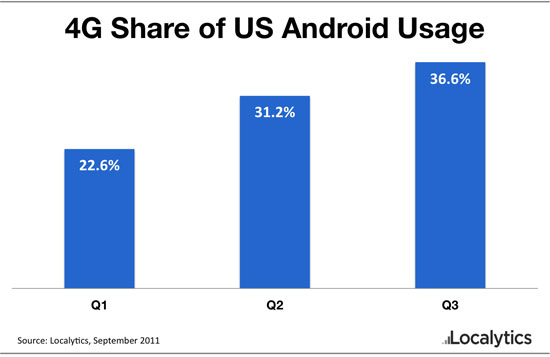
A Localytics study issued today helps understand why Verizon Wireless recently sided with Samsung in the ongoing Apple vs. Samsung legal saga. Per Localytics’ data, 4G is one of Android’s key differentiators: More than one in three Android phones in the United States take advantage of fourth-generation cellular networks. In the third quarter of this year, some 36.6 percent of Android handsets in the United States were 4G-ready, a notable increase over the 22.6 percent in the first quarter of 2011.

This number is increasing rapidly – since the beginning of the year, the percentage of Android devices that are 4G-capable has grown by over 50 percent, culminating at a full third of the Android ecosystem. It will be interesting to see whether the iPhone 5 supports any type of 4G network. The drawbacks – bulkier antenna and a much shorter battery life – may outweigh the benefits in speed. Regardless, with the growth in 4G-capable handsets Android has seen, it appears that smartphone users are buying into the value of speed. We’ll see how this continues. 

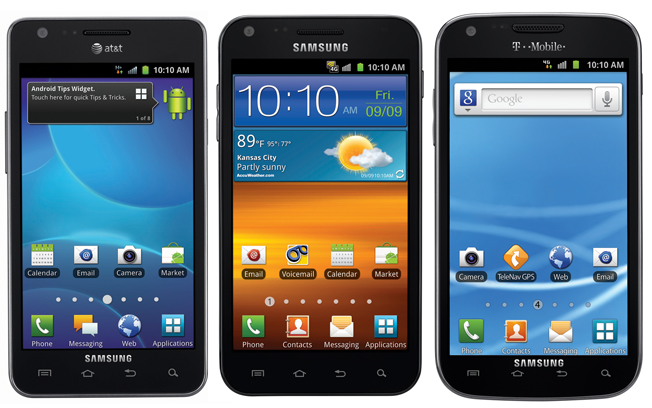
The nation’s most popular 4G handsets in the third quarter were the HTC Thunderbolt (Verizon), the HTC Evo 4G (Sprint), the Samsung Epic 4G (Sprint), the Samsung Droid Charge (Verizon), the myTouch 4G (T-Mobile USA) and the Motorola Atrix (AT&T). A few caveats and the full list of most popular 4G devices in the country right below the fold…


Expand
Expanding
Close

Samsung’s answer to Apple’s patent claims: Firmware update

Site default logo image

The second day of a two-day hearing between Apple and Samsung has brought resolution to a user interface-related patent claim by the iPhone maker. Webwerld editor Andreas Udo de Haes, who covers the hearing from a Dutch court room, wrote on Twitter that carriers are currently testing a firmware update for Samsung’s Galaxy smartphones. It is said to tweak the user interface of the photo gallery program so it doesn’t infringe anymore:

Meanwhile, Samsung can get around this with an update for Android that changes the UI of the photo gallery, so is doesn’t infringe anymore

Some people are reporting that today’s 2.3.4 firmware update lost the bounce effect on whole Android and replaced it with the blue fading effect. For more intricacies of the legalities, knock yourself out here.


Expand
Expanding
Close

Amazon gearing up for Kindle Fire tablet launch with video and magazine deals

Site default logo image


A mockup of a seven-inch Amazon tablet running a forked Android version.

As Amazon gears up to debut its long-rumored tablet on Wednesday at a media event in New York (a subtle hint of a media-focused launch), TechCrunch chimes in with a name. The Android-driven device will be apparently marketed under the Kindle Fire moniker in order to distinguish it from Amazon’s highly regarded family of dedicated Kindle e-readers. Manufactured by Foxconn, Apple’s favorite contract manufacturer, the gizmo should boast a seven-inch color touchscreen (not true multi-touch) and won’t have an email client preloaded, but users will be able to download one from its mobile application store or use a built-in browser for web mail, writes author  MG Siegler who first saw the device early this month.

Meanwhile, AlllThingsD’s Peter Kafka writes the online retailer is cutting partnerships left and right with Hollywood studios and magazine publishers. Amazon has now added Fox shows to its streaming catalog, Kafka reported today, explaining the deal includes shows Fox no longer airs and old Fox movies such as “Office Space,” “Speed” and “Butch Cassidy and the Sundance Kid”. Also, at least three magazine publishers have thrown their weighg behind Amazon’s tablet project: Hearst, Conde Nast and Meredith. Kafka cites industry sources claiming all three publishers “have deals to sell digital versions of their titles on the new device”.

Those titles are allegedly optimized for Amazon’s seven-incher and terms are said to mirror the 70:30 revenue split offered by Apple’s iTunes content store. Even though its success is anything but given, conventional wisdom has it that the Amazon tablet should benefit from Amazon’s many cloud services and long-standing partnerships with content providers. What’s unique about Amazon…


Expand
Expanding
Close

UFC fans, YouTube to live stream fights beginning this Saturday

Site default logo image

[youtube=http://www.youtube.com/watch?v=vUnp3SjDB7s]

As part of Google’s new focus on premium entertainment, the YouTube team announced in a blog post that the video sharing site will stream the Ultimate Fighting Championship events. Viewers in the United States will be able to access this content on the UFC YouTube channel beginning this Saturday, September 24 at 9pm ET/6pm PT. Google said that all of the main card fights from UFC 135 will be available for live streaming for $44.99. The search company will kickstart the UFC streaming deal with the heavyweight title fight between champion Jon “Bones” Jones and challenger Quinton “Rampage” Jackson. If you’re a fan, don’t forget to tune in. You probably have access to UFC fights as part of your cable deal so YouTube will be yet another platform to watch those fights. Besides it is nice seeing Google take premium entertainment seriously.


Expand
Expanding
Close

Samsung: If it wanted, Apple could have licensed the whole package or individual patents

Site default logo image

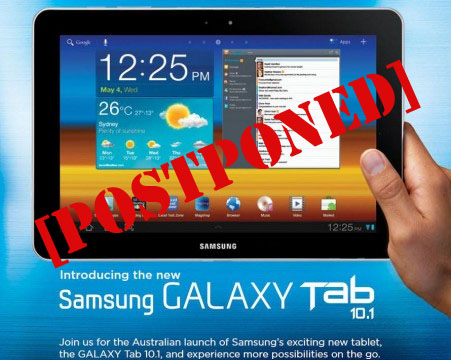
It’s litigation day as Apple and Samsung battle it out in courts the world over. In a two-day hearing which began this morning in Australia a judge asked for more time to study Apple’s claims, resulting in a brief Galaxy Tab 10.1 launch delay until the end of the month. Meanwhile, the first round of hearings is underway in The Hague over Samsung’s accusations that Apple’s iPad and iPhone infringe on Samsung’s wireless patents. The Korean company is seeking a ban on those products in The Netherlands.

Apple is represented by Rutger Kleemans (Freshfields) while Samsung’s legal counsels are headed by Bas Berghuis (Simmons & Simmons). Per information sourced from Webwerld editor Andreas Udo de Haes on Twitter and this Nu.nl report, Apple says Samsung is seeking a 2.4 percent charge of chip price for every patent. Apple has called those demands “simply excessive”. Sounds to us like Apple might have awoken the beast. Apple says because the two parties are still negotiating a licensing agreement of sorts, granting an injunction would be premature.

The Mac maker’s legal sharks stress Apple is buying its components from Intel and Infineon, hence no need for royalties to Samsung. Interestingly, Apple’s lawyers also explicitly stated that iOS devices sold in Europe do not use Qualcomm silicon found in CDMA versions of iPad and iPhone. Apple also said Samsung changed the license to Qualcomm to exclude Apple. In a nutshell, Apple’s argument is that Samsung’s technology and patents are already incorporated in Intel’s chipsets.

Samsung obviously disagrees and argues Apple has more than ten component suppliers and is obscuring them purposefully in order to make determining which components infringe on Samsung’s patents that much harder. Apple launched the iPhone in Holland back in 2008 without securing the necessary licenses, the lawyers for Samsung said. Apple denied Samsung’s claims and said Samsung, its parts supplier, wouldn’t demand a license until 2010 because Apple was an important customer. According to this Guardian article, the Apple account is worth fourth percent of Samsung’s total business…


Expand
Expanding
Close

Samsung’s Galaxy Tab 10.1 to see further delays in Australia: Judge needs time to study Apple’s claims

Site default logo image

Apple in August secured a temporary ban on Samsung’s planned Galaxy Tab 10.1 release in Australia. Today is the first day of a two-day hearing over the matter and Federal Court Justice Annabelle Bennett said she needed more time to dive into Apple’s claims before she ruled on Apple’s request for an injunction.

Bennet observed that “technology moves very quickly”, adding that “it would be in both sides’ interest to have this matter finalized quickly”. The development could further push the launch of the Galaxy Tab 10.1 in the country. Per Bloomberg:

At today’s hearing, Apple focused on one alleged patent infringement, relating to the touch screen technology of the iPads. Samsung had agreed not to fight Apple’s claim that the Galaxy 10.1 uses zoom technology that infringes its patent.

Meanwhile, it’s business as usual for Apple’s fierce competitor from Korea, which counts the Mac maker as its biggest customer. Just as they announced channel shipments of ten million Galaxy S II smartphones worldwide (and expecting to ship as much tablets in 2011), Samsung in Korea took the wraps off the Galaxy S II HD LTE which features a native 720p display and fourth-generation LTE radio technology. Samsung also raised stakes in the legal spat with Apple by threatening to go after the yet unannounced iPhone 5 in both Korea and Europe as soon as Apple put the handset on sale. More importantly, the company has made an important ally in Verizon Wireless in the United States which voiced support for Samsung in the Apple case. Also…

Expand
Expanding
Close

Motorola DROID X2 Android VZW Smartphone, $50 credit for 1 cent + free shipping

Site default logo image

From 9to5toys.com:

With activation of a new line of service, Amazon offers the Motorola DROID X2 Android 3G Smartphone for Verizon Wireless bundled with a $50 Amazon Gift Card for 1 cent with free shipping. Even if you don’t use the credit, that’s still $100 under our June mention and the lowest total price we’ve seen by $50. Features include a 4.3″ 540×960 color touchscreen, virtual QWERTY keyboard with Swype, 8-megapixel camera with dual flash, 720p video capture, HDMI output, microSD slot, WiFi connectivity, Bluetooth, Android 2.2 OS, up to six hours of talk time, and more.

Note that a $36 activation fee applies.
Expand
Expanding
Close

Spotify now available to everyone in the United States, no invitation required

Site default logo image

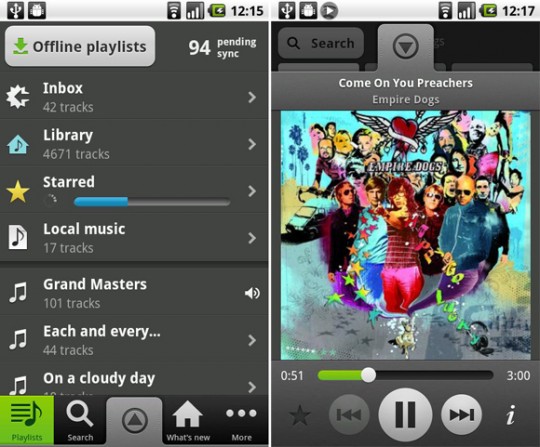
Spotify, a popular music streaming service from Sweden, arrived in the United States mid-July on an invite-only basis. Today, Spotify goes live for everyone nationwide, no invitation required. Users can now sign up for an account at Spotify.com and use a mobile app for Android or iPhone to stream music over wireless and cellular networks to their phones, tag songs for offline viewing, favorite tracks, share them with friends and more. What’s best, you needn’t sign up for a paid Spotify account. Thanks to a new partnership with Facebook that Mark Zuckerberg announced at the yesterday’s developer conference (more in the clip below), anyone signing up with their Facebook account gets six months of unlimited listening. What happens when the six-month free period expires?

[youtube=http://www.youtube.com/watch?v=FjAr5nGzjV8]


Expand
Expanding
Close

Rumor: Barnes & Noble to issue new e-readers and a tablet in October

Site default logo image

The Digital Reader published “some juicy insider info” claiming that Barnes & Noble will be issuing a new Nook Color model next month:

All the unsubstantiated rumors had come out of Asia, so I wasn’t sure that I  should take them seriously. I did, but that was only because B&N have been clearing out the refurbished units at a decent discount. And until today the unsubstantiated rumors were all I had.

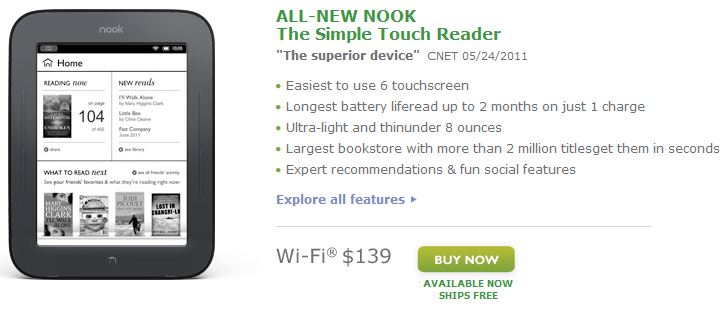
A source told the blog that Barnes & Noble held a meeting last week related to marketing plans for the device. One of the slides allegedly mentions four Barnes & Noble devices next quarter, one of them being a tablet. The four devices are the Smart Touch with a price tag of $139, the Nook Color, the $249 Encore and the $349 Acclaim. The latter two are supposedly tablets, with the Encore likely being a seven-inch model. The blog claims the Acclaim tablet “is the Android tablet that GameStop are currently beta-testing”.


Expand
Expanding
Close

Millennial: Android march unstoppable, News apps on the rise

Site default logo image

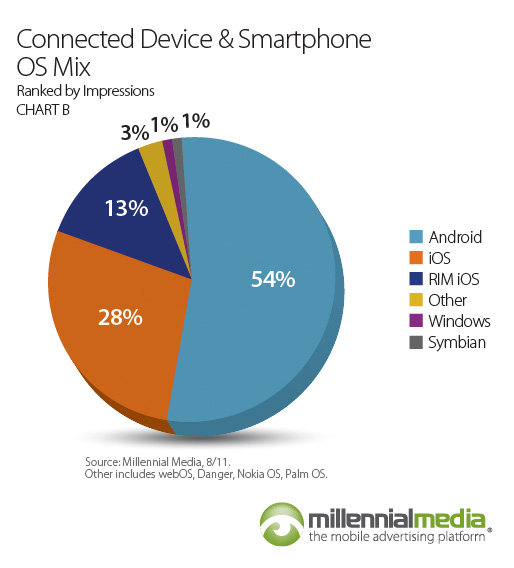
If Google and Apple were to merge, their respective Android and iOS mobile software would seize well over three-quarters of the world’s platform share in smartphones, per latest Millennial Media’s “Mobile Mix” mobile device usage share report. Separately, Android and iOS held 54 percent and 28 percent share in August. Millennial now includes data from smartphones, tablets, e-readers and gaming devices so direct comparison to their smartphone-focused July study is meaningless.

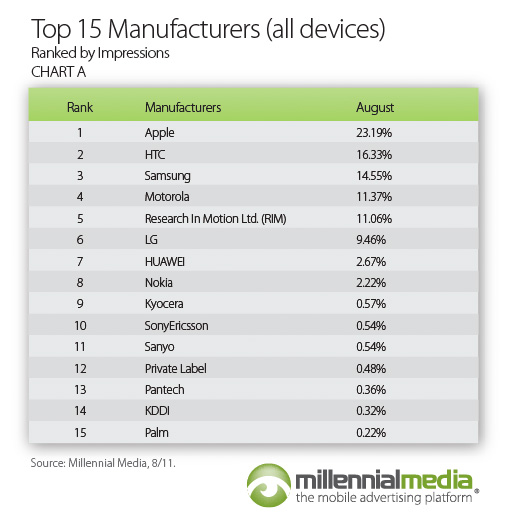
Apple continued to be the leading device manufacturer on our network in August, representing 23% of the Top 15 Manufacturers impression share (Chart A). Apple iPhone maintained the number one position on the Top 20 Mobile Phones ranking with 13% of the impression share.

Nearly one-third of devices on all carriers used wireless hot spots. Verizon Wireless and Sprint had 18 and 14 percent carrier mix, respectively, followed by T-Mobile USA and AT&T with eight percent each. Games, music and entertainment remain the most popular app categories. iOS represented 41 percent of the app platform mix and Android 49 percent. On Android, News apps rose by 26 percent month-over-month. Go past the fold for a bunch of pretty charts and more explanation.


Expand
Expanding
Close

Google to become a Mobile Virtual Network Operator in Spain, rest of Europe coming soon?

Site default logo image

..

Update: The original source of the images is now saying these are fake.

What you see above is every telecom exec’s nightmare.  Google is stepping up the mobile phone value chain once again and making its own SIMs.  But it isn’t as drastic as it may seem.

Google Employees in Spain are getting a surprise SIM card with their Nexus S phones these days.  What you see above and below is Google’s own SIM card which allows the ‘sorta search monopolist’ to become a MVNO in Spain.  While Google doesn’t own its own towers or infrastructure (it buys bulk data from the local telecoms – in this case Telefonica, Vodafone, etc.), the move allows Google to control more of the phone experience.  For instance, it can pay one price for bulk data rather than on a per phone basis.  It can also dictate which carriers the phones pull in data from based on quality of service or price.  Roaming internationally can also be controlled and owned as well.

We’ve heard Spain is first but more European locals will start seeing these soon.  MVNOs have gone the way of the Dodo in the US with Sprint buying Virgin and Boost and others departing the market.  Perhaps if these do well for employees in Spain, Google will consider bringing back the MVNO to the US for not only its employees, but also Android customers.

Will the telecoms continue to allow Google to climb up the value-chain like this unabated?  via Spanish forums. More images below, including a picture of a phone on the “Google_Es” Network:


Expand
Expanding
Close

Survey: Android folks more comfortable switching handsets, one in three eyeing the iPhone

Site default logo image

Apple’s embattled iPhone has had tough time competing against the legions of Android handsets that have flooded the market. That shouldn’t come as a surprise: Carriers are promoting inexpensive Android devices left and right and they are literally everywhere. But how satisfied Android and iPhone users are with their handsets? According to a study of 515 smartphone owners conducted by USB Research (via GigaOM), iPhone is “sticky” like no other phone, with an average retention rate of 89 percent.

It is falling rapidly for other vendors, though, and the next nearest hardware is HTC with a retention rate of 39 percent and 28 percent for Samsung. Android phones in general are at 55 percent. Nokia and Research in Motion are sinking really fast. The former saw its retention rate drop from 42 percent in March 2010 to just 24 percent and the latter dropped from 62 percent to 33 percent.

The survey may not be terribly accurate due to a small sample size, but it helps understand market trends. People are obviously happy with their iPhones and a large portion of users will happily stay within the Apple ecosystem. USB concludes:

Demand for iPhone, iPad and MacBook Pro remains robust, with a leading ecosystem that creates sticky demand.

Truth be told, Android’s low stickiness could be due to its users being more comfortable changing handset manufacturers. Another interesting nugget that bodes well for Apple: Nearly one-third (31 percent) of polled Android users have plans to switch to an iOS device in the future. Also important, more than half the smartphone switchers are in the market for an iPhone while only one in ten iPhone users plan on defecting to other platforms.

Cross-posted on 9to5Mac.com.

YouTube lifts upload limit for verified users, adds 2D-to-3D conversion, clever video effects

Site default logo image

The New York Times reports that Google moved uncharacteristically fast integrating the video editing service Magisto into YouTube, just a day following a $5.5 million in second-round funding. “Magisto takes your unedited video and automatically edits it into short, fun clips”, Google says. Vlix, which lets you add video and text effects to your clips, is also part of the YouTube offering now. Both are available at youtube.com/create.

Google also announced over at the YouTube blog new features. You can now convert plain 2D footage into 3D even if it isn’t filmed with two cameras. Just select “Edit Info” and choose “3D Video” at the end of the uploading process . The conversion won’t result in the same perception of the third dimension as working with two cameras, of course. Also, the current upload limit of fifteen minute has been lifted for verified users:

We’re improving upon our previous launch by enabling long uploads for users with a clean track record who complete an account verification and continue to follow the copyright rules set forth in our Community Guidelines.

In order to verify your account with YouTube, you will need to visit this link and give Google your phone number.


Expand
Expanding
Close