Chromebooks

HP Chromebook 11
Since its release, Google has touted that Chrome OS is incredibly secure and can be used for any type of use case. In a blog post on the Chromium Blog, the company announced today that it is offering a total of $2.71 million USD to anyone that exploit Chrome OS. In order to compete for a portion of that pot, developers have travel to the CanSecWest security conference in Vancouver, which takes place in March.
The criteria for this Pwnium contest, which Google has been holding for years, is pretty specific. Developers and hackers won’t get money for exploiting any portion of the operating system. Instead, Google has guidelines for how much they will be paid, depending on how deep the exploit is.
Google will also consider cash bonuses for demonstrating a particularly impressive or surprising exploit. Hackers will be able to choose between the Haswell-based Acer C720 and the ARM-based HP Chromebook 11.
If this sounds like something you want to try, Google requires that interested parties register ahead of the even by emailing security@chromium.org. Registration will close at 5:00 P.M PST on March 10th.

Update: Best Buy is already listing the new model online for $379 (via Liliputing).
Reuters is reporting a claim by Israel’s Altair Semiconductor that HP will be launching a LTE-only Chromebook 11, with connectivity provided by the company’s chips.
“Our solution equips the Chromebook with a dependable and incredibly fast Internet connection,” said Eran Eshed, vice president of marketing and business development at Altair. “By focusing on 100 percent LTE and eliminating costly 3G components, we were able to help our partners lower the cost of this critical LTE connectivity feature” …
Google’s high end Chromebook Pixel is also LTE-only but the move for a more bargain-centric product has some folks scratching their heads….
Expand
Expanding
Close

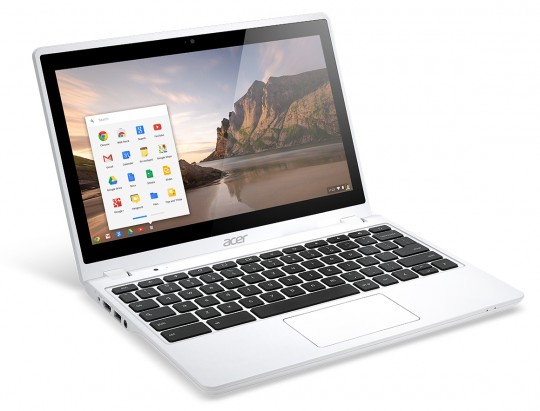
In addition to its new low cost tablets and Android-powered All-in-one computers, Acer announced a new color option to its Chromebook lineup ahead of CES next week.
The Acer C720P that debuted last November will soon be available in Moonstone White and debut next week at CES. The Acer C720P retails at $299 and features 32GB of storage, 2GB of RAM, and an HD touch screen at 1366×768 resolution. Like the existing models, the C720P features USB 2/3 ports as well as HDMI for display-output and runs Chrome OS.

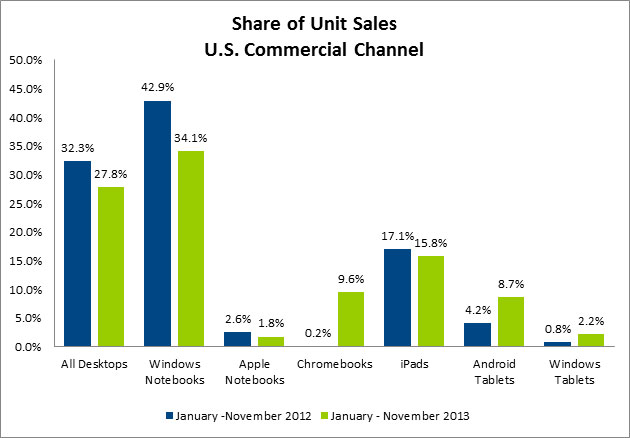
Editor’s note: As noted in the graph above, the numbers in this article refer only to the commercial channel, as NPD does not measure direct sales. Some of the language below has been updated to clarify this point.
A new release from the NPD Group indicates that notebooks running Google’s Chrome OS have gained significant ground in the past year. According to the statistics, over one-fifth of all laptops sold in 2013 were running the free software. Of course, it should be noted that the numbers presented don’t take built-to-order machines or direct sales into account, instead relying on sales of pre-configured options, but even so, this impressive figure is still very good news for Google.
In fact, when considering all computer sales, including desktop and notebook form factors, Chromebooks have still gained a pretty sizeable chunk of the market. Last year Chromebooks took home a measly 0.2%. This year, however, the number comes in closer to one-tenth of the market at 9.6%.
While that may not seem like much next to the 34.1% of all computer sales held by Windows-powered notebooks, it’s over five times better than Apple’s sales for its entire MacBook lineup combined. It now seems that Google—not Apple—is in the best position to someday knock Microsoft from the top of the notebook computer market.


Amazon has never been a company to provide specific sales numbers, but their just-issued press release shows us that Android, Kindle and Chromebooks dominated their holiday shopping season. Surprisingly, or perhaps not surprising at all is the Chromecast, which is the best seller in the Computers and Accessories category outselling the company’s own Kindle Fire lineup as well as Apple TV and the Roku 3 Streaming Media player.

Oh the weather outside may still be frightful, but inside the morning after Christmas is definitely delightful. Now that Christmas music is put back onto the shelf for next year, what Android, Chrome, Google-related goodies did you get for your holidays?
 Google’s Chrome browser and Chrome OS had another banner year in 2013 and with the Chromebook continuing to grow in popularity, 2014 looks to be even better. There’s little question that along with the growth of the Chromebook, Chrome as a web-browser continues to delight users the world over. With a bevy of new features and improvements in 2013, Google has its work cut out to improve on it next year. So without further delay, let’s take a look at the year’s top Chrome and Chrome OS stories of 2013 as determined by the number of pageviews each story incurred:

Following the decision to stop sales of the HP Chromebook 11 pending an investigation into overheating chargers, today the US Consumer Product Safety Commission reports Google and HP will indeed recall the netbook’s charger. Google says it received nine reports in total of overheating chargers and melting with some cases resulting in injuries and property damage:
Google has received nine reports of chargers overheating and melting during use. There is one report of a small burn to a consumer and one report of minor property damage to a pillow from an overheating charger… This recall involves chargers that were sold with the HP Chromebook 11. The charger is black with outlet pins, measures 1¾ inches by ¾ inches, and has a 6-foot long cord with a micro-USB connector on the end. The model number of the charger is MU15-N1052-A00S, which is stamped on the face of the battery charger that has the outlet pins.
The US Consumer Product Safety Commission’s report claims the recall will include around 145,000 units and that users can contact Google to get a free replacement. Google is yet to resume sales of the device on Google Play or through its retail partners, but its website says to “please check back soon.” More info on how to contact Google below.
Expand
Expanding
Close
Microsoft’s renewed nervousness about Chromebooks was likely influenced by advance knowledge of Dell’s announcement that it would be joining Acer, HP and Samsung in manufacturing the ultraportable laptops in January.
The machine will have a Celeron 2955U processor, a choice of 2GB or 4GB RAM and 16GB of flash storage. The screen will be an 11-inch 1366×768 display with 720p front-facing webcam. You’ll get two USB 3 sockets plus HDMI in a case less than an inch thick and weighing under three pounds. Battery-life is said to be around 10 hours …
Expand
Expanding
Close
[youtube=http://www.youtube.com/watch?v=_wAgB5J1gSQ&w=600&h=420]
Imagine my shock and surprise as yet another anti-Chromebook advertisement hits the YouTubes courtesy of Microsoft. The latest in the company’s anti-everything-Google campaign attacks the notion that a Chromebook has “everything you need” as a laptop.
Last month, Acer announced a new Chromebook for the holiday season in the touchscreen-capable C720P, but without any real availability information. Today, however, Google announced that the C720P will begin to hit store shelves in the U.S. and other countries this week. The laptop is also available on Amazon now, whereas it was previously listed as being up for pre-order. Amazon still notes that the Chromebook will not ship until mid-December and that “availability will be limited”. Customers who pre-ordered the laptop on Amazon are now being charged, though, which means that their orders should begin to ship anytime now.
As part of this immersive, tactile world, Acer has announced the new Acer C720P Chromebook with a multi-touch screen, adding the second touch-enabled Chromebook to the lineup. Acer’s Chromebooks are consistent best-sellers on Amazon, and this new device will help more users experience the best of the tactile web for just $299.
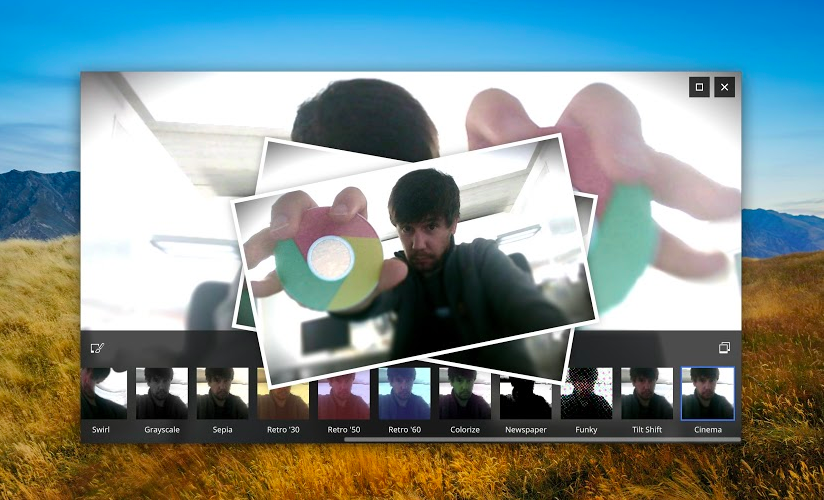
Chrome OS users take note, a brand new camera app is on its way offering a host of new features. The announcement came via Google’s “Happiness Evangelist” Francois Beaufort who suggested that while the current Chrome OS camera is good, the team can do better.

I hope everyone had a great Thanksgiving holiday and now that we’re all sporting an extra loop on our belts, it’s time to get down to the madness of Black Friday. There’s plenty of deals to be had in the Android world especially with smartphones, tablets and even a Chromebook thrown in for good measure. There’s no time to waste today so let’s get right down to it:
Acer has just announced its new C720P Chromebook, a touchscreen variant of the C720 model that it introduced earlier this month. The C720P will be available in early December from Amazon, Best Buy, and the Acer Store for $299.99.
This is Acer’s first touchscreen Chromebook and is capable of all the normal multi-touch features, such as pinch-to-zoom. As far as specs go, the device is packing an 11.6-inch LED “ComfyView” display with a 1366 x 768 resolution. Acer touts that the device will give up to 7 and a half hours of battery life and boot upon just 7 seconds, thanks in large part to the 32GB SSD. Powering the laptop is an Intel Celeron 2955U, which is based off of the Haswell architecture, as well as 2GB of DDR3 RAM. As you would expect, it supports 802.11a/b/g/n wifi as well.
Along the sides of the laptop, you’ll find USB 2.0 and USB 3.0 ports and an HDMI connection. The laptop weighs in at 2.98 pounds and is just .78 inches thick.
Finally, Google is offering 100GB of free cloud storage with Google Drive for 2 years and 12 free Gogo wifi passes to anyone who purchases the C720P.
At $299.99, the C720P is a very compelling option for users who want a touchscreen Chromebook and don’t want to shell out the money for a Pixel. I could very well see this being one of the most popular gifts this holiday season.
https://www.youtube.com/watch?v=aJdpRJ873r8
It might not be as interesting as Google’s floating barge project that will see the company bring interactive technology showrooms to cities in the US, but Google has just opened a number of temporary retail locations leading into the holidays.
The pop-up locations are dubbed Google Winter Wonderlabs and Google’s new site describing the retail experience lists locations for New York City, Washington DC, Chicago, Los Angeles, New Jersey, and Sacramento.
Google is using the stores to let customers try out and purchase the Nexus 7, Chromebooks, and Chromecast (no mention of Google Glass), but it also has a “Snow globe” room that lets people create slo-mo videos with animated snow fall and “Play Zones” with various product demos set up.
Expand
Expanding
Close
Acer today announced the launch of a new Chromebook, although those familiar with the company’s current C7 Chromebook will already be familiar with the new model. Apart from a drop from 4GB of RAM to 2GB, the only difference between the old C7 Chromebook and the new Chromebook C720-2848 is the price. Dropping down from 2GB of RAM also brings the price down to $199, down from the $249 Acer charges for the old 4GB model.
Otherwise specs remain the same: an 11.6-nich 1366 x 768 display, dual-core Intel® Celeron® processor, 16GB SDD, and three USB ports. The old model is still for sale, but now Acer officially has one of the most affordable Chromebooks on the market with its new $199 option. It’s already available on BestBuy and should hit other outlets shortly.
Expand
Expanding
Close
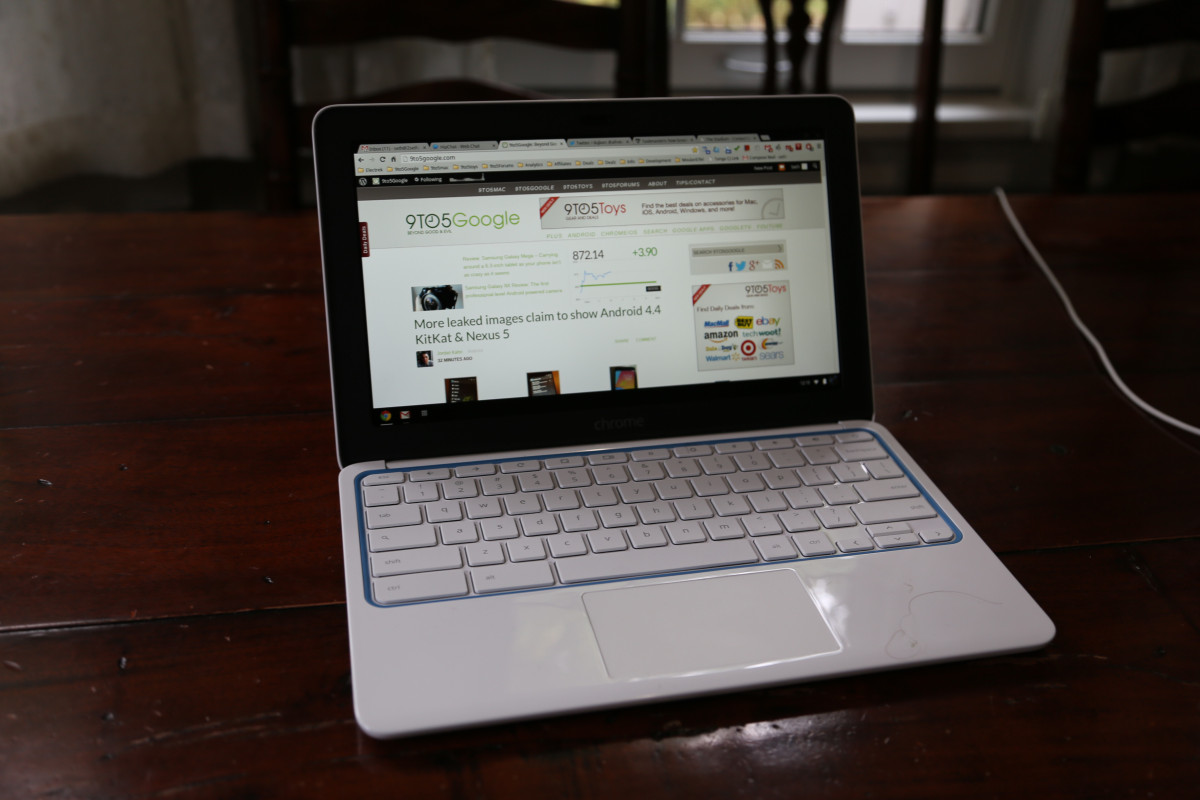
Update: HP has attributed the stopped sales of the Chromebook 11 to overheating chargers and has provided a brief statement on the matter available at the end of the post.
Whoa, some big news on the Chromebook front this morning as Best Buy has halted all sales of the HP Chromebook 11. According to The Verge, Best Buy retail stores are receiving internal memos alerting managers to “Stop selling the HP Chromebook 11 effective immediately…partner with sales support to pull the product off the sales floor to a secure location in the warehouse.”

HP and Google combined to create two new Chromebooks which were launched early last month: The $299 Intel Haswell-powered Chromebook 14 and the smaller Samsung Exynos ARM-powered Chromebook 11. Both machines mark new territory for Google and HP. The Silicon Valley neighbors have been getting closer and closer since Meg Whitman took over as CEO, including an expanding array of Android tablets as well. The initial HP Chromebooks were clearly re-purposed Windows laptops. These clearly are something entirely different…
Expand
Expanding
Close
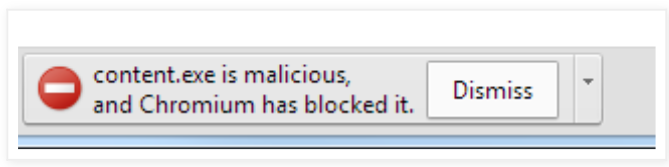
Google has added automatic blocking of malware from the latest ‘Canary‘ build of its Chrome browser.
Bad guys trick you into installing and running this kind of software by bundling it with something you might want, like a free screensaver, a video plugin or—ironically—a supposed security update. These malicious programs disguise themselves so you won’t know they’re there and they may change your homepage or inject ads into the sites you browse […]
In the current Canary build of Chrome, we’ll automatically block downloads of malware that we detect.
Confusingly, Google has four versions of its Chrome browser available at any one time: the official, public release; a developer version; a beta version, for those who want early access to new features; and Canary. Canary is essentially a beta version that installs as a second browser, so you can use that most of the time and fall back to the official version if something doesn’t work.
While not all Canary features make it into the official build, this one seems likely to – and would make Chrome the ideal browser to recommend to any of your less-techy family and friends who cheerfully download anything and everything, usually identifiable by the fact that the top half of their browser window comprises half a dozen different toolbars …
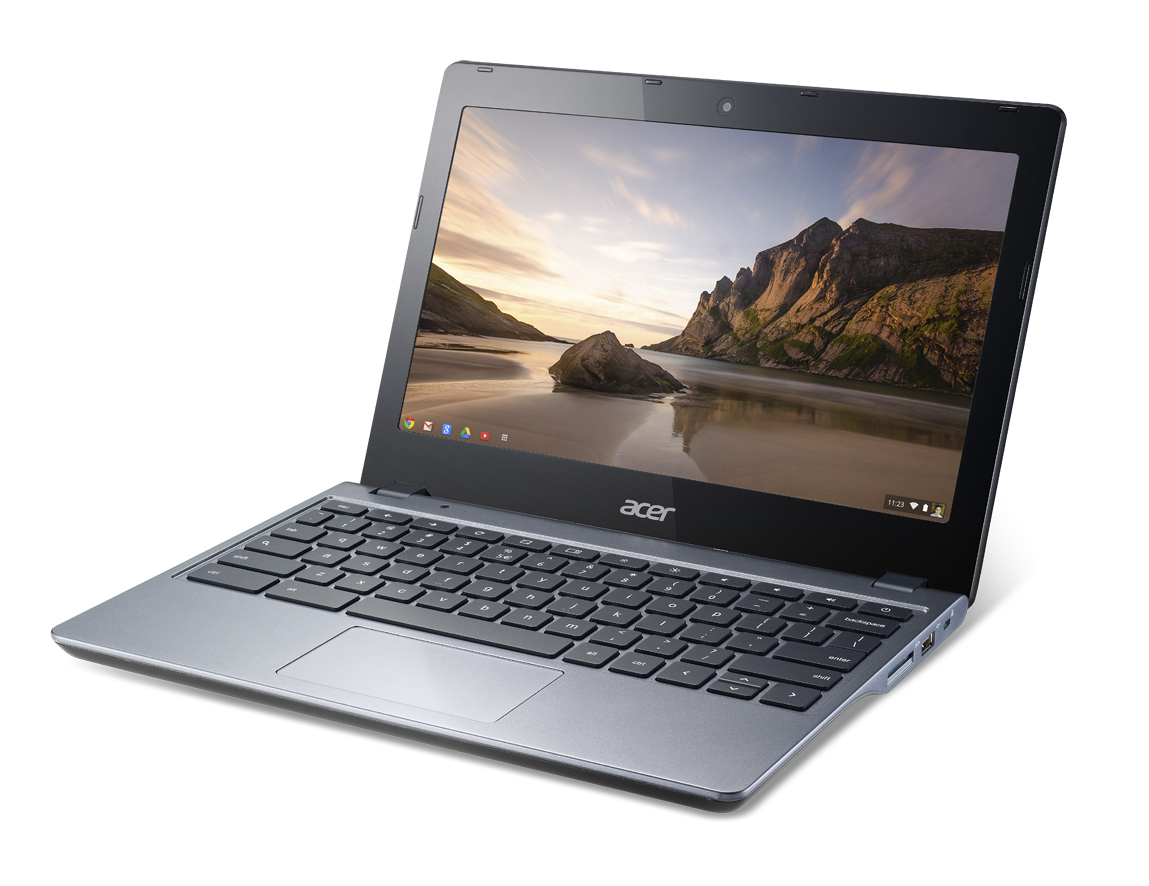
Just a day after Google announced a new HP-made ARM-powered Chromebook for $279, Acer has upped the ante with a Haswell-powered one for $249.
The Acer C720 offers the same 1366×768 resolution screen as the HP. The Acer screen is anti-glare, which offers easier viewing when used outside at the expense of slightly poorer contrast. The machine has 4GB RAM against the 2GB of the HP, and the Haswell processor gives it a claimed 8.5 hours battery life, against 6 hours for the HP …
Expand
Expanding
Close

At Intel’s Developer Forum today, Google and Intel announced three new Chrome OS devices running on the latest Haswell processors. On the Google Chrome blog, Google says the new processors “sip less power to improve battery life by more than 2X over previous generations, while offering increased performance.”
Sadly, no prices or dates were announced for these devices, but these will probably be hitting the shelves shortly to join the touch-screen Pixel.
Chrome has offered ‘Apps’ – bookmarks to web pages – to Mac and PC users for a long time. There is even a Chrome App store that gets little fanfare. But today Chrome is getting serious about desktop apps. In a post on the company’s blog, Google says that improved access to the computer, including USB/Bluetooth, full screen mode, desktop notifications, less ‘chrome’ (Tabs, bookmarks, browser bar, etc) and power off features will make the Chrome apps act more like real apps. So real, in fact, that most people won’t be able to tell the difference.
Today we’re unveiling a new kind of Chrome App, which brings together the speed, security and flexibility of the modern web with the powerful functionality previously only available with software installed on your devices. (Think apps designed for your desktop or laptop, just like the ones for your phone and tablet.) These apps are more powerful than before, and can help you get work done, play games in full-screen and create cool content all from the web. If you’re using Windows or a Chromebook, you can check them out in the “For your desktop” collection in the Chrome Web Store (Mac & Linux coming soon).
Here’s what you can expect with new Chrome Apps:
Expand
Expanding
Close
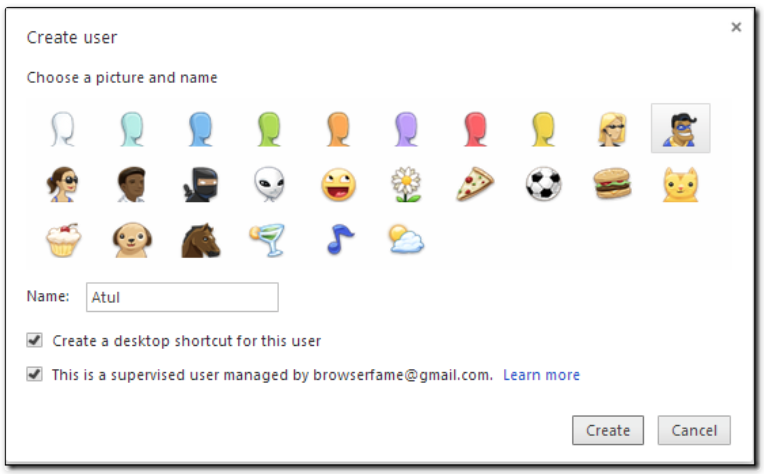
BrowserFame spotted a feature in the Canary (development) version of Chrome that would allow parents and schools to created ‘supervised user’ accounts whose access to the web can be controlled by a master account.
The approach is an extension of the standard accounts available in Chrome, allowing different users to have different settings and to be automatically signed-in to Google services …
Expand
Expanding
Close
The sub-$250 Chromebooks were a huge hit for both Samsung and Acer last year, and according to a new report out of DigiTimes, ASUS is also planning to enter the growing Chrome OS market. The site claims that ASUS is planning to make a foray into the Chromebook market as soon as the fourth quarter of this year. After experiencing low-demand for the back-to-school season, the company is looking to boost its shipment numbers, notably to education customers. ASUS recently reduced its notebook shipment predictions for 2013 from 22-24 million units to 17-19 million units.
With its entry in the Chromebook business, Asustek is hoping to gain orders from the education industry. Although order volumes are likely to be limited, they will still help the company.