Stay up to date on news from Google headquarters. Be the first to learn about plans for Android, Google Plus, Google Apps, and more!
Stay up to date on news from Google headquarters. Be the first to learn about plans for Android, Google Plus, Google Apps, and more!

Google has a dominant presence at the Mobile World Congress (MWC) show now underway in Barcelona, Spain from Feb. 27 through March 1. The company’s Andy Rubin, senior vice president of mobile and digital content, shared a few updates related to the Android ecosystem, and he revealed in a blog post that 850,000 Android devices are now activated each day with the total number of Android devices around the world past 300 million.
The number of apps available in Android Market tripled from 150,000 at the last year’s show to 450,000 items today. Moreover, the Market is now recognizing over a billion downloads each month. All told, about 800 different Android devices launched to date and the company is highlighting more than a hundred new ones at its huge stand at MWC…

[youtube=http://www.youtube.com/watch?v=ODy4Z2Lp_jE]
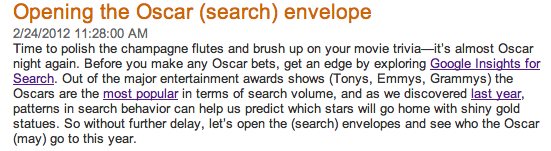
Google Insights for Search is a handy tool that helped the Mountain View, Calif.-based search engine predict last year’s Oscar winners by tracking search pattern behaviors, and the Internet giant has decided to test its service again with this year’s red carpet lineup.
The Academy Awards is the most popular entertainment award show in terms of search volume. The convolute of searches subsequently create a prime foundation for Googlers to analyze patterns. Google’s Rebecca Mall, an entertainment account executive, took to the Official Google Blog today to “open the (search) envelopes and see who the Oscar (may) go to this year,” according to Google Insight’s reaped Web information.
More information is available below.
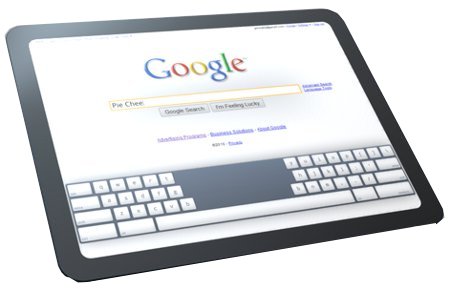
Google plans to enter the tablet market in April with a self-branded 7-inch slate.
CNET’s Brooke Crothers said Display Search analyst Richard Shim expects 1.5 million to 2 million units with a 1280-by-800-resolution display to enter initial production this spring.
The rumor mill also indicates the Google-branded tablet will run Android 4.0 Ice Cream Sandwich operating system, and it apparently also has Nexus ties. The device will see a $199 price tag to compete with Amazon’s Kindle Fire that has a 1024-by-600 display…
[youtube=http://youtu.be/cOZU7BOeQ58]
Google announced today that it is adding Google+ Circles to Google Voice.
Software Engineer Tom Ford took to the official Google Voice blog to tell users how Circles give callers more control with organizing and managing in Google Voice:
Circles give you more control over how you manage your callers; for example, calls from your “Creepers” circle can be sent straight to Voicemail, only your “College Buddies” circle will hear you rap your voicemail greeting, or you can set your “Family” circle to only ring your mobile phone.
As Ford mentioned, go to the Groups & Circles tab in Google Voice settings to customize Circles.
More information is available below.

Microsoft requested European Union antitrust regulators to probe Motorola Mobility on claims that the United States phone manufacturer is blocking sales of Windows and Xbox products.
“Earlier today, Microsoft filed a formal competition law complaint with the European Commission (EC) against Motorola Mobility and Google,” wrote Microsoft’s Vice President and Deputy General Counsel David Heiner in a blog post this morning. “We have taken this step because Motorola is attempting to block sales of Windows PCs, our Xbox game console and other products.”
Microsoft’s post, “Google: Please Don’t Kill Video on the Web,” lambasted Motorola Mobility for not making industry standard patents available on reasonable and fair terms, and for using those patents to block competitors from shipping products.

The industry apparently agreed many years ago to define common technical standards for everyone to use and build compatible Wi-Fi and video products. However, Heiner contended, Motorola is backtracking on its word and attempting to use standard patents for “killing video on the Web.”
More information is available below.
Detailed street-level imagery of landmark spots in Russian cities of Moscow and St. Petersburg is now available in Google Maps, Google’s Russia Product Manager Boris Khvostichenko announced in a blog post yesterday. Among other places, mapping aficionados can now tour Red Square, Moscow Kremlin, great palaces and parks, such as Tsaritsino, Peterhof, Kuskovo, the Oranienbaum, Alexandria, plus The Peter and Paul Fortress and the entire historical center of St. Petersburg (a UNESCO Heritage Site). St. Petersburg is Russia’s former capitol—now the country’s second largest city and northernmost megapolis. As for Google Earth enhancements…
A new URL on the drive.google.com subdomain is another sign that Google’s rumored GDrive cloud storage is coming soon. Available at beta.drive.google.com, it redirects to the Google Accounts login website. Upon providing my credentials, the page was stuck in an endless redirect loop. Something clearly is cooking in Google’s kitchen, though the product is not ready for prime time. Google Drive, or GDrive, leaked many times in past months, revealing its logo and interface. Judging by Google Docs code hooks, GDrive is likely to become at least an integral part of Google’s cloud-based productivity suite if not a full-blown cloud storage service shared across all Google services.
While it is already possible to buy more storage from Google, it is shared only across Gmail, Google Docs, and Picasa Web Albums. The Wall Street Journal reported earlier this month that Google would launch Google Drive “in the coming weeks or months.” The idea of a unified Google storage for consumers’ dates back to 2007, and later leaks suggested the product is anything but vaporware. With Microsoft’s SkyDrive cloud storage service now being revamped, GDrive is likely around the corner.
Google’s Chrome browser has long released with a built-in Flash Player plug-in—the result of a technology partnership between the Internet giant and Flash maker Adobe. Though Adobe still allows customers to download a standalone Flash Player plug-in for Windows, OS X or Linux, the company announced today that the Flash Player plug-in for Linux after version 11.2 would only be available with Chrome browser distribution. The Linux plug-in will no longer be available as a direct download from Adobe. While one could suspect this news foreshadows broader policy changes on Windows and OS X, Adobe insisted that is not the case.
Flash Player will continue to support browsers using non-”Pepper” plugin APIs on platforms other than Linux.
Additionally, it will continue supporting Flash Player 11.2 on Linux for years to come. “Adobe will continue to provide security updates to non-Pepper distributions of Flash Player 11.2 on Linux for five years from its release,” wrote the company in a blog post…

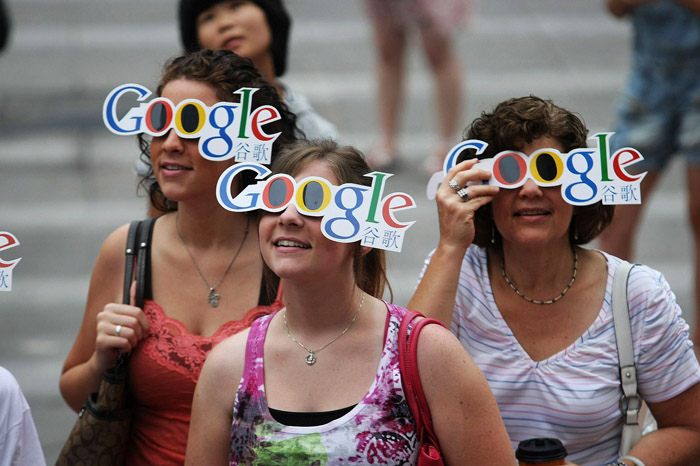
In what seems to confirm our earlier reports, (here and here), The New York Times’ Nick Bilton offered more information today on the Heads Up Display Glasses that Google is building. Some of the new bullet points are as follows:
On a personal note, I think this will be the most exciting technology product release this year.
[youtube=http://www.youtube.com/watch?v=Z07MnBf9QNY]
Fluent is a web-based workflow stream that works with existing Gmail accounts to bring a Sparrow-like user interface to email.

Users can stream email threads and replies, preview aggregated attachments in a tab, quickly reply or compose inline, archive messages, and even add a to-do list with the new design concept that claims to run on any web browser.
Sparrow is a great success as a Mac-only application, and now Fluent hopes to balance the playing field and snag users whom are in dire need of a new Gmail look and functionality. Fluent’s website specifically praises its workflow ability, multiple accounts options, and “blazing” fast search-as-you-type filter.
The streaming email UI is the work of three former Googlers who quit the Mountain View, Calif.-based Company. BusinessInsider said Cameron Adams, Dhanji Prasanna, and Jochen Bekmann left because designers were “less valuable” than engineers at Google, and they felt disconnected from Google’s culture while operating from across the world in Sydney, Australia…
A new comScore research study revealed that United States viewership in January 2012 suffered a slight decline from December 2012, also proving Google was right to invest hundreds of millions of dollars into getting premium partners for content on YouTube. Last month, 181 million online users in the U.S. consumed nearly 40 billion online videos, which is a drop from 43.5 billion clips watched by 182 million users in December 2011. On average, we watched 22.6 hours of online clips with a 6.1-minute duration for each clip.
The search and Internet giant continues to lead the online video market with 152 million unique viewers. Google-operated websites cumulatively account for a whopping 18.6 billion views. Rival Hulu and VEVO delivered 877 and 717 million views, respectively.. In addition to Google websites, VEVO (51.5 million), Yahoo websites (49.2 million), Viacom Digital (48.1 million) and Facebook (45.1 million) round-up the top five online video destinations in the country.
Be advised that comScore defines a video as any streamed segment of audiovisual content for both progressive downloads and live streams. For long-form, segmented content, such as television episodes with ad pods in the middle, each segment of the content is counted as a distinct video stream…
Google is on a roll these days in regards to interesting patent filings. The company filed a patent for Android’s pattern unlock feature in November, and a new filing suggests more unlocking methods with one involving voice recognition and the other based on a two-icon methodology. Today, Patently Apple pointed to another document the search company filed with the United States Patent & Trademark Office (USPTO) on Sept. 29, 2011.
Being made public only recently, it describes methods and apparatus for a Google TV remote that lets you search for televisions shows, movies, music and other media simply by asking. This sounds a lot like Apple’s Siri voice assistant the rumor-mill speculates could enhance an alleged Apple-branded HD TV set.
The difference, per the publication:
Apple has had a similar feature under Remote for several years now, but it doesn’t relate to live TV as Google’s will. Google’s real competitor on this particular front will come from Samsung who just announced their latest TV remote with voice controls and a touch pad. The race to bring the best next generation TV Remote to market is officially on.
One embodiment of the invention describes a situation where a user searches for the popular sitcom “Seinfeld” simply by asking their Android phone, “When is Seinfeld on?” The phone would parse and send the query up to the Google cloud, beaming down the results to your Google TV set-top box.
GPS positioning could enhance the scope of the invention in interesting ways:


Google’s Chairman and former CEO Eric Schmidt plans to sell $1.5 billion in Google stock that he owns, according to a filing with the SEC. Schmidt’s stake in Google is currently 2.8-percent. The prearranged sale of 2.4 million shares of Class A stock will lower his share to 2.1-percent. Google closed at $604.64 per share on Friday. WSJ reported:
Google Inc. Executive Chairman Eric Schmidt is selling stock currently worth about $1.45 billion as part of a trading plan that would cut his ownership stake in the Internet giant to about 2.1% from 2.8%.
As of the end of last year, Schmidt owned 2.8-percent of Google, which equivalates to 9.1 million shares of Class A and Class B stock. At the end of the sale, Schmidt will own 6.7 million shares of stock— or 2.1-percent of Google.
Internet giant Google found itself in a middle of a potential public relations nightmare following a Wall Street Journal article this morning. Tentatively titled “Google’s iPhone Tracking,” the article asserts that “Google Inc. and other advertising companies have been bypassing the privacy settings of millions of people using Apple Inc.’s Web browser on their iPhones and computers” to follow iPhone users even after they explicitly set Safari’s privacy controls to disable such tracking. According to authors Julia Angwin and Jennifer Valentino-Devries, Google used “special computer code that tricks Apple’s Safari Web-browsing software into letting them monitor many users.” Google apparently disabled the problematic code after the newspaper contacted the Mountain View, Calif.-based Company.
Stanford researcher Jonathan Mayer discovered that although mobile Safari’s default setting blocks cookies from third parties and advertisers, Google and advertising companies Media Innovation Group, Vibrant Media, and Gannett PointRoll fooled mobile Safari into thinking “a person was submitting an invisible form to Google,” letting them in turn install a tracking cookie on users’ iPhones and PCs without consent.
Once a cookie installed, a Safari glitch allowed subsequent cookies to attach. Both Google and Apple issued statements following this morning’s report…
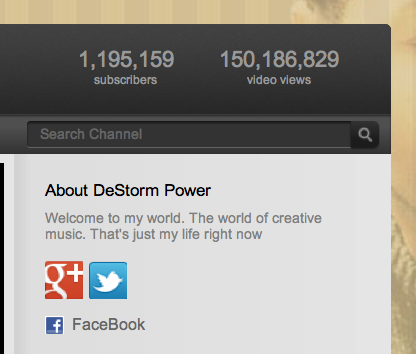
The YouTube team announced a few updates to YouTube Channels on its YouTube Blog today. The major addition to Channels include the ability to promote your Google+ profile (as seen to the right). Viewers can now click on Google+ Profiles from YouTube, signifying Google is continuing its push to integrate Google+ across services.
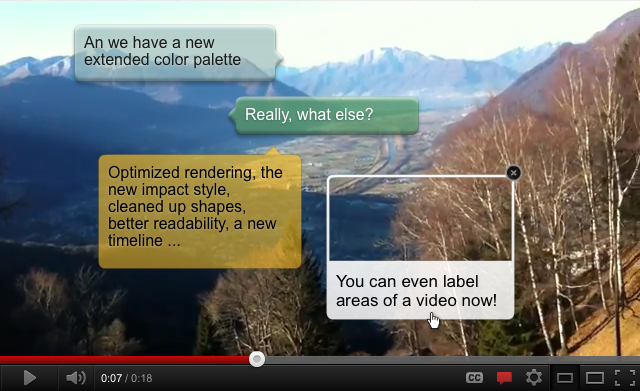
The second addition is that users can posts videos onto their Channel’s Feed by posting a Channel Bulletin. This can be done from the “Post to Feed” box under the feed tab on your own channel. You can also a comment under the video. Lastly, the YouTube team implemented new annotations to add on your own videos, as seen below.
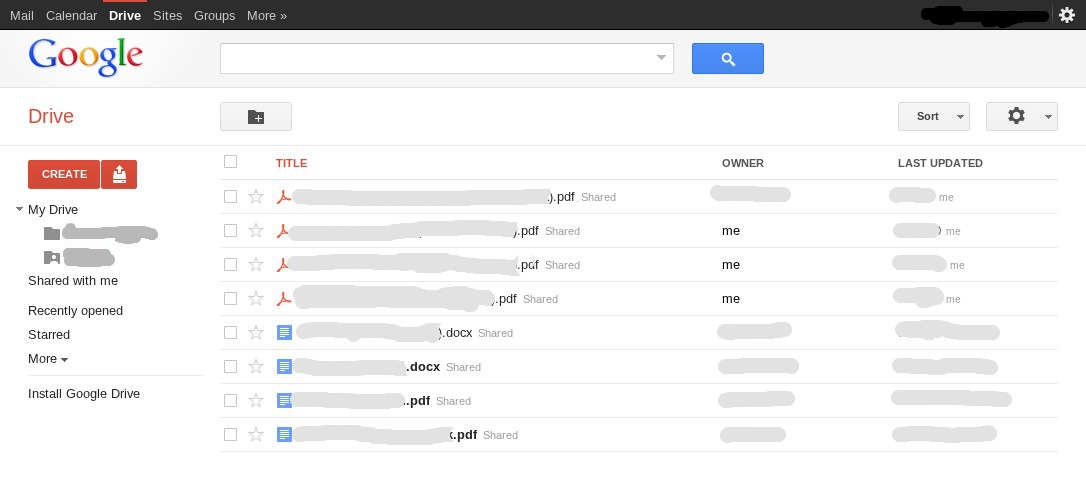
Google Drive was rumored to launch for sometime now and looks to be coming even closer. Geek Wire reportedly obtained a screenshot of Drive from one of its readers. As you can see, Google Drive looks very similar to Google Docs, which can also upload any type of file. Below, Geek Wire enlarged the Google Drive favicon, perhaps exposing the service’s logo.
Along with a web based interface, Google Drive is also rumored to have a desktop application very similar to Dropbox, where users can push files to the cloud for access anywhere. There will also be deep Google Drive integration available on Android, several reports said.
Last week, WSJ reported Google Drive would launch in the coming weeks or months. Google Drive will be available for free, but premium versions will also be available for those who want more space.
Google Drive was already referenced to in Google Docs code. Maybe Google Drive will also be integrated somehow into Google Docs at some point. Expect to see Google Drive in the coming weeks.

Just as you are getting content with Google’s latest Android offering Android 4.0 Ice Cream Sandwich, there are more rumors tonight on Google’s next version of Android. The sometimes-accurate Digitimes reported that Google might launch Android 5.0 Jelly Bean this summer.
This new version of Android will reportedly have a focus on tablet PCs, but hopefully not like the tablet exclusive Honeycomb. Ice Cream Sandwich hoped to pick up on Honeycomb’s mistakes by unifying both the handset and tablet platforms.
Digitimes said Android 5.0 would have a unique feature, because it will have a dual operating system approach. It will reportedly be able to boot into both Android and Chrome without having to shutdown. Perhaps Chrome will be part of the experience like it did with the launch of the browser as an app.
We will most likely hear more at Google I/O in June where Google does many of its big announcements.
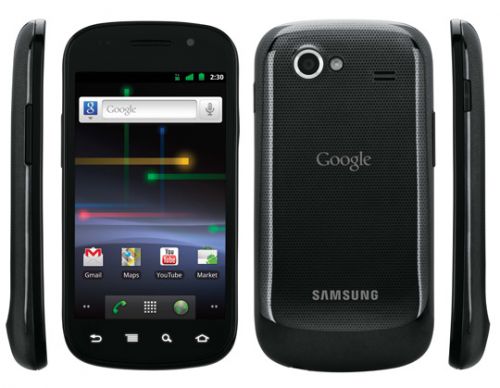
Attention Nexus S 4G users: The moment you have been waiting for is finally hitting tomorrow. Android Police reported that the Nexus S 4G would receive the long-awaited Ice Cream Sandwich update tomorrow, according to a screenshot of Sprint’s internal systems (seen after the break). The over-the-air update should hit any time now, so get ready. Let’s hope nothing goes wrong in the process.
 .
.
It is hard to imagine why GOOG is down when news this exciting hits
Google began rolling out the red link redesign today to the Google Finance websites. It has not hit ours, but reader @tuanye is feeling it. The new design has made it most of the way across Google’s network.
Handset maker Motorola Mobility, about to be acquired by Google for $12.5 billion, published today a list of devices eligible for an Ice Cream Sandwich upgrade (it previously explained why device updates are taking so long). The Xoom Family Edition tablet will get ICS in the second quarter. Unfortunately, owners of other devices will have to wait even longer, particularly the Photon 4G, Atrix 2, Atrix 4G and the non-Verizon Xyboard 8.2 and 10.1 that are slated to get ICS upgrades in the third quarter. Worse, many Verizon devices lack windows, including The Razr, Razr Maxx, Droid 4, Droid 3 and Droid Bionic.
This suggests Verizon certification is pushing back the planned ICS roll out for some of Motorola’s high-end phones sold in the United States. International version of the Razr is due for an ICS upgrade during the second quarter of this year. The company re-iterated that “Our engineers and designers are combing through the code and preparing it for you.”
This year’s world Olympics are set to take place in London this summer. NBC Universal will do the majority of the broadcasting worldwide, and according to PaidContent, NBCU recruited Google and ComScore to develop new ways to track viewership over broadcast, mobile, cable, and Internet.
According to the report, Google will track viewership by creating a small panel of 3,000 consumers. Google will also— in its typical style— create an algorithm to help. As for ComScore, it will be conducting a study from 750 AT&T U-verse customers.
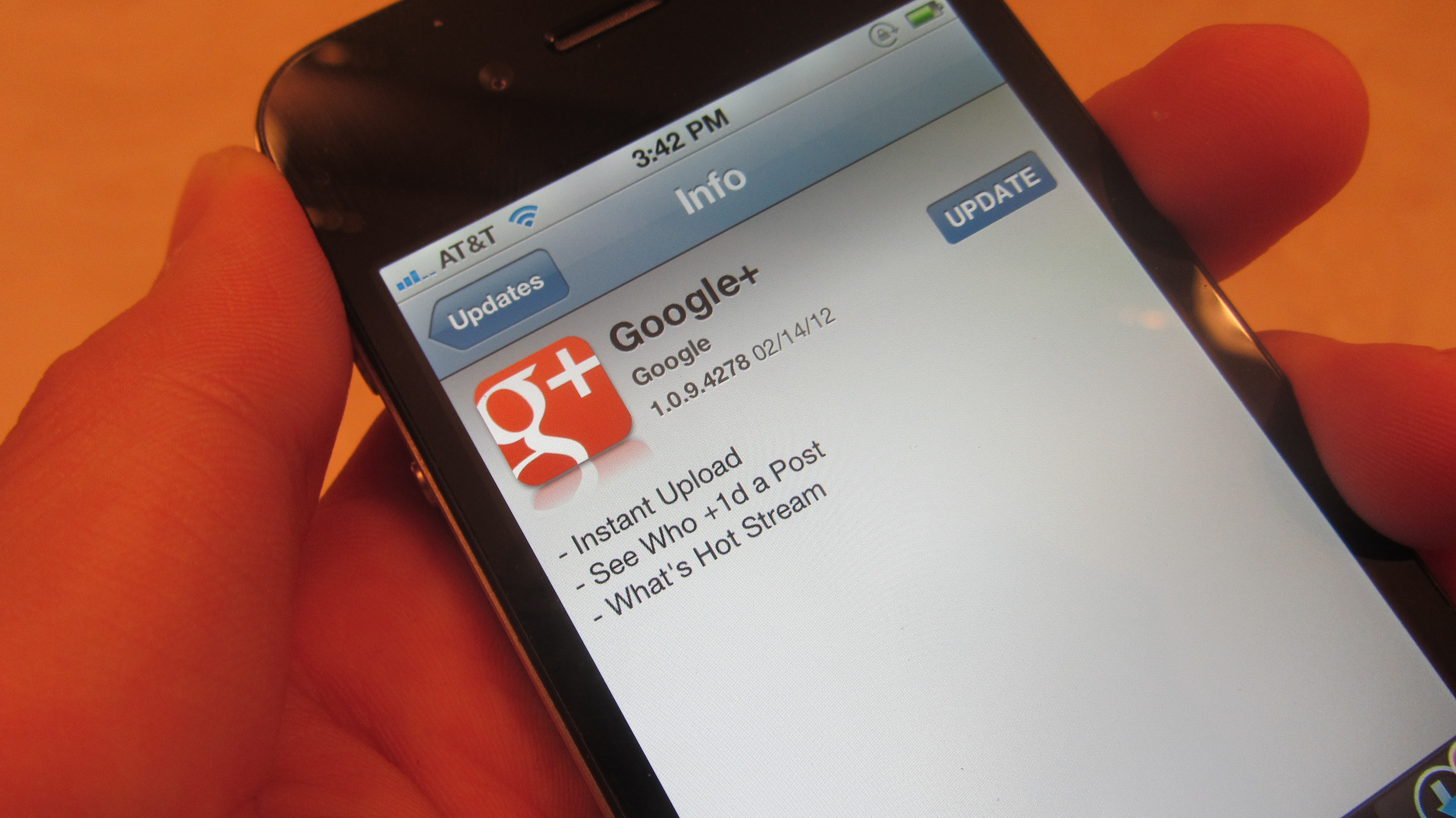
Google just released an update to its Google+ for iOS, bringing it to version 1.0.9.4278. Today’s update for the iOS app brings it up-to-par with the Google+ Android app, which was updated last week. The update brings three new updates: Instant upload of photos, you can see who +1d posts, and the new “What’s Hot” stream.
You can grab the update on the iTunes App Store.

Google has announced on their Official Google Blog that Google DNS is now the world’s largest DNS service, processing a whopping 70 billion requests a day. Google’s DNS efforts make for faster load times if you choose to use the service. Google describes DNS as, “If you had to look up hundreds or thousands of phone numbers every day, you’d want a directory that was fast, secure and correct.”
We launched Google Public DNS in December 2009 to help make the web faster for everyone. Today, we’re no longer an experimental service. We’re the largest public DNS service in the world, handling an average of more than 70 billion requests a day.
Google also dropped word that they currently have over 10 million users using the service. 70% of Google DNS’ traffic comes from outside of the United States, with key markets being North America, South America, Europe, and an emerging Asia.
Not using Google DNS? Check out how.

Google improved its search engine once again by aggregating health-related web content to the top of its main page when users search for symptoms.
The Mountain View, Calif.-based Company took to the Official Inside Search Google Blog today to announce how often people search for health information, as well as what the search engine is doing to make the process easier for Googlers.

“Every day, people search on Google for health information. Many of these searches relate to symptoms they or their loved ones may be experiencing,” wrote Chief Health Strategist Roni Zeiger, MD. “Our data shows that a search for symptoms is often followed by a search for a related condition.”
More information is available below.