Stay up to date on news from Google headquarters. Be the first to learn about plans for Android, Google Plus, Google Apps, and more!
Stay up to date on news from Google headquarters. Be the first to learn about plans for Android, Google Plus, Google Apps, and more!

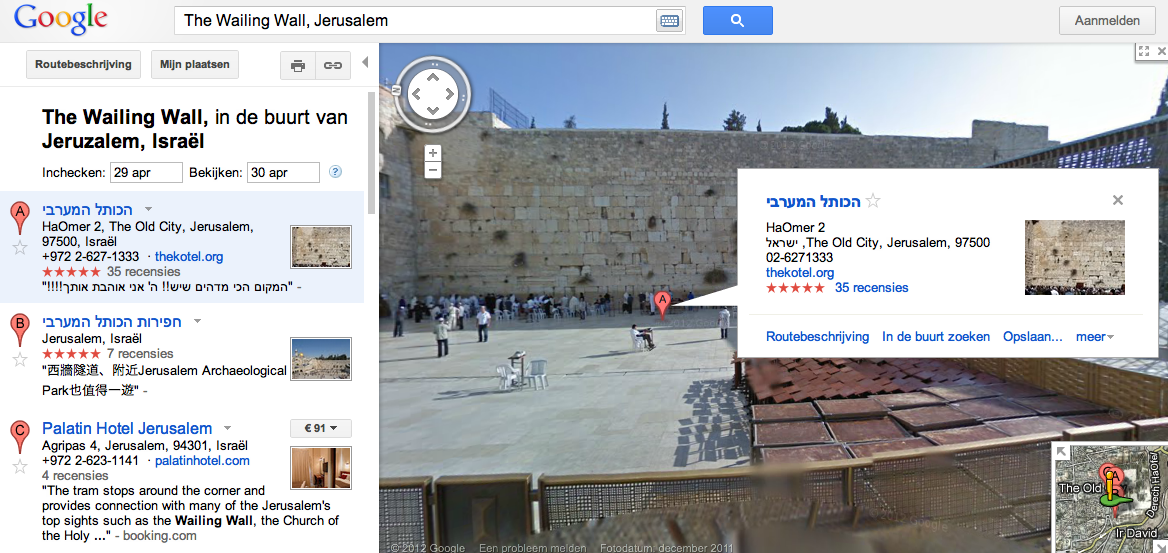
Google plans to launch its Street View mapping service in Israel on April 22, but the project is apparently already online.
According to Dutch blog Websonic (translated), Street View images are live in the capital city of Jerusalem, as well as in Haifa, Tel Aviv, Merhavia, Kfar Kama, Nahsholim, and Beersheba. The Street View above is of the Wailing Wall in Jerusalem, also known as the Western Wall, which is one of the city’s most popular and sacred tourist spots.
For those who live under a rock: Google Street View is a service highlighted in Google Maps and Google Earth that offers panoramic views of streets. It launched in 2007 in the United States and has expanded to many cities and rural areas worldwide. Street View in Israel is significant, because it is the first time Google has published street imagery online from any Middle Eastern country.
An image gallery is below.
[youtube=http://youtu.be/ZooybMt9sRQ]
Google released Gmail Meter today, which is a tool for analyzing your inbox that is similar to the Google Account Activity feature launched last month.
The Google Team announced Gmail Meter on the Official Gmail Blog. Google Apps Script Top Contributor Romain Vialard developed the Google Apps Script-powered feature after looking at his sent mail one day and noticing there were many things he wanted to know about his email habits.
The video above explains the tool, but here is a quick run-down: Gmail Meter sends an email on the first day of every month containing statistics about an Inbox for detailing a user’s emailing habits. Some of the data measured regards volume statistics, daily traffic, traffic patterns, email categories, times before first response, word count, thread lengths, and top senders and recipients.
A screenshot for each data measurement is below.

Reuters reported that a judge rejected Google and Apple’s bid last night to have an antitrust lawsuit dismissed. The lawsuit claimed the companies illegally entered “no-poach” agreements in an effort to stop competitors from stealing talent:
District Judge Lucy Koh in San Jose, California, rejected the companies’ bid to dismiss claims brought under the Sherman Act and California state law, in a decision released Wednesday night. […] The proposed class action lawsuit was brought by five software engineers, who accused the companies of conspiring to depress employee pay by eliminating competition for skilled labor.
Other defendants in the case included Intel, Adobe Systems, Intuit Walt Disney Co’s Pixar, and Lucasfilm.
This Aside is cross-posted at 9to5Mac.
(Image via Zoknowsgaming)
 Badoo is a social discovery website founded in 2006 that is managed out of SoHo, London and quickly reaching its 148 million user, but today it announced a very pivotal hire.
Google’s Product Management Director of Search Products and Local Business Products Benjamin Ling is leaving the search engine to become Badoo’s Chief Operating Officer. He will help Badoo expand across mobile and Web platforms, which is essential since the website is widely revered as one of Europe’s leading Internet firms.
“One of the things that attracted me to Badoo is its mainstream appeal. Badoo is putting the ‘social’ back into social networking, and it’s doing it on a massive scale. To me, that’s a thrilling opportunity,” announced Ling.
Ling’s new gig starts May 2012 in London, where he will oversee corporate matters, product, business operations, engineering, and partnerships.

Shortly after Google switched the name of its content distribution hub from the Android Market to Google Play, the company filed a complaint over the domain name GooglePlay.com. Today, Fusible reported the Whois information for the domain now lists Google:
Despite a ruling not yet being published, part of the Whois information for the name was updated this week and now reflects Google Inc. as the registrant… Google registered several googleplay domain namesin late February through the brand protection company MarkMonitor, but wasn’t able to get its hands on GooglePlay.com at the time since it was already registered… At the time of this story, GooglePlay.com still doesn’t direct users to the official Google Play website.

[youtube=http://www.youtube.com/watch?feature=player_embedded&v=kngOOe37OBA]
YouTube is quickly making its video-sharing platform an all-in-one editing tool with its built-in 3D graphics button and other attractive features, but now Google has taken the service up another notch with its new audio editing and mixing options.
The video above explains it all, but here is a quick run-down:
Google released an update to the “TV & Movies” app for Google TV bringing with it a few new features including enhancements to animations and scrolling, the ability to remove channels from live TV shelves, and additional Dish Network content. The update will also now hide empty shelves by default.
Google also walked through a number of new features and improvements to the updated TV & Movies app on The Official Google TV Blog. Among the improvements is expanded information below content, and a new menu for getting additional details, star ratings, and favorites. The star ratings will provide suggestions based on your feedback, and Google outlined the streamlined channel layout.
When you add them to Favorite Channels you’ll instantly see what show is currently playing on each. Add all your favorite channels and you’ll have a one-stop personalized guide of just the channels you care about. You can also add favorite TV shows and movies to your queue so you can come back later and watch them on Netflix, Amazon, HBO GO and more.
A full list of what’s new in the update is below:
Expand
Expanding
Close
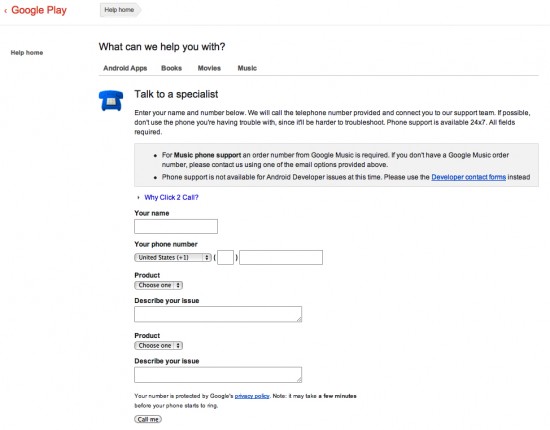
Google offers a variety of services, but its technical support is—well—lacking.
Until now, that is. The ever-popular search engine just debuted 24/7 technical support for Google Play users only. The most interesting part is that Google will now call you to provide answers. That’s right, no more are the days of automated support lines and endless waiting. Just fill out a form on the website, submit the form, and then wait for the phone to ring.
Unfortunately, Android devs are out of luck. They need to use ‘ole Help Center if questions should arise.
Check it out: Google Support
A recent interview with Google’s cofounder Sergey Brin received a lot of attention due to his view that Apple and Facebook are the biggest threats to the open Internet. While Brin still recommends reading the full article here, he posted a note on his Google+ account today to clarify some thoughts that he felt were “particularly distorted in the secondary coverage” of the interview.
In the post, Brin clarifies that on the issue of app ecosystems, which are not as open as the rest of the Web, he does not think the “issue is on a par with government based censorship.” He also took time to clarify his view of Apple and Facebook, noting he has “always admired Apple’s products,” especially while using an iMac to type his post. He also called Facebook “a key tool for political expression.” Brin’s full post is below:
Expand
Expanding
Close
[youtube=http://youtu.be/7yBemw0eW9g]
Google announced it is introducing a new initiative today to reinvent online measurement for brand marketers.
“Today at the Ad Age Digital Conference we’re introducing the Brand Activate initiative, a new effort to re-imagine online measurement for brand marketers and—crucially—to help brands turn measurement into action, immediately,” explained Google’s Vice President of Display Advertising Neal Mohan on the Official Google Blog. “We’re working with the industry and supporting the IAB’s Making Measurement Make Sense (3MS) coalition on this project.”
The coalition is committed to developing brand-building online metrics and measurement solutions. Meanwhile, the Ad Age Digital 2012 combines marketing, technology, and media in one place: Chelsea’s Metropolitan Pavilion in New York City. The events start today and end April 18. It is a melting pot of the world’s biggest brands and newest startups.
The conference intends to “connect the dots” between Madison Avenue and Silicon Valley, while highlighting 700 high-level attendees, two days of keynotes, workshops, and networking with celebrated guest speakers.
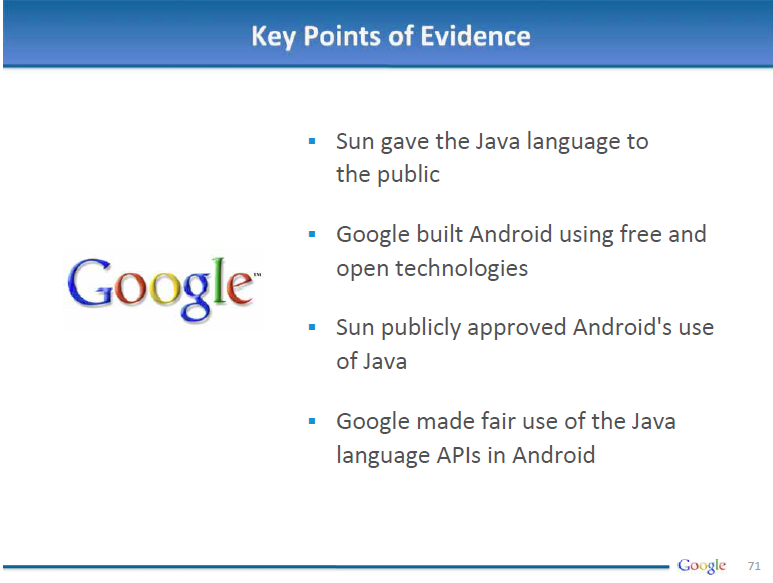
So, everyone is aware that Java platform maker Oracle is amid a courtroom grapple with Google over whether Java patents were infringed in the search engine’s mobile operating system Android, but not everyone is clued in to the defendant’s intriguing side of the story.
According to Google’s money slides (via ZDNet), the heart of Google’s defense is summarized in three clear-cut points: Java code was free and openly available to the public; Google did not violate any patents or copyrights when developing Android; and, Oracle is disgruntled due to its and Sun’s failed attempts to market a Java-based platform for smartphones.
[tweet https://twitter.com/benjrubenstein/status/192310507179483137]
Google announced on the Google Chrome Blog today an updated version of the “Chrome for Android Beta” app that includes support for 31 additional languages and a few new features highly requested by users. The beta is now available to users in all countries with access to Google Play.
Among the new features is the ability to view the desktop version of a website, add bookmarks to your home screen as shortcuts, select default apps for opening links, and use Chrome with the system proxy for Wi-Fi.
As always, “Chrome for Android Beta” is available free through the Google Play store for Android 4.0 devices. Google also released a change log of fixes, changes, and known issues:

LATEST UPDATE: Google’s App Status Dashboard, an official website that offers performance information for Google Apps services, claimed earlier today that Gmail’s status went down, but the problem is now resolved less than an hour later.
“Please rest assured that system reliability is a top priority at Google, and we are making continuous improvements to make our systems better,” contended Google.
The service interruption only affected 2 percent of Gmail’s user-base. DownRightNow, a universal monitoring service for the Web that is similar to Google’s Dashboard, described the outage as a “widespread service disruption” that started somewhere between 12:40 p.m. and 12:59 p.m. EST. The service interruption did not seem to affect mail pushing to third-party clients.
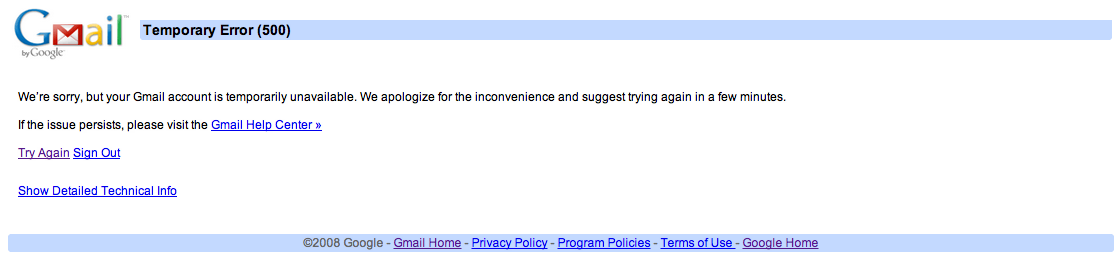
Those who tried to access Gmail.com directly found the following “Temporary Error (500)” notice with a “93” numeric technical code:
While Greenpeace’s “How Clean is Your Cloud” report had not so great things to say about Apple, Amazon, and Microsoft’s use of coal energy in their data centers, Google was praised for its “comprehensive energy reduction plan”. The organization is urging consumers to contact the companies to convince them to change their approach to powering the cloud and read the 50-page report to learn more.
“Google has been the most open in the industry about the importance of increasing not only energy efficiency within the sector, but also the need to move our energy sources to renewable energy… Google has a comprehensive energy reduction plan that has resulted in its data centers using half the energy of the industry standard… Google’s commitment to using renewable energy as much as possible has set the bar for the industry.”

Oakley could soon give Google’s Project Glass a run for its money.
 The eyewear maker told Bloomberg that it is developing technology for integrating smartphone elements into its products. The science is only in the preliminary stage, however, as Oakley’s Chief Executive Officer Colin Baden (picture, left) would not even validate plans to launch such spectacles. He did explain his company’s stance on the project, though, while detailing how the public is yearning for a heads-up display:
“As an organization, we’ve been chasing this beast since 1997,” explained Baden. “Ultimately, everything happens through your eyes, and the closer we can bring it to your eyes, the quicker the consumer is going to adopt the platform.”
Colin then described a few features he would like to see in the product, such as voice-controlled display information in conjunction with a smartphone via Bluetooth. The company actually has a few patents in place that detail its vision (available here, and pictured above). Oakley’s augmented-reality glasses would obviously not be cheap for consumers— especially because its initial target audience consists of athletes and eventually the U.S. military:
 The creative mind behind the head-turning Old Spice advertising campaign just joined the Google Creative Lab.
Wieden + Kennedy’s Iain Tait is leaving his executive creative director gig behind and opting for a role that promotes Android, Google+, Chrome, and other Google-branded services. Aside from the slue of YouTube slapstick Old Spice videos, he is also known for his advertising work at Levi’s, Coke, and Nike.
“I’m going to be an ECD at Google Creative Lab in New York,” announced Tait in a blog post. “I can’t believe that I’m leaving W+K. And I can’t believe that I’m about to join Google Creative Lab. The whole thing is kind of unbelievable.”
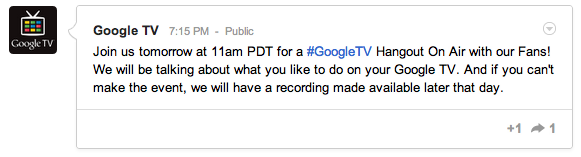
Google TV just announced on its official Google+ page that it will hold a live Hangout tomorrow at 11 a.m. PST to hear fans’ feedback about the service. So, make sure to set alarm clocks!

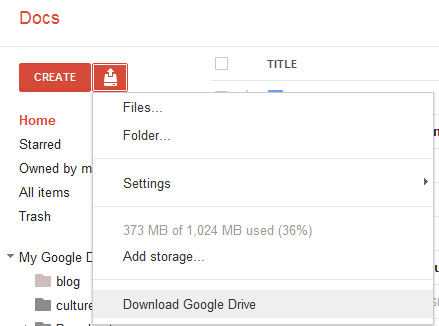
<em>Google Drive appearing in Google Docs during testing.</em>
Are you ready to ditch Dropbox? According to a new report, Google’s long-rumored file storage service Google Drive is set to launch next week. The Next Web said the service is likely to launch next Tuesday, and it will provide users with 5GB of free storage. Much like Dropbox, which currently trumps the industry, users will be able to store any file on the service’s servers for access anywhere. Being Google, however, Drive will most likely also integrate throughout Android and other services—as Apple does with iCloud, though it is a bit more limited. Drive will also launch with integration into other third-party services, according to a leak from last week. We will also look out for the announcement, because we hope this not another source wrong about the launch date.
 Google’s cloud-based email service has been available to Germans over for seven years, but they are just now getting the official Gmail domain.
A local businessperson previously held the domain, which forced Google to provide “googlemail.de” addresses to users in Germany. However, according to a recent story by The Financial Times (translated), the Gmail trademark and domain were effectively transferred to Google earlier this month.
There are no further details regarding the settlement.
[youtube=http://youtu.be/-sSsRIhVYB4]
Many Google Glasses parody videos are swirling around the Web, but two Israeli-based filmmakers decided to up the ante with a take on “Battlefield 5.”
Nadav Pessach and Uzi Mor created the video above and hosted it on the “There is a Canal” YouTube channel. It features “Battlefield 5” in a much-idealized version of how some gamers expect Project Glass to one-day change the gaming industry. The Battlefield franchise is a series of FPS video games developed by the Swedish company EA Digital Illusions CE and published by Electronic Arts.
[youtube=http://youtu.be/vT503jUG4Y4]
A leaked video suggests Microsoft’s world-renowned productivity suite will soon feature cloud-like options in an effort to curb Google Apps’ growing market share with its alternate offering.
The 30-second promo above is hosted on YouTube by Within Windows. It emphasizes “Office 15” as the suite’s newly re-branded name. It also focuses on the accessibility of the next iteration through remote access to documents, which is enabled by a normal sign-in procedure. The cloud options will tracks and store all of a user’s virtual papers in Microsoft’s cloud-based Sky Drive service.
Microsoft Office is dueling many cloud-based productivity suites, such as Google Apps, and it is steadily losing market share. The downward spiral even caused the once-great Word processing giant to embark on a smear campaign against Google, where it lambasted the Mountain View, Calif.-based Company as a shady advertiser with alternative motives.

Photographer Scott Kelby is gathering 15 world-renowned photographers together for an unofficial Google+ Photographer’s Conference.
“On May 22-23, fifteen of the biggest photographers, instructors, and social media magnates on Google+ are gathering in San Francisco for the first-ever Google+ Photographer’s Conference at the Yerba Buena Center for the Arts (in San Francisco), “announced the Google+ Photographer’s Conference page.
[youtube=http://www.youtube.com/watch?feature=player_embedded&v=NcX9V86JB4Y]
The official Google+ page later reposted the conference’s announcement, but the social network clarified: “This is not an official Google event, but we are excited to see this launch! Hope you can attend.”
Registration information is below.

A 30-year-old man used Google Earth to literally move mountains and find his long-lost family after nearly three decades of separation.
 Saroo Brierley, 5-years-old, boarded the wrong train in 1986 and accidentally arrived in Calcutta, India. The boy found himself adopted one month later and then grew up in Australia. Roughly 25 years flew by without any way of knowing where he came from or how he could find his family.
With time, came technology. Using Google Earth, coupled with basic math to find the radius of Calcutta and the length of that fateful train ride, Brierley pinpointed his birth city.

The trendy photo-sharing app “Instagram” for Android debuted in the Google Play Store nearly two weeks ago and has since increased the service’s user base by 25 percent.
It took Instagram 19 months to reach 30 million iOS users, but it quickly garnered 10 million Android users in less than 10 days.
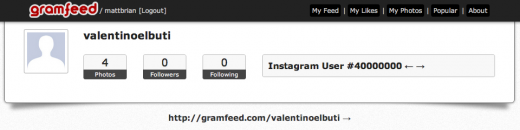
Gramfeed, a third-party user tracking website, dug into Instagram’s API to determine Mr. Valentino Elbuti (valentinoelbuti) as the 40 millionth user. He recently signed-up and already has four filtered-images posted to his account.