Stay up to date on news from Google headquarters. Be the first to learn about plans for Android, Google Plus, Google Apps, and more!
Stay up to date on news from Google headquarters. Be the first to learn about plans for Android, Google Plus, Google Apps, and more!

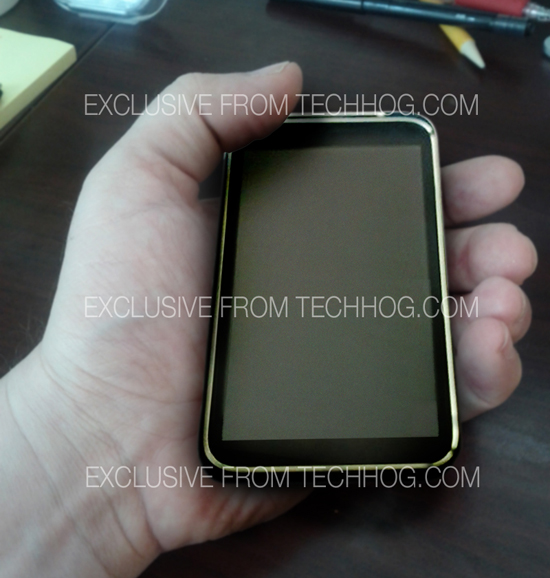
Before it got pulled, TechHog showed off a picture of what they said was a Nexus 3 device that was to be made by HTC. HTC obviously was the maker of the original Nexus One and has a pretty strong relationship with Google, even if it pays Microsoft patent fees for every Android device it ships.
Interestingly, the device above doesn’t have any permanent front facing buttons, much like the Honeycomb tablets that are being produced right now.
It stands to reason that software-only buttons will make their way down to phones in the next version of Android, called Ice Cream Sandwich, which will combine the Honeycomb tablet versions of the Tablet OS and the Gingerbread phone versions. Ice Cream sandwich is due later this year and Andy Rubin claimed that a Ice Cream Sandwich reference device was in the works before Christmas.
Is this it?
Techhog says the images were pulled at the request of an outside petitioner, though it isn’t clear who it is. Google and HTC are obvious suspects.
Expand
Expanding
Close

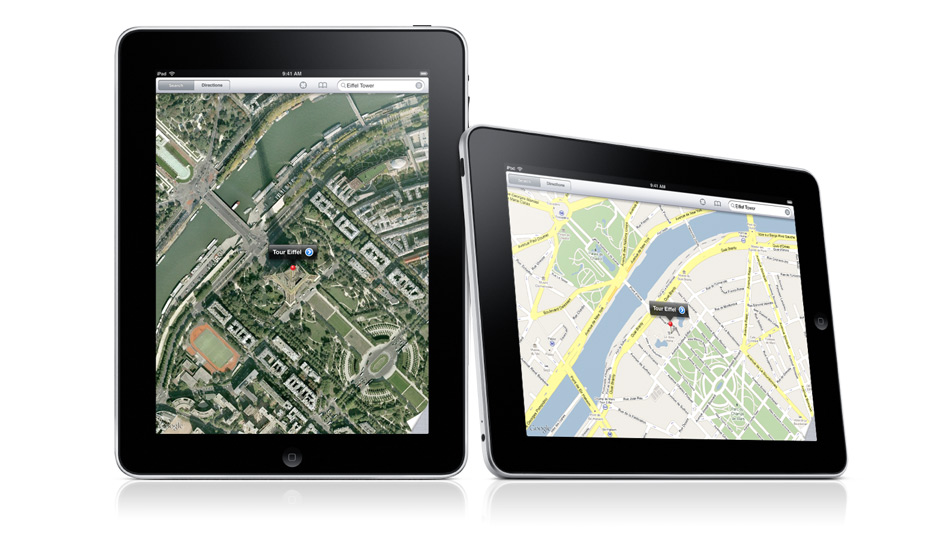
With Apple’s purchase of two mapping companies over the last couple of years – Poly9 and Placebase – many have speculated that iOS 5 will finally be the iOS release where Apple moves from a Google Maps backend to an Apple backend. Multiple job postings on Apple’s official site backed up this speculation and even Apple promised some under-the-hood maps tweeks for their next-generation iPad, iPhone, and iPod touch operating system.
Now, sources have told 9to5Google that although Apple is working to improve the iOS Maps application, iOS 5 will not bring an Apple developed maps service and Google Maps is still in. Besides Apple’s purchase of both Placebase and Poly9, some speculated that Apple is building their own maps service to either compete with Google or step away from their input into iOS.
Apple began the process of distancing themselves from Google when former Google CEO Eric Schmidt resigned over “conflict of interest.” Apple has also added Microsoft’s Bing as a Safari search option and will be competing with Google head-to-head with their upcoming cloud-based music service. Those who enjoy Google Maps should not fear iOS 5, though, and hopefully Apple is working to implement turn-by-turn directions or something else to improve their maps application without changing the backend.
Expand
Expanding
Close

Google has made it a little easier to find flights online by integrating flight information with their main Google.com search page. From now on, a quick summary of flights and airlines is displayed right on the results page for users in ten language markets (English, French, Italian, German, Spanish, Dutch, Brazilian Portuguese, Polish, Russian, Turkish and Catalan). You can also browse a full time-table of non-stop flights and search for non-stop flights from a particular airport.
Even though flight data comes from their ITA acquisition, Google Search does not currently use ITA’s search technology, a Google engineer Petter Wedum noted in a post over at the official Google Search blog. Right now it’s just a schedule, but obviously the ITS deal will pave the way to buying tickets online. Try this example search for flights from San Francisco to Minneapolis.
A report from Citi analyst Walter Pritchard made headlines this morning with claims that HTC agreed to paying five bucks per every Android handset sold. The basis for this is Microsoft’s patent settlement with the Taiwanese handset maker over intellectual property infringement, the analyst has found out. The fact that HTC makes Windows Phones obviously didn’t help dodge that patent hit.
Microsoft’s boss Steve Ballmer argued last October that Android wasn’t free just because it’s open-sourced. Some watchers are calling the Android platform a patent bomb waiting to explode. HTC is also being sued by Apple over alleged breach of iPhone patents and Oracle is suing Google over use of Java in Android. Pritchard warns other Android vendors can expect to pay royalties to Microsoft between $7.50 to $12.50 per device, which is troubling and here’s why.
If you’re still wondering why all the fuss about Google Wallet, here’s a little video from Google that will help you process today’s announcement.
[youtube=http://http://www.youtube.com/watch?v=gZGoXvzW4WU&w=670&h=411]
Anyone notice the excitement, catchy tunes, the excessive use of superlatives and the overall shininess in Google’s product videos lately? Yeah, very Applefied.
Gartner is out with their first quarter 2011 mobile phone market survey. The results are astounding. The first quarter belonged to Google and everyone else was reduced to extras in an Android show. Both Apple and Google grew their respective share of the smartphone market, estimated at 100.8 million quarterly units – nearly double the 54.5 million units from the year-ago quarter. Smartphones grew 85 percent and cut into sales of regular handsets, accounting for almost one quarter (23.6 percent) of the 427.8 million handsets shipped during the first quarter.
Predictably, Android was the leading smartphone platform in the first quarter of 2011. And here comes your mind-boggling takeaway: More Android-powered smartphones were sold during the first quarter than the combined sales of Apple’s iPhone, RIM’s BlackBerrys, Microsoft Windows Phone smartphones and vendors belonging to the Other OS category. And that is worldwide, mind you. Go ahead, do the math yourself (the below table).
It’s fascinating that Microsoft and Symbian combined had three percentage points lower market share than Android. Also, while Apple doubled iPhone sales, they barely gained any marketshare. This just shows that Android is gobbling up market share at a rapid pace, eating pretty much everyone’s lunch in the process…
[youtube=http://www.youtube.com/watch?v=2HrQbjPjbBA&w=670&h=411]
So how do you stand out in the crowded Android space? I know – let’s put a bunch of cats in a television commercial, Sprint’s marketing people must have said when pitching creative concepts for the Nexus S 4G campaign to their bosses. The resulting advert is cutesy and a bit mischievous, but not bad at all. Plus, you gotta love the closing line:
It’s the first phone that’s Google to the core with Sprint’s lightning fast 4G speed. It’s powerful enough to do just about anything, including filling the internet with more cats.
The cats theme runs throughout the campaign and on the Nexus S mini-site.
One thing that keeps people on Excel is the ability to use Pivot tables. Google today eliminated one more barrier to migrating to apps by implementing pivot tables today in Google Spreadsheets.
In essence, a pivot table does just that — it allows you to “pivot” or rotate data, thus looking at it from different angles and seeing a variety of patterns which may not be immediately obvious. Let’s take a very simple example of a list of students. This list includes a number of students and some information about them, including gender, class level, and major.
Updates to Spreadsheets are rolling out now.
Expand
Expanding
Close
Nvidia CEO Huang Jen-Hsun blamed slow sales of Android slates to a multitude of factors ranging from the lack of expertise at retail, sub-par marketing, higher price points and software. Extending the opinion, Asian sources from notebook vendors warn that lack of content is to blame for weak demand for Android slates. It’s the software, stupid, they argue, reports DigiTimes.
The sources pointed out that most of the applications that are executable on Android 2.x are turned out to be un-executable on Android 3.0, while any application that can run on iPhone can be directly transfer to iPad for execution. Since there are only limited applications specifically designed for Android 3.0, it has significantly lagged demand of Android 3.0-based tablet PC.
“Apple would have achieved a much bigger market share than it already has if the player decided to wait”, the source admitted. Android 3.1 should resolve all those issues when it becomes available in the second half of this year, the source concluded. Most apps designed for Android 2.x smartphones apps either don’t scale well or “turn out to be un-executable on Android 3.0”, the source noted, blaming poor demand for Honeycomb tablets on a limited number of tablet-specific software experiences. Apple, of course, is employing quite the opposite tactics focused on promoting apps tailored to the iPad.
We’re not going to prognosticate on what a $100 price drop means for the Logitech GoogleTV. We’ve been hearing mighty nice things about the Honeycomb update that is in the works for this summer in fact. But we thought you should know that Amazon has lopped of $100 which makes this Intel-based 1080P machine a pretty good bargain.
Update: Best Buy has matched the $200 price and Sony also offers the Sony BluRay GoogleTV for $260.
Expand
Expanding
Close
According to PocketNow, Samsung is gearing up for the US release of AT&T-compatible Google Nexus S. The pearly white model is labeled with the model number GT-I9020A instead of SGH-Ixx7, indicating that the handset will be sold directly through the carrier. The publication nevertheless noted:
It’s still unclear if this will be available directly from AT&T — like the Sprint Nexus S 4G — or strictly from third party retailers, as is the case with the T-Mobile-flavored Nexus.
A version of the Nexus S designed to work with AT&T’s 3G network was first uncloaked this January in an FCC certification document. The Android-driven handset supports AT&T’s 850/1900MHz WCDMA bands, in addition to Bluetooth, single-band 802.11 b/g/n WiFi. It also supports the 13.56MHz band required for the RFID functionality.
Looks like a guy in the above image has a Samsung Galaxy Tab 10.1 hooked up to his MacBook Air. I bet he’s manually dropping some files from the Mac notebook to his brand spanking new tablet, which is easy because Android devices mount as external USB storage.
That’s pretty much everything he can do, though. That is, unless he was using Eltima Software’s SyncMate, an all-around syncing application for the Mac. It’s been around for ages and in most recent version they added support for Android devices. Read on…
[youtube=http://www.youtube.com/watch?v=MiYND_zvIc0&w=670&h=400]
The entire hour-long presentation is now available on YouTube for your viewing pleasure.
It doesn’t get any better than this folks. Dan Lyons, who has a contentious relationship with Bursten’s Jim Goldman (especially from his days as a CNBC reporter, above) busted the mystery Google smear campaign wide open. It turns out, it wasn’t Apple and it wasn’t Microsoft trying to smear Google. It was Facebook.
I won’t spoil it but knowing how much Lyons loves Jim Goldman, he must be in hog heaven right now.
Expand
Expanding
Close
Over at Fortune, I profiled the the two new guys presenting at Google I/O on Android yesterday. It turns out that Matt Hershensen and Joe Brit aren’t actually new (though they are new at Google) in the smartphone scene. They actually founded Danger with Andy Rubin and were working at Microsoft (which bought Danger) less than a year ago.
At Google, they’ve been charged with starting up the Android hardware division which is putting together reference designs for the new accessory interfaces that will be built with the ADK.
Here’s their 2004 talk on founding Danger:
http://ecorner.stanford.edu/swf/player-ec.swf
Expand
Expanding
Close
Chromebooks, the just announced notebooks optimized to run Chrome OS, will benefit from new features in Chrome OS. When Google introduced Chrome OS a year ago, many people wondered how useful the upcoming notebooks would be the software’s clunky handling of external storage, your documents and other items. Google has been perfecting Chrome OS with these specific concerns in mind and today they dispelled myths that Chromebooks won’t be a fit for the average Joe Schmuck.
First up, Chrome OS has built-in players for music and video that show your content in a panel form factor by default. You can, however, take your video to fullscreen with a simple click. Another sought-after feature is a file manager that pops up when you slide a USB thumb drive or other peripherals to a Chromebook. But what about photos?
Sundar Pichai, senior vice president of Chrome, has just announced two cool Chrome notebooks up on stage here at Google I/O 2011. He used a new word to describe them – Chromebooks. Add that to your vocabulary, I have a feeling we’re gonna use it a lot moving forward.
Samsung’s 12.1-inch Chromebook, shown above, has eight-hour battery and sports instant-on performance, like Apple’s MacBook Air, with eight-second boot time.
Acer’s machine, seen below, has a 11.6-inch display, 6.5-hour battery and also boots in just eight seconds. So, how much will those beauties cost you?
Google just said at Day Two Keynote that users have installed 70 million web apps found in the Chrome Web Store in the first three months. To put things in perspective, Google said Chrome has been downloaded 160 million times worldwide so far. The store is also available in 40 new languages as of today.
The company also introduced a simple way to enable one-click purchases withing web apps themselves, via Google Checkout. So, what’s the deal? Unlike Apple which takes 30 percent cut on iTunes content sales or in-app purchases, Google said it would take just five percent. “We at google felt we can do a little better”, a Google engineer said during the keynote in a hint at Apple’s 70:30 revenue sharing deal.
In addition to a whopping 160 million Chrome downloads so far, up from 70 million a year earlier, Google shared some interesting stats related to their live video feed of the keynote. Yesterday’s keynote had been viewed by 60,00 simultaneous users, topping 600,000 people at its peek. Currently, Day Two Keynote is underway. You can tune in at a dedicated Google I/O Live – it’s the next best thing to being there in person. Alternatively, check out live YouTube channel.
Sundar Pichai, senior vice president of Chrome, just said that the Chrome browser now has more than 160 million Chrome users worldwide, more than doubling the application’s 70 million-strong user base just a year ago. We are officially impressed!
(Cross-posted on 9to5Mac.com)
Just sayin’…
It’s a familiar scene. MacBook-toting journalists, bloggers and guests providing Apple with omnipresence and free advertising at rivals’ events, thanks in large part to the glowing Apple logo on the well-designed notebook family. Who knows, this time next year some of these folks might carry around machines with the Google logo on them if there’s any substance to the whispers of subscription-based Chrome OS notebooks. Check out seven additional Apple sightings below the fold and meet us in comments.
Check out the sticker: “My other computer is a data center”. Touche.
Google I/O Day Two Keynote is set to begin at 9:30 here at the San Francisco’s Moscone West. Yesterday’s was all about Android and today we will learn what’s in store for the Chrome browser and the Chrome operating system for notebooks. According to Forbes, Google will announce a $20 a month hardware subscription option for Chrome OS notebooks.
Instead of dropping a couple of hundred dollars upfront, you’ll be able to get a free Chrome OS machine as long as you continue paying twenty bucks a month to Google. The offering will include both the hardware and the accompanying cloud services and will be targeted at students, a Google source told the publication. That could put Apple, the leader in education, in an uneasy position. The Forbes piece says nothing about hardware refresh cycles or a possible 3G/4G connection bundle.
A lot of interesting news came up during yesterday’s Android-focused keynote. We’ve processed key announcements for you, but there’s a whole bunch of tidbits and nice-to-knows that came in yesterday’s keynote. As we await Chrome OS-related Day Two Keynote, why not watch the entire video footage from yesterday? It’s embedded below the fold or available over at YouTube.
The hour long presentation includes a bunch of Google engineers giving cool on-stage demos, in addition to key executives like the Android head Andy Rubin and vice president of software engineering Vic Gundotra. Hint: Scrub to mark 2:10 for an amusing anti-Apple moment. You can also rewatch the Google I/O 2011 countdown, in case you missed it. Google will provide real-time video stream of Day Two Keynote, which is scheduled for Wednesday, May 11, at 9:30am Pacific time.

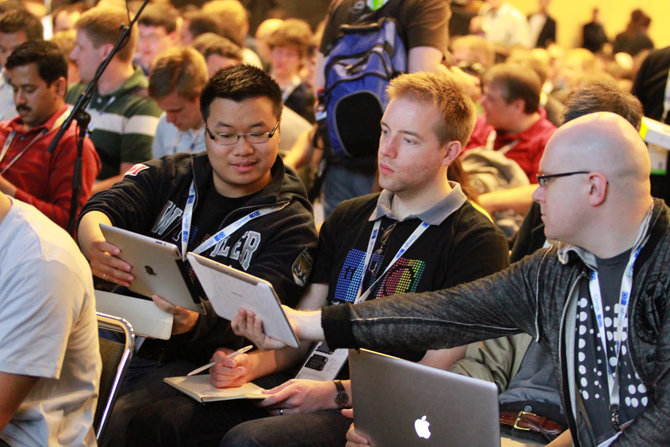
(Left) Software engineering head Vic Gundotra sits in the front row as his colleagues demo new Android features (Right) Audience members comparing their slates
Hot on the heels of a plethora of yesterday’s Android announcements, Google has launched a new site aimed at app developers. In a nod at “The Hitchiker’s Guide to the Galaxy”, a sci-fi comedy series by Douglas Adams, the company named it “The Guide to the App Galaxy by Google”.
Available here, this useful new place is meant to “help app developers, regardless of platform, build a business on mobile – whether they’ve just launcher their first app or are looking for additional tips as they grow their portfolio“, Google says. Resources include Google’s AdMob network to promote apps via paid campaigns or cross-promote apps within one’s own portfolio.
It’s all about monetizing lazy users who aren’t keen keen on paying for Android apps as much as their iOS counterparts. In addition to the freemium model, the site notes, developers will benefit from better understanding of the ways to monetize users with in-app adverts and in-app purchases as opposed to one-time paid downloads.
Hint: Use the arrow keys on your keyboard to navigate the spaceship through the site.