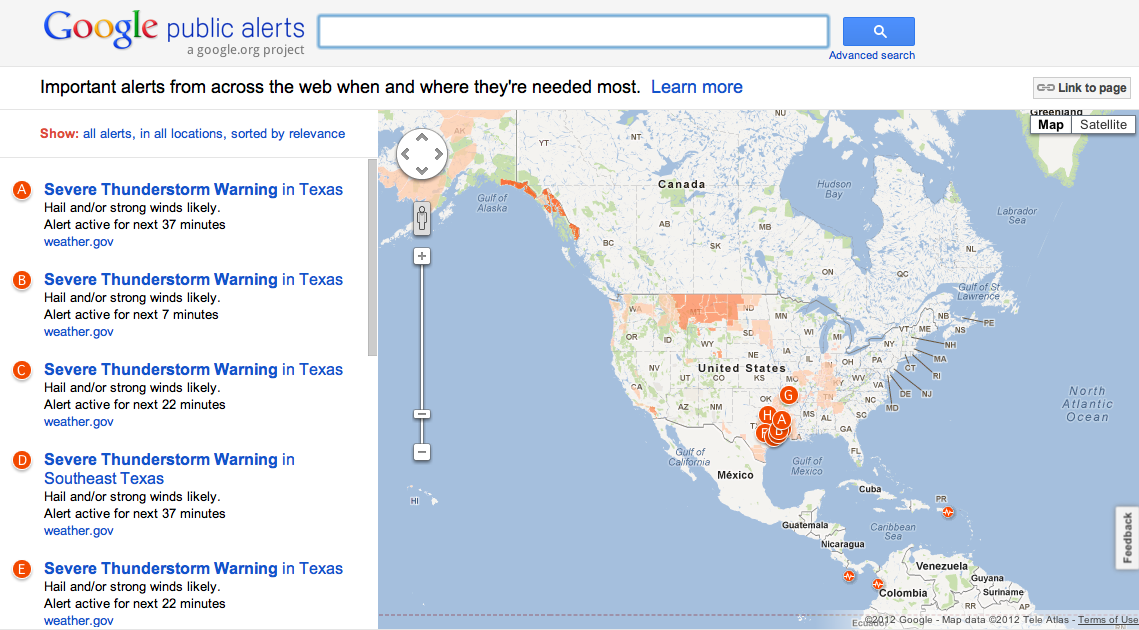
Folks seeking information on natural disasters or other global emergencies can now access Google Maps for the latest details through a new Google Crisis Response project.
The Mountain View, Calif.-based search giant launched a Google Public Alerts system today to keep users informed of disaster alerts regarding tornadoes, floods, winter and tropical storms, and other hazards menacing throughout the world.
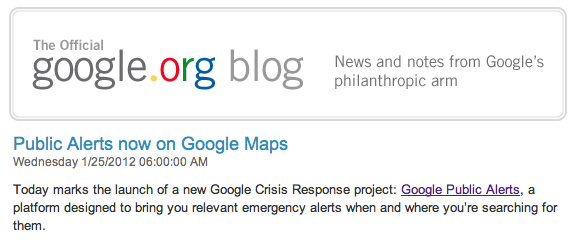
“With today’s launch of Public Alerts on Google Maps, relevant weather, public safety, and earthquake alerts from US National Oceanic and Atmospheric Administration (NOAA), the National Weather Service, and the US Geological Survey (USGS) will be accessible when you search on Google Maps,” announced Google in a blog post.
Google just announced a completely revamped privacy policy that replaces over 60 separate documents with just one, while clearly defining that signed-in Google users will now operate Google services through a unified experience.
“We’re getting rid of over 60 different privacy policies across Google and replacing them with one that’s a lot shorter and easier to read,” explained Google’s new policies’ website.
Google’s foray into the complete integration and paring of its services reflects the Mountain View, Calif.-based Company’s recent effort to create a single product, and its new privacy policy and terms of service agreement demonstrates the transition, as well.
The policy takes effect on March 1, and while users’ privacy preferences remain, the new arrangement allows Google to gather and implement user data across its services. Google is charging ahead with Search plus Your World, Gmail, Picasa, YouTube, and Google+, so it is probably attempting to connect all the loose legal ends and make one continuous experience…
Newsweek‘s Dan Lyons reported today that Apple’s “thermonuclear war” on Android smartphone manufacturers is fading fast, while a new rumor surfaced among the suits’ lawyers claiming the company spent $100 million on its initial set of claims against HTC.
“Who knows if it’s true, but if so, Apple didn’t get a lot for its money,” wrote Lyons on his RealDanLyons’ blog Jan. 23.
Apple’s legal claims are abruptly junked left and right, and its only minor victories to date are so inconsequential that Android device makers can dance around the momentary obstacles with just a few minor tweaks to products, explained the Newsweek reporter.
The technology giant’s case against HTC with the International Trade Commission began in February 2010, when the Cupertino, Calif.-based company wanted the ITC to block HTC from importing products into the United States. The case originally had 84 claims based on 10 patents, but it was dwindled down to only four claims by the time a judge became involved, according to Lyons.
The rulings —for the most part— were a score for HTC. One patent was invalid as Apple did not have a rightful claim to it, and HTC did not infringe upon two of the other patents due to Apple apparently not implementing them into its products. In other words, Apple did not have a right to seek an injunction, because ITC injunctions can only occur if it is provable that both parties are “practicing” the patent in question, which Apple could not demonstrate against HTC…
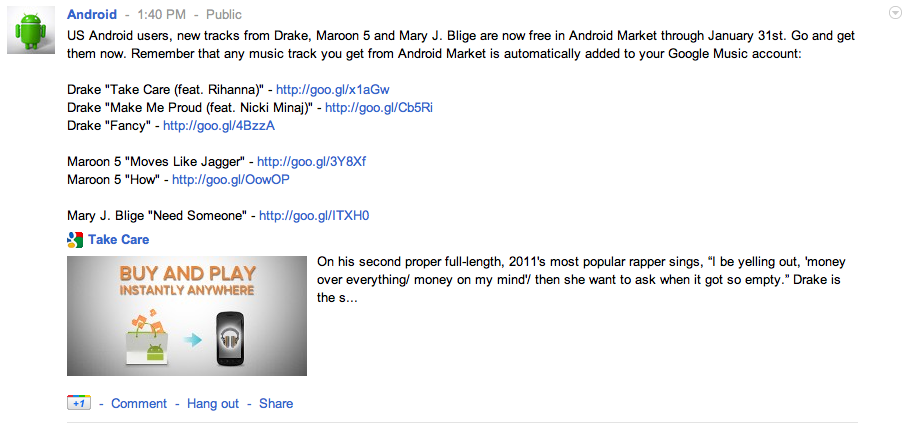
Android just announced on Google+ that new songs from artists Drake, Mary J. Blige and the band Maroon 5 are now free in Android Market for all United States users until Jan. 31. Android also reminded users that every track syncs from Android Market to their Google Music accounts, as well.
Detailed information regarding the select songs is available below.
Facebook held at least two meetings with Vevo —the most recent one occurring within the last couple of weeks— to discuss moving the music video service from YouTube to the social network’s platform.
However, sources told CNETthat the talks are “very preliminary,” and they mentioned there is one year remaining on Vevo’s contract with Google’s YouTube.
Vevo launched in 2009 and offers music videos from Universal Music Group, Sony Music Entertainment and EMI Music. YouTube helped launch the startup, and subsequently Vevo’s videos appear on the partner’s service, with Google and Vevo sharing advertising revenue.
Vevo features the most extensive catalog of premium music content on the Internet, and it is available in the United States, Canada and the United Kingdom through its website, mobile apps, or by way of connected televisions. The service currently powers music videos on artist profiles across Facebook, and its content is syndicates to numerous online websites, including AOL, BET, CBS Interactive Music Group, Fuse.tv and Univision. Moreover, through YouTube, Vevo is accessible in over 200 countries.
Facebook is allegedly interested in an arrangement similar to the one Vevo has in place with YouTube now, which would allow the social network to stream Vevo’s music videos with the two companies sharing profits from advertising revenue…
Google Inc., announced last spring that Kansas City, Kan., landed the search engine’s super-speed Internet project, but disputed details within the original agreement over wires and fees have created a troublesome hurdle, and lawyers and engineers are still attempting to find middle ground nearly 10 months later.
The local community was nicely suited for hanging Google’s cables, so it vied against 1,100 other United States localities that were courting the Mountain View, Calif.-based Company and its ambitious Internet plans. Subsequently, KCK became known as the first “Gigabyte City” or “Fiber Town.”
“Since we announced our plans to build experimental, ultra high-speed broadband networks, the response has been tremendous. Hundreds of communities and hundreds of thousands of individuals across the country have expressed their interest in the project,” said Google on its Fiber Network website.
“We’re planning to build and test ultra high-speed broadband networks in a small number of trial locations across the United States. We’ll deliver Internet speeds more than 100 times faster than what most Americans have access to today with 1 gigabit per second, fiber-to-the-home connections. We plan to offer service at a competitive price to at least 50,000 and potentially up to 500,000 people,” Google added on its official blog.
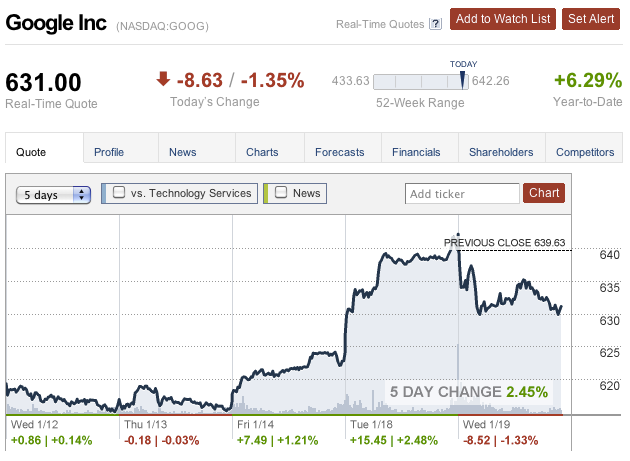
Google just announced its record-breaking fourth-quarter earnings and, within minutes of reporting, the Mountain View, Calif.-based Company dropped a whopping 10 percent in early-after hours trading due to missed expectations.
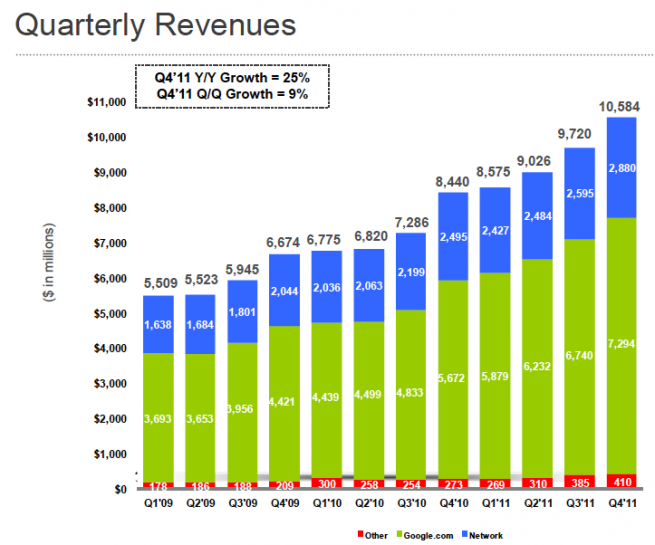
Google missed analyst expectations for earnings per share during Q4 2011 and its stock immediately plummeted. Analysts predicted the company would produce $10.49 in non-GAAP earnings per share, but it only amounted to $9.50 in earnings per share (versus $8.75 in the Q4 2010).
Nevertheless, the earnings’ upswing surpassed the $9.72 billion revenue reported in Q3 2011. Google revenue hit a record $10.58 billion in Q4 2011, before deducting traffic acquisition costs, which is a 25 percent increase from $8.44 billion a year earlier. Profit also grew to $2.71 billion, compared to $2.54 billion in the Q4 2010.
“Google had a really strong quarter ending a great year. Full year revenue was up 29 percent, and our quarterly revenue blew past the $10 billion mark for the first time,” said Larry Page, CEO of Google, in a press release.
Android, Gmail, and Google+ are also growing. The new social network reached 90 million users globally, which is “well over double what I announced just three months ago,” Page explained. The CEO also announced today that Google saw 250 million Android device activations, and over 11 billion apps downloaded from the Android Market.
“I’m very excited about what we can do in 2012 – there are tremendous opportunities to help users and grow our business,” Page said.
Although Google did not meet analysts’ expectations, the company is trumpeting its first $10 billion quarter.
The Q4 2011 financial summary and highlights are detailed below.
The European Commission set a Feb. 13 deadline to restart its antitrust review and decide whether to approve Google Inc.’s proposed acquisition of Motorola Mobility Holdings, Inc.
According to Reuters, the Mountain View, Calif.-based Company came forward with new documents to support its case, so the EU lifted the temporary suspension in order to make a decision next month.
The commission took a “routine” step and hit the pause button on its Jan. 10 deadline last month to gather more information and documents from Google, but the EU still anticipated the deal to close in 2012. It seems as though the commission’s forecast may be correct, as Motorola shareholders already announced their unanimous approval last November…
While conducting a search on Google+, a user can only comment on an existing post or share a found item, however, the Google+ team announced a new feature today that lets users start a conversation directly from search results.
Until now, options for interacting with a certain phrase or interest was limited to commenting and posting. The newly announced component suddenly turns a search into a conversation and relieves the pressure from users needing original content to partake in discussions…
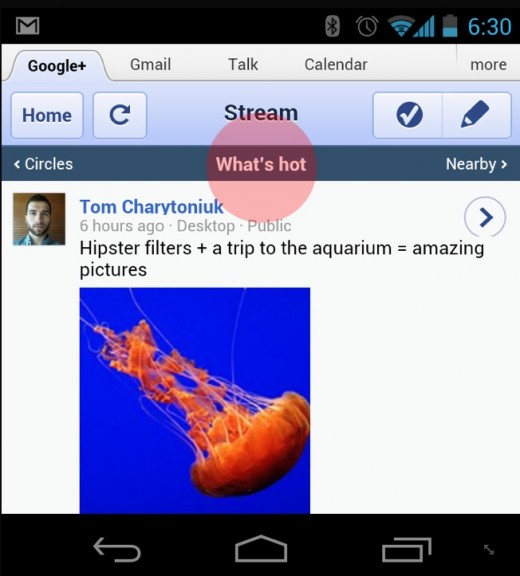
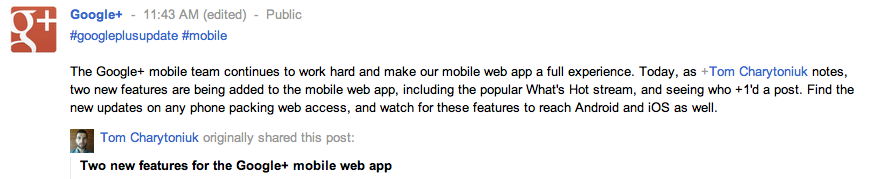
Google announced two new features for Google+, including a “What’s Hot” stream that allows users to see the most interesting content shared throughout Google+, and users can now view who has “+1′d” posts —not just the count.
These minor tweaks display Google’s attempts to make Google+ more interactive and attractive. The “What’s Hot” stream on mobile devices could be a response to Twitter’s “Discover” feature that surfaced last month. It is accessible in the Web app by swiping to the right of the Circles stream, and a constant view of trending posts for Google+ will immediately appear. This ensures a flurry of content, even when people within a user’s Circles are silent for the day…
Google Inc., is among the first of the major technology names to deliver quarterly results for Q4 2011 after the close of trading on Jan. 19, and results are generally available within minutes after the closing bell, as a conference call is scheduled at 4:30 p.m. EST.
As the Internet’s most popular search engine and information gateway, Google is one of the world’s most powerful companies, and its quarterly earnings have a domino effects on millions businesses and people. A consensus of FactSet analysts expect earnings of $10.49 per share based upon revenue of $8.37 billion, after subtracting Google’s advertisement commissions and excluding expenses for employee stock compensation. In Q4 2010, Google earned $2.5 billion, or $8.75 per share on revenue of $6.37 billion, after subtracting advertisement commissions and excluding stock compensation.
The October to December period of 2011 is likely the first time that the Mountain View, Calif.-based Company will earn $3 billion in a single quarter due to more people buying gifts through computers and smartphones, and holiday season electronic commerce increased 15 percent from the 2010, according to the research firm comScore Inc.
A more detailed breakdown of the Q4 earnings preview is available after the break.
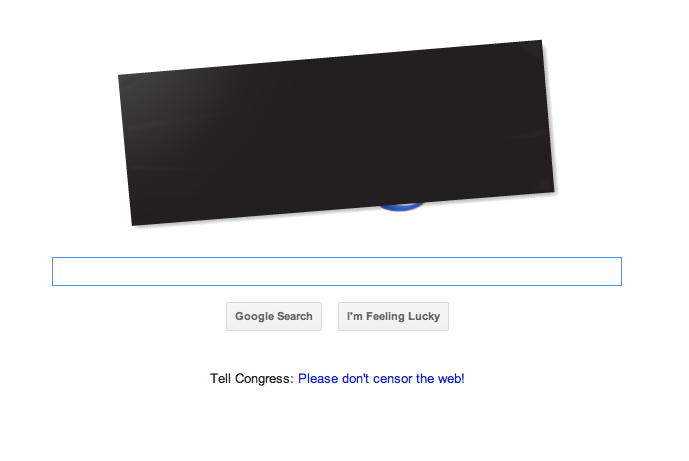
Google and many other websites went black today to oppose the Stop Online Piracy Act (SOPA) in the House and the Protect IP Act (PIPA) in the Senate, but now the globally popular search engine has taken the protest one step further.
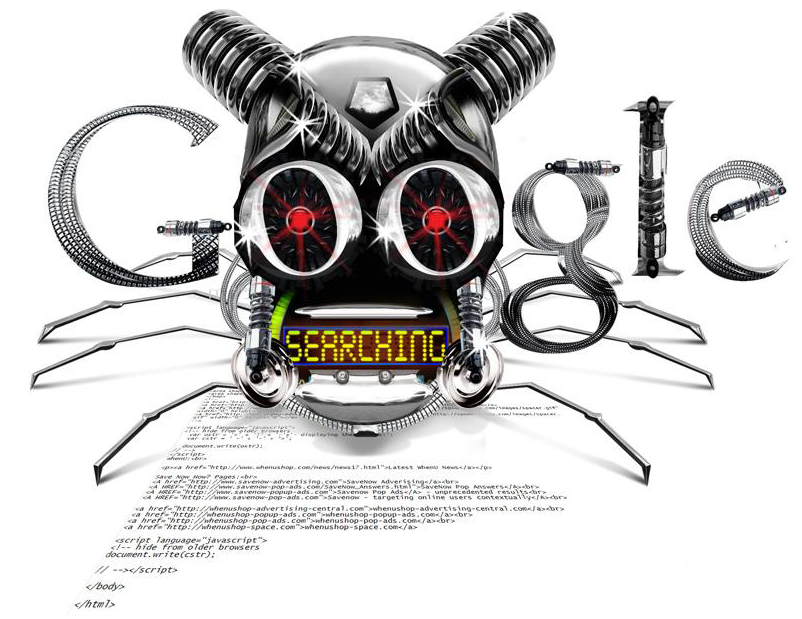
Pierre Far, a Webmaster trends analyst at Google, announced on Google+ today that the Mountain View, Calif.-based company slowed its web crawlers to continue support against U.S. anti-piracy bills.
LG Electronics unveiled the Optimus Pad LTE today — its first LTE-capable tablet.
The South Korean-based conglomerate furnished the tablet with both LTE technology and a True HD IPS display at a 1280 x 720 resolution.
“With tablets generating five times more traffic than the average smartphone, it’s not a huge jump to assume that tablet users need and want faster connectivity,” said President and CEO of LG Mobile Communications Company Dr. Jong-seok Park in a press release (PDF).
“The combination of LG’s LTE technology with the tablet form factor is a clear advantage for consumers who use a tablet as their primary consumption device when on the move,” Park added.
The LG Optimus Pad LTE is equipped with an 8-megapixel rear-facing camera and a 2-megapixel front-facing camera, and it is the first tablet to support an SD memory card expandable to 32GB.
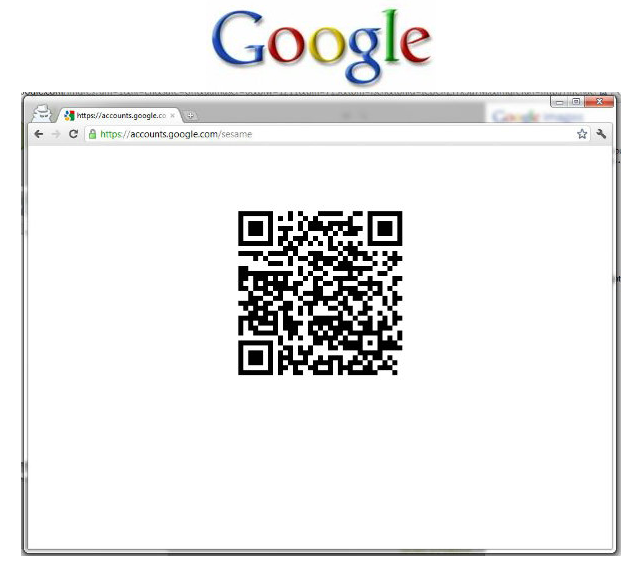
Google is experimenting again —but this time, with a QR-code login.
Apparently, a few Web surfers discovered a new QR-code account that served as an authentication tool to help Google users login securely while at a public computer. Keylogger programs are an eminent threat and may snatch and store passwords when people use public desktops to manually access Gmail and other Google services; therefore, a QR-code login could be a safer alternative.
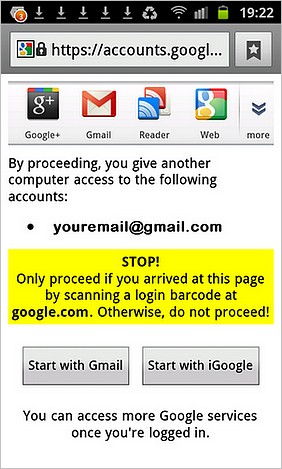
With the new login that was found yesterday, users could use Android-powered smartphones to scan a QR code on a desktop that will automatically take them to a mobile login website. According to Google Software Engineer Walter Chang, users can sign into a Google service on their own device, and the action will directly forward them to Gmail or iGoogle on the public computer. Obviously, fake QR-codes imitating as an authentic Google login could pose a security risk, as well.
The feature made the rounds on the Internet yesterday, and Google Security Team Software Engineer Dirk Balfanz took to his Google+ account to announce the QR-code login as an experimental project.
“Looks like people have found the page for an experiment we’ve been running for phone-based authentication,” said Balfanz.
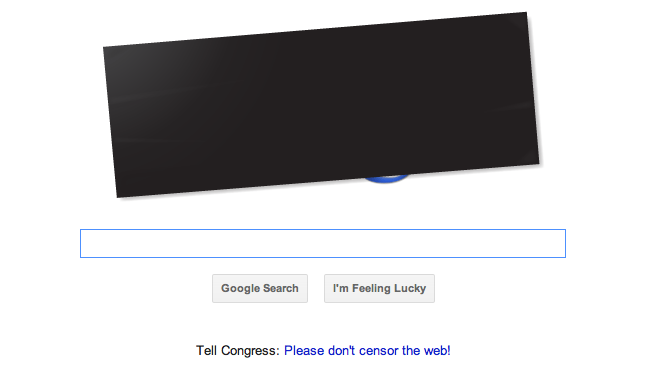
Google Inc., announced it will insert a link and censor its logo on the search engine’s home page tomorrow to emphasize its opposition to U.S. anti-piracy bills in conjunction to rolling out a new campaign that promotes online privacy awareness.
Business Weekreported the globally popular search engine is among many Internet companies that criticize the measures, claiming the bills could encourage online censorship and stunt the growth of the American technology industry.
The movie and music industries have experienced huge sale declines in recent years and subsequently support the Stop Online Piracy Act (SOPA) in the House and the Protect IP Act (PIPA) in the Senate.
According to the Recording Industry Association of America, music sales in the U.S. have dropped 47 percent, from $14.6 billion to $7.7 billion, since peer-to-peer file sharing emerged in 1999. Moreover, the Motion Picture Association of America released an info graphic (PDF) last year that claimed 29 million American adults by 2010 had downloaded illegal copies of film or television shows.
However, both bills —if passed— would be a means to prevent the sale of illegal content or counterfeit goods by websites operating outside United States borders…
Interbrand assesses brand value across the world, and the consultancy recently released its “2011 Ranking of the Top 100 Brands” with Google sitting tight at the No. 4 spot.
“With a 27 percent increase in brand value in the past year, Google’s position as one of the world’s preeminent brands is growing and nothing seems capable of stopping it,” announced the annual report.
There are three main aspects to the methodology of assessing a brand, according to Interbrand, and those include financial performance, role of brand, and brand strength. Internal factors vary between authenticity and consistency to responsiveness and commitment of the brand regarding strength…
Coby Electronics unveiled its first Android 4.0 tablet at the 2012 Consumer Electronics Show in Las Vegas last week. Well, its first of many Ice Cream Sandwich models anyway, and they each have a first-quarter launch planned.
The tablets creating the most noise include the 7 inch MID7042 for $179, 8 inch MID8042 for $299, 9 inch MID 9042 for $259, 9.7- inch MID9742 for $279, 10 inch MID1042 for $289, and the 10 inch MID1045for $299.
The upcoming units are certainly less pricey than other Android tablets on the market, but some have questioned the quality of specs available across the lineup. According to a press release, the prototypes at CES 2012 feature 1GHz ARM Cortex A8 CPU, capacitive multi-touch screens, up to 1GB of RAM, expandable memory up to 32GB, Wi-Fi and HDMI 1080p output, and a front-facing camera.
“Overall, Coby has streamlined its features to address the core applications including: browsing the web, playing games, email and viewing one’s favorite media,” announced the Lake Success, N.Y.-based consumer electronics manufacturer.
Showcase videos for a few models are available after the break.
The U.S. Federal Trade Commission is expanding its antitrust probe of Google to include the inspection of social network service Google+, according to Bloomberg.
The publication sourced two people “familiar with the situation,” and cited “competition issues raised by Google+” as the primary aspect of the FTC’s investigation into whether the globally popular search engine gives preference to its own services. The FTC is also inquiring whether such practices violate antitrust laws, according to Bloomberg, who could not identify its sources due to the investigation’s nonpublic status.
The Mountain View, Calif.-based company rolled out “Search, Plus Your World” to its search engine Jan. 10 and dubbed the revision a “personal results” feature that displays Google+ photographs, news and comments when user’s conduct Web searches. The Electronic Privacy Information Center promptly called upon the FTC on Jan. 12 to investigate the recent search changes in a letter posted on its website…
The CEO of Mocality, a Kenyan business directory startup, took to the Internet today to vent about Google poaching clients after discovering the search engine accessed his company’s database without permission to obtain sensitive sales lead information.
In the “Google, what were you thinking?” blogpost, Stefan Magdalinski claimed Getting Kenyan Business Online, a Google-backed initiative that offers small businesses free websites for one year, systematically accessed Mocality’s database to leach information. The CEO said the operatives harvested sales lead information to contact Mocality customers and pitch Google’s alternative service.
Magdalinski, after noticing the breach of security, set up a sting operation. He swapped a few clients phone numbers listed in the database with Mocality’s own call center phone numbers, and then waited patiently. Magdalinski said he was able to record calls from Google operatives in both Kenya and India. GKBO said it had a partnership with Mocality during its sales pitches, but as Magdalinski pointed out, no such partnership exists…
Chipmaker Texas Instruments placed its OMAP 4 application processors in many smartphone, tablet and e-reader devices last year, but the company debuted the first reference design demo running its latest OMAP 5 chip and Android 4.0 at CES 2012, and Texas Instruments’ Vice President said it is “way ahead of Apple.”
The device is a chunky reference design, but its responsiveness while swiping through the Ice Cream Sandwich operating system is impressive (as seen in the video below). The demo’s video playback is fluid, and Texas Instruments said the OMAP 5 could push 1080P content at 60 frames per second or more.
OnLive’s Founder and CEO Steve Perlman just announced on the official Google TV Blog that his cloud-gaming platform is launching on Google TV as an application.
The OnLive Viewer app is available now in limited form. It will let users watch other gamers play and engage in a few of OnLive’s social features.
“Cheer (click thumbs-up) if you like what you see,” wrote Perlman. “Try friending and striking up some chat. And, definitely watch some Brag Clip® videos, showing the best (and worst!) of OnLive gaming.”
OnLive is “working closely” with Google to enable full game play with worldwide gamers on Google TV, and more devices with OnLive already built-in will debut soon…
Google Maps is making headlines in a variety of ways this week.
A Jan. 10 update to the Android application made noise at the 2012 Consumer Electronics Show yesterday. The Google Maps upgrade claimed to increase battery life while improving location tracking within Google Latitude.
The latest version Google Maps also improved Transit Navigation and more closely estimates location position when GPS signal is lost. The update even increased the number of possible transit routes from three to four.
The final update includes indoor maps that can —well— navigate around various indoor venues in the United States. In this particular update, maps for CES in the Las Vegas area were included (hence all the commotion).
“We hope that these indoor maps will come in handy when finding your way through the slots and to the shops,” announced Google on its LatLong blog. “And for those of you who catch gadget-fever with CES in town, we’ve also partnered with a number of Best Buy stores in the Las Vegas area.”
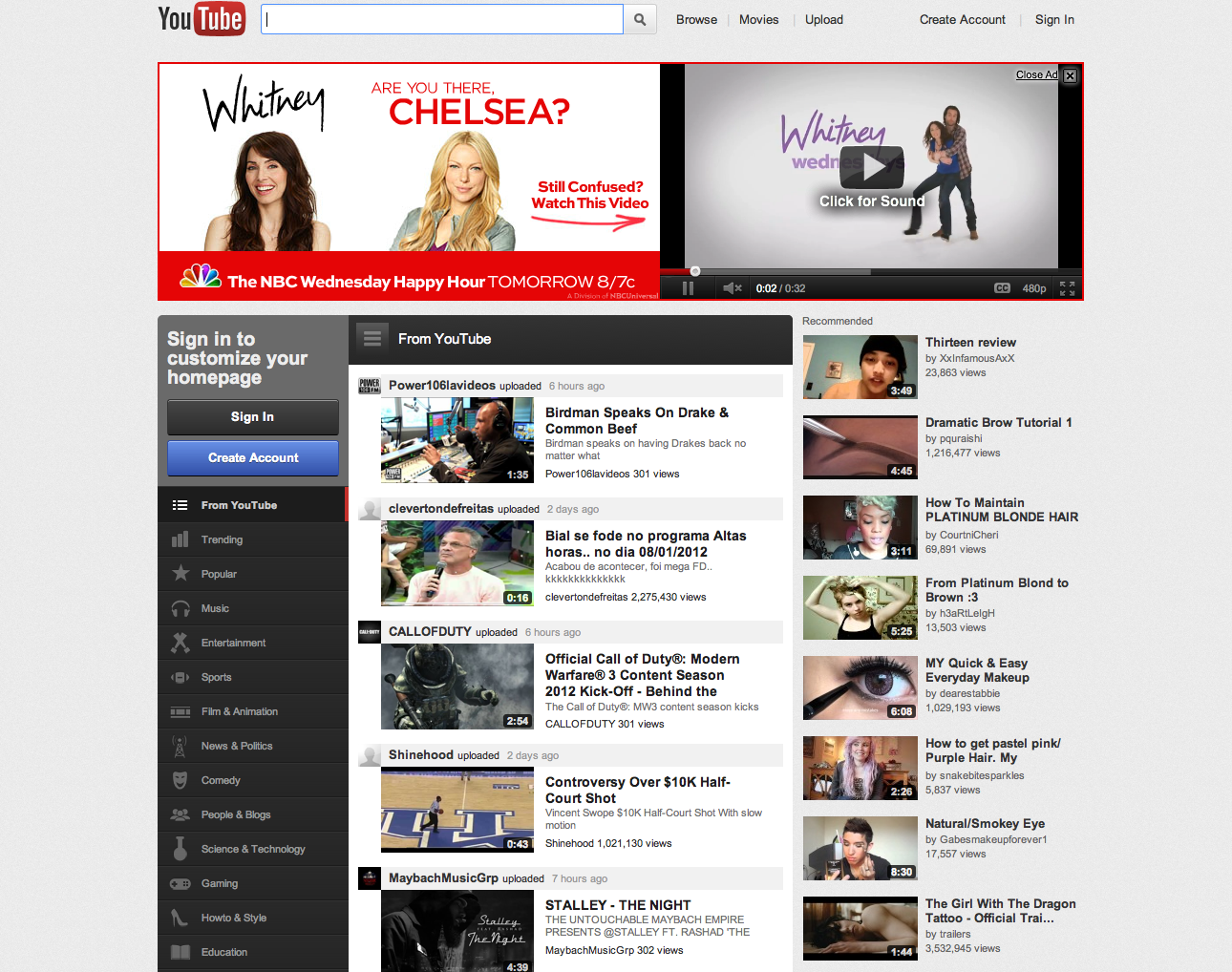
YouTube's latest interface that displays video channels upfront versus individual uploads.
The New Yorker’s John Seabrook recently interviewed YouTube’s Global Head of Content Robert Kyncl about the video-sharing service’s future and extensively detailed how YouTube is targeting a $300 billion chunk of the television industry through increased viewership, enhanced content, connected devices, and niche audiences.
Niches, as The New Yorker illustrated, are the future of television. The iconic industry started with just three networks decades ago, and it now features hundreds of cable channels each serving a niche—news, sports, food, weather, music, and more.
“People went from broad to narrow,” said Kyncl to The New Yorker. “And we think they will continue to go that way—spend more and more time in the niches—because now the distribution landscape allows for more narrowness.”
The downside to niches, as Kyncl explained, is cost. Apparently, it is expensive to program niche channels when factoring in various technical costs and the practicality of filling a 24/7 loop. However, with the advent of the Internet, niches are in high-demand, costs are lower than ever, and accessibility is at an all-time high…
Samsung participates in the International Consumer Electronics Show —the world’s largest consumer technology trade show, where the South Korean-based company unveils its latest products and innovations every January over the three-day event.
At last year’s show, Samsung hyped up its Web-connected televisions, and the company did more of the same this year by focusing on the “Smart TV” through a strategy built upon three main categories: “Content,” “Services” and “Connectivity.” Samsung covered all aspects of the Smart TV market from 3D content to voice-command options at its latest CES press conference held Jan. 9, and it seems Google TV —at this point— is certainly lagging in terms of adequate competition.
Front-facing view of Samsung's ES8000 LED TV.
Samsung ES8000 LED Smart TV
Samsung updated its television lineup with the Samsung ES8000 LED TV. It features a dual core processor, slim bezel and U-shaped stand. The television goes up to 75-inches and displays a more intuitive user-interface with an emphasis on voice interaction, facial recognition, integrated camera controls for multi-video conferencing, and multitasking.
“Let’s say you are watching a movie on Netflix and want to check in on the hockey highlights, just toggle from Netflix to one of my favorite apps, NHL Game center, and come right back to the movie without having to quit the app and launch another app,” said Samsung America President of Consumer Electronics Division Tim Baxter.
The company president said Samsung is “pushing boundaries” with an emphasis on “Smart Content, Smart Interaction and Smart Evolution.” In other words, the new Smart TV can listen, see and act without the use of a remote control.
The Samsung ES8000 LED TV will launch sometime soon.
Samsung's 'Ultimate' OLED TV debut at CES 2012.
More details on Samsung’s CES 2012 press conference are provided after the break.