
Author

Avatar for Seth Weintraub

Seth Weintraub

Founder, Publisher and Editorial Director of the 9to5/Electrek/DroneDJ sites.

Seth Weintraub is an award-winning journalist and blogger who won back to back Neal Awards during his three plus years  covering Apple and Google at IDG’s Computerworld from 20072010.  Weintraub next covered all things Google for Fortune Magazine from 2010-2011 amassing a thick rolodex of Google contacts and love for Silicon Valley tech culture.

It turns out that his hobby 9to5Mac.com blog was always his favorite and in 2011 he went full time adding his Fortune Google followers to 9to5Google.com and adding the style and commerce component 9to5Toys.com gear and deals site. In 2013, Weintraub bought one of the Tesla’s first Model S EVs off the assembly line and so began his love affair with the Electric Vehicle and green energy which in 2014 turned into electrek.co.

In 2018, DroneDJ was born to cover the burgeoning world of drones and UAV’s led by China’s DJI.

From 1997-2007, Weintraub was a Global IT director and Web Developer for a number of companies with stints at multimedia and branding agencies in Paris, Los Angeles, New York, Sydney, Hong Kong, Madrid and London before becoming a publisher/blogger.

Seth received a bachelors degree in Industrial and Systems Engineering from the University of Southern California with a minor in Multimedia and Creative Technology in 1997. In 2004, he received a Masters from NYU’s Tisch School of the Art’s ITP program.

Hobbies: Weintraub is a licensed single engine private pilot, certified open water scuba diver and spent over a year traveling to 60 cities in 23 countries. Whatever free time exists is now guaranteed to his lovely wife and two amazing sons.

More at About.me. BI 2014 profile.

Tips: seth@9to5mac.com, or llsethj on Wickr/Skype or link at top of page.

Google looks to Marvell to lead its GoogleTV transition to ARM and 3D

Site default logo image

Marvell could not quite wait for Consumer Electronics Show 2012 to spill the beans this on its huge GoogleTV win. The ARM-based processor company will have its Armada 1500 chipset at the heart of upcoming GoogleTV 2.0 solutions.

Most of the processor details are below, but the big news is that Google is going with low cost/low heat ARM processors for its next-generation set top boxes rather than Intel, who dropped out of the set top box market.  With Marvell, Google should be able to compete on price with Roku, AppleTV and the other players in the market, and more importantly, it should be able to persuade TV manufacturers to include the low cost chips into hardware designs.

Marvell boasts that the Armada 1500 does 1080P 3D, as well as Flash – even though Adobe’s long-term plans outside of the desktop market are murky at best.

It does not appear that Google will build its own devices (although, the image above makes for interesting conversation), but it will continue to OEM out Google software. In a statement, Mario Queiroz, VP, Product Management Google TV said: “The Google and Marvell teams have been working closely together to bring our combined software and chipset technologies to market to grow the Google TV ecosystem of manufacturers and devices. Marvell-powered Google TV solutions will enable powerful products to be brought to market at attractive prices.”

Eric Schmidt recently said Google hopes to have GoogleTV embedded in the majority of SmartTVs by the summer of 2012, so this is a very aggressive rollout plan.  We expect to hear much more at CES, where most consumer electronics companies release product plans for the upcoming year.

Another interesting tidbit: GoogleTV appears to be fully underneath its YouTube wing with media contacts listed for YouTube press people. The full press release is available below.
Expand
Expanding
Close
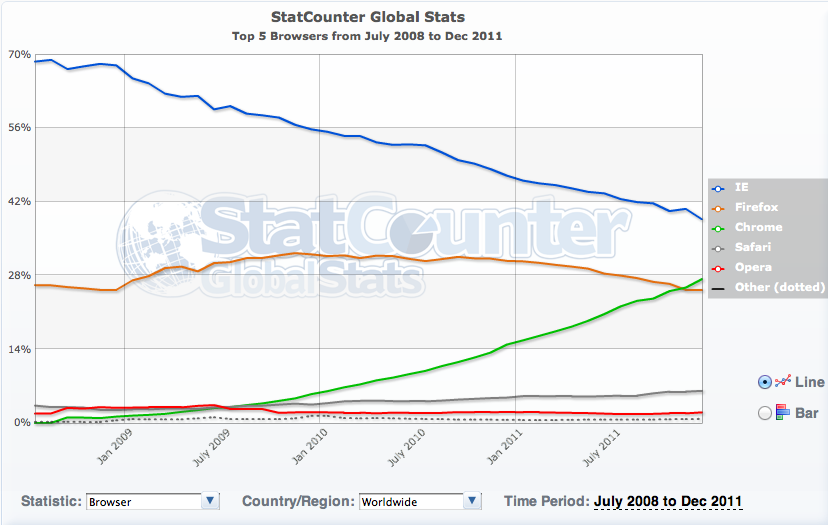
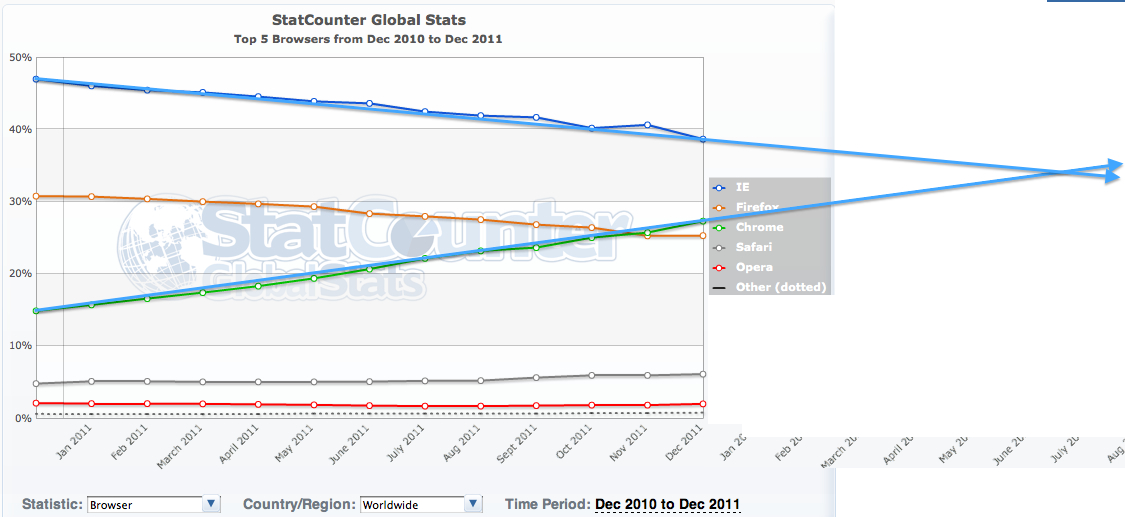
Chrome Browser ends 2011 within 12 points of Internet Explorer, will likely become the No. 1 global browser in 2012

Site default logo image

[youtube=http://www.youtube.com/watch?v=sDPJ-o1leAw]

Just a few years ago, Microsoft’s Internet Explorer owned the browser market with three quarters share and the only real alternative was Mozilla’s Open Source Firefox.  However, in 2008, Google noticed Apple’s WebKit Browser engine and built their own Chrome browser.  In late 2009, Chrome started to break out of the “other” category in StatCounter’s figures and started its rise to what will likely to be the world’s most used desktop browser in 2012.

A few months ago, Chrome passed Firefox and if you look at the slope of the graph over time, it looks like Chrome’s rise is still accelerating.  Even if it only grows at its 2011 rate and IE continues to fall at its 2011 rate, Chrome will pass Internet Explorer in late Summer 2012 according to Statcounter’s numbers.  Below, I have extrapolated IE and Chrome’s 2011 numbers over the first half of 2012…


Expand
Expanding
Close

Google counts only the devices it can count

Site default logo image

In a clearing up the “confusion” around Andy Rubin’s recent numbers releases (here and here), the Verge spoke to a Google source on what constitutes an “Android device activation.”

We’ve now gotten some additional clarification from trusted sources on what Google considers an “Android device” for the purposes of counting activations (which would presumably apply to every activation count Google has released in the past). It’s actually really simple: you need to activate Google services on the device. In all likelihood, Google’s counter actually jumps the moment you sign into your Google account on the phone or tablet, whether that be the first time you turn it on or when you’re prompted after jumping into something like Gmail or the Android Market. And as Rubin says on Google+, it only happens once per physical device.

It turns out that Google is only counting activations it activates (I know!). It is not counting devices that use Android code, because it does not have control over -or no way of- counting like the Kindle Fire or Barnes and Noble Nook (I know!).

Perhaps Amazon, who is very transparent with its Kindle numbers, could help Google out there.


Expand
Expanding
Close

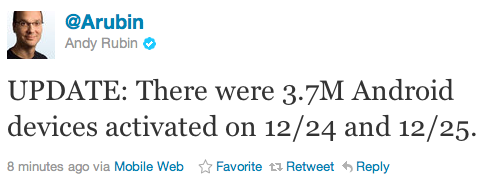
Andy Rubin: There were 3.7M Android devices activated on Christmas Eve and Christmas Day

Site default logo image

Title says it all.  Andy Rubin just tweeted some more Android numbers and they are pretty impressive.  In the two day Christmas period, 3.7 million Android phones were activated.  Compare that to 1.4 million on an average two day period.

Another comparison: After 16 months without releasing a phone, Apple sold 4 million iPhone 4S’s in the first week of release.

The Android Freight Train continues to roar.
Expand
Expanding
Close

Interview: Google Enterprise VP Amit Singh on expansion, social and numbers

Site default logo image

We sat down with Google Enterprise Vice President Amit Singh in his Mountain View office this week to discuss the direction and plans of the Google Enterprise team.  While he did not share the all-important revenue numbers with us, he did shine a light on Google Apps’ impressive growth across all of its markets.

Singh was a two-decade alumnus of Oracle when he came with many, many others to the GooglePlex last March to help Dave Girouard and the Enterprise Team sell to big business.  Oracle announced this week very disappointing earnings that has thrown the stock price off almost 15 percent.  Meanwhile, Google Apps is growing like gangbusters; Perhaps Singh’s timing is good.

9to5Google: Hi, Amit. I assume we’re here to talk about your big GM announcement.

Singh: We have no big announcements today but look forward to a whole assortment of announcements in mid-January.  We tend to announce new customers after implementation rather than after sign up. Here’s a hint: we’re growing very big in South America…and Asia, where we’re building three monster data centers in Hong Kong, Taiwan and Singapore that should all be online in the next 12-18 months.

9to5Google: Speaking on that, Apps has had a pretty solid year.  It seems like you have a big announcement almost every week and new features added to Google Docs every day.

Singh: It has been incredible across the board. We are seeing double the daily signups and about 5,000 organizations per day vs. 3,000 per day at the beginning of the year [those numbers also seems to point to bigger signups] and a lot of those are paying users.

9to5Google: You mentioned the new Hong Kong data center and it appears that Google’s plan for China is to deal with Hong Kong’s system.  But what about users in China? Certainly international organizations have to be wary of Google’s relationship with greater China.


Expand
Expanding
Close

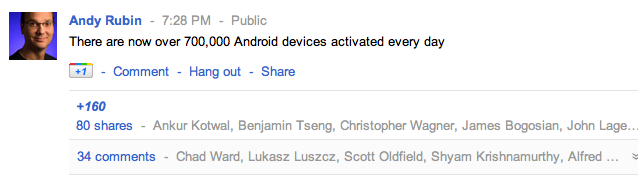
Andy Rubin announces: 700K devices activated every day

Site default logo image

Rubin made the announcement through Google Plus (and Twitter and noted:

…and for those wondering, we count each device only once (ie, we don’t count re-sold devices), and “activations” means you go into a store, buy a device, put it on the network by subscribing to a wireless service.

Google’s latest public figure was just 550,000 devices a day that was noted by Chairman Eric Schmidt in Germany earlier this year and confirmed a few times, most recently at LeWeb last week.

To put it in perspective, 700,000 devices a day is almost 5 million every week, or 21 million a month, or over a mind-boggling 250 million a year.

As a comparison, Apple announced 1 million iPhone 4S’s sold in the first day of sales and topped 4 million in the first week (after some pent up demand and a week of preorders).

The Freight Train continues to roar.
Expand
Expanding
Close

Google X’s wearable technology isn’t an iPod Nano, but rather a heads up display (glasses)

Google Goggles gets a new meaning

The New York Times today relayed an open secret among some in the Google community: the company is working on wearable technology in its secret off-campus Google X lair.  However, the technology we have heard about is not the watch-type variety as described (although, we would be surprised if Google was not working on that technology, too):

Over the last year, Apple and Google have secretly begun working on projects that will become wearable computers. Their main goal: to sell more smartphones. (In Google’s case, more smartphones sold means more advertising viewed.)

In Google’s secret Google X labs, researchers are working on peripherals that — when attached to your clothing or body — would communicate information back to an Android smartphone.

People familiar with the work in the lab say Google has hired electronic engineers from Nokia Labs, Apple and engineering universities who specialize in tiny wearable computers.

While Apple may be focusing on iPod nano-like watches, Google seems to be pushing ahead in heads-up displays. We first brought news that prominent wearables PhD Richard DuVaul moved from Apple to Google in June.  His research is focused on wearable heads up displays (HUDs).

His dissertation was on “The Memory Glasses“, a heads-up display  focused on the problems associated with wearable memory support technology. This included hardware and software architectures, and low-attention human-computer interaction for wearable computing, including the use of subliminal visual cues for just-in-time memory support.

Our source tells us that this is what Google is building.  They are in late prototype stages of wearable glasses that look similar to thick-rimmed glasses that “normal people” wear.  However, these provide a display with a heads up computer interface.  There are a few buttons on the arms of the glasses, but otherwise, they could be mistaken for normal glasses.  Additionally, we are not sure of the technology being employed here, but it is likely a transparent LCD or AMOLED display such as the one demonstrated below:

[youtube=http://www.youtube.com/watch?v=M6YQiKmDWpI]

In addition, we have heard that this device is not an “Android peripheral” as the NYT stated.  According to our source, it communicates directly with the Cloud over IP. Although, the “Google Goggles”  could use a phone’s Internet connection, through Wi-Fi or a low power Bluetooth 4.0.

The use-case is augmented reality that would tie into Google’s location services.  A user can walk around with information popping up and into display -Terminator-style- based on preferences, location and Google’s information.

Therefore, these things likely connect to the Internet and have GPS.  They also likely run a version of Android.

Google VP Marisa Mayer recently talked to Jason Kincaid about serendipity and location back in May:

[vodpod id=Video.9929744&w=650&h=400&fv=%26amp%3BembedCode%3DUzNDJoMjpzR4v5RcbxsAczC071d3QOq1]

This would be a great tie in to this system.  Instead of actual inputs, this system could just pull information as it becomes available and shoot it to the screen when the information was desired.

We do not have a release date for this new device, but we know that Google Co-founder Sergey Brin is closely associated with the project and it will be Google-branded hardware.

Google representatives couldn’t comment on rumors and speculation.

It ain’t dead yet: Flash 11.1 delivered to Android 4.0 ICS

Site default logo image

Those ICS early adopters who want to browse all the Internets, including the ones that are Flash enabled, got some good news today that Flash 11.1 is ready, right on time, for Android 4.0.  Currently available in the Android Market, the release date actually says Dec 12th wich was a few days before the release of the Galaxy Nexus in the US.

Adobe of course shelved their Mobile Flash development earlier this year after a dismal earnings report and the need for cost cutting.


Expand
Expanding
Close

Verizon Galaxy Nexus Review: Bigger, faster, cheaper and less Google

Site default logo image

LTE makes Ice Cream Sandwich all the more tasty…

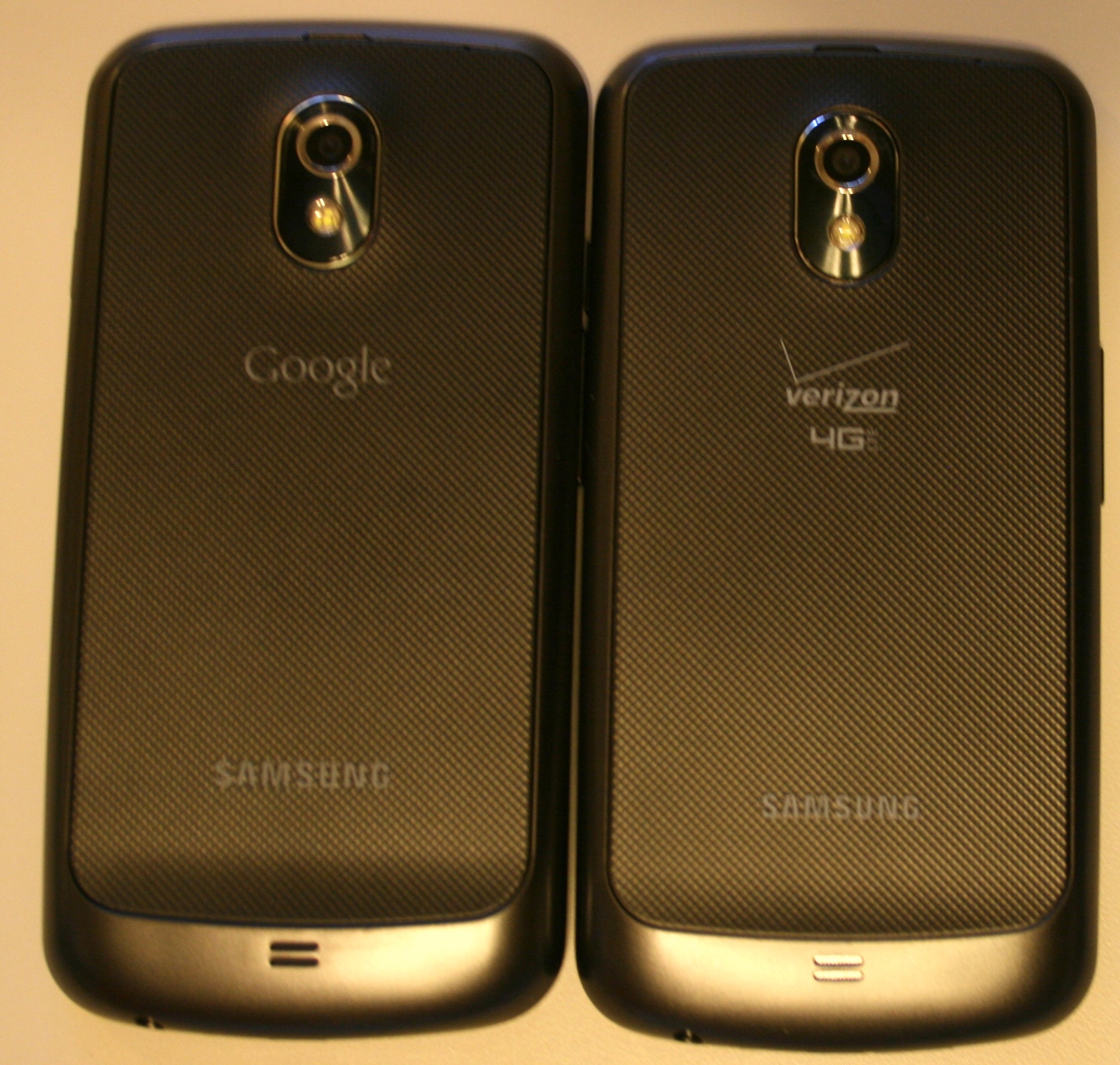
The biggest difference philisophically is demonstrated in the logos above. No longer a Google phone, the Verizon Galaxy Nexus is a Verizon LTE phone – for all that is worth.

After 24 hours with the Verizon Galaxy Nexus, I am not going to say something that hasn’t already been guessed, so refer to the previous Galaxy Nexus Review for most of my original thoughts. However, here’s what is different:

  1. The Verizon GN is slightly thicker to house the LTE Radios/antenna and the larger battery required. It’s also slightly heavier, but you will not notice or care about the size difference. Five people, who I’ve given blind tests to, could hardly determine one from the other. Battery life differences will matter more, though, as I have not run through my initial full charge on Verizon. So, that’s a good sign for the LTE version, but I still believe people will be able to go longer on HSPA+. By perhaps saving a little bit of space, Verizon/Samsung opted for an LTE Micro-SIM rather than a full sized one. This is interesting, especially when the International version is a full sized GSM variant.
  2. Bigger also means 32 GB on Verizon’s LTE vs. 16 GB on HSPA+
  3. LTE is faaaast (shocker!) and adds to an already lightning quick phone. Browsing is silly fast here: You have the fastest browser, coupled with one of the fastest processors, and an LTE connection to boot. We’re talking about desktop speeds here folks. Honestly, when I’m on a good LTE connection, it is as fast as Wifi on a Cable broadband connection… almost indistinguishable.
  4. GPS is still a bit laggy compared to other manufacturers; however, since GPS is often tied to the Baseband, I was hoping for improvement. Both versions are the same.
  5. They feel the same processor/GPU wise. There might be some differences, but real world – you won’t notice much.
  6. Verizon Backup Assistant and My Verizon Mobile come on the device. You can delete these from Manage apps, and I’m sure many will.
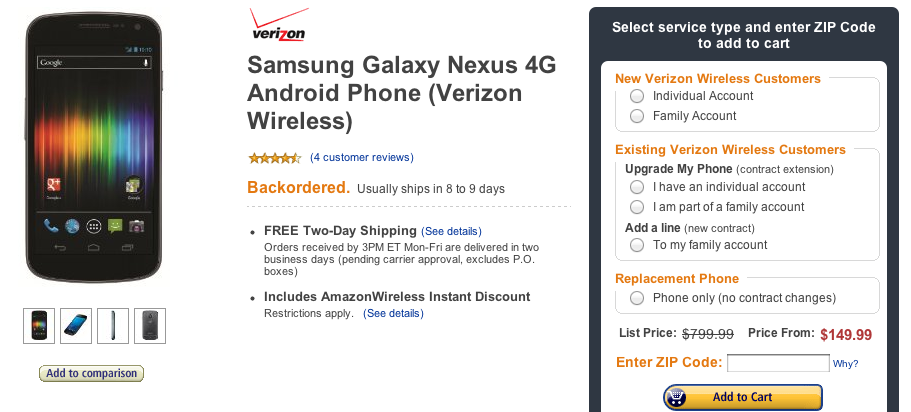
  7. For $149 on a Verizon LTE plan vs. purchasing the International version for $700+ and getting on an HSPA+ plan from T-Mobile or AT&T, I am going to wager that it is going to sell much faster than the international/unsubsidized (and the lines seem to bear this out). Whatever Verizon did to get the exclusive here was worth it (for them, not for us Google/Samsung customers).
  8. While there are no VCast Apps or navigation apps, it would appear that Google relented in putting its Wallet on the Verizon device. Verizon’s line needs more testing. I anticipate it will be allowed on the device around the time Verizon’s ISIS service arrives in 2012, if ever.

[slideshow]

Bottom line: If you are cool with Verizon and their 4G plans, missing out on Google Wallet and battery life isn’t the dominating factor in choosing a phone, so go grab one of these now. This is by far the best Android device on the market (by the way, Verizon is offering a bigger battery pack for $25).

However, if you want to roam internationally, hope to use Google Wallet or want some carrier/plan freedom or need to be on AT&T/T-Mobile, you are going to want the International version. So, pick up another device or wait it out.

Anyway…we’ll have a more in-depth look at this device when we’ve had more time to play.


Expand
Expanding
Close

Slingbox comes to GoogleTV

Site default logo image

…and just like that, the GoogleTV suddenly becomes interesting again.

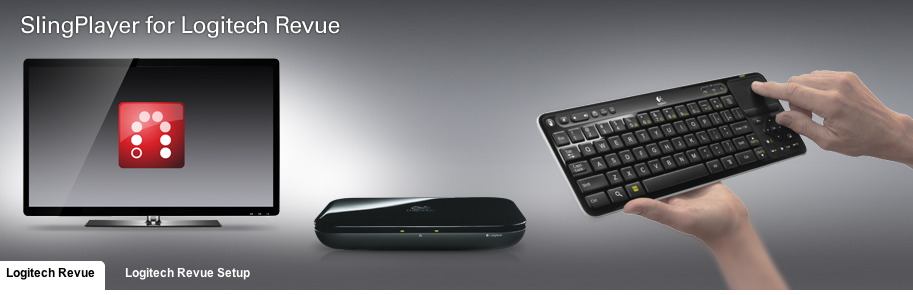
SlingPlayer for Logitech Revue

SlingPlayer for Logitech Revue now works with the Slingbox to extend your complete living room HDTV experience to another TV in your home, or wherever you want to watch. Access the SlingPlayer app from Google Spotlight and change channels, navigate the program guide, or watch and schedule recordings on your DVR – all on the big screen. Now you can enjoy your programming in crystal-clear HD on a TV in your ski condo, beach house, or let your college student watch in the dorm.

Strangely, no support yet for Sony GoogleTVs. In any case, the GoogleTV just got put in our vacation trip bag (not kidding).  Now, where is Hulu?
Expand
Expanding
Close

Galaxy Nexus HSPA+ Review: There isn’t a lot to complain about here

Site default logo image

[slideshow]

Tomorrow, or tonight, is the big US Verizon launch of the Galaxy Nexus LTE so I figured I’d better get my HSPA+ review up already.  The short version: The HSPA+ version is the best Android device on the market today.  Buy it.  You’ll be ahead of everyone else software-wise for the next year or so.

The long version:

I’ve been using the Galaxy Nexus HSPA+ version with both AT&T and T-Mobile SIMs and here are my takeaways.

  1. In my particular neck of the woods (Westchester just north of  NYC), AT&T is faster and has better coverage.  However, when I train into the city, T-Mobile has better coverage and is significantly faster as a broad generalization.  Both SIM phone numbers are tied to Google Voice so the change is pretty smooth otherwise.  What’s nice is the Google Nexus HSPA+ isn’t a BSer – it tells you when you have regular 3G or when you have HSPA+.  Most phones I’ve tested tell you you have 4G whenever you have a connection at all.
  2. The 720P 4.65 inch pentile screen is the best in the business, bar none.  I realize that the Rezound has a IPS LCD true 720P display and just about everyone is producing some sort of 720P display but Samsung’s is the best I’ve yet seen.  The only display I liked more?  Samsung Galaxy Note’s 720P 5.3″ display but that is a freakishly big “phone”.  With limited bezel, the 4.65 inch display “works” for the GN.  I still think the Droid RAZR is the coolest looking phone and won’t fault anyone for picking one up, especially at the significantly discounted price it was on offer for a few weeks ago.
  3. The GPS, like all Samsung Android  devices, is still behind HTC and Motorola as far as accuracy.  Samsung has been improving since the Captivate and Vibrant debuted over a year ago but they aren’t there yet and it sometimes takes 30 seconds for the phone to kick into navigation.  On the up side, you can use a normal charger and actually charge your phone while using GPS.  On the HTC Rezound, I actually lost charge while the device was plugged in and used GPS (and Pandora and Tethering).  So upside is low power GPS.  Downside is low power GPS.
  4. ICS is fast, feature-packed and a pleasure to use.  Android, like iOS, had gotten boring but there are a lot of cool new hooks inside Android 4.0.  Favorites include the new social contacts lists, screenshots, rapid fire camera shooting, dictation, and the improved CHROME browser.
  5. The Google Wallet omission thing is lame.  I understand Verizon blocking it.  But why can’t I use it on the International unlocked version?
    Expand
    Expanding
    Close

Verizon Confirms: Galaxy Nexus launches tomorrow, $299 w/ 2 year plan

Site default logo image

[slideshow]

After all the wait, we’ve finally gotten definitive word from Verizon: The LTE Galaxy Nexus, which will be the first ICS phone sold in the US, will go on sale tomorrow for $299 with a two year service plan from Verizon.

Furthermore, the hold up was in fact the 4.0.2 update which we told you about hours ago.

http://www.youtube.com/watch?v=CdD8s0jFJYo&feature=youtu.be&hd=1

Full press release follows:
Expand
Expanding
Close

Droid 4 makes appearance on Verizon website

Site default logo image

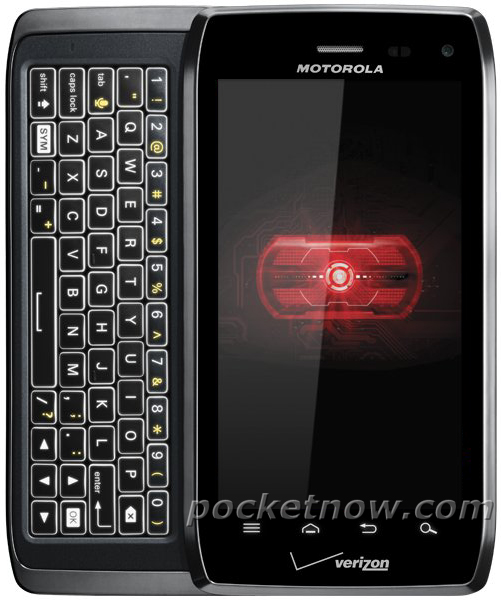
The answer to the question of “what would happen if you slapped a keyboard on the back of a Droid Razor” just showed up for a brief moment on Verizon’s DroidDoes website.  The Droid 4 “only” has a 4-inch screen compared to the RAZR’s 4.3″ but pretty much everything else lines up the same.  Perhaps more importantly, yes, that is a 5 row keyboard (4 rows is for suckers) and of course the speedy LTE comes along too. DOES below.
Expand
Expanding
Close
Virgin Optimus V No contract phone hits $65 at Best Buy, unlimited data plans start at $35/month

Site default logo image

From 9to5Toys.com:

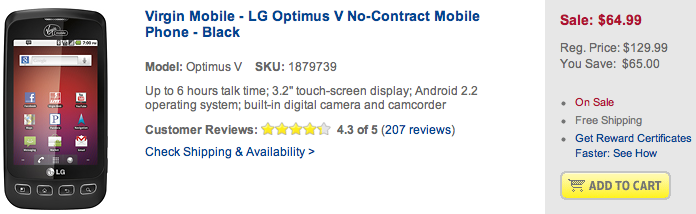
Best Buy today has the lowest price we’ve seen on the Virgin LG Optimus V since Black Friday$65 with free shipping.  That’s half price for this pre-paid Android 2.2 device.

I am a big fan of this phone because of the low, no contract pricing starting at $35/month for unlimited text/data and the relatively untouched Android 2.2 experience.  There are Android 2.3 ROMs floating around for the somewhat adventurous, though frankly Virgin should get their act together and update this phone themselves.  Even with 2.2, you get voice actions, a very capable GPS and free unlimited 3G tethering if you know what you are doing.

This is also one of the smallest Android devices you can find with a 3.2-inch 320×480 screen and nice physical buttons.

Expand
Expanding
Close
Samsung Galaxy Player 5 review: the first real Android iPod touch

Site default logo image

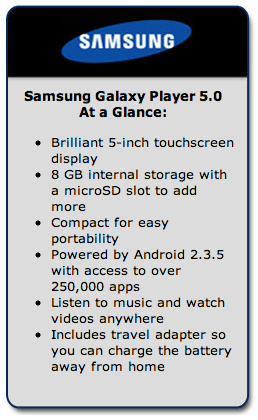
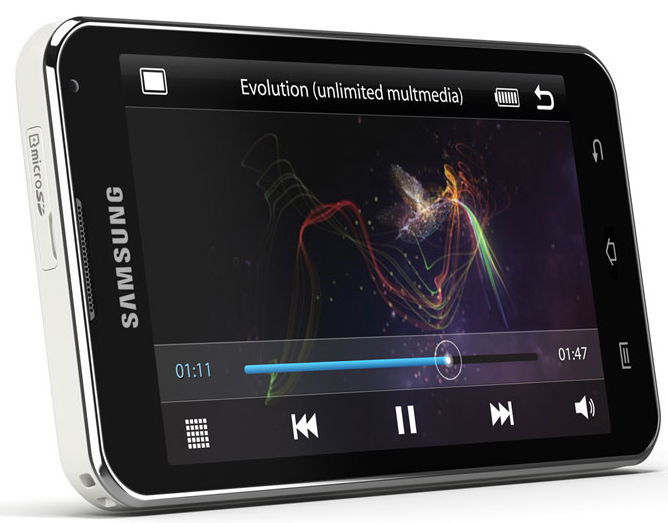
The Samsung Galaxy 5 player is probably exactly what you think it is: a big-ass Galaxy S phone without the “phone part”.  That is, it doesn’t have a 3G radio for voice and data, instead relying on Wifi to connect to the Internet.  If you are like me, however, you spend 90+ percent of your day around Wifi and during that 90% of the time, it is as good as any 3G or 4G mobile device – the reviewers agree.

As you’d expect, the screen is huge, especially compared to typical phones.  I have a white one and it looks like a comically large white iPhone 3G from afar.  The screen also has the standard Samsung 480×800 pixel count, though with the larger screen the fonts aren’t as crisp as a 4-incher.  Having gotten my hands on the Samsung Galaxy Note and Galaxy Nexus, I can tell you that this screen isn’t even close to as crisp.  But that doesn’t mean it isn’t beautiful, especially for playing Netflix or Youtube content.

This is generally the first Android device that goes up against Apple’s iPod Touch franchise and I believe it does have some compelling differentiators, besides the much larger, but not “Retina crisp” display.  I’ll break these down below:

  1. The 3MP backside Camera is actually good for taking pictures. If you’ve tried to take a picture with the iPod Touch’s backside camera, you know it is barely passable.  Samsung’s on the other hand takes decent pictures – think iPhone 3GS-type quality.  It also has a Flash for those times you are in the dark and want to cast a flashlight type shadow on your subject.
  2. Removable Storage: The Galaxy Player has a Micro SD card slot that instantly bumps your Player capacity up to 40GB with $40 worth of card. With an iPod, that costs $100.  It’s also nice for quickly moving storage around.
  3. Sound: The Galaxy Player stereo speakers blows away the iPod touch mono.  To make matters better/worse, Samsung includes a very nice pair of in-ear headphones with the Player, while Apple’s White earbuds are…what they are.
  4. FM Radio: The Galaxy Player has an FM Radio which is nice when you run out of Wifi.  FM Radio is also helpful if there is an emergency but it only annoyingly works with headphones in.
  5. GPS: If you are navigating off of a 3G hotspot or some cached maps, you’ll get a way better location than with just Wifi triangulation.
  6. Google Voice plus Skype (or other VoIP app) turns this into a great phone.  Samsung left the mic and sfrom speaker in the right spots so it makes a fantastic, if not a little large, phone.
  7. Price. Street Price of $199 and $239 for the 4 inch screen and 5 inch screen Player varieties respectively compare well to Apple’s iPods.  When considering bumping up to larger capacities is just a MicroSD card away, it is that much more compelling an offer.
    Expand
    Expanding
    Close
Marisa Mayer talks about SoLoMo at LeWeb

Site default logo image

Silicon Filter grabbed some pertinent quotes from Marissa Mayer’s interview today at LeWeb on Mobile, Local, Social (SoLoMo).  We’ll have the video up when it becomes available.  Notables:

  • Google+ was a pleasant surprise. Comparing to the low bar set by past efforts, we’ll give this one a “#obvious tag.
  • “We save two years, every day, of idle time using Google Maps and Navigation.”
  • Google+ Check-In Deals Coming Next Week (goodnight FourSquare?)
  • On the location space in general, there is still  a lot of competition
  • Android is a vehicle for delivering Google services


Expand
Expanding
Close
Verizon issues new statement on Google Wallet, “continuing discussions with Google”

Site default logo image

Following up on our Verizon blocking Google Wallet report last night, Verizon spokesperson extraordinaire Jeffrey Nelson just emailled us with an updated statement that moves from vagary to confusion.

Statement from Jeffrey Nelson, Verizon spokesperson . . .  on Google Wallet

Recent reports that Verizon is blocking Google Wallet on our devices are false. Verizon does not block applications. 

Google Wallet is different from other widely-available m-commerce services. Google Wallet does not simply access the operating system and basic hardware of our phones like thousands of other applications.  Instead, in order to work as architected by Google, Google Wallet needs to be integrated into a new, secure and proprietary hardware element in our phones. 

We are continuing our commercial discussions with Google on this issue.

“OUR Phones?”  The Google Galaxy Nexus is now a Verizon phone, not a Google phone.  So the Verizon iPhone isn’t Apple’s either it would seem.  However, Google has told us previously that you can get your Google Galaxy Nexus Android updates from Google, not Verizon.

Making Google Wallet’s NFC sound scary and experimental is a controversial tactic – especially when Verizon is heavily invested in a competing NFC payments consortium, ISIS.  Verizon will obviously not only bless, but push ISIS on its phones next year when the spec is finalized.  As for Wallet, Google’s Samsung Nexus S on Sprint has been running Google Wallet for months.

Then to make the obvious more obvious, Verizon slips up in the final sentence. Right after saying the Wallet blockade is a technical issue (“needs to be integrated into a new, secure and proprietary hardware element”), they say that Verizon and Google are continuing COMMERCIAL (not technical) discussions about the app.

Oops.  So which issue needs to be worked out to get Wallet onto the Galaxy Nexus?  Is it a technical issue or commercial?


Expand
Expanding
Close