Android

See All Stories

Breaking news for Android. Get the latest on apps, carriers, devices, and more!
Android is Google’s mobile operating system, launched in September 2008, although its history technically began with the release of the Android alpha in November 2007. To this day, Android powers the majority of the world’s smartphones and comes in several different flavors across many phone makers.

What is Android?

Android Inc.

Android, before it was Android, was a company called Android Inc. That company was founded in Palo Alto, California, in 2003 by a crew of four: Andy Rubin, Rich Miner, Nick Sears, and Chris White. The company and its project was acquired by Google in 2005 for a sum of more than $50 million, although the exact number is unknown. The company’s founders joined Google as part of the deal.

In its infancy, Android was an operating system built not for touch screen smartphones like the iPhone, but rather BlackBerry-like devices with physical keyboards. It’s well documented that after Apple shocked the world with the iPhone, ahead of its nearest competition by at least a couple years, Google and Android Inc. had to go back to the drawing board to build something competitive.

Adoption by third-party makers

It didn’t take long after the launch of the iPhone for various manufacturers to enter the market with their alternatives — and Google’s Android immediately became the obvious platform of choice for just about everyone except Microsoft. HTC was the first manufacturer on board, and introduced the T-Mobile G1 running Android in September 2008. Soon after, HTC, Motorola, Samsung, and carriers like Sprint and T-Mobile jumped on board to form the Open Handset Alliance.

Android makers across the world

Iconic Android handsets

There have been thousands of Android phones released since Android’s inception, but some have been more important to the platform’s history than others. There was the original T-Mobile G1, as mentioned, but there was also the HTC One Google Play Edition, Moto G, Samsung Galaxy S4, and others. Some of the most iconic Android handsets include:

  • HTC G1
  • HTC Nexus One
  • Samsung Galaxy S, S2, S3, S4, and their successors
  • HTC Incredible S
  • Samsung Nexus S
  • Samsung Galaxy Nexus
  • Samsung Galaxy Note
  • Nokia 8
  • BlackBerry KeyOne
  • Google Pixel and its successors

In more modern times, there are several Android smartphones makers that popped up across various niches and in several international markets. Huawei is a dominant Android maker in China and many European markets, while Samsung is by far the most popular maker in the United States by far — effectively creating a duopoly with Apple. Today, there are dozens of major device makers contributing to the Android ecosystem.

Full list of Android OEMs

History of major Android versions

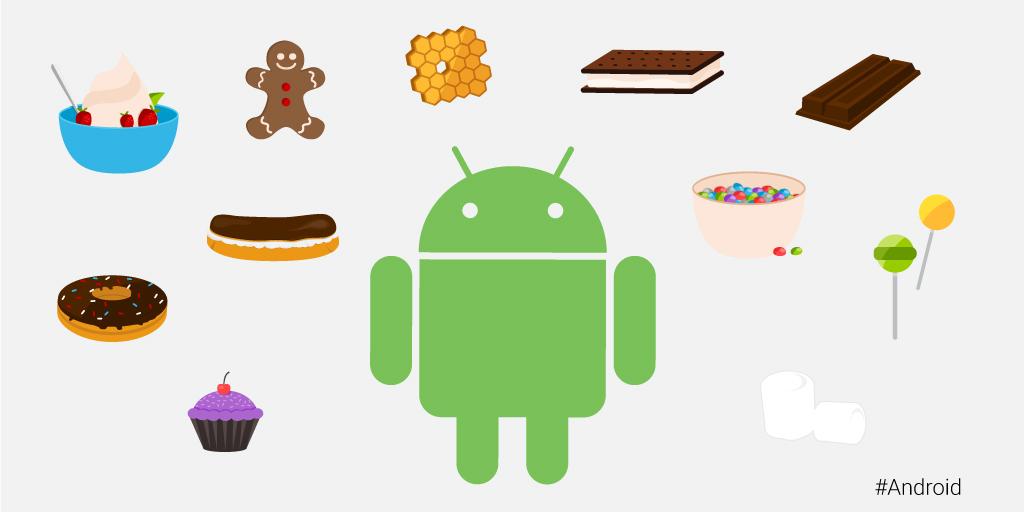
Android has seen countless software revisions over the course of its life, but in modern times the OS usually sees a major release on an annual cadence. In the earlier days, Google famously gave its major software releases dessert-themed codenames, but retired that practice in 2019 with the release of Android 10.

VersionNameReleaseDevices
2.3GingerbreadFebruary 9, 2011Nexus S
4.0Ice Cream SandwichOctober 19, 2011Galaxy Nexus
4.1Jelly BeanJuly 9, 2012Nexus 7
4.2Jelly BeanNovember 13, 2012Nexus 4, 10
4.3Jelly BeanJuly 24, 2013Nexus 7 (2013)
4.4KitKatOctober 31, 2013Nexus 5
5.0LollipopNovember 3, 2014Nexus 6, 9
5.1LollipopMarch 9, 2015Android One
6.0MarshmallowOctober 5, 2015Nexus 5X, 6P
7.0NougatAugust 22, 2016Nexus 5X, 6P
7.1NougatOctober 4, 2016Pixel, Pixel XL
8.0OreoAugust 21, 2017Pixel, Pixel XL
8.1OreoDecember 5, 2017Pixel, Pixel XL
9PieAugust 6, 2018Pixel 2, Pixel 2 XL
1010September 3, 2019Pixel 3, 3a
1111September 8, 2020Pixel 4

List of major Android OS platforms

While Android proper is certainly the most widespread of Google’s Android operating systems, the company has also launched many offshoots of the main OS over the years. There’s Android Auto, Android Wear (now Wear OS), Android TV (now rebranded to Google TV), as well as versions of Android built for tablets and Android Things (now defunct).

Google officially announces new Fit platform to track health and fitness data

Site default logo image

As was rumored earlier this month, Google today announced its new Google Fit platform. The service, similar to Apple’s HealthKit, will track all of your health metrics, including sleep, steps, biking, and much more. Google Fit will be built directly into the upcoming “L” version of Android. The “L” version of Android is expected to come out at the same time as iOS 8 and Apple’s HealthKit Platform.


Expand
Expanding
Close

Google announces new enterprise features, “Drive for Work” program, Slides app for Android and iOS

Site default logo image

During its annual developer conference today, Google announced several new enterprise features that are coming to Android with its “L” update and a new “Android for Work” program. Thanks to a plethora of new APIs, the “L” version of Android will be able to seamlessly unify personal and business apps and data. Google claims that currently, many employees are required to carry two phones: one for work and one for personal use.


Expand
Expanding
Close

Site default logo image

Google introduces new API beta that makes it easier for apps to integrate Gmail features

Yet another announcement from Google I/O today comes in the form of a new Gmail API beta that will make it easier for developers to integrate Gmail features into their apps:

While IMAP is great at what it was designed for (connecting email clients to email servers in a standard way), it wasn’t really designed to do all of the cool things that you have been working on, which is why this week at Google I/O, we’re launching the beta of the new Gmail API.

Designed to let you easily deliver Gmail-enabled features, this new API is a standard Google API, which gives RESTful access to a user’s mailbox under OAuth 2.0 authorization. It supports CRUD operations on true Gmail datatypes such as messages, threads, labels and drafts.

So what’s the benefit over IMAP or other solutions that developers have already been using to integrate Gmail features? Google says the new API, unlike IMAP, “gives fine-grained control to a user’s mailbox.” That means that an app, for example, “only needs to send mail on behalf of a user and does not need to read mail, you can limit your permission request to send-only.” There are also other benefits like speed:

To keep in sync, the API allows you to query the inbox change history, thereby avoiding the need to do “archaeology” to figure out what changed. Finally, a huge benefit is speed. While there’s still some tuning to be done (“beta” – remember?), results from our tests and feedback from pre-release developers suggest that the new Gmail API is delivering dramatic performance improvements over IMAP for web application use cases.

Google has more on the new API here. 

Google announces new Chromebook features including Android app integration

Site default logo image

Today during its annual I/O conference, Google announced that its Chromebook platform has eight OEMs and 15 devices in 28 countries. Google says that the top 10 highest rated laptops on Amazon are all Chromebooks. The company says it’s aware that most users carry a smartphone while using their laptop and to bridge the gap between both platforms, Google is introducing a feature baked into Android’s L release that will automatically unlock your Chromebook when nearby.


Expand
Expanding
Close

Google details more about Android Wear, full SDK available later today

Site default logo image

On stage at its Google I/O developer conference, the company talked wearables, as we expected it to. Google says that Android users check their phones “an average of 125 times a day,” so the company hopes that Android Wear paired with various wearables will help cut down on this number. Demoing it on an LG G Watch, Google showed more details about the Android Wear interface. The company also announced that starting today, the full Android Wear SDK is available to developers. Most importantly, Google announced that the LG G Watch will be available on Google Play today, although a price is still yet to be determined. The company also announced that the the Samsung Gear Live will be available today, as well. The Moto 360 will be available later this summer.


Expand
Expanding
Close

Android Wear-powered LG G Watch and Samsung Gear Live available today, Moto 360 launching ‘later this summer’

During the I/O Keynote, Google announced that LG’s G Watch and newly announced Samsung Gear Live will be available today on the Play Store. These two new Android Wear-powered smartwatches are going to be an exciting advancement for wearables. The Samsung Galaxy Live will be available for $199 and LG’s G Watch will be priced at $229.

Along with that, Google announced that the Moto 360 smartwatch will be available “later this summer.” It’s unclear why Motorola wasn’t able to launch alongside the two smartwatches mentioned above. No pricing was mentioned for the Moto 360.

If you’d like to pickup an LG G Watch or Samsung Gear Live, they will be available for preorder on the Google Play Store around 4 p.m. PDT and ship July 7th, 2014.


Expand
Expanding
Close

Google announces Android Auto connected car platform

Site default logo image

Building off its work with the Open Automotive Alliance, Google has just announced Android Auto. This new platform is a retooled version of Android that lets drivers safely use their connected apps and mobile services while on the road. Google says it researched what apps people were looking for while in their car and placed a major focus on navigation, communication and music.


Expand
Expanding
Close

Android “L” will include Factory Reset Protection (kill switch) and Universal Data Controls (privacy) to enhance security

Site default logo image

At Google I/O today, Sundar Pichai specifically discussed security innovations happening on Android as it builds an open platform that innovates quickly. Pichai used this as an example to jab at Apple’s iOS 8 for only now introducing alternative keyboard and widgets as Android has had the features for years. Pichai said that “less than half a percent of users” ever experience any issue with malware on Android. He also noted that 93% of Android users are on the latest version of Google Play Services which updates every six weeks. Pichai also announced features coming to Android “L” including a kill switch and universal privacy controls.
Expand
Expanding
Close

Google announces over 300 million active mobile web users

Site default logo image

Today at I/O, Google’s director of product management for Chrome,Avni Shah announced that the company has over 300 million active users on its mobile browser. Based on the company’s new Material Design, this refreshed version of Chrome features new animations that move at 60 frames per second. One of the new features coming to mobile web is the addition of Recents being able to display Chrome tabs for fast access.


Expand
Expanding
Close

Google announces Project Volta & Battery Saver to vastly improve battery life on Android

Site default logo image

Today towards the end of its keynote address previewing its upcoming Android L release, Google announced software enhancements coming in the release that will vastly improve battery life. Dubbed “Project Volta”, Google has new tools for both developers and users that will increase battery life and optimize software on devices to be more efficient.

Google showed off a new tool called Battery Historian that will help quickly identify a system task that might be draining battery. The company said it’s already been using the tool to make Google Apps more efficient and hopes it will improve instrumentation of battery data for all. It also has a new Jobshceduler API that will allow a device to better allocate system tasks when users might be low on battery.

Lastly, Google has a new Battery Saver mode that allows things like clocking down CPU, turning off background data, and other tasks that are hard on battery life. The feature can be triggered manually or configured to come on when battery is low. Google said the Battery Saver can offer up to an extra 90 minutes of usage on a Nexus 5 for a typical day.

“L” version of Android to drop Dalvik, introduce new Android Runtime with better performance, graphics

Site default logo image

While introducing its “L” release of Android on stage at Google I/O, the company announced that this version of Android runs on the ART, or Android Runtime. Previous versions of Android ran on the Dalvik runtime, but the “L” version of Android is dropping it in its entirety.  Googler David Burke introduced this change on stage and said that the switch to ART should make Android run “twice as fast” as it did with Dalvik. Burke also said that developers won’t have to make many changes to switch to ART.

ART is a 64-bit runtime that includes a variety of changes. It’s designed to support a mix of AOT and JIT, and is cross-platform with support for ARM, x86, and MIPS. ART is much better for “garbage collection,” Burke said, in addition to being better about managing RAM. Graphic support is also much improved with ART. It supports graphic qualities like tessellation, geometry shaders, and many other things designed for gamers. Burke remarked that “You’re going to see new high-end tablets and phones with PC gaming capabilities.”

As part of the new ART-based operating system, Google introduced Project Volta, designed for improving battery life.

Expand
Expanding
Close

Google announces Android One program to create high quality, affordable smartphones in developing markets

Site default logo image


Screen Shot 2014-06-25 at 11.18.23 AM

Today at Google I/O, Sundar Pichai announced a new program called Android One. The program will launch in India in the fall with partners including Karbon, Spice, and Micromax. The Android One Software Experience includes stock Android like what is found on Google’s Nexus devices with Play apps auto-installed with automatic updates. The program is intended to create high quality, affordable smartphones for developing markets using easily available parts to keep cost down. As an example, Pichai showed off a sub-$100 smartphone featuring a 4.5-inch display with dual SIM, SD card slot, and FM radio. After launching in India, Google will expand the Android One program.

Expand Expanding Close

Numbers from Google I/O: Over 1 billion 30 day active users, 62% of overall tablet market

Site default logo image

Today Google kicked off its opening keynote address from for its Google I/O developer conference with an update on some company numbers since last checking in. Here’s a break down of some numbers and updates announced by Google’s head of Android and Chrome Sundar Pichai during today’s keynote including over 1 billion active users over a 30 day period. That is a measurement that’s replacing the activation numbers per day it usually announces:
Expand
Expanding
Close

Site default logo image

LiftMaster MyQ home automation platform now “Works with Nest”, triggers thermostat when garage door opens

Following the announcement that Google will open up its Nest smart thermostat to third-party app developers interested in integrating with the platform, LiftMaster’s MyQ® technology announced at Google I/O today its now an official “Works with Nest” product. That means users of LiftMaster hardware and the MyQ home automation mobile app for Android and iOS will be able to automatically trigger Nest. Imagine Nest automatically switching to Away mode when closing your garage door (LiftMaster makes garage door opener hardware and software) and it switching back to Home mode when opening the door:

In working with Nest, LiftMaster customers will be able to easily and quickly set their Nest Learning Thermostats to Away mode when closing the garage door as they leave home and switch back to Home mode when opening garage doors upon returning home –making it easier for them to avoid wasting energy heating or cooling an empty home. In addition, our customers will be able to view their home temperature by accessing Nest directly from the MyQ app.

The company sells a number of garage door opener products that work with its mobile app and its MyQ technology is integrated into many Chamberlain garage door openers sold in stores. Full press release below:

New press render shows what could be the Moto X+1, possibly to be unveiled at I/O

Site default logo image

We’ve been hearing quite a bit  recently about the upcoming Moto X+1, which is expected to be Motorola’s next flagship smartphone. Now, 9to5Google has received what appears to be a promotional render for what is said to be that device from a source we consider reliable.

While a lot of information has already been leaked about this phone, one new feature revealed by this source is the apparent inclusion of a front-facing speaker at the bottom of the phone, though the purpose for that hardware (beyond possible music playback or speakerphone support) is still uncertain.

The source says it’s possible this phone will be revealed at Google’s I/O developer conference. If that’s the case, it would make sense for promotional images to start floating around about this time as the company prepares to unveil the next-gen device.

We’ve also gotten our hands on two separate images from a second render from the same source which is embedded below:


Expand
Expanding
Close

Google to unveil at least one Android TV-powered set-top box during Google I/O

Site default logo image

Earlier today, Bloomberg published a profile of Android head Sundar Pichai in which it was stated that Google has several Android TV announcements slated for its I/O developer conference tomorrow. The WSJ has now published another report corroborating the earlier profile. According to the report, Google on Wednesday will unveil at least one “small set-top box” running its new Android TV operating system.


Expand
Expanding
Close

Last-minute unlikely moonshot for Google I/O: Nano blood bots that are read by Android Wear

Site default logo image

I missed out scooping the Google Glass skydiving unveil at Google I/O 2012 because I didn’t believe my source. He knew about the entire thing, but it was too unbelievable for me to post. I’m posting this late word from my source because I think there is a small chance that Google announces it tomorrow (by posting late, it hopefully won’t go mainstream and I don’t look like an idiot when it doesn’t happen).

According to the source, Google has some biomedical superstars working in its X Lab on some cutting-edge micro bots that can detect things like certain kinds of cancer. These bots are small enough (the size of blood cells) to fit through human capillaries, yet they can detect diseases in the blood and can trigger an RFID reader, which in turn talks to a watch – perhaps a device running Android Wear. I was told this technology is at least 2 years from being a real product (and likely more when you consider FDA and public outcry). This isn’t the first time we’ve heard of nanobots circulating human bloodstreams, with scientists working on the idea as far back as 2009.

The bots would circulate in your blood stream, and when they went through your wrist (under your watch), the watch would be capable of reading the status (cancer/no cancer etc.).

Similar technology is already well documented and in recent years has become closer to something Google could actually use in a product. Ray Kurzweil, futurist and director of engineering at Google, described his vision for nanobots that could enter our blood stream in a piece he penned for The Guardian back in 2007:
Expand
Expanding
Close

Site default logo image

Netflix for Android updated with new logo, tweaked interface

Hot on the heels of a similar update to its iOS app, Netflix this evening started rolling out a minor update to its Android app. The app bumps the app to version 3.6, but is relatively small. The first thing you’ll notice is that the app has an entirely new logo. Instead of being white on red, the logo is now red text on a white background.

There’s also a minor interface tweak within the app. The action bar along the top of the interface is now black, whereas it was originally red. This makes the app look quite a bit different, more so than you’d expect a different color change to.

The update is available on the Play Store now.


Expand
Expanding
Close

Google reportedly making moves to boost Android’s appeal to business customers

Site default logo image

Google I/O is literally hours away and while we expect to see several things at this year’s conference, one of Mountain View’s biggest talking points could be improving Android’s appeal to business customers. To accomplish this, Google’s head of Android, Sundar Pichai is in talks with companies like Qualcomm to develop chips that store confidential information such as passwords and user data, so they won’t be as vulnerable to hackers, according to The Information.


Expand
Expanding
Close

Report: Samsung’s “Gear Live” Android Wear smartwatch specs & July 7 release date leak

Site default logo image

Following a report that Samsung was preparing to launch one of the first smartwatch products running Google’s new Android Wear platform, another report today follows up with what it says its branding and full specs for the device. A translated report from alt1040.com claims the Samsung Android Wear product will be dubbed “Gear Live” and begin selling on July 7 following an unveiling sometime this week at the Google I/O developer conference.

The report, which claims Samsung will unveil the device as one of the first products running the Android Wear OS, also shared full specs for the device that include a 1.63-inch display, 4GB of storage, a heart rate monitor, and a 300mAh battery:
Expand
Expanding
Close

Nokia announces the X2, a quasi-Android smartphone with mid-range specs

Site default logo image

Today Nokia announced the X2, the Finnish company’s second attempt at producing a smartphone that plays nice with Android. Not to be confused with Motorola’s flagship circa 2011, Nokia’s new device features a 4.3-inch ClearBlack WVGA display, a 1.2GHz Snapdragon processor, 1GB of RAM, 4GB of storage space and a 5-megapixel shooter with an LED flash. Available in a broad range of colors, including green, orange and black, additional hues are scheduled to be launch after its release.


Expand
Expanding
Close

Sundar Pichai to Tim Cook: Android’s not a toxic hell stew, it’s just a more popular operating system

Site default logo image

Bloomberg Businessweek just published a lengthy profile and interview with Google’s head of Android and Chrome Sundar Pichai and within addressed some of Apple’s recent comments about Android. While much of the conversation circled around what we can expect from Google at this year’s developer conference and Sundar’s scheduled keynote address — wearables and TV will be a big focus— Sundar was also asked his thoughts on Apple’s recent announcements at its own WWDC developer conference earlier this month.

While noting that much of what Apple announced for iOS 8 were features that Android already had— third party keyboards, widgets, etc— Sundar said shipping a new version of Google Play every six weeks makes Android allows them to “move the platform faster than anyone else and provide a consistent layer for developers.” Next he addressed Tim Cook’s claim from WWDC that Apple is gaining lots of new customers from Android switchers:
Expand
Expanding
Close