Stay up to date on news from Google headquarters. Be the first to learn about plans for Android, Google Plus, Google Apps, and more!
Stay up to date on news from Google headquarters. Be the first to learn about plans for Android, Google Plus, Google Apps, and more!

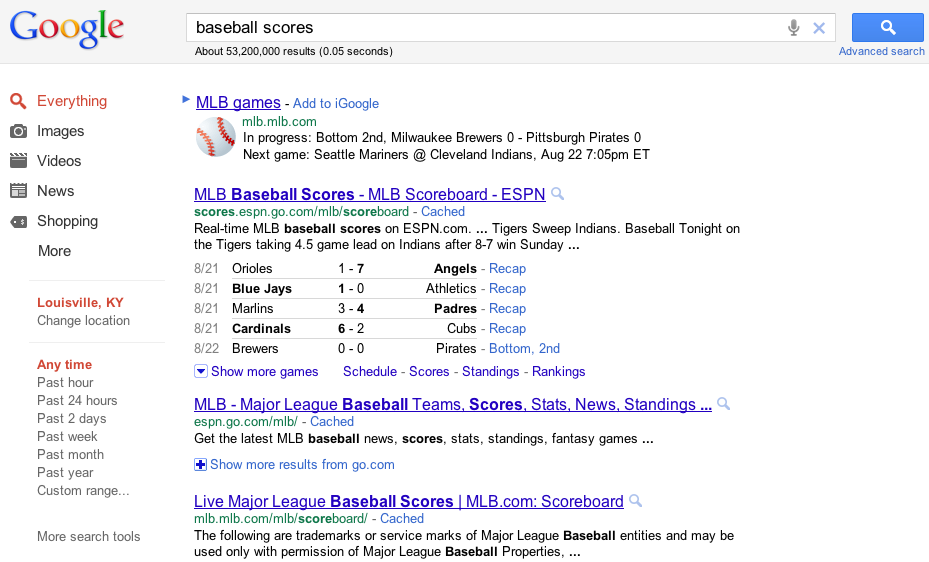
Google and ESPN have announced they are now offering sports scores, presented through microdata, straight into Google Search results. For now, Google and ESPN will only be offering Baseball, but more sports will be following very soon. A simple search of “Baseball Scores” returned the following results.
Besides making the obvious search, you can also search specifically for teams, players, and scores. The results include up-to-date game scores and statistics, and link off to content on ESPN.
Expand
Expanding
Close

We already showed you how to give Google’s new search UI a try, but yesterday The Next Web discovered that you can also give Google’s new sign-in page a try. The new sign-in page goes along with the rest of Google’s general new design we’ve been seeing spring up across products, ever since the launch of Google Plus. Enabling the new design is much easier than what we showed you yesterday. You could just go and click the option to preview the new sign-in page, but here’s the link to make things easy.
While there isn’t much of a change, we do like the new colors and general spacing.

Google has been on a role rolling out new designs across all of their products, including Google Search. Techno-Net (via Google Operating System) has discovered that with a small cookie change you can try the latest version of Search. The new version features a less uncluttered look, but we’ve read it isn’t as fast as the version you know and love. Head on past the break to see how it’s done.

The latest rumor out of the mill is that Google is developing multiple online “Celebrity Themed” online TV channels. It is unclear exactly where these channels will be located, whether it’s YouTube or a part of a bigger plan to bolster Google TV. A source said yesterday that such celebrities as Robert Pattinson, Cameron Diaz and Deepak Chopra are just a few of the celebrities that will take part in this project.
This news would not be surprising as Google has recently been adding additional services to its YouTube platform in hopes of monetizing the service further. Combine this with their fledgling Google TV service, Google may see an opportunity that other streaming services are currently not taking part in. Would this be a good opportunity to snap up a Logitech Revue on the ($99)cheap?
Expand
Expanding
Close
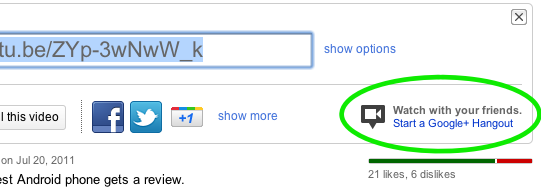
YouTube’s Brian Glick gave Google+ a short feature update this evening. We’ve enjoyed watching YouTube video in Google+Hangouts ever since the product launched earlier this year, but today you can now start watching a YouTube video with just one click. After clicking the “Start a Google+ Hangout” when watching a video on YouTube, you’re brought into the Hangout you know and love, where you can invite your friends to take part. We’re looking forward to seeing how much traffic this drives to Google+. (via The Next Web)

Image credit: dropit2entrecard.blogspot.com
Something fell off our plate amid the late craze in tech reporting, especially with Google buying Motorola and HP abandoning PC biz and webOS devices. That doesn’t mean this little nugget is not worthy your attention, quite the contrary. Three years ago, Google mentioned it would eventually enable the so-called native code execution in Chrome. The latest beta of Chrome 14, unleashed a week ago, now supports this functionality, the Google Operating System blog has discovered.
In Layman’s terms, native code execution lets the Chrome browser run snippets of web code specifically optimized for your computer’s processor rather than analyze, interpret and painstakingly turn HTML code line by line into a machine-readable format – that takes a lot of time, slowing down code execution as a result.
Google’s definition simply states the technique lets developers “build web applications that seamlessly execute native compiled code inside the browser”. For our tech-savvy readers, Google outlined some of the benefits of this technique in the announcement blog post three years ago:
Modern PCs can execute billions of instructions per second, but today’s web applications can access only a small fraction of this computational power. If web developers could use all of this power, just imagine the rich, dynamic experiences they could create. At Google we’re always trying to make the web a better platform. That’s why we’re working on Native Client, a technology that aims to give web developers access to the full power of the client’s CPU while maintaining the browser neutrality, OS portability and safety that people expect from web applications.
The stable Chrome 14 release is expected within a month, when native code execution will become standard feature for the 160 million active Chrome users, as of May 11. So, why should you care? Read on…
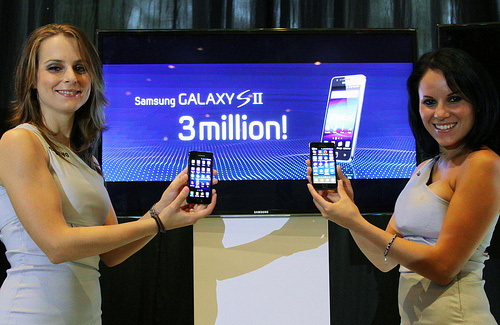
Apple has already tried to ban the Galaxy Tab 10.1 in most of Europe (injunction lifted), but today they are going even farther with their legal proceedings, asking a Netherlands court to ban all Galaxy series devices. The ban includes the widely popular Galaxy S II, which has seen some success in Europe. On top of trying to ban sales, Apple is trying to push the thought of Samsung sending a letter to all of their partnered retailers within 14 days to end sales. Stated strongly:
“For the record we would like to mention the fact that by storing, offering and/or selling of the above mentioned Galaxy smartphones [and tablets], you commit infringement of the intellectual property rights of Apple Inc.,”
The trial will take place in The Hague, Netherlands September 15th, and the judge said if he grants any injunctions, they would take effect no sooner than Oct. 13. (Webwereled via Computerworld)

[youtube=http://www.youtube.com/watch?v=PvIYjsRwt5A&feature=player_embedded]
Google has just launched a nifty new weather layer for Google Maps that provides you with current weather conditions from around the globe generated by the U.S. Naval Research Lab. This will definitely save you the frustration of jumping from Maps to your current weather app of choice when planning your next excursion.
You can click the icon for any given city to get a four-day forecast and more detailed data including wind and humidity conditions. In the left-hand pane, you can select temperature(F/C) defaults, wind speed (km/h, mph, or m/s), and optionally “hide clouds”.
Click here to start using the new weather layer now. You can also enable the weather layer at any time from the menu in the upper right corner (image below).
Expand
Expanding
Close

The smoke has cleared on Google’s $12.5B purchase of Chicago-based Motorola and now that almost everyone has had a chance to speak, I think we’re starting to understand what went down.
Google purchased Motorola (MMI) for $12.5B, a 63% premium over its weekend closing price. Motorola, however, has around $3B in cash and securities, which makes the real purchase a slightly more reasonable $9.5B for Google. For instance, if Google wanted to slice and dice Motorola, they’d take the cash and patents and sell off the cable box and device divisions for a couple billion dollars each and come away with about what they would have paid for Nortel – and get double to triple the patents. On sheer numbers of patents alone, it seems like a good buy. Obviously some patents are worth more than others.
If the deal doesn’t go through, Google owes Motorola $2.5B for the trouble, so Google is dead serious about this play.
But back to what Motorola does: They have IP, they make smartphones, they make tablets and they make cable top boxes. It seems like almost too good a setup for Andy Rubin’s Android to just want to sell off piecemeal.
But did Google want to pick up a hardware company? I reported earlier this year that the Android Hardware division that Andy Rubin had started up with former Danger Co-founders had intentions to build physical devices, not just Operating Systems.
That scale is what attracted and the former Danger founders to get the band back together, with their goal being to build the hardware and features they want to see show up in new Android devices. It’s not enough for Google to just provide Android software to carrier — now they hope to influence what handset makers build, too.

Shoot, I’d take a 63% return on my investment, wouldn’t you? It seem’s like a lot to us, but a Motorola shareholder thinks Google underpaid in their acquisition of the company Monday. The shareholder believes Google solely paid for the patents, and not the rest of the mobile phone business. To back up the shareholder’s statement, analytical firm Frost & Sullivan came up with the same conclusion. (Phandroid via ZDNet)
Motorola has a portfolio of 24,500 patents and patent applications that instantly bolsters Google’s strength in the IP war. Looking at some recent patent auctions and using some simple math can show why these patents were indeed the target of Google’s acquisition.
Continue after the break..

Late this afternoon, Google announced a new blog called Magnifier. Magnifier’s purpose is to shed light on new songs, and well, to remind you to start using Google Music Beta again. The blog features free music and interviews from the artists that make it.
Each day there will be a “Song of the Day” available for free. Today’s featured artist is a personal favorite of mine, My Morning Jacket. Head on over and grab two free songs.
 According to the Wall Street Journal, Kodak has started the process of auctioning off some or all of its lucrative patents. Kodak’s demise is well documented as the once $30B company has seen its market cap slide to around $800m as the digital imaging company has continuously lost share to competitors. According to the WSJ one potential bidder is “a large, strategic buyer in the wireless industry looking to use the patents for defensive protection.”
This news comes on the tails of this past Monday’s acquisition of Motorola Mobility by Google for a whopping $12.6B in cash. Google has long been rumored as potential suitors of multiple patent-holding companies such as InterDigital, Kodak and of course Motorola Mobility. If these Kodak patents do sell, they will not gather nearly as high of a price as the Motorola deal, but could likely see Kodak’s stock take a nice move up. This morning’s news of one analyst saying Kodak’s patents could be worth 5x the company’s market cap sent shares up more than 25% and are currently up more than 5% in after hours trading on the latest Wall Street Journal news. Meanwhile, InterDigital saw a pop in its shares today as another rumor was swirling that an auction will take place after Labor Day weekend and that there are multiple interested parties.
Expand
Expanding
Close
Using their Content ID feature, YouTube can match song covers to a publisher to enable them to make money from a video they didn’t publish. Today to help Content ID along, YouTube announced they landed agreements with National Music Publishers Association (NMPA) and its subsidiary Harry Fox Agency (HFA). Today’s agreement will give YouTube another 46,000 more songs to match ads to. YouTube currently also has agreements with many more publishers.
Going forward, the 46,000 music publishers already affiliated with HFA will be able to license the musical compositions they represent for use by the YouTube community. When these publishers allow YouTube to run ads alongside user generated videos that incorporate their compositions, the publishers, and the songwriters they represent, can make money.
Some users don’t agree with Google/YouTube’s decision to place ads on content that they made — such as a cover of a song. The user isn’t actually using the artist’s song, per-say, but using their own voice..and they don’t get to make a cent from it.
Expand
Expanding
Close
[youtube=”http://www.youtube.com/watch?v=Grr1arPxX0E”]
To go along with their new expanded sitelinks, Google is testing infinite scrolling in Google Search. This new feature will allow you to view all of your search results on one page, but you do have to click a “more results” button. Google has already announced this feature in Images, so there is a chance this could stick around in Search. Google told Search Engine Land, “Google is constantly experimenting with new features.” (Waebo via The Next Web)

Feeling adventurous? Soon, you will be able to float down the Amazon River — Google Earth Street View style. The Google Earth team is currently on the Amazon River taking images to stitch together in the 360 panoramic view that you know and love. Google has partnered with the Foundation for a Stable Amazon (FAS) to take these images of the river, as well as local communities and forests.
In this first phase of the project, the Google and FAS teams will visit and capture imagery from a 50km section of the Rio Negro River, extending from the Tumbira community near Manaus—the capital of the state of Amazonas—to the Terra Preta community. We’ll then process the imagery of the river and the communities as usual, stitching the still photos into 360-degree panoramics.
After the Earth team is done they will leave equipment for the FAS to continue to take more images. While you wait for the Amazon to become available, you can view Stonehenge and the Whistlers slopes. This is sure to be exciting for Amazon enthusiasts who can’t travel.
[youtube=http://www.youtube.com/watch?v=8R3V9qjzD40]
The $12.5 billion acquisition of handset maker Motorola has spurred an intense debate on the web as to what Google might do with the company and whether or not it could affect Apple negatively. Unfortunately for us tech watchers, neither Apple nor its boss – who’s been on a medical leave of absence since January – have reacted publicly thus far. Heck, even Microsoft voiced its opinion. Taiwan based Next Media Animation took it upon themselves to illustrate how Apple’s head honcho might react to the deal and what it could possibly mean for you and me. The YouTube description teases:
Motorola was once at the forefront of mobile communications, but has lost its way. Meanwhile, one-trick pony Google is desperately searching for a second act.
Check out the full animation embedded above or watch it on YouTube.
If you haven’t heard by now, Google has shocked many this week with their acquisition of Motorola Mobility for $12.5 billion, which still may have to pass regulatory review for GOOG to avoid an unusually high $2.5b reverse termination fee. However, while there might be a few hoping the deal falls through, Microsoft is taking this time to convince smartphone makers the Windows Phone platform is the only “truly open mobile ecosystem”.
President of Windows Phone division, Andy Lees, provided the following statement (via WinSuperSite) following the Google/Motorola acquisition announcement:
“Investing in a broad and truly open mobile ecosystem is important for the industry and consumers alike, and Windows Phone is now the only platform that does so with equal opportunity for all partners..”
This comes after Microsoft announced a deal with Nokia in February that would see Windows Phone 7 become Nokia’s primary OS for smartphones (a deal that appears to give Nokia an unfair advantage over other partners). As a result, Nokia will be working closely with Microsoft and integrating a ton of their own content into the OS including their content and application store, and the Nokia Maps app. The handsets will also receive the Xbox Live, Zune music store, and Bing search treatment from Microsoft.
While the deal isn’t exclusive (allowing Microsoft to partner with other manufacturers and Nokia to make devices powered by another OS), it certainly gives the two companies an unfair advantage over other OEMs considering the Windows Phone platform… and seems to contradict Lees’ statement of the OS being an “equal opportunity for all partners”. Google’s acquisition of Motorola may have a bigger impact down the line depending on their plans for the company… but for the time being the Google/Motorola partnership doesn’t provide any less incentive for new Android partners than the Microsoft/Nokia deal does for potential Windows Phone manufacturers.
Expand
Expanding
Close
We previously told you that HTC is gearing up to launch a tablet with a stylus later this year. They are calling it the Puccini and it’s said to include a 10.1-inch display plus a 1.5GHz processor, 4G LTE modem and HTC’s Sense interface on top of Honeycomb software. Today, their finance chief Winston Yung indicated that the device might launch at the end of the third quarter or early fourth quarter, reports DigiTimes, quoting the Chinese-language Liberty Times. It’s the first official confirmation we’ve gotten concerning the Puccini launch date and with a fourfold sales increase in China, the Puccini should be off to a nice start.
The company should also benefit from an increase of sales outlets in the country from 650 to about 2,000 by the end of the year. HTC is embroiled in a legal spat with Apple over an alleged patent infringement involving the iPhone. Today, HTC countersued Apple, Reuters reported, charging that Macs and all iOS devices infringe upon their patents, a day following Google’s stunning $12.5 billion takeover bid for Motorola Mobility. Per latest Nielsen survey, HTC is America’s #2 smartphone maker and the nation’s leading Android vendor accounting for a 14 percent of all Android smartphones sold. The company shipped 12.1 million phones in the second quarter for a 104 percent revenue growth year-over-year.
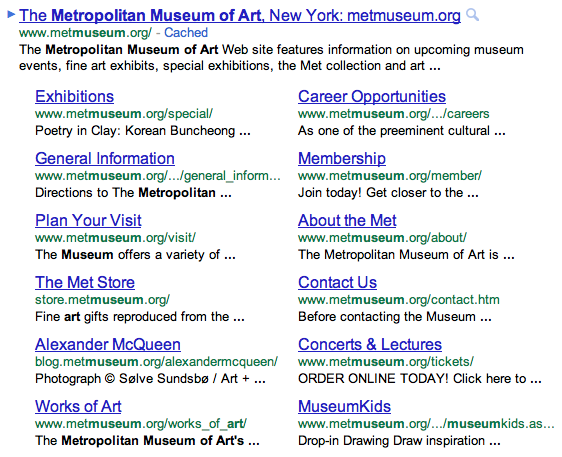
Today on their Search Blog, Google announced a new layout for sitelinks under Search results. The new update brings an expanded look for sitelinks — showing the title, URL, and a snippet of text from the site. Instead of eight sitelink results, a site can now have twelve.
Sitelinks will now be full-size links with a URL and one line of snippet text—similar to regular results—making it even easier to find the section of the site you want. We’re also increasing the maximum number of sitelinks per query from eight to 12.
Sitelinks will also be using a similar algorithm to regular search results, to provide a higher-quality list of links. The update will be rolling out to users over the next couple of days.
[youtube=http://www.youtube.com/watch?v=FdT3eKdto4w&feature=player_embedded]
Historypin, a user-generated map displaying historical data of nearby locations (previously only available on Android devices), is now available as an iOS app for iPhone, iPad, and iPod touch. Created in partnership with Google by not-for-profit We Are What We Do, the app allows users to add their own historical photos by pinning them to a map, capturing historic moments as they happen, and creating replicas of historical images. The images are then shared with users requesting data for a specific location….
Historypin uses Google Maps and Street View technology to reveal the user-generated photos and data related to historical events that happened close to your current location. It does this by “overlaying them onto the live camera view”…essentially aiming to give you a live snapshot of what your surroundings looked like in the past.
Simply holding your phone up in the street will provide you with relevant nearby images. Selecting one of the images allows it to be overlaid onto the iPhone’s camera view. You can then fade between the image and your live shot for comparison, as well as pull up stories and data related to the image and your current location.
Full list of features and some shots of the app in action after the break…
Expand
Expanding
Close
GigaOm is reporting that many companies were in the race to buy Motorola Mobility, including Microsoft. GigaOm contributes this as one of the reasons why Google made the purchase for such a high price, so other manufacturers couldn’t hurt their ecosystem even further with IP lawsuits.
The reason Motorola didn’t go with Microsoft was due to the fact Microsoft only wanted the company for its patents, rather than running a hardware business.
Talks between Google and Motorola began five weeks ago, reports GigaOm. Their sources say CEO Larry Page and Motorola CEO Sanjay Jha were talking directly and only a few other executives were brought in. Also, Android co-founder Andy Rubin wasn’t bought into the talks until recently. The deal Google has struck gives the company 17,000 current patents and 7,500 patent applications.
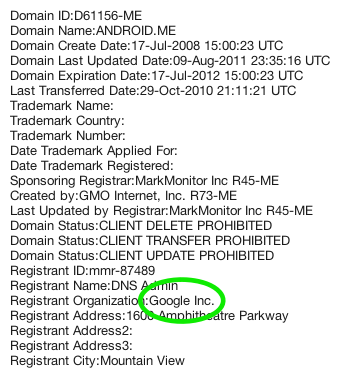
Who.is of Android.me
Discovered by TechCrunch, Google now has control of the Android.me domain — either by nicely asking or forcing. Of course, Google could be on their way to making a whole new product around the domain (maybe a central hub?), but we don’t think that will be the case. It’s more likely Google just wants control, which is understandable.
We here at 9to5Google are no strangers to Chrome Experiments, sweet little snippets of code that highlight the many advances Google’s been adding to its browser. Take, for example, a tech demo where you write your message and have the band in a music video dance it out. Today, Conceivably Tech points us to another interesting showcase that highlights the efficiency of Google’s WebGL support in Chrome.
WebGL is for the web what OpenGL stands for on your desktop, a standardized way for web developers to tap the power of your graphics card directly, by embedding an OpenGL code right inside web pages. The WebGL Water demo runs smoothly full screen on my 1.6GHz Core i5 MacBook Air and the water ripple effect, particles and lighting effects have to be experienced first hand in order to be fully appreciated.
The code runs best in Chrome due to the use of the OES-texture-float extension, which is currently only available for Chrome. If this is a sign of things to come, soon we will be able to run complex visualizations and shiny 3D games right inside our browser.
Newsweek Technology Editor Dan Lyons makes some great points this morning regarding Google acquiring Motorola Mobility for $12.5 billion. First he talks about TechCrunch MG Siegler’s remarks that Google made themselves “look like huge asses in retrospect”. Lyons pretty much says Siegler’s opinions were just foolish. Lyons also makes an interesting point that Google most likely didn’t actually want the Nortel patents, they were just driving up the price for Apple and Microsoft with their PI (3.14 billion) bid.
And today it all makes sense. Google just sandbagged its rivals. The whole thing was a rope-a-dope maneuver. Google never cared about the Nortel patents. It just wanted to drive up the price so that AppleSoft (those happy new bedmates) would overpay. Today, with the Motorola deal, Google picks up nearly three times as many patents as AppleSoft got from Novell and Nortel. More important, Google just raised the stakes in a huge way for anyone who wants to stay in the smartphone market.
In the end of things, Google is earning 3 times the patents than they would have in the Nortel deal, but for three times the price. One last word from Lyons: