According to the latest data from IDC, four of the top five worldwide vendors eyed shipment increases year-over-year and solid growth in Q2 2012.
Global tablet shipments hit 25 million units, with a 66.2-percent year-over-year increase, while Apple’s iPad set a shipment record in Q2 2012 by jumping from 11.8 million units shipped in Q1 2012 to 17 million.
Samsung sits at second place with 2.4 million units shipped, which is an increase from 1.1 million units in Q2 2011, and ASUS notably almost tripled its amount of units shipped from a year ago. Interestingly, shipments of the Google/ASUS-branded Nexus 7 are not a part of these totals.
Apple and Samsung appeared in a San Jose federal court today, where U.S. District Judge Lucy Koh presides, to give opening statements starting at 9 a.m. PST.
Apple filed the first suit in this monumental case in April 2011. The Cupertino, Calif.-based company claimed Samsung infringed its patents by “slavishly copying” its iPhone. Samsung, a South Korea-based Company, promptly countersued.
This is one of the important cases to go to trial among a slew of other litigations on smartphone patents. If Apple wins, Samsung could suffer a financial blow and the ability to sell its infringing products in a large market. If Apple loses, its “thermonuclear war” against Android smartphone manufacturers could essentially wither away as Samsung collects royalty fees.
This morning’s most notable highlights are below (continually updated).
OUYA, the Android-powered alternative gaming console that raised millions of dollars in mere days on Kickstarter, just revealed that it partnered with Square Enix to release Final Fantasy III as its launch title.
In addition to announcing that the service is now up to 15 million active users and 4 million paying subscribers worldwide, Spotify also announced today that it is rolling out the radio streaming feature (previously only available on iOS) to Android. Same as the iPhone version, the feature provides ad-free radio streams for premium subs and ad-supported streams for free accounts. Unfortunately, the free streams are U.S. only at the moment. You can also save songs from radio streams to a “Liked from Radio” playlist.
What’s in this version:
There’s a great new radio experience in Spotify. Now you can discover and save music on the go! If your station plays a song you really like, save it with a single tap.
New: Start a radio station based on your favorite playlist, genre, album, artist or song.
New: Personalize your radio stations by voting songs up or down.
News broke earlier today that Apple is buying mobile security company AuthenTec for $365 million. The company makes the majority of its money from fingerprint sensors and various security tools. AuthenTec also made a deal just last week with Samsung to implement its VPN technology in some of its Android devices. Many have speculated why Apple decided to make the purchase, and some point to the possibility of using AuthenTec’s technology in a future wallet solution. A report from ZDnet’s Larry Dignan offers another reason: simply to “beat Samsung to the punch.” Citing a report from analyst Richard Shannon, who recently said AuthenTec’s technology would be critical to Samsung, Dignan explained:
With Apple and Samsung’s jury trial slated to kick off in a federal district court in San Jose, Calif., this Monday, AllThingsD points us to trial briefs where Samsung’s lawyers argued Apple’s inspiration for the original iPhone CAD drawings and designs were inspired by a Sony product:
Right after this article was circulated internally, Apple industrial designer Shin Nishibori was directed to prepare a “Sony-like” design for an Apple phone and then had CAD drawings and a three-dimensional model prepared. Confirming the origin of the design, these internal Apple CAD drawings prepared at Mr. Nishibori‘s direction even had the “Sony” name prominently emblazoned on the phone design, as the below images from Apple‘s internal documents show..
Soon afterward, on March 8, 2006, Apple designer Richard Howarth reported that, in contrast to another internal design that was then under consideration, Mr. Nishibori‘s “Sony-style” design enabled “a much smaller-looking product with a much nicer shape to have next to your ear and in your pocket” and had greater “size and shape/comfort benefits.” As Mr. Nishibori has confirmed in deposition testimony, this “Sony-style” design he prepared changed the course of the project that yielded the final iPhone design.
The article referenced above is from a 2006 interview with Sony designers that appeared in Businessweek.
We just received an invite from Samsung Electronics America to “Save the Date” for a major Galaxy announcement. This business division is not to be confused with Samsung Telecommunications America that handles mobile phones.
What could it be?
We are hoping the Samsung Galaxy Camera lands, but it will likely be a tablet or TV.
SAVE THE DATE
August 15, 2012
10:00AM EST
Please join Samsung Electronics America for a major announcement and unveiling of the newest GALAXY device. An exclusive press conference will take place where full details will be disclosed.
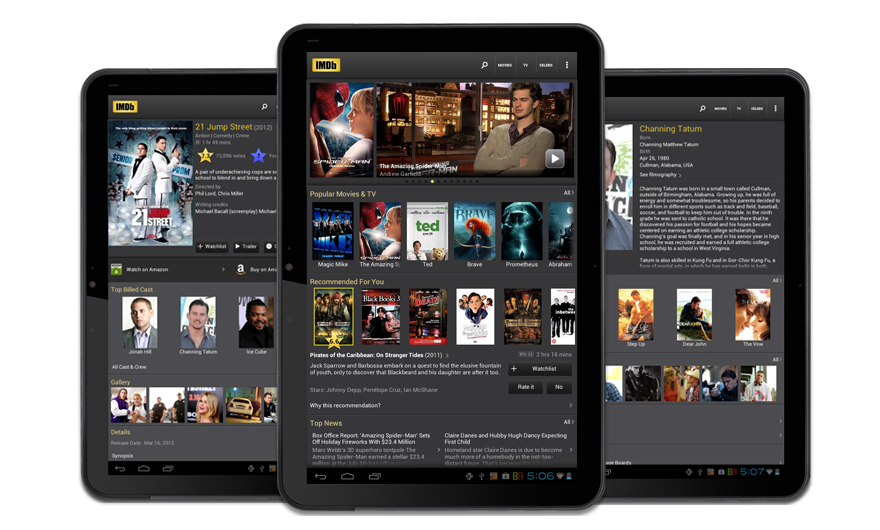
IMDb, the unofficial resume for everyone and everything Hollywood, just announced its iOS and Android apps have experienced more than 40 million total downloads. The Android counterpart for tablets and smartphones claimed half of those downloads, and IMDb is celebrating with today’s launch of “highly anticipated discovery, personalization and social features.”
The app’s latest version now includes:
– Sharing – check in on Facebook & Twitter to share what you’re watching
– Recommendations – discover other titles you might be interested in
– Mobile IMDb message boards – join in the discussion on your Android phone or tablet
– Filming locations & soundtracks – learn even more about the movies you love
– Similar titles – discover new movies and TV shows
Metacritic – now see both the IMDb user rating of a title as well as how the film critics scored it
– Amazon login – log in using your Amazon account
The IMDb Movies & TV app is a free app at the Google Play store. It rates 4.5-stars as of press time.
Instead of going for an obvious attack on the iPhone, like in the past, Samsung is opting for ads that actually focus on the features of the its latest flagship Galaxy device. In Sammy’s latest three Galaxy S III ads (above and below), the company focuses on content-sharing capabilities made possible through the device’s AllShare features.
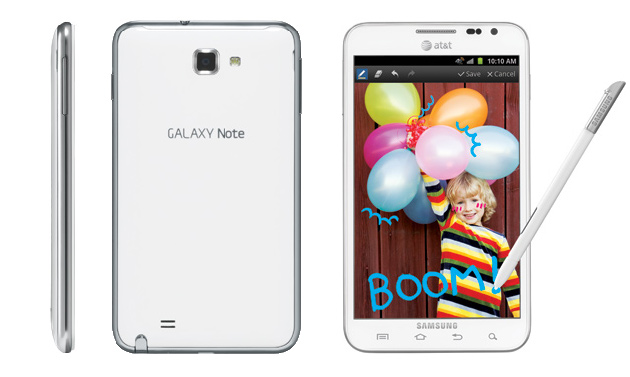
A recent report suggests the Galaxy Note successor will début with a slightly larger display at a popular consumer electronics show in Europe next month.
According to Maeil Business Newspaper, the Galaxy Note 2 will boast a 5.5-inch display, which is .2-inches larger than the original model, and it will run Android 4.1 Jelly Bean. A quad-core Exynos processor will give the phablet a performance boost, and its rear-facing camera will see an upgrade from 8-megapixels to 12- or 13-megapixels.
“Samsung will unveil the Galaxy Note 2 during the IFA 2012, a consumer electronics show held in Berlin, Germany in late-August,” reported South Korea-based Maeil, while quoting a source “familiar with the matter.”
This phone is exactly what you think it is: a throwback to last year when HTC made thick phones, while Verizon loaded phones with crapware (O.K., that’s still happening). I have to wonder what happened behind the scenes with the HTC-VZ relationship. Did HTC say to Verizon, “You want to do WHAT with our One phones? Errr, here—have this instead of the One.”
I mean, T-Mobile, Sprint, and AT&T each released the next generation of thin, svelte One series smartphones with big, beautiful displays. They are critically acclaimed! The Incredible 4G’s 4-inch display would have been passable, if it had a body like the HTC One S, which I am still in love with. This phone is so thick (.46 inches) that you almost expect it to have a slide out keyboard (Droid 4 with a keyboard is only microns thicker).
This…this is like the Rezound Jr., which is not entirely bad…for a 2011 grenade phone.
The August issue of Vanity Fair fully dissects “How Microsoft Lost Its Mojo,” but it also gives an interesting glimpse at how the once-reigning tech company foolishly underestimated Google.
The actual article is not online, but BetaBeat obtained a physical copy and found a little nugget buried inside that describes chief executive Steve Ballmer going on a rampage in 2004. After allegedly throwing a chair, the CEO had this to scream say about an engineer who left Microsoft for Google:
“Fucking Eric Schmidt is a fucking pussy!” Ballmer yelled, according to the court document. “I’m going to fucking bury that guy! I have done it before and I will do it again. I’m going to fucking kill Google.”
Ballmer is notorious for his emotional antics and miscalculated quotes about the competition. The video atop is a perfect demonstration of Ballmer going, well, crazy. Meanwhile, the video below shows the executive laughing about the iPhone in 2007, while dismissing its ability to handle business-oriented tasks due to its lack of a tangible keyboard.
Reuters interviewed the U.S. judge today who dismissed Apple’s patent court case against Motorola, and the details behind the jurist’s reasoning for tossing the lawsuit are as interesting as they are controversial.
Richard Posner sits on the 7th U.S. Circuit Court of Appeals in Chicago and disputes whether software and related tech industries should even have patents for their products.
“It’s not clear that we really need patents in most industries,” said Posner, referring to the slew of features in smartphones that are legally protected. “You just have this proliferation of patents. It’s a problem.”
Posner, 73, argued the pharmaceutical industry better deserved protection for its intellectual property because of the, as Reuters coined it, “enormous investment it takes to create a successful drug.” He tossed Apple’s lawsuit against Google’s Motorola Mobility last month and denied an injunction against the sale of Motorola devices using Apple’s patented technology.
The judge attributed Apple’s scramble to attack competitors allegedly using its technology to a “constant struggle for survival.”
“As in any jungle, the animals will use all the means at their disposal, all their teeth and claws that are permitted by the ecosystem,” Posner contended.
“You can now share all of your favorite Chrome Web Store items with people in your Google+ circles by finding them in the Chrome Web Store and clicking the +1 button located in their store detail page,” wrote Software Engineer Hui Guo on the official Google Chrome blog.
Users can also review app, extension, and theme recommendations from friends in their Google+ circles by hitting up the ‘From your circles’ link under the left category menu on the Chrome Web store. If apps have been +1’d by people in a user’s circles, the indication will appear respectively on the Chrome Web Store to help folks pick an app. Those new to Google+ will notice suggestions from the Chrome team instead.
The mobile browser went live for iPhone and iPad owners yesterday, and now it holds the top spot for both device categories. The app notably allows users to view open tabs, bookmarks, and other browser particulars running on other computers and devices. Users can even send pages from Chrome on a computer to their iPhone, iPod touch, or iPad with “one click and read them on the go, even if you’re offline.”
Chrome for iOS already touts 4.5-stars based on over 3,500 reviews as of press time. Despite the glowing accolades, some folks are noticing its lack of Apple-given attention:
Google just announced at Day 2 of Google I/O that Chrome for iPhone & iPad will come to the App Store later today for devices running iOS 4.3 or later. The app will feature many of the features present in other versions of the browser, including: Chrome sync, incognito mode, and its unique tab UI. Google also announced during the keynote that it would bring its recently launched Google Drive cloud service to iOS devices.
Update: A report fromBloomberg Businessweek confirmed with some clarification. As we reported in April, the ITC will have to review Judge Pender’s previous ruling that Apple infringed on one Motorola patent related to industry standard 3G and wireless technologies. The date for that hearing is now scheduled for August 24 and could result on a block of iOS devices from Asia to the United States:
The U.S. International Trade Commission said it will review ITC Judge Thomas Pender’s findings that Apple was violating one of four Motorola Mobility patents. The commission is scheduled to issue a final decision on Aug. 24, and has the power to block devices made in Asia from entering the U.S.
According to several tweets from financial analyst @zerohedge, Google is apparently attempting to block shipments of the iPhone and iPad in the U.S. related to 3G patents. We do not have any more information at the moment, but we will keep you updated as the story unfolds…
T-Mobile just announced plans to exchange and purchase spectrum from Verizon Wireless in a deal the carrier claimed would improve its “spectrum position in 15 of the top 25 markets” that covers 60 million people. T-Mobile said the spectrum would help enhance its 4G network and advance the rollout of its LTE service. The agreement includes spectrum that Verizon planned to acquire from several cable companies, so T-Mobile will first have to wait for the Federal Communications Commission and U.S. Department of Justice to approve the deal:
“This agreement will provide T-Mobile with critical AWS spectrum, enhancing both network capacity and performance and allowing us to meet the growing consumer demand for 4G mobile broadband,” T-Mobile CEO and President Philipp Humm said. “This is good for T-Mobile and good for consumers because it will enable T-Mobile to compete even more vigorously with other wireless carriers. We anticipate FCC approval later this summer, in time for us to incorporate this new spectrum into our network modernization and the rollout of LTE services next year.”
T-Mobile mentioned a few of the cities that would benefit if the agreement goes through:
T-Mobile will gain spectrum covering 60 million people — notably in Philadelphia; Washington, D.C.; Detroit; Minneapolis; Seattle; Cleveland; Columbus, Ohio; Milwaukee; Charlotte, N.C.; Raleigh-Durham, N.C.; Greensboro, N.C.; Memphis, Tenn.; and Rochester, N.Y
The South Korea-based Company is making it easier than ever to jump ship from iOS to its Galaxy line with the Easy Phone Sync app. The software is free to anyone purchasing a Samsung Galaxy device, and it quickly installs on any Galaxy product, PC, or Mac.
In the most straightforward manner, it transfers media, contacts, content—and all that other stuff packed into handhelds—from iTunes to an Android-powered tablet or phone by Samsung. Users can also manage their content through iTunes to maintain preferences during the sync process.
For more information on Samsung’s plan to pilfer iPhone users from Apple, check out its newest marketing strategy that 9to5Google detailed earlier this week.
Wirefly listed Samsung’s new Galaxy S III with 4G LTE to new and existing Sprint customers for just $149.99 on its website, which is currently one of the lowest price tags available.
Sprint offers the base model of the Galaxy Nexus successor on its website for $199.99, but it previously revealed that “overwhelming demand and limited supply” could cause the smartphone to ship late.
Meanwhile, T-Mobile sells its version for more bread than the main carriers: the 16GB model costs $279.99 after a $50 rebate. AT&T and Verizon Wireless now list pre-order prices for the 16GB Samsung Galaxy S III at $199.99.
Another third-party retailer, Amazon, offers the 16 GB Ice Cream Sandwich-powered smartphone for $189.99 to new AT&T customers, where as those eligible to upgrade only need to cough up $149.99. The deal comes with free two-day shipping.
Samsung let New Yorkers experience the all-new Galaxy S III today at a release event in Manhattan, while the company reiterated its goal to “win over” the competition’s user base (ahem, iPhone 4S users) with this latest Android offering.
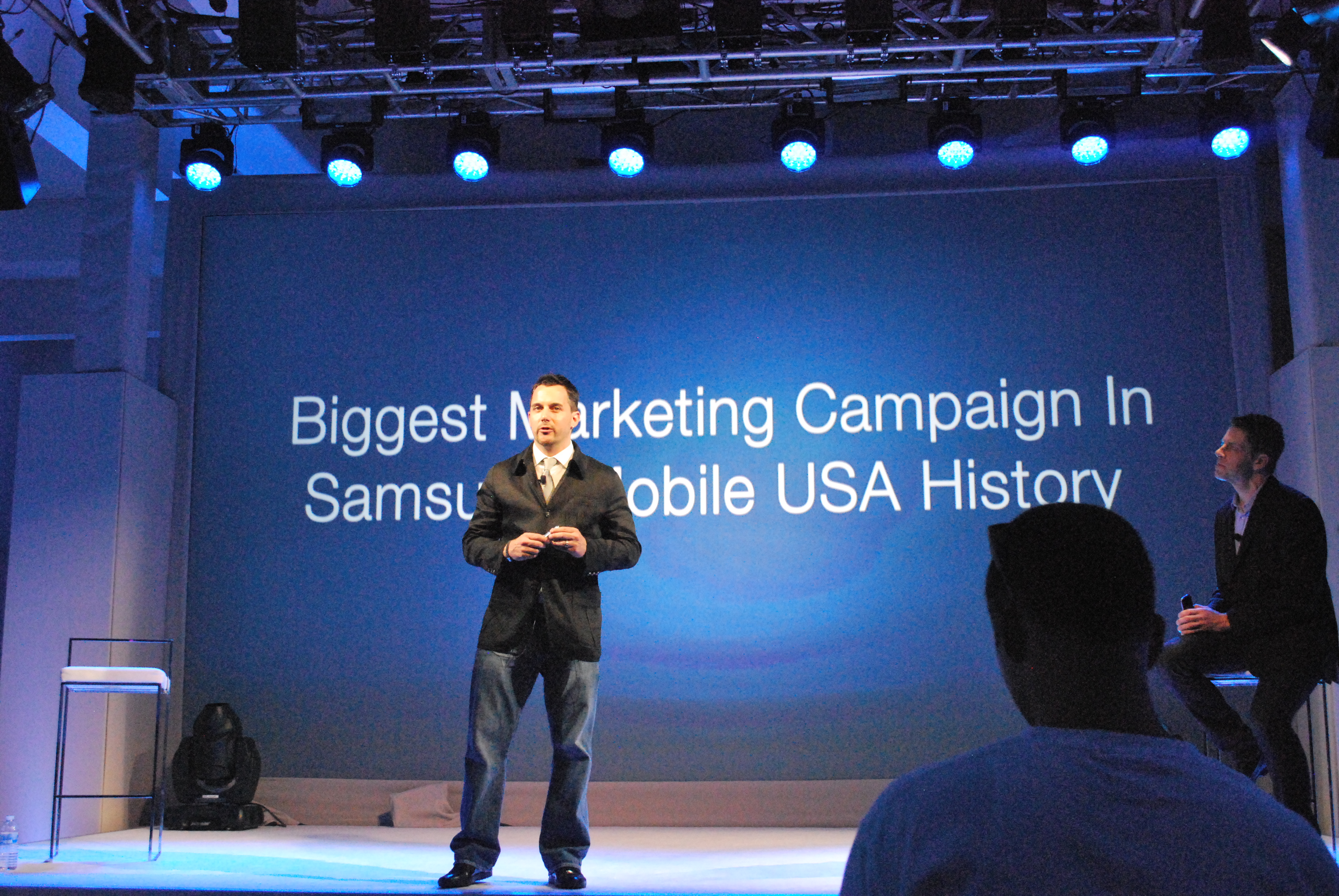
Chief Marketing Officer Tom Pendleton and Chief Product Officer Kevin Packingham were on stage this afternoon to celebrate the S III’s launch on all the major U.S. carriers. They also unveiled their marketing strategy, with a few numbers on mobile sales. The executives revealed that Samsung sold 61 million devices in the United States—just add another 80 million for the worldwide sales. They further pinpointed the S III as the fastest-selling pre-order smartphone in the company’s stateside history.
The Galaxy-branded smartphone boasts many impressive features, such as Ice Cream Sandwich OS, but the South Korea-based manufacturer focused on the S III’s uniqueness, 2100 mAh battery, 4.65-inch high-definition screen, 2 GB of RAM, LTE capability, and integrated sharing options.
“We want to show you five things no other phone can do,” added Packingham, while touting the S III’s bevy of highlights.
The chief explained how the Galaxy Nexus successor packs an “All Share Group Cast” feature for sharing documents and media anytime or anywhere. Meanwhile, the “Share Shot” tech specifically—and automatically—streams photographs to friends, but “S Beam” is available for those who want to send large video files or even contacts with just one tap. Next up is the “Smart Stay” feature, which maintains screen brightness, so users are never again interrupted by a dimming display. The last showcased feature is the “Pop-up Play” that allows S III owners to do multitask such as watching video and texting simultaneously.
I spent the last week with two Samsung Galaxy S IIIs—a Sprint version and an AT&T version. Sprint’s version is LTE, which has not rolled out yet, so it has been on the slow 3G CDMA. AT&T’s version is also LTE, which I am often able to get access to while on the outskirts of Silicon Valley. For that reason, I have used the AT&T version most of the time. But really, they are the same phone, which is the big news here…
Cities available (US only): Atlanta, Austin, Baltimore, Boston, Brooklyn, Charlotte, Chicago, Columbus, Dallas, Denver, Detroit, Fort Worth, Houston, Indianapolis, Kansas City, Long Beach, Los Angeles, Miami, Milwaukee, Minneapolis, NYC, Philadelphia, Phoenix, Pittsburgh, Portland, Oakland / East Bay, Oklahoma City, Omaha, Orlando, Sacramento, Salt Lake City, San Antonio, San Diego, San Francisco, San Jose, Seattle, St. Paul, St. Louis, Tampa and Washington D.C.
Instant savings, just around the corner: Quickly discover offers near you in map view or search for deals by category to easily find the right deal for you.
See & use the deals you want, when you want them: All of your purchased and saved offers are tracked in “My Offers,” for easy access from your iPhone or online.
Savings made simple: Instantly redeem most offers with your iPhone, without having to print vouchers.
Never miss a great deal: Get notifications when new deals are available or when a deal that you’ve purchased or saved is about to expire.
William Blair analyst Anil Doradla (via Barron’s) wrote in his notes today that the iPhone is still the best-selling smartphone across the United States, but it is coming “under pressure, particularly at Verizon” due to the carrier’s aggressive marketing of 4G-capable devices. Citing his checks of sales for the current quarter as of June, Doradla claimed the Motorola Droid RAZR MAXX outsold the iPhone on Verizon:
Since Apple’s iPhone launch in North America, we believe this was the first quarter where the iPhone was not the best‐selling smartphone at a North American mobile operator (where it was available). While Apple continued to maintain its top position at AT&T and Sprint, Motorola’s Droid RAZR MAXX was the best‐ selling smartphone at Verizon. Our checks also indicate that at this stage consumers are not pausing in front of the iPhone launch as it is not influencing their purchasing decisions (but we expect it to start impacting over the next couple of months).
While the RAZR MAXX took the top spot, Samsung’s Galaxy Nexus grabbed third position behind the iPhone, according to Doradla. He backed his “outperform” rating on Apple by saying he is “not worried” given the next generation iPhone, which is likely due in October, is expected to include 4G LTE capabilities: Expand Expanding Close