Motorola


[youtube=”http://www.youtube.com/watch?v=qTxFjBTfqZg”]
Motorola has announced a successor to its earlier Droid Pro, the Pro+. The Pro+ features a full QWERTY keyboard on the front of the device, Android 2.3, 1 GHz processor, 3.1-inch screen, and hotspot capabilities. Sadly, the device will not be making its way to the U.S. — rather, hitting Europe and Asia in October.
Motorola is filling a gap that Apple hasn’t yet attacked. Users who are tired of BlackBerry, but still need the business feel, now have a more viable option. We look forward to this hitting the states hopefully by the end of the year.
Full press release and gallery after the break:

Over the weekend, many outlets reported that the Droid Bionic Twitter account tweeted the official Droid Bionic release date was September 8th. Sadly, PC Mag has confirmed with both Motorola and Verizon that the account is a hoax. That’s not to say the Bionic launch date still couldn’t be September 8th, but we’ll have to wait and see.
Motorola has also taken down the official Store listing that they made Saturday. The store listing didn’t provide anymore details on the device specifically. The listing did however give us a glimpse at a few more press shots — which you can find after the break.

The Droid Bionic you have all been waiting for has just made its official debut on the Motorola Store. The Store posting doesn’t say much. In fact, there aren’t any specs or details, but we’re assuming those are coming shortly. And of course, you can’t purchase the device quite yet.
Luckily, a few more press shots were provided with the official posting. Upon our first look we’ve noticed the device is still looking pretty thick. We can’t make any official judgements quite yet, but look out for early September. (via Android Central)
Check out a few more press shots after the break:
[youtube=”http://www.youtube.com/watch?v=iJaowSisMGs”]
As the launch of the Motorola Droid Bionic comes closer, more and more information regarding the device is leaking — almost daily. Today’s leak is the Droid Bionic’s teaser, and boy is this quite a production. Besides the great theatrical entertainment, it confirms a September drop. Boy this must have been expensive — enjoy! For those of you who didn’t see, check out the Bionic’s boot sequence after the break. (via Droid Life)
[youtube=”http://www.youtube.com/watch?v=xYN6ZPGOiIU”]
PhanDroid has discovered the Droid Bionic’s boot sequence, leaked by YouTube user hkscomm. The sequence is nice and flashy, and certainly gets us drooling with what’s coming up this September.
Along with the boot, the user showed off LTE on the Bionic by doing a simple speed test. The speeds looks pretty snappy, getting up to 4.5 down and 1.9 up. This is sure to be a nice addition to Verizon’s already impressive LTE line up.

You probably know by now that Google’s move to acquire Motorola Mobility for $12.5 billion was seen as one specifically focused on acquiring their more than 17,000+ patents, many of which are thought to be key in protecting Android from other smartphone makers (Apple and Microsoft) in court. However, according to a report from Bloomberg, only 18 of those patents will be essential in fighting patent-infringement related cases against, namely, Apple.
According to CEO of ICAP Patent Brokerage Dean Becker (“global leader in intellectual property brokerage”) Google only needs a few of the 17000+ patents to protect it’s mobile IPs, he added:
“There are a lot of sweet patents in that portfolio…”- Dean Becker, ICAP Patent Brokerage
The patents cover a little bit of everything that we’ve come to expect from a smartphone; touch-screen gestures, antenna designs, location-based services, email,etc. Among some of the more notable patents that will certainly provide value when protecting Android include one from 2001 that details disabling a “touch sensitive” display that detects a user’s head in relation to the device to prevent accidental input (sound familiar?), another shows a feature that would allow users to control when their location data is sent over a network via GPS (lack of these types of features were recently the subject of debate at a senate judiciary hearing in May where Apple and Google were questioned on their practices in relation to user location data). Other noteworthy patents include one related to increasing data storage for users and others that detail features we see in most modern smartphones.
Motorola, even before being acquired by Google, was and still is involved in mobile related legal issues. Most recently Apple filed patent-infringement complaints with the ITC in October, and also sued the company in civil court for “a pattern of unfair, deceptive and anticompetitive conduct”. Claims which also mirror those of Microsoft. Motorola seems to be confident in their patents, however, by going after Apple in lawsuits on three separate occasions and filing their own complaint with the ITC.
Expand
Expanding
Close

In the battle for mobile supremacy, Apple and Google are winning as competitors continue to lose ground, finding it increasingly difficult to compete with the strong iOS and Android ecosystems (can you say ‘duopoly’?), per latest survey from the NPD Group. The results came by tracking U.S. consumers aged 18+ who reported purchasing a mobile phone and exclude corporate purchases. In the June quarter, iOS grabbed 29 percent of the U.S. smartphone share versus Google’s 52 percent share. Both tech behemoths have grown their platform share at the expense of BlackBerry maker Research In Motion.
Cross-posted on 9to5Mac.com
RIM’s been on a serious decline amid poor sales and delays related to their QNX-based superphones. Their BlackBerry OS software share fell to just eleven percent in the U.S. Meanwhile, Hewlett-Packard’s webOS is in a state of limbo as the world’s leading computer maker announced intentions to exit the hardware business. Microsoft’s Windows Phone 7 and Windows Mobile grabbed five percent of the market each.
The emerging prepaid market is the next battelground for iOS and Android. Google, however, has the first mover advantage here…
Expand
Expanding
Close
It’s no secret patent-related legal disputes have become the subject of most media coverage lately…Whether it’s Apple halting sales of Samsung’s tablets, HTC going after Apple, or Google snatching up Motorola to beef up their patent portfolio, it’s clear the company with the most patents will have an advantage over others in the legal proceedings that we’re bound to continue encountering down the road. This is why we’re intrigued by the graphic above (via GigaOM) from mobile analyst Chetan Sharma charting the number of issued patents (in the US and Europe) between 1993 and 2011.
While these estimates of mobile communications related patents don’t take the quality of patents into account (which is obviously a huge factor in determining their long-term value), you can see from the breakdown below that Nokia and Samsung top the list, with the other expected players including IBM, Microsoft, Sony, Motorola, and Intel following.
Noticeably far down the list is Apple, the one company who seems to have had more success than others fighting patent-related issues recently. Again, these numbers in no way represent the quality of patents and the ability for companies to protect their IPs in the courtroom… which is also a good indication that perhaps we should be looking more closely at the quality of patents rather than the sheer number.
Expand
Expanding
Close

The smoke has cleared on Google’s $12.5B purchase of Chicago-based Motorola and now that almost everyone has had a chance to speak, I think we’re starting to understand what went down.
Google purchased Motorola (MMI) for $12.5B, a 63% premium over its weekend closing price. Motorola, however, has around $3B in cash and securities, which makes the real purchase a slightly more reasonable $9.5B for Google. For instance, if Google wanted to slice and dice Motorola, they’d take the cash and patents and sell off the cable box and device divisions for a couple billion dollars each and come away with about what they would have paid for Nortel – and get double to triple the patents. On sheer numbers of patents alone, it seems like a good buy. Obviously some patents are worth more than others.
If the deal doesn’t go through, Google owes Motorola $2.5B for the trouble, so Google is dead serious about this play.
But back to what Motorola does: They have IP, they make smartphones, they make tablets and they make cable top boxes. It seems like almost too good a setup for Andy Rubin’s Android to just want to sell off piecemeal.
But did Google want to pick up a hardware company? I reported earlier this year that the Android Hardware division that Andy Rubin had started up with former Danger Co-founders had intentions to build physical devices, not just Operating Systems.
That scale is what attracted and the former Danger founders to get the band back together, with their goal being to build the hardware and features they want to see show up in new Android devices. It’s not enough for Google to just provide Android software to carrier — now they hope to influence what handset makers build, too.

Shoot, I’d take a 63% return on my investment, wouldn’t you? It seem’s like a lot to us, but a Motorola shareholder thinks Google underpaid in their acquisition of the company Monday. The shareholder believes Google solely paid for the patents, and not the rest of the mobile phone business. To back up the shareholder’s statement, analytical firm Frost & Sullivan came up with the same conclusion. (Phandroid via ZDNet)
Motorola has a portfolio of 24,500 patents and patent applications that instantly bolsters Google’s strength in the IP war. Looking at some recent patent auctions and using some simple math can show why these patents were indeed the target of Google’s acquisition.
Continue after the break..

 According to the Wall Street Journal, Kodak has started the process of auctioning off some or all of its lucrative patents. Kodak’s demise is well documented as the once $30B company has seen its market cap slide to around $800m as the digital imaging company has continuously lost share to competitors. According to the WSJ one potential bidder is “a large, strategic buyer in the wireless industry looking to use the patents for defensive protection.”
This news comes on the tails of this past Monday’s acquisition of Motorola Mobility by Google for a whopping $12.6B in cash. Google has long been rumored as potential suitors of multiple patent-holding companies such as InterDigital, Kodak and of course Motorola Mobility. If these Kodak patents do sell, they will not gather nearly as high of a price as the Motorola deal, but could likely see Kodak’s stock take a nice move up. This morning’s news of one analyst saying Kodak’s patents could be worth 5x the company’s market cap sent shares up more than 25% and are currently up more than 5% in after hours trading on the latest Wall Street Journal news. Meanwhile, InterDigital saw a pop in its shares today as another rumor was swirling that an auction will take place after Labor Day weekend and that there are multiple interested parties.
Expand
Expanding
Close
[youtube=http://www.youtube.com/watch?v=8R3V9qjzD40]
The $12.5 billion acquisition of handset maker Motorola has spurred an intense debate on the web as to what Google might do with the company and whether or not it could affect Apple negatively. Unfortunately for us tech watchers, neither Apple nor its boss – who’s been on a medical leave of absence since January – have reacted publicly thus far. Heck, even Microsoft voiced its opinion. Taiwan based Next Media Animation took it upon themselves to illustrate how Apple’s head honcho might react to the deal and what it could possibly mean for you and me. The YouTube description teases:
Motorola was once at the forefront of mobile communications, but has lost its way. Meanwhile, one-trick pony Google is desperately searching for a second act.
Check out the full animation embedded above or watch it on YouTube.
If you haven’t heard by now, Google has shocked many this week with their acquisition of Motorola Mobility for $12.5 billion, which still may have to pass regulatory review for GOOG to avoid an unusually high $2.5b reverse termination fee. However, while there might be a few hoping the deal falls through, Microsoft is taking this time to convince smartphone makers the Windows Phone platform is the only “truly open mobile ecosystem”.
President of Windows Phone division, Andy Lees, provided the following statement (via WinSuperSite) following the Google/Motorola acquisition announcement:
“Investing in a broad and truly open mobile ecosystem is important for the industry and consumers alike, and Windows Phone is now the only platform that does so with equal opportunity for all partners..”
This comes after Microsoft announced a deal with Nokia in February that would see Windows Phone 7 become Nokia’s primary OS for smartphones (a deal that appears to give Nokia an unfair advantage over other partners). As a result, Nokia will be working closely with Microsoft and integrating a ton of their own content into the OS including their content and application store, and the Nokia Maps app. The handsets will also receive the Xbox Live, Zune music store, and Bing search treatment from Microsoft.
While the deal isn’t exclusive (allowing Microsoft to partner with other manufacturers and Nokia to make devices powered by another OS), it certainly gives the two companies an unfair advantage over other OEMs considering the Windows Phone platform… and seems to contradict Lees’ statement of the OS being an “equal opportunity for all partners”. Google’s acquisition of Motorola may have a bigger impact down the line depending on their plans for the company… but for the time being the Google/Motorola partnership doesn’t provide any less incentive for new Android partners than the Microsoft/Nokia deal does for potential Windows Phone manufacturers.
Expand
Expanding
Close
We showed you images of that extremely thick battery attached to the back of what we believed to be Motorola’s Droid Bionic. Now, new leaked images (via Engadget) show a mystery device known only as the “Droid HD”… which is seemingly a thinner, but beefed up version of the Bionic. However, we can’t help but feel the Droid HD looks like a polished, finished version of the Bionic (possibly as a pro model). There is a possibility it’s just a revised design and renaming of the Bionic, considering we find it hard to believe the device will be released publicly with that unnecessarily chunky design.
From the images, the apparently detachable battery appears to cover more surface area but is, luckily, much thinner than those leaked Bionic shots (the image above shows the Droid HD next to what we believe is the Droid Bionic). Some of the notable features discovered from the images include an 8mp rear-facing 1080p camera, front-facing camera, microUSB, HDMI, SIM & microSD on the left, and volume rocker on the right. Of course most are expecting the 4.5-inch display to sport HD resolution given the device’s “HD” moniker.
Expand
Expanding
Close

GigaOm is reporting that many companies were in the race to buy Motorola Mobility, including Microsoft. GigaOm contributes this as one of the reasons why Google made the purchase for such a high price, so other manufacturers couldn’t hurt their ecosystem even further with IP lawsuits.
The reason Motorola didn’t go with Microsoft was due to the fact Microsoft only wanted the company for its patents, rather than running a hardware business.
Talks between Google and Motorola began five weeks ago, reports GigaOm. Their sources say CEO Larry Page and Motorola CEO Sanjay Jha were talking directly and only a few other executives were brought in. Also, Android co-founder Andy Rubin wasn’t bought into the talks until recently. The deal Google has struck gives the company 17,000 current patents and 7,500 patent applications.
Newsweek Technology Editor Dan Lyons makes some great points this morning regarding Google acquiring Motorola Mobility for $12.5 billion. First he talks about TechCrunch MG Siegler’s remarks that Google made themselves “look like huge asses in retrospect”. Lyons pretty much says Siegler’s opinions were just foolish. Lyons also makes an interesting point that Google most likely didn’t actually want the Nortel patents, they were just driving up the price for Apple and Microsoft with their PI (3.14 billion) bid.
And today it all makes sense. Google just sandbagged its rivals. The whole thing was a rope-a-dope maneuver. Google never cared about the Nortel patents. It just wanted to drive up the price so that AppleSoft (those happy new bedmates) would overpay. Today, with the Motorola deal, Google picks up nearly three times as many patents as AppleSoft got from Novell and Nortel. More important, Google just raised the stakes in a huge way for anyone who wants to stay in the smartphone market.
In the end of things, Google is earning 3 times the patents than they would have in the Nortel deal, but for three times the price. One last word from Lyons:

After a shocking announcement this morning from Google regarding a $12.5 billion acquisition of Motorola Mobility, most are already discussing what this means for the future of Android. However, a report from WSJ claims their sources are reporting Motorola has an “unusually large” 20% reverse termination fee in place that would see Google paying $2.5 billion if the deal falls through.
The report claims this might be proof Motorola is worried the acquisition could be the subject of antitrust regulators who are already investigating Google for its ability to abuse its market lead. However, Google execs noted in a conference call with financial analysts this morning that they aren’t worried about the deal being seen as anti-competitive in nature.
Why would the deal fall through? The report points to potential legal hurdles in Washington, similar to those that allegedly stopped a Groupon acquisition from happening. Google is already the subject of an antitrust probe related to their purchase of ITA software, and continues to be in the middle of intense legal battles with rival smartphone makers.
Expand
Expanding
Close
Google has made its decision to acquire Motorola Mobility public this morning, announcing the acquisition worth $12.5 billion via The Official Google Blog (that’s $40 per share, 60% higher than the company’s closing price as of Friday):
Today, more than 150 million Android devices have been activated worldwide—with over 550,000 devices now lit up every day—through a network of about 39 manufacturers and 231 carriers in 123 countries. Given Android’s phenomenal success, we are always looking for new ways to supercharge the Android ecosystem. That is why I am so excited today to announce that we have agreed to acquire Motorola.
This is obviously being looked at by most analysts as a move by Google to beef up their patent portfolio in the midst of the smartphone patent wars. It appears Google plans to continue running Motorola as a separate company, meaning the brand itself isn’t in jeopardy as of yet. However, this could easily be Google’s first step in the direction of gaining more control over the manufacturers that run Android. Even with Android making huge strides in recent months, Apple continues to dominate the smartphone market with their unique approach of building both hardware and software to compliment one another (at the same time as keeping the intellectual properties related to their products under one roof).
Google and Motorola will be holding a press conference at 8:30 ET. Grab the live webcast here. A snippet from the official press release below, if you’re interested. We’ll keep you posted as more info becomes available.
Google to Acquire Motorola Mobility
Combination will Supercharge Android, Enhance Competition, and Offer Wonderful User Experiences
MOUNTAIN VIEW, CA and LIBERTYVILLE, IL – AUGUST 15, 2011 – Google Inc. (NASDAQ: GOOG) and Motorola Mobility Holdings, Inc. (NYSE: MMI) today announced that they have entered into a definitive agreement under which Google will acquire Motorola Mobility for $40.00 per share in cash, or a total of about $12.5 billion, a premium of 63% to the closing price of Motorola Mobility shares on Friday, August 12, 2011. The transaction was unanimously approved by the boards of directors of both companies.
Expand
Expanding
Close
So the war continues… Motorola has been around for quite a long time, so it’s no secret they have a pretty big patent portfolio. During a keynote at the Oppenhimer Technology & Commmunications conference Motorola’s CEO Sanjay Jha had this to say regarding their pool of patents:
I would bring up IP as a very important for differentiation (among Android vendors). We have a very large IP portfolio, and I think in the long term, as things settle down, you will see a meaningful difference in positions of many different Android players. Both, in terms of avoidance of royalties, as well as potentially being able to collect royalties. And that will make a big difference to people who have very strong IP positions.
To sum it up Jha and company may plan to collect royalties from other Android handset manufacturers like HTC, Samsung, etc.
Houston, we have a problem.
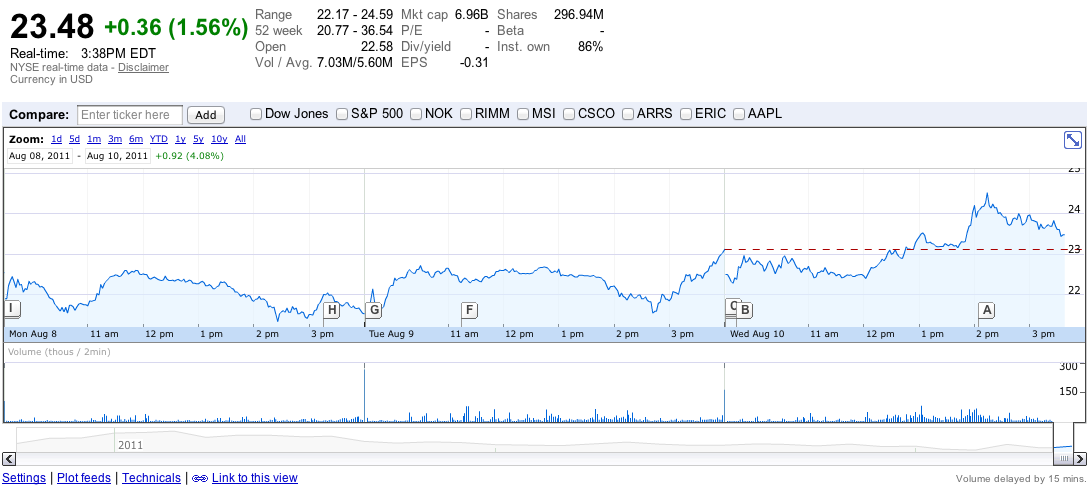
There have been rumors floating around that Motorola Mobility may be bought ought by Carl Icahn and KKR. The buyout would include both paying $34.25 per share, financed with $3 billion cash and other tricks. These rumors have caused a spike in Motorola’s stock (as seen above). (via Benzinga)
Expand
Expanding
Close
We know the Droid Bionic has a big battery, unfortunately, the images that had previously surfaced didn’t give us a good view of the device’s profile, which we now know appears to be rather thick (to put it nicely). These new images from GottaBeMobile give us a whole new perspective.
Yesterday FCC filings for the Motorola Droid Bionic started popping up and confirmed it would be a 4G LTE capable device sporting a 4.3 inch qHD display, 1GHz dual core TI Omap processor, a front-facing VGA camera, and an 8 megapixel rear camera with 1080p HD video recording. Judging by the image below, it should have good battery life too.
Expand
Expanding
Close
[youtube=http://www.youtube.com/watch?v=GbP7wQBJ35E&feature=player_embedded]
Debating which carrier to sign up with for that new Android-powered handset you’re thinking about? Virgin Mobile is about to launch a new advertising campaign directly taking on T-Mobile and detailing exactly why it’s the better choice for Android smartphone users.
Virgin Mobile USA’s president of Marketing Bob Stohrer explains:
“T-Mobile has anointed itself as the value leader in wireless, yet they’ve conveniently left Virgin Mobile out of their comparison set, so we’re crashing their party. No matter how you dress their plans up, they’re no match for Virgin Mobile’s no-contract, Unlimited Data offering at $35/month coupled with Android-powered phones like the new Motorola Triumph.”
The commercials set to launch today and run through September feature a faux hollywood couple known as Sparah, a fake T-Mobile spokesperson, and portray a party-like atmosphere and lifestyle in contrast to their competitors’s run-of-the-mill offerings. In the spot, the fake T-Mobile spokesperson also takes a stab at AT&T by noting, “imagine us being taken over by AT&T, who’s last in customer satisfaction.”
Expand
Expanding
Close
A report from Fusible shows Motorola has been acquiring domains names, five in total, each related to the “Kore” moniker. The domain names listed include MotorolaKore.com, KoreMotorola.com, Moto-Kore.com, MotoKore.com and Motorola-Kore.com
Of course speculation that Kore may be the successor to the Xoom, which recently received a price cut, at this point is just that.We told you about a leaked Verizon document that suggests Motorola is still planning on launching the LTE Xoom in early September despite less than spectacular sales, so we aren’t holding our breath for a new tablet before then.
Rumor has it the Kore device will have a 4:3 aspect ratio, but that is pretty much a given if it plans to take on its competition. There is still always the possibility the Kore could be a new smartphone, rather than a tablet.
If it is a tablet it could be the first running Nvidia’s Kal-El Quad core processor (demo below).
We’ll keep you posted as more becomes available.
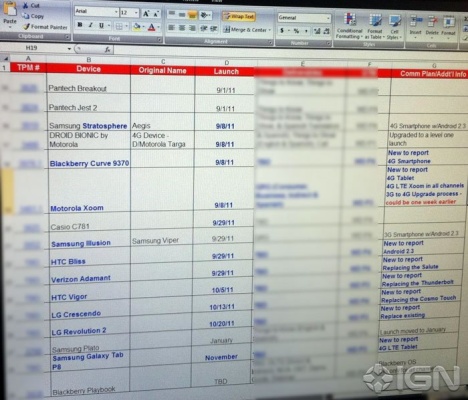
IGN has discovered a leaked Verizon document going over the release date for many upcoming devices this fall. The Droid BIONIC, which we’ve been waiting forever for, is set to launch September 8th according to the doc. Also, it appears the Motorola Xoom LTE is launching the 8th.
Something we haven’t quite heard of is the Samsung Galaxy Tab P8, which is set for November according to the doc. This in fact could be the 8.9-inch Galaxy Tab we’ve seen floating around. Android Central outlines:
- Samsung Stratosphere on Sep 8
- Motorola Droid Bionic on Sep 8
- Motorola Xoom LTE on Sep 8 (3G to 4G upgrade could be one week earlier)
- HTC Bliss with Android 2.3 on Sep 29
- HTC Vigor is slated to replace the Thunderbolt on Oct 5
- LG Revolution 2 to replace the LG Revolution on Oct 20
- Samsung Galaxy Tab P8 with LTE in November
Expand
Expanding
Close
