Stay up to date on news from Google headquarters. Be the first to learn about plans for Android, Google Plus, Google Apps, and more!
Stay up to date on news from Google headquarters. Be the first to learn about plans for Android, Google Plus, Google Apps, and more!


Asus CEO Jerry Shen revealed today that the company plans to ship Asus notebooks running Chrome OS later this year.
Acer, HP, and Samsung have already shipped Chromebooks ranging in price from $199 to $449, as PC World notes, which gives an idea at where Asus could price their hardware.
The Asus CEO expects Chromebook’s success to be in government and education as well as commercial use rather than with consumers.

Wired has published an interesting interview with Vint Cerf, “Father of the Internet” and Google’s chief internet evangelist. The interview focuses on Vint’s work with NASA to develop protocols for the “interplanetary internet”:
Working with NASA and JPL, Cerf has helped develop a new set of protocols that can stand up to the unique environment of space, where orbital mechanics and the speed of light make traditional networking extremely difficult. Though this space-based network is still in its early stages and has few nodes, he said that we are now at “the front end of what could be an evolving and expanding interplanetary backbone.”
…it’s actually not new at all – this project started in 1998. And it got started because 1997 was very nearly the 25th anniversary of the design of the internet. Bob Kahn and I did that work in 1973. So back in 1997, I asked myself what should I be doing that will be needed 25 years from then. And, after consultation with colleagues at the Jet Propulsion Laboratory, we concluded that we needed much richer networking than was then available to NASA and other space faring agencies.
Head over to Wired to check out the full interview.

In a statement given to the BBC on Friday, Google spokesman Nathan Tyler said: “We’re changing the name ‘Palestinian Territories’ to ‘Palestine’ across our products. We consult a number of sources and authorities when naming countries. “In this case, we are following the lead of the UN, Icann [the Internet Corporation for Assigned Names and Numbers], ISO [International Organisation for Standardisation] and other international organisations.”
The Palestinian Authority (PA) welcomed Google’s decision.
“This is a step in the right direction, a timely step and one that encourages others to join in and give the right definition and name for Palestine instead of Palestinian territories,” Dr Sabri Saidam, advisor to Palestinian President Mahmoud Abbas, told the BBC.”Most of the traffic that happens now happens in the virtual world and this means putting Palestine on the virtual map as well as on the geographic maps,” he added.
Agree this is a bigger deal than it would immediately appear…for Palestinians especially. The Google Maps folks aren’t yet on the same page:
While there might not be much information surrounding Google’s recent hire of Noah Falstein, the company’s decision to pick up the game design veteran as its “Chief Game Designer” certainly gives the impression Google has something big planned in the way of first party titles. TechCrunch first spotted the job title on Noah’s LinkedIn page and notes that an earlier cache of the page shows his new gig at Google used to be listed as “Chief Game Designer at Android Play Studio.” That’s a pretty good indication that whatever Falstein is working on is likely Android related.
Google of course has its feet into gaming through Google Play and Chrome apps, but it has not been active in developing its own titles for Android or Chrome OS. Falstein has worked as a game designer and producer at a number of studios over the years including LucasARTS Entertainment, DreamWorks Interactive, and the 3DO Company. More recently he has been active in developing the concept of serious games.
Expand
Expanding
Close

Google Keep, the Evernote-like content storing app for Android, is now available for the desktop as well as a Chrome web app, bring offline support to the desktop and keeping with its web app initiative.

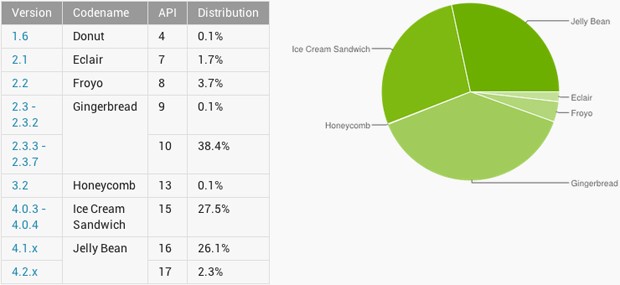
Jelly Bean (Android 4.1 on) has overtaken Ice Cream Sandwich (4.0.x) for the first time, with 28.4 percent of active Android devices now using it against 27.5 percent for ICS …
Expand
Expanding
Close
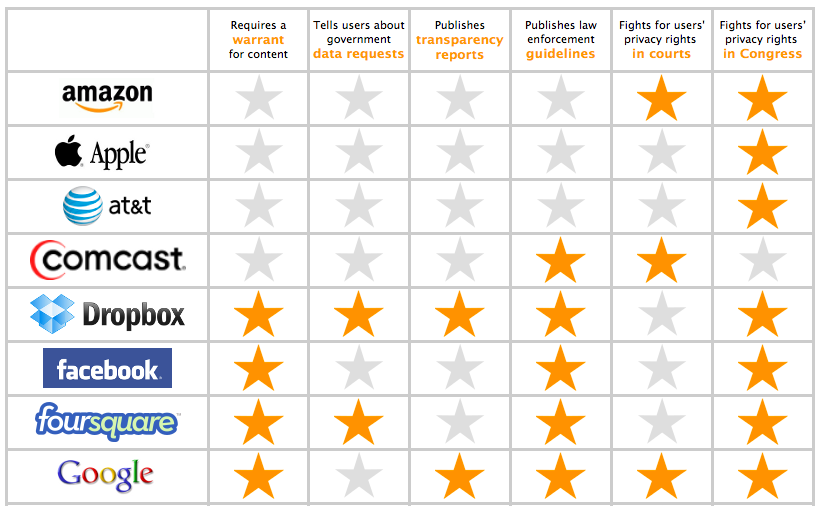
International digital-rights group Electronic Frontier Foundation has delivered its annual report card of which tech companies best protect its consumer data.
Some may be surprised that both Google and Twitter top the list of companies offering the most consumer protection from governments accessing your data and transparency toward data management.
While Dropbox and LinkedIn also fair well this year, the same cannot be said for Apple, AT&T, or Yahoo.
These companies miss the mark on data protection almost across the board with exception to protecting your rights in courts or Congress.
Read the full “Who Has Your Back” report at EFF.org.

Last month Google announced it was dropping ‘web’ from its Google Web Fonts brand and today made their robust font collection available to download for the desktop via sync with SkyFonts.
When you stage a debate on Google Glass between a self-described technology evangelist and a man who believes that current technology trends are debasing culture, things are likely to get interesting … especially when the discussion begins with the question of the etiquette of wearing the gadget at a urinal.
Check out The Next Web‘s conference video below of a conversation between Glass enthusiast Robert “I will never live a day of my life from now on without it” Scoble and British entrepreneur and privacy advocate Andrew Keen …
http://www.youtube.com/watch?v=YcRZeRyUq1k
Google made available today an introductory video to Glass featuring a brief tutorial on how to navigate its controls.
Using Glass certainly doesn’t seem to come naturally, but the controls are basic enough that Glass should be fairly easy to learn.
It seems the more of this kind of thing I see, the more I want to try Google Glass for myself, which is probably exactly what Google is trying to do.
Google announced today on its Google+ Developers Blog that it will be working with app and site developers to integrate what it is calling “app activities” into search results. In other words, when searching for an app or site through Google search such as SoundCloud, users will now be greeted with a section to the right of search results showing related SoundCloud content that’s popular among Google+ users. Google is initially teaming up with music and movie apps Deezer, Fandango, Flixster, Slacker Radio, Songza,SoundCloud and TuneIn but plans to add more soon as the feature begins to roll out on desktops in the coming weeks.
Below Google compares the current search results for Fandango to the new improved results page with app activities:
Expand
Expanding
Close
Robert Scoble isn’t mincing words on Google Glass. He thinks it will be big, big, big. His review after having Google Glass for two weeks reads like he’s had an epiphany and the only thing preventing these from ruling the universe is Larry Page’s inability to price these things as low as $200. His 6 points:
1. I will never live a day of my life from now on without it (or a competitor). It’s that significant.
2. The success of this totally depends on price. Each audience I asked at the end of my presentations “who would buy this?” As the price got down to $200 literally every hand went up. At $500 a few hands went up. This was consistent, whether talking with students, or more mainstream, older audiences.
3. Nearly everyone had an emotional outburst of “wow” or “amazing” or “that’s crazy” or “stunning.”
4. At NextWeb 50 people surrounded me and wouldn’t let me leave until they had a chance at trying them. I haven’t seen that kind of product angst at a conference for a while. This happened to me all week long, it is just crazy.
5. Most of the privacy concerns I had before coming to Germany just didn’t show up. I was shocked by how few negative reactions I got (only one, where an audience member said he wouldn’t talk to me with them on). Funny, someone asked me to try them in a bathroom (I had them aimed up at that time and refused).
6. There is a total generational gap that I found. The older people said they would use them, probably, but were far more skeptical, or, at minimum, less passionate about the fact that these are the future, than the 13-21-year-olds I met.
It is important to keep in mind the context of his perspective. He’s a uber-geek who spends his life immersed in technology. Some people will find the idea of wearing a computer on your face unsettling and there undoubtedly will be backlash. The wow factor will wear off and they will have to produce some value. Right now image and video taking are the key apps. As Scoble mentioned, other apps are coming fast and furious.
And, no, I don’t believe they won’t be $200 (unless there is a subsidy like phones). If Google is charging developers $1500/pop, there is no way Google can make them for $200, at least in the near future.
All of those disclaimers aside, I really do see a lot of opportunity for Google here. They’ve thought forward and this bet on the future of technology is going to change things.
Expand
Expanding
Close
looks like root is easy too: reboot-bootloader gives you fastboot oem unlock. There is fun to be had here…
— Liam McLoughlin (@Hexxeh) April 26, 2013
Update: A post from Google employee Dan Morrill clarifies that, although the original developer claimed a “root is easy”, the process developers are using is actually a ‘fastboot oem unlock’. Rather than exposing a security exploit, Google has actually intentionally left Glass open for devs to tinker with, as further explained by Googler Stephen Lau:
Not to bring anybody down… but seriously… we intentionally left the device unlocked so you guys could hack it and do crazy fun shit with it. I mean, FFS, you paid $1500 for it… go to town on it. Show me something cool.
Updated 2: Founder of the Cydia jailbreak store @saurik provided some clarification on his earlier tweets, informing us that he did not use fastboot oem unlock:
Actually, my device’s bootloader is still locked: I did not use fastboot oem unlock, and in fact that would not have been useful without the source code to the Glass kernel, which was not made available until this morning. I relied on a race condition in the adb restore process, a bug that existed in Android 4.0 (and even Android 4.1). As the Glass ships with Android 4.0.4, the bug was easy to exploit. This exploit was not one that I found, to be clear (unless you count “using Google” ;P): I pulled apart an implementation by@Bin4ryDigit, and adapted it for use on Glass (which required very small modifications to the backup; the entire process of learning the exploit and fixing it took 2 hours).
Saurik later published an article explaining some of the ins and outs of the potential for writing apps for Glass and the exploit he originally took advantage of.
Have you been wondering how long until developers crack into Google Glass to provide full root access and start creating some interesting mods? It appears we might not be too far off with Google intern on the Chrome OS team and hacker Liam McLoughlin confirming on Twitter that a root might be easier than many people think (via selfscreens).
McLoughlin first tweeted that, “There’s a “debug mode” option on Glass that appears to enable ADB access. I got a shell on my Glass :D (no root yet!).” Shortly after it appears he also figured out a root method, tweeting, “looks like root is easy too: reboot-bootloader gives you fastboot oem unlock. There is fun to be had here…”
He isn’t the only one working on a root for Google Glass, hacker @chpwn tweeted today that founder of the Cydia jailbreak store @saurik is in the process of unlocking his Google Glass and Saurik later confirmed:
Expand
Expanding
Close
Previously only available to Chromebook users, Google announced today on its Chrome blog that Mac and Windows users will now have the ability to open Microsoft Office files directly within Chrome. The functionality works for users running the latest Chrome Beta and requires installation of the Chrome Office Viewer (Beta) extension.
In addition to saving you time, the Chrome Office Viewer also protects you from malware delivered via Office files. Just like with web pages and PDFs, we’ve added a specialized sandbox to impede attackers who use compromised Office files to try to steal private information or monitor your activities.
On top of rolling out some new features to Google Drive earlier this morning including profile pictures and one-click group chat, Google also just announced some new additions to Drive’s offline mode.
When using Google Drive in offline mode, users will no longer have to worry about what files have been made available offline. Google will now automatically make Google Docs, Sheets, and Slides available offline as long as you have enough storage. Users will also now be able to create and edit drawings in offline mode.
The new offline features will be available to users in the coming days alongside the new group-chat and profile pictures features.
We already knew that future generations of Google’s Glass headset would include prescription frames and lenses in addition to rumors of the company working with trendy designers to make the frames more fashionable. Today we get a hint at some of the ideas Google is floating around for future iterations of the hardware via a patent application published today by the US Patent & Trademark Office and first spotted by UnwiredView.
As highlighted by the patent drawing above, Google’s idea is to use see-through displays in order to make Glass look more like an ordinary, traditional pair of sunglasses. Google describes the invention as “A near-to-eye optical system includes an optically transmissive substrate having a see-through display region and a repeating pattern of diffraction elements:
Expand
Expanding
Close
Google announced some new handy features for Drive on its official Google Drive Blog today. To make it even easier to quickly see who you are collaborating with inside a file in Drive, Google has added profile pictures in addition to names at the top of the web app. Hovering over the new profile pics will let you see details and add users to circles on Google+:
Now when you open a file in Drive, you’ll see the profile pictures of other viewers at the top instead of just their names, making it easy for you to do a quick scan of who else is in the file. You can hover over a photo to see details about the viewer and add them to your circles on Google+ — all without ever leaving Drive.
Google is also providing easy, one click access to starting group chats with both new features rolling out to users in the next couple of days. Google also confirmed it will be adding support for new files types soon, such as Google Sheets.

In other news, I’m going to intern for Google in a few weeks.
— comex (@comex) April 24, 2013
Former notable iOS jailbreak developer Comex announced on Twitter that he will be heading to Google for an internship position.
Comex previously interned for Apple, but left the company after failing to respond to an email to renew his contract with the company. It is also notable amidst a time where people are speculating that Apple is losing people resources to competitors such as Google.
Comex, whose real name is Nicholas Allegra, developed a notable Jailbreak.me hack that could jailbreak an iOS device via a simple website.


Following in the footsteps of Apple and Google attempts at the set-top-box market, Amazon is planning to release a set-top-box, according to Bloomberg.
They say the box will plug into TVs and give users access to Amazon’s expanding video offerings. Those include its a la carte Video on Demand store, which features newer films and TV shows, and its Instant Video service, which is free for subscribers to the Amazon Prime two-day shipping package. The Amazon set-top box will compete with similar products like the Roku, Apple TV and the Boxee Cloud DVR, along with more versatile devices like the Playstation 3 and the Xbox. An Amazon spokesperson declined to comment.
The device is reportedly being developed in Amazon’s Cupertino based labs and could launch this fall. The project is reportedly being spearheaded by a former Apple and Cisco employee:
The project is being run by Malachy Moynihan, a former vice president of emerging video products at Cisco (CSCO) who worked on the networking company’s various consumer video initiatives. Moynihan also spent nine years at Apple (AAPL) during the 1980s and 1990s.
Perhaps this future product is the reason that Apple and Amazon have no deal for Amazon content streaming on the Apple TV.
https://twitter.com/verizonwireless/status/327073775063531521
Our review is here. If you are in Camp Plastic and Camp Big Red, tomorrow’s your day.
Expand
Expanding
Close
Two of the major US carriers today announced they would be pushing back availability of the Samsung Galaxy S4 citing inventory challenges on Samsung’s end. First, T-Mobile late last night informed customers that it would be delaying the launch of the device until Monday, April 29th. The carrier originally planned to have the device available through its online store today. T-Mobile’s statement cited delays with “inventory deliveries,” and a press release from Sprint shortly after confirmed carriers are experiencing “unexpected inventory challenges from Samsung.”
Sprint initially planned on making the device available on April 27, but now will only be taking orders online with supplies in brick and mortar stores “as inventory becomes available.”
Sprint is excited to launch the new Samsung Galaxy 4. We had planned to launch this next generation of the award-winning Samsung Galaxy line-up on Saturday, April 27. Unfortunately, due to unexpected inventory challenges from Samsung, we will be slightly delayed with our full product launch. Sprint is one of Samsung’s largest partners and we are working closely with them to launch in all Sprint channels as soon as possible. We expect to make Galaxy S 4 available at www.sprint.com and Telesales (1-800-SPRINT1) as planned on Saturday with Sprint retail stores and other channels receiving devices as inventory becomes available.
Earlier today the unlocked variant of the Galaxy S4 found its way to eBay at a cost of $739.
As for Verizon, it had originally quoted an online release date of April 30th with shipments sometime in May and is yet to make an announcement regarding delays. The nation’s other major carrier, AT&T, is planning on making the device available in-store on April 27. You can check out 9to5Google’s full review of the Galaxy S4 here and we’ll keep you posted if there are any further announcements regarding availability.

Update: Following Google’s acquisition, Wavii has shut down its service and pulled its iOS app.
Google has purchased natural language processing engine Wavii for more than $30 million, according to TechCrunch.
The acquisition has several similarities to Yahoo’s recent purchase of Summly, which Yahoo integrated into its iOS app just yesterday, as both start-ups focused on parsing text from content and delivering summarized snippets of information.
Users in other countries have had access to Google’s public alerts for weather warnings and other critical public information through its Google Public Alerts platform since as early as January of last year. Now, Google has teamed up with Public Safety Canada and Environment Canada to roll out the feature in Canada, bringing severe weather alerts in both English and French to users through Google Search, Google Maps, and the Google Public alerts website. Users on Android will also be able to receive the alerts through Cards that automatically appear in Google Now:
We couldn’t have launched Public Alerts in Canada without Public Safety Canada and Environment Canada. Their meteorological data will ensure our users are notified of severe weather when relevant. We also appreciate their commitment to open data standards such as the Common Alerting Protocol (CAP).
For more information, or to see all active public alerts, visit our homepage at www.google.org/publicalerts. If you are a data provider, we also provide instructions here that will help you get your emergency data ready for Google Public Alerts.

Google launched its Google Fiber TV for iPad app today allowing Google Fiber customers to transform their iPads into QWERTY keyboard, TV guide yielding TV remotes.
For the past month, our Fiber TV customers have been able to control their TVs with any recent Android device. Using the Fiber TV app from the Google Play Store, they can search for programming, browse listings, and select shows or recordings with just the touch or swipe of a finger. Now, iPad users can enjoy this simple, intuitive experience, too.
This should come as great news to tablet owners in Kansas City, Austin, and Provo.
Google Fiber TV for iPad is available for free in the App Store.
(Source: Google)