IPhone

See All Stories

US court reverses Apple’s injunction on Samsung Galaxy Nexus

Site default logo image

U.S. Judge Lucy Koh granted Apple’s request for a preliminary injunction against Samsung’s Galaxy Nexus smartphone in June, and the decision resulted in the temporary removal of the device from Google Play pending a software fix with Android 4.1. Today, Reuters reported that Apple’s U.S. injunction on the Galaxy Nexus has been reversed. 

TheNextWeb got its hands on the official order. Samsung argued that its product would “sell almost as well without incorporating the patented feature” :

Samsung argued, somewhat humiliatingly, that the sales of the Galaxy Nexus were so poor that they didn’t pose a threat to Apple’s iPhone and that the unified search feature was not essential to the success of its device. The appeals court apparently agrees, as it states in its official order:

…it may very well be that the accused product would sell almost as well without incorporating the patented feature. And in that case, even if the competitive injury that results from selling the accused device is substantial, the harm that flows from the alleged infringement (the only harm that should count) is not.

According to Reuters, the U.S. Court of Appeals for the Federal Circuit ruled the court “abused its discretion in entering an injunction” and will send the case back to the California court for consideration.

Expand
Expanding
Close

Site default logo image

Report: Softbank in talks to buy Sprint for $19B

According to a report from Nikkei (via Bloomberg), Japan’s Softbank, the third-largest mobile carrier in the country, is currently seeking to acquire two-thirds of U.S.-based Sprint Nextel Corp. The price is rumored at roughly $19 billion USD and would make AT&T the last fully U.S.-based carrier:

Softbank Corp. (9984), Japan’s third- largest mobile-phone company, is in talks to buy control ofSprint Nextel Corp. (S), according to two people familiar with the matter…The deal would give Softbank a base for entering the U.S. market with a compatible carrier that uses similar equipment made by Sweden’s Ericsson AB, the Nikkei reported.

Google testing new mobile site

Site default logo image

[tweet https://twitter.com/nerderk/status/256020893275414529]

As Google has done with past updates to its products, it appears to be testing a redesigned version of its mobile homepage with a small group of users. A 9to5Google reader noticed the change on Android. There were also reports of iOS users noticing a new UI. As highlighted in the image above, the updated Google mobile website includes a redesigned top toolbar that looks similar to the desktop version. The redesigned toolbar also provides access to a slide-out sidebar that contains quick links to all of Google’s services as opposed to a top bar containing just a few tabs for “Images”, Maps”, “Places”, “more”, etc. The toolbar provides links to the “Web” and “Images”, as well as Google+ notifications and profile information. It is possible Google will push the redesigned UI to all users soon.

Site default logo image

Sprint says ‘accidental dual fibercut’ on network causing nationwide outages, attempting to fix issues

A widespread network outage on Sprint’s network started at 7:30 a.m. PST today and hit Portland, Ore., Seattle and Tacoma Wash., Minneapolis, Minn., and San Francisco and Sacramento, Calif. Sprint just confirmed it is working diligently to fix the issue.

Sprint’s statement to 9to5Mac:

“Earlier this morning, an accidental dual fibercut occurred on Sprint’s network causing a disruption in data and voice services for some Sprint customers in parts of Portland, Oregon; Seattle and Tacoma Washington; Minneapolis, Minnesota; and San Francisco and Sacramento, California. Sprint network technicians are working aggressively to resolve this issue and we hope to have service restored soon.”

This article is cross-posted on 9to5Mac.


Expand
Expanding
Close
Google’s Market cap passes Microsoft for the first time in history, closes $19B in 10 months

Site default logo image

Google’s Market cap passed Microsoft this morning for the first time, as first noted by a Bloomberg news tweet.

[tweet https://twitter.com/BloombergNews/statuses/252764243567464450]

Google trailed Microsoft by $19 billion earlier this year. The Mountain View, Calif.-based company closed the Market cap gap in just 10 months, however, forcing the once-goliath Microsoft to now walk in the footpaths of Google and Apple as the world’s most valuable tech companies.

Check out the fight in realtime: 

Microsoft currently boasts a $3 billion lead over Google, according to Business Insider, which cited Yahoo Finance, but their points are bound to sway if Google continues to swell.


Expand
Expanding
Close

Site default logo image

Samsung issues ‘Save the Date’ for ‘The Next Big Thing’ in NYC on Oct. 24

Samsung just sent preliminary press invites to “The Next Big Thing” for Oct. 24 in New York City.

Judging by the stylus featured on the above “Save the Date,” and after noting Samsung’s recent announcement about the Galaxy Note 2 launching stateside “by mid-November” with five major carriers, we have a pretty good idea as to what is coming.


Expand
Expanding
Close

Verizon finally pushes Jelly Bean upgrade to Samsung’s Galaxy Nexus

Site default logo image

Samsung’s Galaxy Nexus is the first smartphone at Verizon to get Android 4.1 Jelly Bean, announced the leading 4G LTE carrier today, with the software upgrade rolling out over Wi-Fi now.

Those interested in getting the latest, buttery-smooth version of Android can go to System Updates under the “About Phone” Setting’s menu. As noted, a Wi-Fi network is required to complete the download. The update comes to Verizon more than three months after Jelly Bean was released on the GSM version of the Galaxy Nexus.

“The interface on Jelly Bean is also the most responsive Android OS to date,” said Verizon in its announcement. “Customers can interact with messages, photos, emails and event details from the notification screen, allowing them to directly access important information without navigating their phone.


Expand
Expanding
Close

Site default logo image

Samsung mocks iPhone 5 line sitters (again) in new Galaxy S III ad

[youtube=http://www.youtube.com/watch?feature=player_embedded&v=nf5-Prx19ZM]

Samsung just released its latest ad mocking iPhone line sitters, right on time for the release of the iPhone 5 this week. The ad is quite similar to its old “The Next Big Thing” Galaxy ads bashing iPhone customers waiting in line at the Apple Store, but this time the commercial is of course for its latest device, the Galaxy S III.

Site default logo image

You will soon control the color of your energy-efficient LED light bulbs with your iPhone/Android [Video]

[protected-iframe id=”daad12569d07f2c915d6d3399237d9a5-22754319-20587613″ info=”http://www.kickstarter.com/projects/limemouse/lifx-the-light-bulb-reinvented/widget/video.html” width=”640″ height=”495″ frameborder=”0″]

Oh, Kickstarter. It is a primary place where tech lovers’ dreams have an opportunity to become reality; it not only promotes some of the most innovative ideas, but it also makes those of us in the real world more anxious for a gadget-filled tomorrow. Enter LIFX.

LIFX’s, well, life on Kickstarter is only nearing the 48-hour mark, but the reinvented light bulb already surpassed its set goal and hit $402,707 (as of press time) worth of pledges. In a nutshell: LIFX is a “Wi-Fi-enabled, multi-color, energy efficient LED light bulb that you control with your iPhone or Android.”

Just watch the video above for the full effect. A few of the more notable integrated uses include changing indoor light color to match any mood, visualizing music, security measures for while away, or even just enabling couch potatoes. Those who pledge at least $69 will get a handy-dandy LIFX “smartbulb” to try, with an estimated delivery pegged around March 2013.

Check it out: LIFX: The Light Bulb Reinvented

Home-automation technology is a huge hit among startups, such as former Apple Senior Vice President Tony Fadell’s popular Nest Learning Thermostat, and even carriers are trying to get on board by developing services that streamline life and home processes.

AT&T, for instance, produced a consumer home automation and security suite of services that began trials earlier this summer. The services, which exist under the “AT&T Digital Life” naming umbrella, control home functions and implement security features. With Nest and others creating a buzz in the mobile home-automation space, expect to see LIFX flying off retailers’ shelves this time next year.

This article is cross-posted on 9to5Mac.


Expand
Expanding
Close

Site default logo image

Droid Razr M lands on Verizon’s 4G LTE network today for $99 with contract

Google subsidiary Motorola Mobility unveiled its new line of Droid Razr smartphones just last week, and now the Droid Razr M is officially available at Verizon Wireless for $99 on a two-year contract.

Check it out: Verizon Wireless

We recently reviewed the device and dubbed it our “favorite little Droid.”  It packs a Super Amoled Advanced 4.3-inch display with 40 percent more screen real estate and a 40 percent more powerful battery than the Apple iPhone 4S. It also notably features a Corning Gorilla Glass display, DuPont Kevlar fiber and a splash-guard coating on the outside, while the software on the inside comes equipped with Android 4.0.4 Ice Cream Sandwich (with an upgrade to Jelly Bean by “the holidays”) and access to Google Play. It also touts Chrome for Android, Google Maps, Voice Actions for Android, Google, YouTube, and an easy-to-use tutorial for interactive help with customization

Additional premium specs include 4G LTE and NFC capability, a 1.5 GHz dual-core processor, 1 GB RAM, 8-megapixel camera with LED flash and 1080p HD recording, front-facing camera for video chatting, mobile Hotspot and a microSD card slot with support for up to 32 GB. The Droid Razr M comes in either “sleek black” or “stand out white.”

The new Razr M commercial:

[youtube=http://www.youtube.com/watch?v=s3mdkqOiuyg&feature=plcp]

In related news, Motorola also released a new Razr Maxx HD commercial (below):


Expand
Expanding
Close

Andy Rubin announces 500M Android activations to date ahead of tomorrow’s iPhone 5 event

Site default logo image

Are you ready for the latest breakdown of Android’s performance ahead of Apple’s iPhone 5 event tomorrow afternoon? Android boss Andy Rubin just announced this evening that 500 million Android devices have been activated to date, which follows Eric Schmidt’s announcement of 480,000 devices last week. Rubin reiterated Schmidt’s announcement, claiming 1.3 million Android devices are being activated daily (70,000 of which are tablets). Last week, we calculated Google could hit a whopping 1 billion devices activated in a year’s time at its current growth. Tonight’s announcement was definitely interesting timing.

[tweet https://twitter.com/Arubin/status/245663570812100608]


Expand
Expanding
Close

Sony explains Xperia V’s sensor-on-lens touchscreen tech

Site default logo image

After announcing the new ICS-powered Xperia lineup last month, Sony shared some details today on the new sensor-on-lens touch screen tech being built into the Xperia V. Sony described the tech as providing the same benefits to smartphones as in-cell and on-cell touch technology, which Apple is rumored to be including in the next-generation iPhone. In a blog post on the Sony Mobile Developer blog, the company explained exactly how the sensor-on-lens technology works and some of the benefits it provides to the Xperia V. Some of those benefits include better image quality, less haze, 5 percent better display luminance, and a lighter and thinner device due to an extra layer of glass being removed:

Sensor-on-lens touch technology means that the number of physical layers in the touch panel (handset stackup) is reduced, as the sensor layer is actually part of the lens itself. This in turn means that you will get better image quality, as there is no interference from the touch sensor component.  There is one less layer of glass and one less layer of glue, compared to conventional touch panels… This technology also moves the image plane closer to you as a user, which makes it feel like you are actually touching the image itself. With this direct touch experience, you will get less parallax issues compared to a conventional touch panel, as the image and the point of touch are closer together in the sensor-on-lens touch screen technology.


Expand
Expanding
Close

Site default logo image

StubHub shows off 3D maps for mobile app and site, says open APIs coming soon

Yankee Stadium

StubHub is the latest company to join the 3D craze with updated maps for its online and mobile apps counterparts.

The 12-year-old online ticket reseller, bought by eBay in 2007, allows users to buy and sell tickets for sports, concerts, theatre, and other live entertainment events. It acquired Peekspy, which is a company that leverage’s Google Earth’s technology to create 3D products, in early 2012 for an undisclosed amount. Fanvenue, Peekspy’s website, further builds 3D interactive seating maps for venues and stadiums.

With Peekspy in its pocket for the last six months, StubHub is preparing to roll out 3D maps. The tech is for both online and mobile, but StubHub said it is working toward a consistent experience on both platforms. The first phase is onsite only, but upcoming rollouts will simultaneously land for both Stubhub.com and mobile.

StubHub Product Director Mats Nilsson announced at a media event in New York City recently that StubHub for Android would soon sport the tech, although an exact launch date has not been announced, so folks could find seats in a more easier and entertaining way. For instance: Users on either Android, iOS or Windows Phone will be able to hover over a desired seating section, tap to zoom, and then closely inspect desired seats, interior views, stage setup, bathroom locations, and more.

Only a few venues are now launch-ready for mobile apps, such as Yankee Stadium, but Nilsson said StubHub is diligently working with many arenas to get 3D maps into full swing. With that said, MLB stadiums are now live online as part of the “first phase” previously mentioned by StubHub.

In related news, StubHub CTO Raji Arasu revealed plans to completely open APIs in the coming months. The limited StubHub API already allows some partners, such as ESPN, to gain information and functionality, but the ticket reseller hopes full read-and-write access for all will further encourage development.

A gallery of StubHub 3D maps is below.

This article is cross-posted on 9to5Mac.


Expand
Expanding
Close

Almost comical, unintended consequence of of Apple’s patent win: Your manufacturer/carrier might actually update your Android phone

Site default logo image

Something funny just hit me. Samsung’s “pure Google” Nexus S phone was hit with a number of software infringements in the Apple trial. This is not Samsung…this is core Google Android. However, according to patent attorney Nilay Patel who now works at The Verge, these software infringements are only for older versions of Google’s Android OS.

[tweet https://twitter.com/reckless/status/240117223828619264]

So, phones with Android 2.x are infringing on Apple’s IP. Therefore, if they are upgraded to Android 4.1, they do not infringe? By that logic, carriers and manufacturers will be forced to upgrade their handsets or else face IP infringement charges. How are they doing at upgrading so far? Google’s own market share numbers from earlier this month show a small sliver of Android 4.1 devices out there.

.

Perhaps this verdict is a huge win for Android-device holders. If the verdict in this Apple case forces Android manufacturers (and carriers) to update their devices or face stiff infringement penalties, clearly the Android customer comes out ahead.


Expand
Expanding
Close

Google’s attempt to block U.S. imports of iPhone and iPad thwarted as ITC remands investigation of one patent

Site default logo image

Following the verdict in the Apple vs. Samsung trial today, where Samsung was found guilty of infringing various Apple patents related to the case, Apple is also coming out a winner, at least temporarily, in Google/Motorola’s attempt to block imports of iPhones and iPads to the United States.

In late June, we told you about Google’s attempt to block U.S. imports of iPhones and iPads based on a previous ruling that Apple infringed on one standard-essential Motorola patent. The initial ruling was under review by the ITC, which has power to block U.S. imports of Apple devices from Asia, with a decision expected at a hearing scheduled for today.

The ITC has now concluded its review (via paid blogger FossPatents), finding no violations for three of the four patents in the initial suit (including the one mentioned above), but remanded an investigation on a fourth, non-standard essential patent to Judge Thomas Pender. The result? According to FossPatents, there might be a violation and import ban related to the patent, but a remand and ITC review could take up to a year:

Expand
Expanding
Close

Jealous of the new iOS Facebook App? An Android version is in the pipeline says Facebook Director of Mobile Engineering

Site default logo image

Android Police pulled some nice quotes from a recent Reddit thread on the future of the Facebook App on Android…

FB: Facebook is committed to both Android and iOS, and you’ve now seen what we can do. Stay tuned. (There are things in the Android app that aren’t in the iOS one today, like mentions in posts and comments, photo multi-upload, event creation. Since version 1.9 the Android app has tested faster than the iOS one, but FB-iOS 5.0 obviously changes the game.)

Android presents some unique challenges for developers, especially those with a large user base, but we do and will power through them. A lot of time is spent dealing with device-specific issues and limits, and you really have to fight with the toolkit to get iPhone-smooth interactions. Some vendors have a different HTTP stack (!), none implement the Camera APIs consistently, and reliability of hardware acceleration is…imperfect, GC pauses are terrible, lots of the toolkit insists on doing real work on the UI thread and allocating recreationally. On iOS you can test on 5 devices and basically have the market covered. We have to test on many dozens to get to the top 1/3 of our users, and then the tail starts to getreally long.

Q: Do you know when we could expect a native app too? I realise you probably can’t give away too much but are we talking weeks? Months?

A: Nobody is more excited about the state of our current development version than we are, and we will get it to users as soon as we can. One of our awesome PR people is standing next to me (10,000 miles away) with a gun (frowny face), so I can’t say more. Also, I have been doing software 20 years too long to make estimates in public. Experience and quality determine the time. I am utterly confident that you’ll find it worth the wait, and I wish I could give it to you today.

Q: Pretty much everyone I know has problems with the app even loading anything at all, and that’s before complaints about performance issues. This has gone on for ages, how come something as important as this has been unresolved for so long?

A: There are lots of reasons that people can experience problems, and we work through (and fix) different ones all the time. We have pretty detailed metrics on different aspects of performance, stability, load-time, load-error, etc. We can see them getting better in meaningful chunks, but that spreads out across 130M users in a way that isn’t to anyone’s satisfaction. (This is one area in which neither the inherent characteristics of the Android webview nor the OEM-specific tweaks that occur are our friends. Really, they aren’t even cordial.) We’ve been on fixed-date release cycles since 1.9, and we’re now down to every 4 weeks (where we’ll stay); this was a shit-ton of work for a large number of people, but it means we can get improvements out to users faster even while investing in longer-term features or architecture changes.

Q: What’s the best way for us, as users, to make it known that something isn’t working right with the app and make a difference? As of right now I could make quite a list of things that don’t work with the app, however it would feel a bit like a drop in the ocean for all the feedback you probably receive and feels like it would go unnoticed…We want to help :)

A: There’s a bug reporting mechanism either via the website or the app that someone on my team reads and rolls up for the developers weekly. My internal build has another mechanism for it, so I embarrassingly can’t tell you in more detail right now. :-/

Q: Is it true that Facebookers have been forced to use the android app to get a feel for how bad it is?

A: Neither the assertion nor the implication are true to my knowledge, and I am virtually certain that my knowledge on this issue is complete.

Enhanced by Zemanta
Site default logo image

Google’s Voice Search adds 13 new languages

Google’s Voice Search is now available in 42 languages in 46 countries.

The search giant added 13 new languages to its app; so over 100 million worldwide speakers can now use Voice Search. The new languages include, according to the official Google blog, Basque, Bulgarian, Catalan, European Portuguese, Finnish, Galician, Hungarian, Icelandic, Norwegian, Romanian, Serbian, Slovak, and Swedish.

“Each new language usually requires that we initially collect hundreds of thousands of utterances from volunteers and, although we’ve been working on speech recognition for several years, adding these new languages led our engineers and scientists to tackle some unique challenges,” explained Product Manager Bertrand Damiba in Google’s post.

This update is rolling out over the next week. Those with an Android 2.2 or later device can use Voice Search by way of a microphone icon on the Google Search widget from the homescreen. Otherwise, a user must install the Voice Search app from Google Play.


Expand
Expanding
Close

Site default logo image

Instagram 3.0 adds geo-tagged photo map and UI tweaks [Video]

[vimeo 47138800 w=600 h=381]

The Facebook-acquired, vintage photo-editing app Instagram is rolling out version 3.0 today for iOS and Android with a new Photo Map that highlights geo-tagged, filtered images.

“With every major release, we pick a theme – and for this one we’ve focused on the browsing experience. We’ve introduced a new and unique way to browse your photos and others’ photos on a map, which means you’re no longer constrained to browsing through page after page of photos,” announced Instagram on its official blog.

Once the update lands on the App Store and the Google Play Store, a Photo Map section will appear on all profiles. Instagram’s 80 million users can change between Grid and Chronological view modes and then zoom in and tap on photo stacks to navigate through all the geo-tagged images saved on an account. They can further delete unwanted pictures from their own stacks.

Additional user-interface refreshes include usernames now appearing in the app’s header, a multi-line caption box, and several performance enhancements to make the browsing experience, such as infinite scrolling in the feed and a new spam reporting system, more fluid and responsive.

“On newer devices, you should notice a marked improvement in speed while browsing. With that, we’ve introduced infinite scrolling in feeds so that you can quickly see more photos while browsing around the app. And finally, we’ve paid special attention to keeping Instagram a safe place. With improved reporting tools, users can now flag both photos and comments for review with ease,” Instagram explained.

The full change log:

  • – View your photos on a map (visit your profile and tap Photo Map to select which of your photos will be viewable on the map)
  • – Redesigned profile screen
  • – Redesigned upload screen
  • – Design improvements throughout
  • – Infinite scrolling on photo feeds
  • – Flag inappropriate comments
  • – Bug fixes and performance improvements

Get the latest version of Instagram at the Google Play Store.

This article is cross-posted on 9to5Mac.


Expand
Expanding
Close

Site default logo image

Pinterest refreshes mobile experience, launches first Android app

Pinterest updated its entire mobile app lineup today with a completely refreshed design, and it released all-new tablet and Android apps. Previously only available on the iPhone (and now iPad), the developer released Android versions today that work on both phones and tablets. Pinterest walked through some of the new features in a blog post announcing the updated apps. The app is available as a free download on Google Play now.

Android owners have been very vocal with their requests for an app – every product announcement we’ve recently made has resulted in the question “What about an Android app?” We were listening, and our custom-designed Android app makes it simple and fast to pin, so that the time you spend on Pinterest is as productive as possible. We also made sure the app works well on Android phones and tablets, regardless of your device’s cost, speed or screen size.

Teens flock to YouTube for music consumption over iTunes and other mediums

Site default logo image

The majority of American teens prefer YouTube to iTunes, radio, online radio, and CDs when it comes to finding and listening to music.

Approximately two-thirds of 18-and-younger U.S. teenagers, according to a “Music 360” survey from research firm Nielsen (via The Wall Street Journal), claimed they sidestepped other music-listening mediums for Google’s video-sharing platform.

YouTube snagged 64 percent of 13-to-17 year olds, while radio came in second at 56 percent. iTunes held 54 percent, with CDs and Pandora rounding the top five at 50- and- 35 percent respectively.

The Wall Street Journal noted young folks regard YouTube as a “de facto free music service,” but adults do not take full advantage of the site’s complimentary content. The survey showed 67 percent of them actually preferred radio for music consumption, but another 61 percent still gave CDs a whirl. Meanwhile, YouTube stole 44 percent, Pandora landed the No. 4 spot at 32 percent, and iTunes sat at fifth with 29 percent.


Expand
Expanding
Close

Google launches clever Google Ads campaign with animated commercials in Brazil (Videos)

Site default logo image

Google is using witty animation to enlighten folks in Brazil about the conditions of online advertising and how its service helps streamline those operations.

The Internet giant recently hosted five animated videos on YouTube as part of a Brazil-based campaign for Google Ads products. According to TheNextWeb (via Brainstorm9), agencies Pepper Melon and Ño Empire co-created the farcical advertisements that focus on brand awareness, audience engagement, efficient technology use, target selection, and new product launches.

The commercials are in Brazilian Portuguese with English subtitles, check ’em out:


Expand
Expanding
Close

MetroPCS launches Dyle TV service on Samsung Galaxy S Lightray 4G, requires old school antenna

Site default logo image

We told you in January that MetroPCS planned to bring local broadcast TV to Android devices through the “Dyle Mobile TV” app. We knew, at the time, Samsung would launch the first device to feature the service preloaded, and we get the details today with CNET reporting that the 4.3-inch Samsung Galaxy S Lightray 4G will officially introduce the Dyle Mobile TV service. Unfortunately, the service requires the device—which is a variant of US Cellular’s Galaxy S Aviator—to have a retractable antenna:

Dyle is the answer for people who can’t live without their favorite daytime talk shows and soap operas. Essentially a mobile TV service that picks up special broadcasts of local TV channels, Dyle allows you to get programming anywhere you have your handset or smartphone. In the works for years, it’s finally launched on the Samsung Galaxy S Lightray 4G, which MetroPCS began selling today.

Expand
Expanding
Close

Google Apps for Business users can now remotely wipe their mobile device if lost or stolen

Site default logo image

Google introduced a new feature last year for Google Apps for Business admins that allows them to manage a large set of mobile devices across all platforms. Admins can make settings, like allowing or blocking the phone’s camera, which then requires employees to set passwords on their devices, and making a way for administrators to set data encryption policies for users’ devices. It is an easy way to manage a ton of devices.

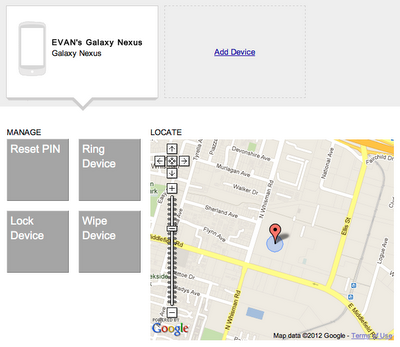
To hopefully make things a bit easier, Google unveiled a new feature for administrators today that gives users (employees) the ability to remotely wipe data off their phone from the moment it is lost or stolen. The feature is very similar to Apple’s Find My iPhone, which just today allowed New York Times reporter David Pogue to locate his iPhone. Users will be able to view their device from the “My Devices” page, where the PIN on the phone can be reset and the device can be locked, rung, or wiped. Non-work Android device users have had a similar feature for quite sometime. We all know it is a scary situation when a personal artifact is lost, so having the ability to somehow find it is always welcomed.

[Enterprise Blog]


Expand
Expanding
Close