Stay up to date on news from Google headquarters. Be the first to learn about plans for Android, Google Plus, Google Apps, and more!
Stay up to date on news from Google headquarters. Be the first to learn about plans for Android, Google Plus, Google Apps, and more!

Although we have not seen that much about how Google’s augmented reality glasses will actually work (apart from a few photos and video at the Google I/O skydiver demo), the company plans to get the $1,500 Explorer Edition into hands of I/O attendees who preordered the device by next year. Google appears to already be thinking about security features for Project Glass with a patent published by the United States Patent & Trademark Office (via Engadget) that details various ways of locking the device or sounding an alarm when detecting unnatural movements. It would also be capable of alerting authorities that the glasses have been stolen or unintentionally removed.
These features would have certainly been useful to University of Toronto professor Dr. Steve Mann (pictured above), who recently was physically assaulted for wearing his EyeTap Digital Eye Glass system. Mann described the experience of having his vision system, which he explained could only be removed with special tools, ripped off his head by a McDonalds employee:

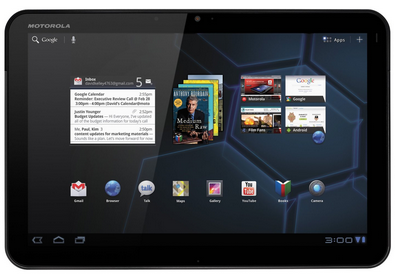
A German court ruled this morning that the Android-powered tablet does not violate the patented look of Apple’s tablet. The Duesseldorf court discarded one claim by the Google-owned manufacturer, however, about the iPad’s design patent being inapplicable.
FoxBusiness explained:
- Apple initially sued Motorola for allegedly infringing three iPad designs with the Xoom. It sought to have the device banned across Europe.
- Although the judges ruled Motorola’s Xoom doesn’t infringe on the iPad, the court rejected a counterclaim brought by Motorola alleging the iPad’s design patent is invalid, a spokesman for the court said.
- As the court ultimately rejected both parties’ claims, it ordered Apple to pay two-thirds of costs and Motorola to pay a third, the spokesman added.
- […] During two hearings prior to the ruling, the presiding judge had indicated the court was leaning in Motorola’s favor. Judge Johanna Brueckner-Hofmann said in March that the court considered the evenly bent back and shaped edges on the front of the Xoom tablet sufficient to give the product individual character.
Apple is also suing Motorola in a Mannheim court for allegedly breaching a patent on multi-touch enabled devices.
Get the full report at FoxBusiness.
[youtube=http://www.youtube.com/watch?v=g7VzVTNN6DA&feature=player_embedded]
Almost two years after launching Street View imagery of the Antarctic, Google is now adding breathtaking, panoramic views of historic locations.
According to the official Google Blog:
- In the winter of 1913, a British newspaper ran an advertisement to promote the latest imperial expedition to Antarctica, apparently placed by polar explorer Ernest Shackleton. It read, “Men wanted for hazardous journey. Low wages, bitter cold, long hours of complete darkness. Safe return doubtful. Honour and recognition in event of success.” While the ad appears apocryphal, the dangerous nature of the journey to the South Pole is certainly not—as explorers like Roald Amundsen, Robert Falcon Scott and Shackleton himself discovered as they tried to become the first men to reach it.
Google joined forces with the Polar Geospatial Center at the University of Minnesota and the New Zealand Antarctic Heritage Trust to capture 360-imagery—including interior, exterior, and landscape shots—of the explorers’ preserved camp sites.
The South Pole Telescope, Shackleton’s hut, Scott’s hut, Cape Royds Adélie Penguin Rookery, and the Ceremonial South Pole are now on Google Maps in stunning, high-resolution photography.
Check out a few screenshots below.
Nexus 7 owners can finally rejoice as the hugely popular Instagram for Android app now supports Google’s new Jelly Bean tablet.
Version 1.1.7 allows the Nexus 7’s 1.2-megapixel front-facing camera to snap away, where as the app previously showed a compatibility message on the tablet. The latest update also includes Flickr support, so Instagram users can immediately access the sharing menu to take full advantage of this addition.
Check out the jazzed up, filtered-photography app on the Google Play store today.
As first noted by Marketing Land’s Danny Sullivan, Google+ came out on top among the highest scores for social media sites in the annual American Customer Satisfaction Index for its debut year. The downfall for Facebook, according to the report, is largely due to the introduction of Timeline, advertisements, and privacy concerns. On the other hand, better privacy controls, no ads, and great mobile support allowed Google+ to take the top spot:

 The NYTimes has the story:
- The appointment of Ms. Mayer, who was employee No. 20 at Google and was one of the few public faces of the company, is considered a surprising coup for Yahoo, which has struggled in recent years to attract top flight talent in its battle with competitors like Google and Facebook.
- Ms. Mayer, 37, had for years been responsible for the look and feel of Google’s most popular products: the famously unadorned white search homepage, Gmail, Google News and Google Images. More recently, Ms. Mayer, an engineer by training whose first job at Google included computer programming, was put in charge of the company’s location and local services, including Google Maps, overseeing more than 1,000 product managers. She also sat on Google’s operating committee, part of a small circle of senior executives who had the ear of Google’s co-founders, Larry Page and Sergey Brin.
Mayer has been on the outs for some time at Google, and she did not show for Google I/O this year. She moved up the food chain from being Google employee No. 20 and first female engineer. Mayer’s rise took her from engineer to project manager to Director of Consumer Web Services to VP of Search Products and User Experience, and finally to Location in a broad shift. She was also on the very influential “Operating Committee” of high ranking officers.
However, she was not promoted as one of Larry Page’s seven business heads when he re-took over the company last year.
[tweet https://twitter.com/marissamayer/status/224968460139114496]
Mayer is on Walmart’s board of directors, and she briefly dated Google CEO Page who said:
“Since arriving at Google just over 13 years ago as employee #20, Marissa has been a tireless champion of our users. She contributed to the development of our Search, Geo, and Local products. We will miss her talents at Google.”
Mayer said,
“I am honored and delighted to lead Yahoo!, one of the internet’s premier destinations for more than 700 million users. I look forward to working with the Company’s dedicated employees to bring innovative products, content, and personalized experiences to users and advertisers all around the world.”
The press release is below.
[youtube=http://youtu.be/sYBy0p485Sc]
Microsoft is slated to unveil its next iteration of Office today, and The Wall Street Journal’s Shira Ovide is prepping the announcement with some comparison data about the productivity suite and its direct cloud-based rival Google Apps.
According to the WSJ’s video above, Dominion Enterprises held a $2 million annual contract with Microsoft, but it recently decided to switch to Google Apps. The company now pays $200,000 for Google’s services.
Despite the loss, the Office sodtware remains a hugely successful product for Microsoft. It is one of the company’s most profitable goods, and it continues to maintain a stronghold in the desktop productivity market. Google Apps, on the other hand, is still in its infancy, but it is rapidly gaining steam and attention.
Today’s announcement from Microsoft CEO Steve Ballmer will surely set the pace for the company’s future against the ever-growing Google Apps.
With Google and several retailers accepting preorders for the new Nexus 7 tablet leading up to last week’s launch, it appears Google is selling the device as quickly as it can ship it to retailers. As noted by CNET, several of Google’s key retail partners, including GameStop, Staples, Sam’s Club, and Office Depot, now list the device as backordered, sold out, or out of stock.
It looks like Google’s initial wave of units has run out. However, some customers report there is limited stock at select brick-and-mortar locations for some of these retailers, despite lack of online availability. Canadian retailers, such as BestBuy.ca and Staples.ca, are also listing the device as out of stock, while Google Play still lists shipping to both the U.S. and Canada as “1-2 weeks“.
Google told us during its Google I/O keynote that it would bring Chromebooks to 100 Best Buy stores in the United States in the near future. Today, customers tipped TechCrunch that in-store displays for the Chromebooks finally started popping up in Best Buy retail locations. One interesting aspect of the displays is a rack of CDs loaded with the Chrome browser being offered to customers for free. However, we are not sure how many users this will actually convert. In a blog post on his Google+ account, the customer described the CDs and provided the screenshots above:
One thing I was most surprised about was the free +Google Chrome CDs. The CDs were in really cool plexi-glass cases held together by magnets. The Chrome Expert also gave us the cool idea of using the case as a picture frame after we were done using the CD. I think it is a great idea for Google to use their Chromebook’s placement in Best Buy stores to also spread the goodness about Chrome.
As noted by the official Google Play account on Google+, the company started shipping out Nexus 7 tablets today for customers who pre-ordered the device. Google informed customers via an automated message on its help line that all pre-ordered devices are expected to ship within the next three business days. Customers will receive a tracking number and confirmation email once the device has shipped from Google. Pre-ordered devices from some retailers are also now ready for pick up. Phandroid reported today that GameStop started informing customers that pre-ordered Nexus 7s have now arrived and other retailers are expected to start doing the same.
The full statement from Google (via AndroidPolice) is below:
“We’re now shipping Nexus 7 pre-orders. The first wave of orders are going out today and all pre-orders are scheduled to ship within the next 3 business days. Once your order has shipped you will receive a confirmation email and tracking number. Though our agents are unable to provide a specific delivery date for individual pre-orders, please rest assured that our shipping team is working to fulfill all orders as quickly as possible.”
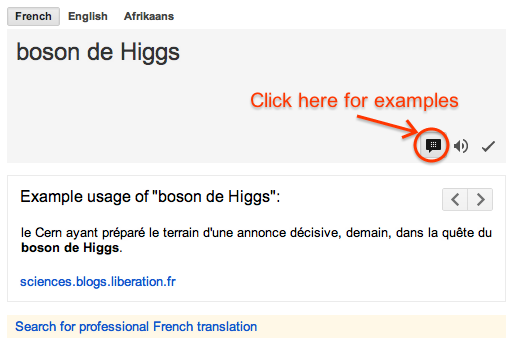
About 5,000 new words are created each year.
Of course, that is Google’s own statistic. The folks in Mountain View took to the official Google Translate blog to explain how its, well, Google Translate tool now offers example sentences for those newly created words. The examples are aggregated from “fresh new stories around the web,” wrote Google Associate Product Manager Etienne Deguine.
To use the feature, type into the left-hand text box of Google Translate, and then click on the example sentence icon on the bottom right (screenshot above).
Today, Patent Bolt covered a newly published Google patent application that details what appears to be a hybrid notebook/tablet design. We noted recently it would not be too shocking to see more Google-made hardware following the company jumping into end-to-end manufacturing of its new U.S.-made Nexus Q hardware. With that in mind, it is certainly interesting to see innovative notebook designs are at least being conceptualized at Google.
As noted in the report, aspects of the patent application cover a notebook device with virtual keyboard and trackpad in place of a traditional physical keyboard. While the patent covers a wide variety of possible configurations, some highlights include:
Expand
Expanding
Close
In a blog post on his Google+ page, Google+ Product Manager Ronald Ho announced a new tool to transfer circles from one account to another that is now available through Google Takeout. In an overview of the long-requested feature, Google explained the tool would migrate “circle names, circle members, “your circles” settings, and people and pages you’ve blocked or ignored.” However, Google noted there is a 7-day waiting period before a transfer is initiated, and both profiles will have limited functionality until the transfer is complete:
-There’s a 7 day waiting period before your transfer begins.
-To cancel the transfer before it starts, sign in to either account on Google+. Then click Cancel transfer at the bottom of the page. Note that you cannot cancel using a mobile interface.
-If the source or destination accounts are managed by an organization, the account administrator may restrict your ability to transfer your connections and/or use Google+.
-You won’t be able to use this tool with these accounts again for 6 months.
-Once the transfer begins, it cannot be cancelled or undone.
As for limited functionality, both accounts will not be able to share content on Google+ during the transfer—nor can they add, remove, block, or ignore people in circles and elsewhere. Google continued by explaining the result of a transfer once complete:
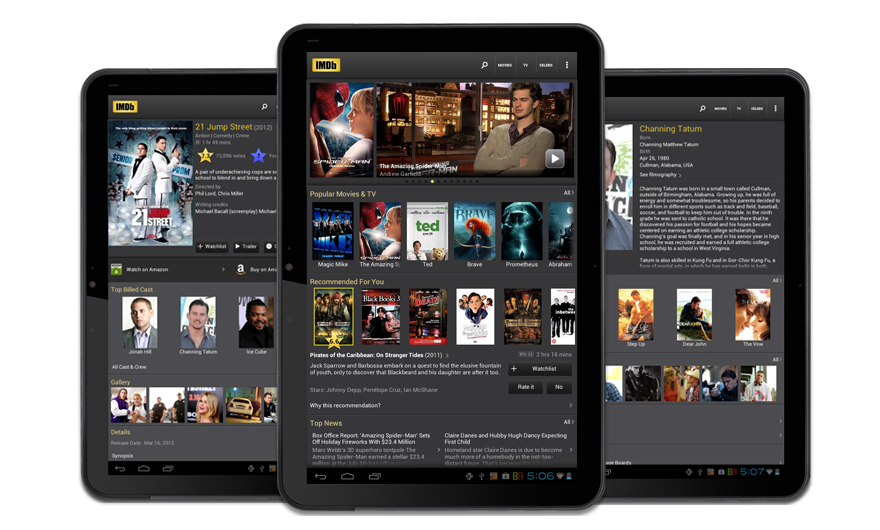
IMDb, the unofficial resume for everyone and everything Hollywood, just announced its iOS and Android apps have experienced more than 40 million total downloads. The Android counterpart for tablets and smartphones claimed half of those downloads, and IMDb is celebrating with today’s launch of “highly anticipated discovery, personalization and social features.”
The IMDb Movies & TV app is a free app at the Google Play store. It rates 4.5-stars as of press time.
The press release is below.
[youtube=http://www.youtube.com/watch?v=e1ErgRekjn8&feature=player_embedded]
Google is expanding its “Search as You Type” feature under Google Commerce Search to U.S.-based AdWords advertisers today as a free, stand-alone service.
“It’s easy to implement and helps increase sales and conversion rates on merchant websites. The Search as You Type pilot is available to US-based AdWords advertisers for free, up to 25 million searches annually, after which licensing fees would apply,” announced Google Shopping Product Management Director Jennifer Dulski on the official Google Commerce blog.
Google’s famous predictive suggestions, auto complete, and related product results are integrated into Search as You Type to bulk a merchant’s existing website search functionality. Today’s announcement supports Google’s recent attempts at enhancing its online retail and search experiences.
“When shoppers type a search query into a merchant’s site, Search as You Type shows them product suggestions and photos, making it faster and easier for people to spot the product they’re looking for and click through to make a purchase,” Dulski explained.
[youtube=http://www.youtube.com/watch?v=1bFdNFTq8Vw&feature=player_embedded]
Sustrans, a British charity promoting sustainable transport, just announced that it partnered with Google to bring cycling routes to United Kingdom-based Google Maps users.
Greener-minded Americans are quite familiar with the biking icon and its bevy of alternative transit routes, but now U.K. fans of the popular mapping app can plan their cycling trips, navigate bike lanes, and time routes on both smartphones and computers. For those unfamiliar, Google Maps offers worldwide mapping technology, directions and local business information to mobile and desktop users by way of satellite and street-level imagery and user-contributed content.
“We know how popular cycling is in London and the rest of the UK, especially ahead of a busy summer, which is why we are thrilled to bring cycling directions to Google Maps. Thanks to Sustrans, we now have thousands of miles of trails and routes, as well as bike lanes and recommended streets for cities across the country,” said Google UK Geospatial Technologist Ed Parsons.
“We’ll continue to add new trail information and urge commuters to swap their car for a bike as they can now find a convenient route that makes use of dedicated bike tracks and avoid hills whenever possible, Parsons added.
The new feature goes live today, and Sustrans is celebrating the launch with its own video, called “Lucy’s Cycling Treasure Hunt” (above).
The press release is below.
[youtube=http://www.youtube.com/watch?v=HdoxX0XGros&feature=player_embedded]
Amazon just announced a new gaming experience for developers and the Kindle Fire: GameCircle.
According to the Amazon Mobile App Distribution blog, GameCircle is a “new set of services designed to make it easier for you to create more engaging gaming experiences and grow your business on Kindle Fire,” by making “achievements, leaderboards and sync APIs accessible, simple and quick for you to integrate, and will give gamers a more seamless and entertaining in-game experience.”
Amazon offers a growing suite of developer services. Its new GameCircle is geared specifically for game developers too, which is great news for the Kindle Fire since it is facing a firestorm of Android-based content competition from the new Nexus 7. Game Circle also helps players to better experience their games through three key features —achievements, leaderboards, and sync—that will surely continue to entice folks to the dominating Android-based eReader.
Achievements allow players to “track all earned trophies, treasures, badges, awards, and more without leaving the gaming experience,” while leaderboards give an “in-game view of score comparison information and percentile ranking, allowing players to quickly and easily check standings against top players or competitors, without ever leaving your game.”
Sync autosaves players’ in-game progress to the cloud for immediate pick-up exactly where they ended when switching devices or restoring a deleted game. Losing progress, scores or achievements is not a problem with GameCircle, because as all data is safely stored in the cloud.
The last time we updated you on the FTC’s investigation into Google’s method of bypassing the default Safari browser settings on iOS devices, reports claimed the company was facing possible fines that could reach tens of millions. Today, The Wall Street Journal said Google is close to reaching a $22.5 million settlement with the FTC, according to people close to the negotiations:
The fine is expected to be the largest penalty ever levied on a single company by the U.S. Federal Trade Commission. It offers the latest sign of the FTC’s stepped-up approach to policing online privacy violations, coming just six months after The Wall Street Journal reported on Google’s practices.
In recent weeks, the FTC staff and Google have reached a proposed settlement and agreed on a fine, according to several people close to the investigation. The settlement is awaiting approval by FTC commissioners and could still be altered before it becomes public.
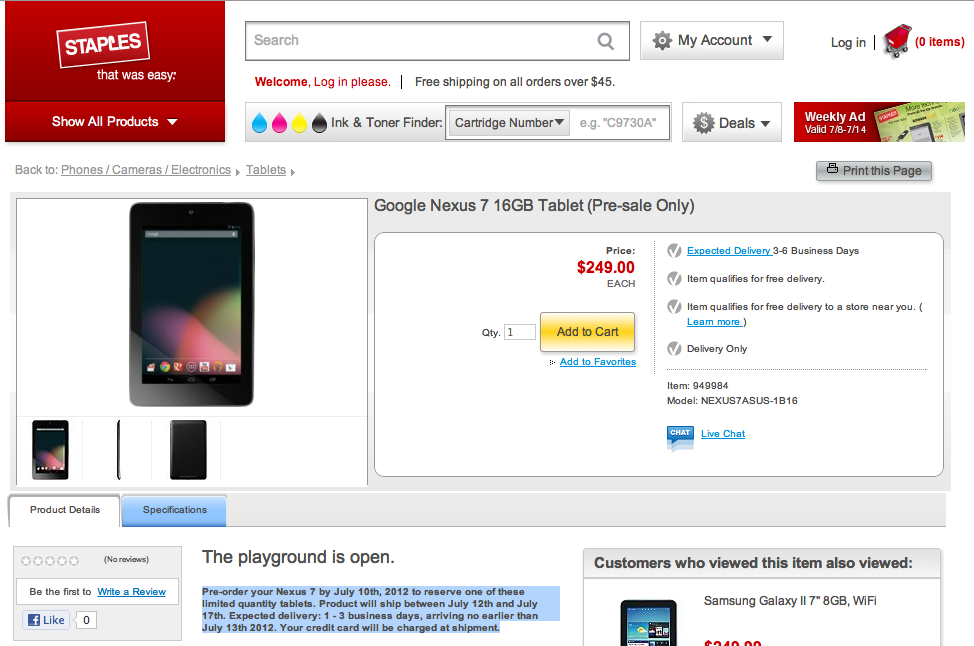
It has been a couple of weeks since Google dropped its Asus-built Nexus 7, but the Jelly Bean-powered tablet is just now becoming available at a slew of third-party online retailers.
The 7-inch Android slate first debuted on the Google Play store, where the 16 GB version retails for $249, with a $25 credit. Folks can only pre-order at the moment, because shipping is still another two to three weeks out, but they can now place their orders for the Nexus 7 just about anywhere. GameStop, Staples, B&H, Adorama, Abt, and Canada’s FutureShop are just a few of the latest places to offer the world’s first Android 4.1 Jelly Bean tablet. Canada’s Best Buy reportedly started selling the Nexus 7 as well, but United States listings are currently not live on the retailer’s website.
Interestingly, Staples offers the Nexus 7 with free shipping. It also promises delivery between July 12 and July 17, if pre-ordered by July 10. B&H, Best Buy and Future Shop peg expected availability around mid-August, while Adorama does not even have the tablet in stock. Abt is vague about shipping with estimated delivery between “3-5 Business Days,” but the website also noted, “Estimated Arrival dates are based on in-stock items only.” GameStop features similar wording, too.
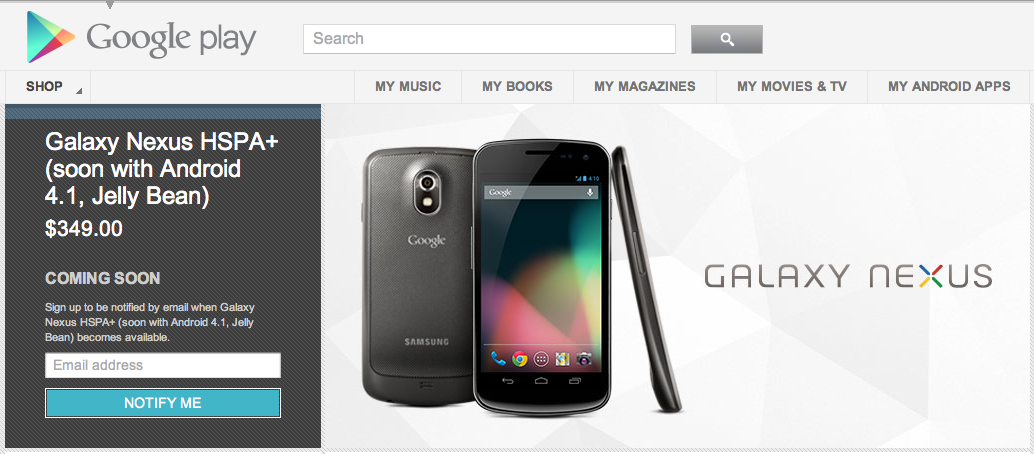
The Google Play store abruptly removed the Galaxy Nexus earlier this week for unknown reasons, but Google just confirmed that it pulled the device from the Android marketplace due to Judge Lucy Koh’s recent decision to not lift the injunction against the smartphone.
The device will continue sales on Google Play next week, according to ABC News, with Jelly Bean preloaded as the operating system to solve the contending issues within the dispute:
Google confirmed to ABC News that the Galaxy Nexus had been pulled from its Google Play store as a result of the judge’s decision, but said it would begin selling the device again next week running the latest version of Android — Android 4.1, known as Jelly Bean. The updated version of Android would address the issues in dispute, Google said.
The Galaxy Nexus is currently listed on Google Play as “coming soon,” and visitors have the option to receive an email notification for when the smartphone becomes available.
Update: As The Verge reports, this afternoon the Court of Appeals has suspended the ban on the Galaxy Nexus until a formal response is given from Apple. From there, the Court will decide if the ban should go in effect or not.
[youtube=http://www.youtube.com/watch?v=wvsboPUjrGc&feature=player_embedded]
 The August issue of Vanity Fair fully dissects “How Microsoft Lost Its Mojo,” but it also gives an interesting glimpse at how the once-reigning tech company foolishly underestimated Google.
The actual article is not online, but BetaBeat obtained a physical copy and found a little nugget buried inside that describes chief executive Steve Ballmer going on a rampage in 2004. After allegedly throwing a chair, the CEO had this to scream say about an engineer who left Microsoft for Google:
“Fucking Eric Schmidt is a fucking pussy!” Ballmer yelled, according to the court document. “I’m going to fucking bury that guy! I have done it before and I will do it again. I’m going to fucking kill Google.”
Ballmer is notorious for his emotional antics and miscalculated quotes about the competition. The video atop is a perfect demonstration of Ballmer going, well, crazy. Meanwhile, the video below shows the executive laughing about the iPhone in 2007, while dismissing its ability to handle business-oriented tasks due to its lack of a tangible keyboard.
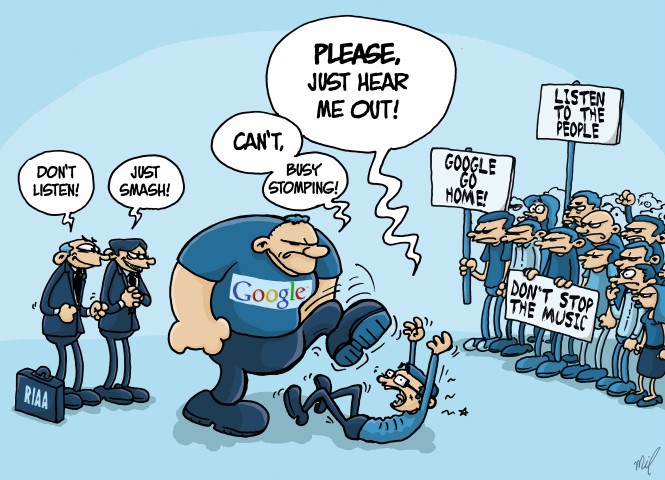
Google wanted to stop YouTube-MP3.org last month from ripping audio embedded in YouTube’s videos, but the conversion website’s 21-year-old owner is not ready to roll over and admit defeat.
YouTube-MP3.org received a letter from the Mountain View, Calif.-based Company last month that threatened to take legal action. Google’s video-sharing platform is free and provides content that is embeddable or accessible through its API, while YouTube-MP3.org is also free and pulls audio from YouTube videos. The website then converts those files into downloadable MP3s. Apparently, despite the API that gives developers access to many features, pirating any sound directly violates YouTube’s Terms of Service agreement.
The June 8 “cease and desist” letter from YouTube’s Associate Product Counsel Harris Cohen addressed the website’s Germany-based owner, Philip Matesanz. Cohen cited the platform’s terms for API in the legal notice, and he noted separating, isolating, or modifying “the audio or video components of any YouTube audiovisual content made available through the YouTube API” is strictly prohibited. Cohen warned of “legal consequences” for YouTube-Mp3.org, and he gave the website a week to comply. However, Google immediately blocked the website’s servers from accessing YouTube.
Matesanz took to his website yesterday, conveniently on the United States’ Independence Day, to give a “Situation Update” on the, well, situation:
After numerous reports questioning the legality of this service I have decided to get case studies from two highly reputable lawyers in Germany to prove the difference. I have asked them to create English reports about the legal situation of this service and the accusations Google has made. They agree that there are no copyrights of a third party violated by providing this service and it has to be considered legal. It might be surprising to some but they also agree that all claims Google has brought up so far are not justified: There is no TOS violation. They even question if Google can take action against so called “YouTube Converters/Recorders” since they seem to be protected by federal law. Google would have to make massive changes to their public broadcasting service to demand that such services shut down e.g. no more embedded videos, restrict access to registered users who have agreed to the TOS[..]. There are also doubts about the legitimacy of the section Google is accusing me to violate: Section 6.1K is designed to abandon a fundamental right all German citizens have. According to federal law you have the unquestionable right to create a private copy of certain media; including YouTube. Google’s attempt to abrogate the rights of the public in their TOS has to be considered as illegal and is in a strong contrast to their public self-representation.
Matesanz further disclosed to readers that YouTube-mp3.org is officially operated through PMD Technologie UG, which is a company registered in Germany, and he has tried to contact Google “multiple times,” but all of his attempts have failed. A recent call to Google’s main legal head was even blocked by an assistant, Matesanz wrote, who claimed Google would only communicate in written form but allegedly did not respond to three e-mails sent.
“I don’t have any marketing or public relations experts […] I am just an IT guy with no experience whatsoever,” Matesanz added, while referring to the case as a “David vs. Goliath situation.”
The computer science student-turned-Google arch nemesis is now attempting to level the playing field with a petition on Change.org, where he asks Google to permit third-party recording services to access YouTube. The petition has over 343,000 signatures.
In a story detailing some recent updates to the two-year-old GoogleEDU program, The Wall Street Journal noted today that last year saw roughly 11,000 Google employees enrolled in the program’s classes as Google “cut classes that didn’t work and retooled others.” That is about one-third of the 33,100 Google employees worldwide.
“What’s important is that it aligns with our overall business strategy,” says Karen May, Google’s vice president of leadership and talent, who has led the revamping of GoogleEDU.
As part of the revamping of the program, the report described how Google is using data analytics and other methods to suggest new courses to employees:
Expand
Expanding
Close

Reuters interviewed the U.S. judge today who dismissed Apple’s patent court case against Motorola, and the details behind the jurist’s reasoning for tossing the lawsuit are as interesting as they are controversial.
Richard Posner sits on the 7th U.S. Circuit Court of Appeals in Chicago and disputes whether software and related tech industries should even have patents for their products.
“It’s not clear that we really need patents in most industries,” said Posner, referring to the slew of features in smartphones that are legally protected. “You just have this proliferation of patents. It’s a problem.”
Posner, 73, argued the pharmaceutical industry better deserved protection for its intellectual property because of the, as Reuters coined it, “enormous investment it takes to create a successful drug.” He tossed Apple’s lawsuit against Google’s Motorola Mobility last month and denied an injunction against the sale of Motorola devices using Apple’s patented technology.
The judge attributed Apple’s scramble to attack competitors allegedly using its technology to a “constant struggle for survival.”
“As in any jungle, the animals will use all the means at their disposal, all their teeth and claws that are permitted by the ecosystem,” Posner contended.