Stay up to date on news from Google headquarters. Be the first to learn about plans for Android, Google Plus, Google Apps, and more!
Stay up to date on news from Google headquarters. Be the first to learn about plans for Android, Google Plus, Google Apps, and more!

The folks at iFixit recently took a look inside Google’s Nexus 7 tablet, and today they are ripping apart another new Nexus device: the Nexus Q media streaming, Apple TV competitor. We already told you all about Google’s reasoning behind manufacturing the device just 15 minutes away from its United States headquarters, but iFixit wanted to find out exactly what parts came from where.
There was nothing too shocking in the teardown, but iFixit was able to identify the origin of many components. As noted in the report, “it’s nearly impossible to have a truly American-made electronic device.” Here is what it found:


The Chrome Web Store is now Google+ integrated.
“You can now share all of your favorite Chrome Web Store items with people in your Google+ circles by finding them in the Chrome Web Store and clicking the +1 button located in their store detail page,” wrote Software Engineer Hui Guo on the official Google Chrome blog.
Users can also review app, extension, and theme recommendations from friends in their Google+ circles by hitting up the ‘From your circles’ link under the left category menu on the Chrome Web store. If apps have been +1’d by people in a user’s circles, the indication will appear respectively on the Chrome Web Store to help folks pick an app. Those new to Google+ will notice suggestions from the Chrome team instead.
[youtube=https://www.youtube.com/watch?v=fHkhp6BwnGo&feature=player_embedded]
The video above is a quality demonstration of voice searches on Android Jelly Bean.
Jean-Louis Nguyen posted the video, titled “How to impress your friends (or annoy your iOS counterparts): 40+ voice searches thrown at Google on Jelly Bean,” on Google+ yesterday.
“I never make videos, but felt compelled to share the many new voice capabilities on +Android, some of which were not demoed on stage during Google #io12. You may be surprised by some answers, notably those provided by the Knowledge Graph,” Nguyen wrote.
Since Google unveiled its Nexus Q streaming device at Google I/O, more and more details have come out about what is essentially a set-top box (albeit orb-shaped) Apple TV competitor with a built-in stereo amplifier. Google was first to make it clear that the device was manufactured entirely in the United States, and a report from The New York Times later confirmed the Q “was being assembled in a large factory 15 minutes from Google headquarters.”
Today, a report from Reuters quoted Google’s Senior Director of Android Global Partnerships John Lagerling explaining that the decision was based on the ability to innovate faster and not necessarily cost:
“We wanted to innovate fast. This is the first end-to-end hardware product that Google has ever put out,” said John Lagerling, Google’s senior director of Android global partnerships.
The cost of building the orb-shaped Nexus Q, a cross between a streaming video box like Apple TV and a stereo amplifier, “was not the No. 1 priority,” Lagerling said. “We wanted to see if we could do fast (design iterations) rather than having our engineers fly across the world.”

iFixit is hardcore when it comes to breaking open our favorite electronics to see what’s inside, and the website did it again today with the refreshed Google-flagship, Asus-built Nexus 7 that unveiled at the Google I/O conference last week.
Teardown highlights:
— The 7-inch tablet offers GPS, NFC, and Wi-Fi antennas all manufactured between April 20 and May 25, 20011.
— The Nexus 7 boasts a 4326 mAh battery that lasts 9:49 hours, whereas the Kindle Fire has a 4400 mAh battery that lasts 7:42 hours. Meanwhile, the new iPad battery, which is “significantly larger” at 11,500 mAh, only lasts 9:52 hours for HSPA and 9:37 hours for LTE.
— The official Nexus page stated there is one “speaker” in the back, but iFixit spotted
— Hydis manufactures the 7-inch, 1,280-by-800 HD display designated by model HV070WX2.
What’s inside:
— NVIDIA T30L Tegra 3 processor
— Hynix HTC2G83CFR DDR3 RAM
— Kingston KE44B-26BN/8GB 8GB flash
— Max 77612A inverting switching regulator
— AzureWave AW-NH665 wireless module
— Broadcom BCM4751 integrated monolithic GPS receiver
— Invensense MPU-6050 gyro and accelerometer
A gallery is below.
With the rollout of Jelly Bean to a number of new devices just around the corner, Google updated its platform statistics today on the Android Developers website. After having been released for nine months, Ice Cream Sandwich was able to post an increase. However, it remains at just under 11 percent of total Android devices. That is an increase of approximately 3.8-percent for ICS 4.0 and 4.0.4, and it definitely highlights the fragmentation issues Android continues to face. Jelly Bean is not included in the platform stats, because it has not launched on any devices available to consumers.
Google also released updated information about the number of devices currently utilizing a particular screen configuration. The graph below shows the majority of Android devices are still running what Google classified as “Normal/hdpi,” which is a configuration that includes devices roughly 3.5-inches to 4.5-inches with at least 470dp-by-320dp:
[youtube=http://www.youtube.com/watch?v=t99BfDnBZcI]
Google launched Search by Image last year, and then updated algorithms for it almost every week since, but now the search engine will use its Knowledge Graph to power the popular feature.
Search by Image allows users input an image, and then Google offers images and search results related to that image. Users select an image through the ‘ole drag-and-drop, and then uploading, or even inputting a URL. Meanwhile, the Knowledge Graph is new technology that allows Google to provide search results for concepts linked between words, rather than showing results for just the query term.
Software Engineer Sean O’Malley explained the inclusion on Google’s Inside Search blog today:
With the recent launch of the Knowledge Graph, Google is starting to understand the world the way people do. Instead of treating webpages as strings of letters like “dog” or “kitten,” we can understand the concepts behind these words. Search by Image now uses the Knowledge Graph: if you search with an image that we’re able to recognize, you may see an extra panel of information along with your normal search results so you can learn more. This could be a biography of a famous person, information about a plant or animal, or much more.
Google wants to improve its image search. When a user uploads an image of a specific type of flower, for instance, Google would previously give general flower search results. Now, Google will try to guess the exact type of flower. Google will also show the most recent content in search results, which is helpful for news images.
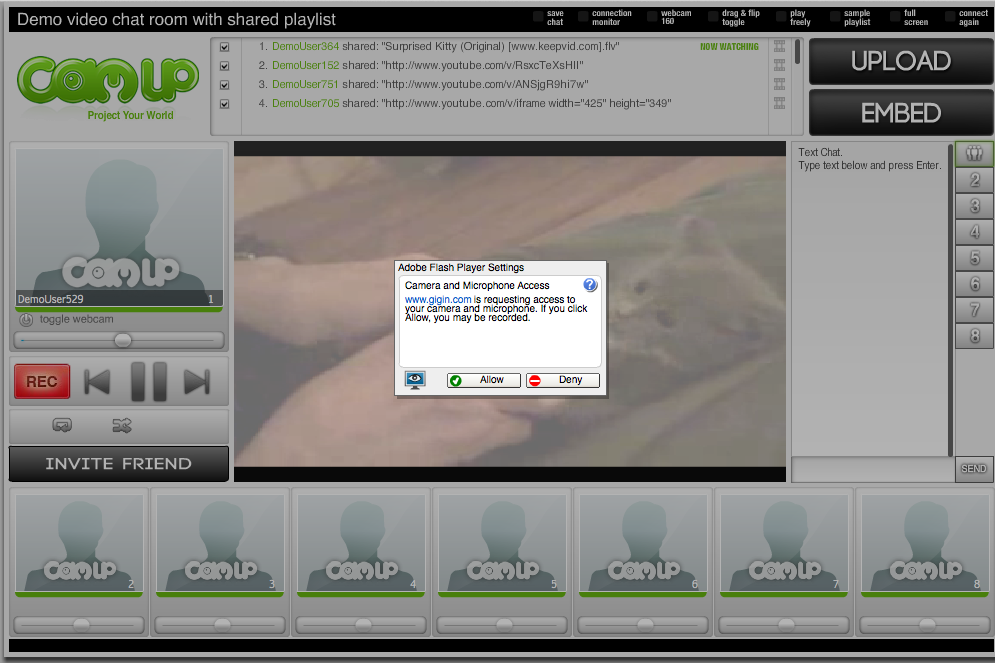
CamUp filed a lawsuit late last week that claimed Google ripped its video-chat feature for Google+ and YouTube.
The lawsuit filing revealed Marissa Mayer, Google’s vice president, along with a few Mountain View engineers, approached the New York-based startup at the South by Southwest Festival in March 2011. They later met in London to negotiate adding a Hangout-like button, called “Watch with your friends on CamUp,” to Google’s popular video-sharing platform, YouTube. Despite receiving accolades on its product, CamUp did not hear from the Googlers after the meeting.
By May 2011, CamUp detected an alarming amount of visits from Google’s headquarters in California. The startup suggested that the traffic is evidence of Google beginning to examine its product for copying purposes. Google launched Hangouts with a “Watch your friends” button just one month later, which were allegedly indistinguishable from CamUp’s offerings.
CamUp is seeking damages, an injunction to remove Hangouts on YouTube and Google+, and it is suing Google UK’s Director of Business and Markets Richard Robinson.
The filing (via GigaOM) is embedded below.
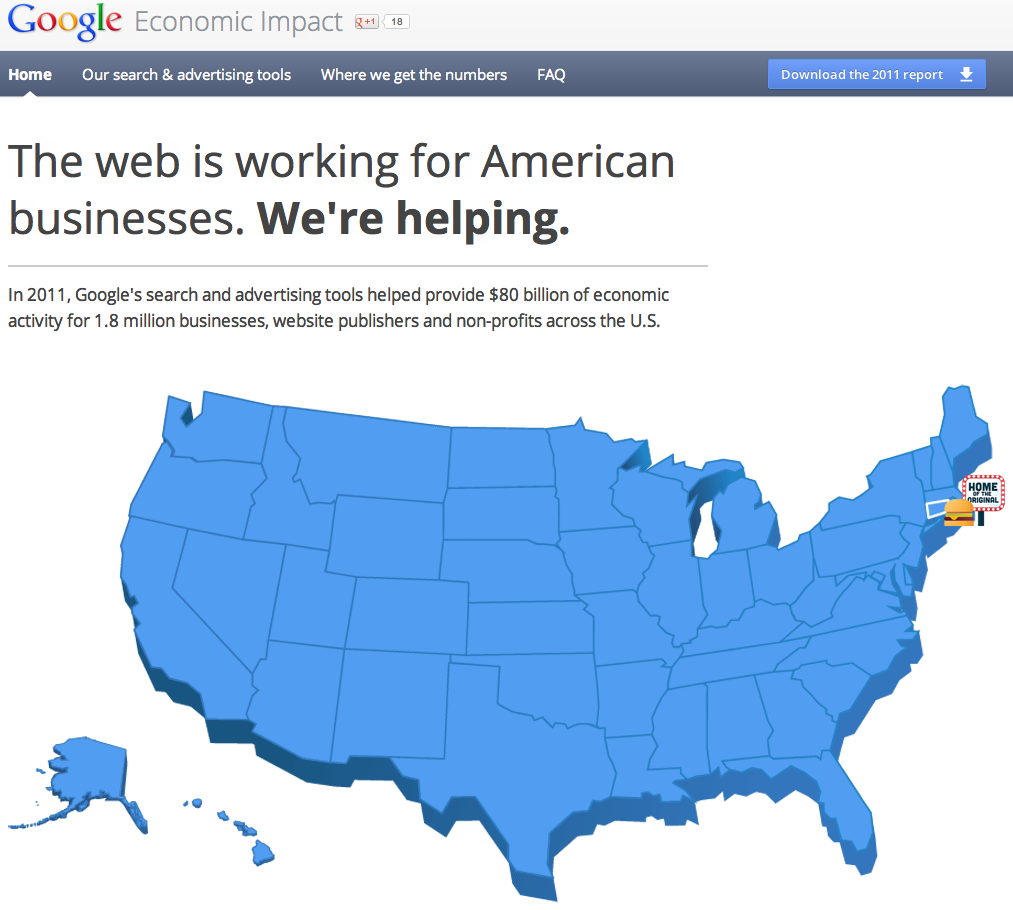
Google is touting its successes again by explaining how it helped boost American business last year.
Vice President of Americas Sales Margo Georgiadis took to the Official Google Blog to first spew some economic statistics:
From there, the VP explained how Google is “committed to helping make the web work for American businesses.” The Mountain View, Calif.-based Company, through its search and advertising tools, helped provide “$80 billion of economic activity for 1.8 million advertisers, website publishers and nonprofits across the U.S.” in 2011. The full breakdown for each state is available at Google’s Economic Impact website.
“[…] Google is committed to getting even more businesses online. Over the past year, we’ve been traveling the country with our Get Your Business Online program, encouraging businesses throughout the U.S. to create free websites and reach more customers,” Gerogiadis wrote. “So far, we’ve worked with thousands of businesses to launch their new websites. It’s a fact that the Internet is creating jobs and helping the American economy grow. And we’re proud to be a part of that process.”
As highlighted on the official Google Analytics blog, the company is today announcing the addition of mobile app analytics for three main areas: Acquisition and new users, Engagement (retention, crashes, conversions), and Outcome (app sales and in-app purchases).
New and active users – measure the number of new and active users who launch your app everyday and analyze your most valuable segments.
App versions – keep track of the distribution of active users over the older and newer versions of your app so you know what to support.
Device overview – check out the top mobile devices and OS versions that your app runs on, and optimize the experience for each device.
User behavior – assess how loyal your users are, how frequently they use the app, and the engagement level of each loyalty group.
Engagement flow – visually see the screens, actions and paths users take to move throughout your application in order to optimize usage.
In-App purchases – if you sell virtual or tangible goods in your app, you can measure the number of purchases and the revenue generated.
In addition to the inclusion of the new Mobile App Analytics reports that can be seen in the screenshots above, Google is also rolling out a new Google Analytics Android app (images above via AnalyticsTalk.) If you are interested in checking out the new Mobile App Analytics and app, Google said it would roll out to select whitelisted users. You can sign up to become part of the beta here.
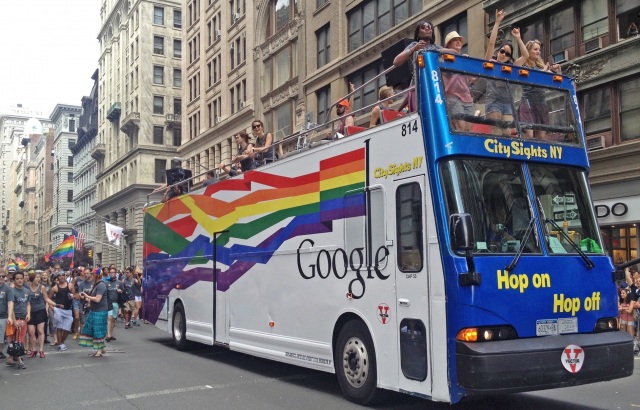
Google is once-again touting support for the LGBT community by participating in worldwide Pride events and expanding company-wide benefits.
According to “Gaygler” Randy Reyes on the official Google blog:
We encourage people to bring their whole selves to work. And this month Googlers, Gayglers (gay Googlers), and their families and friends took this spirit to the streets in Pride parades and celebrations around the globe. In Sao Paulo, a group of 50 marched as a Google contingent for the first time ever. In San Francisco, more than 1,000 Googlers and allies marched (nearly doubling the number of people we had in 2011!). In New York, more than 700 of our friends and colleagues took over 5th Avenue marching alongside our double-decker Pride bus. And this weekend in Singapore, we’re sponsoring the Pink Dot celebration for the second consecutive year.
Reyes further revealed action-based plans to celebrate World Pride in London this year. The Mountain View, Calif.-based Company will host a “Legalise Love” Conference at Google London, with hopes to “eliminate homophobia” and “decriminalize homosexuality.”
Google also significantly increased coverage of transgender health care for its U.S. employees. Transgender-inclusive benefits, such as “transitioning procedures and treatment in accordance with the World Professional Association for Transgender Health’s Standards of Care,” now receive a lifetime maximum coverage of $75,000.
“Next month we’ll carry the energy of Pride into our fourth annual company Diversity & Inclusion celebration, the Sum of Google. The Sum is an opportunity to celebrate and engage in a discussion about diversity and inclusion across our offices around the world,” Reyes concluded.
A picture gallery is below.
[youtube=http://www.youtube.com/watch?v=tpEGuSwv1fY&feature=player_embedded&start=585]
Above is the full Google I/O session for Google Wallet Cloud APIs, and perhaps the most notable announcement comes at 9:45 seconds of the video when Google introduces a new “Save to Wallet” API that will initially roll out to select partners. Coming to offers and payment cards first, the new feature will allow consumers to save coupons and deals or load a payment cards directly from a merchant’s website to Google Wallet. Check out the video for all the details.
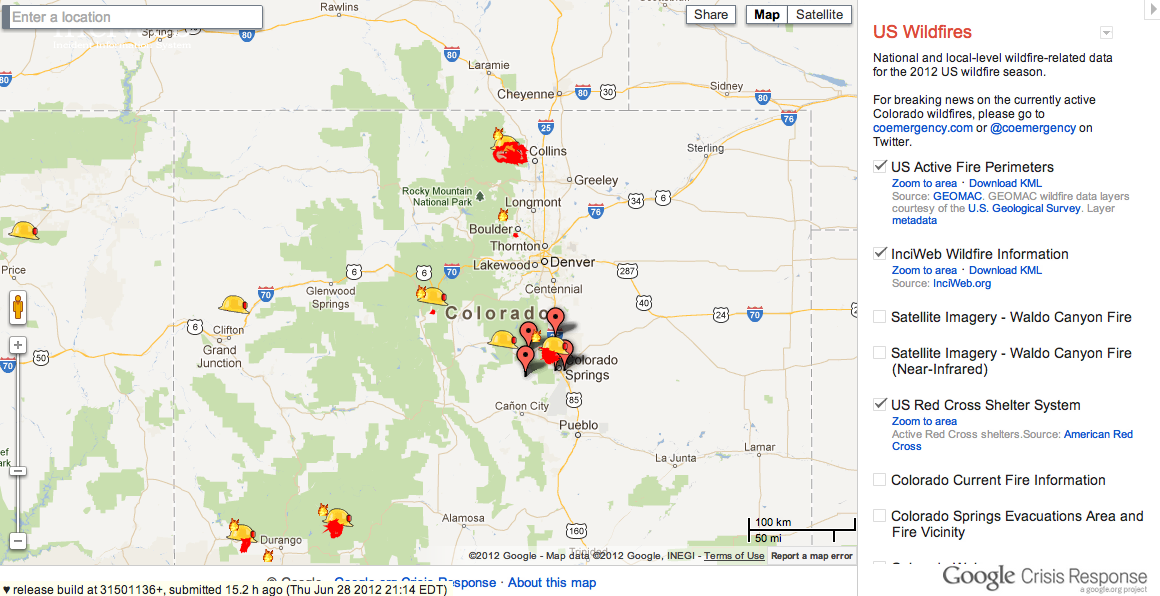
The Google Crisis Response team just issued a new crisis map for the 2012 U.S. wildfire season.
Major media outlets are reporting on the massive wildfires wreaking havoc in Colorado and Utah, and Google is working to provide related information to those affected by way of maps that feature fire perimeters cropped from the U.S. Geological Survey, Red Cross, and satellite imagery by DigitalGlobe.
“Use the checkboxes along the right-hand panel to turn on and off the layers of information, and the ‘Share’ button at the top of the map to grab the URL or embed code. Note that both the URL and the embed code will automatically restore your current view of the map, including the set of layers that you have turned on,” wrote Googler Pete Giencke on the Google Lat Long Blog, while explaining how to navigate the crisis map.
[tweet https://twitter.com/Scobleizer/status/218486102720393216]
When Google announced some updates to Google+ during its I/O keynote this week, perhaps apart from the new iPad compatible tablet version, the most talked about new feature was the Facebook-like invitations called “Events.” While Google calendar integration in the Events feature was supposed to be a big selling point, Google unfortunately did not provide users with control over which invites were added to their calendars. The issue led to massive amounts of spam in the form of notifications and calendar entries—most notably for Google+ users with large followings. Robert Scoble outlined the problem in a Google+ post:
As noted by Scoble, another avid Google+ user, Will Wheaton, highlighted the issue and received a response from Google’s Senior Vice President of Engineering Vic Gundotra:
Expand
Expanding
Close
Google’s Chrome browser is now No. 1 in Apple’s App Store for free apps.
The mobile browser went live for iPhone and iPad owners yesterday, and now it holds the top spot for both device categories. The app notably allows users to view open tabs, bookmarks, and other browser particulars running on other computers and devices. Users can even send pages from Chrome on a computer to their iPhone, iPod touch, or iPad with “one click and read them on the go, even if you’re offline.”
Chrome for iOS already touts 4.5-stars based on over 3,500 reviews as of press time. Despite the glowing accolades, some folks are noticing its lack of Apple-given attention:
[tweet https://twitter.com/piecykw/status/218530635013300224]
This article is cross-posted on 9to5Mac.
GameStop already had a ton of success with its iOS device trade-in program that we told you about on 9to5Mac, and today the company announced it will soon extend the program to select Android tablets. In addition, GameStop is taking pre-orders of Google’s new Nexus 7, and it will offer a ” 30% trade bonus on all items traded” towards the cost of the pre-ordered tablet. This comes after a rollout of its own Android-powered gaming tablets in select stores, a project detailed by president Tony Bartel in an interview with Games Industry last year.
Beginning tomorrow, consumers can pre-order the Nexus 7 at all U.S. GameStop stores. GameStop customers can also take advantage of a 30% trade bonus on all items traded towards the pre-order of the Nexus 7. This includes trades of video game hardware, software and accessories as well as iDevices and eligible Android tablets… For consumers looking to trade in an Android tablet, all U.S. GameStop stores are now offering instant cash or in-store credit for Android tablets from a variety of top brands. Trade values, ranging up to $250 in-store credit or $200 cash, are based on model, memory size and physical condition.
Expand
Expanding
Close
Adobe announced it abandoned mobile Flash last fall, but the company just confirmed to the masses that Google’s new Android 4.1 OS does not have certification for Flash. It is also stopping access to Flash Player updates and installations from Google Play on August 15, but security updates will continue for existing users.
Check out the full presser:
An Update on Flash Player and Android
We announced last November that we are focusing our work with Flash on PC browsing and mobile apps packaged with Adobe AIR, and will be discontinuing our development of the Flash Player for mobile browsers. This post provides an update on what this means for ongoing access to the Flash Player browser plugin for Android in the Google Play Store.The Flash Player browser plugin integrates tightly with a device’s browser and multimedia subsystems (in ways that typical apps do not), and this necessitates integration by our device ecosystem partners. To ensure that the Flash Player provides the best possible experience for users, our partner program requires certification of each Flash Player implementation. Certification includes extensive testing to ensure web content works as expected, and that the Flash Player provides a good user experience. Certified devices typically include the Flash Player pre-loaded at the factory or as part of a system update.Devices that don’t have the Flash Player provided by the manufacturer typically are uncertified, meaning the manufacturer has not completed the certification testing requirements. In many cases users of uncertified devices have been able to download the Flash Player from the Google Play Store, and in most cases it worked. However, with Android 4.1 this is no longer going to be the case, as we have not continued developing and testing Flash Player for this new version of Android and its available browser options. There will be no certified implementations of Flash Player for Android 4.1.
Beginning August 15th we will use the configuration settings in the Google Play Store to limit continued access to Flash Player updates to only those devices that have Flash Player already installed. Devices that do not have Flash Player already installed are increasingly likely to be incompatible with Flash Player and will no longer be able to install it from the Google Play Store after August 15th.
The easiest way to ensure ongoing access to Flash Player on Android 4.0 or earlier devices is to use certified devices and ensure that the Flash Player is either pre-installed by the manufacturer or installed from Google Play Store before August 15th. If a device is upgraded from Android 4.0 to Android 4.1, the current version of Flash Player may exhibit unpredictable behavior, as it is not certified for use with Android 4.1. Future updates to Flash Player will not work. We recommend uninstalling Flash Player on devices which have been upgraded to Android 4.1.
For developers who need ongoing access to released versions of Flash Player for Android, those will remain available in the archive of released Flash Player versions. Installations made from the archive will not receive updates through the Google Play Store.
As always this and other Flash runtime roadmap updates can be found in the Adobe roadmap for the Flash runtimes white paper.
[youtube=http://www.youtube.com/watch?v=kDsOtdRtG0Q&start=23]
As noted by Phillip Elmer-DeWitt at Fortune, Apple analyst Gene Munster published a note to clients today that contained the results of a Siri vs. Google search 1600-question showdown.
While it is not exactly a test of how well the companies’ various voice services stack up against one another (since Google Search queries were typed-in and not spoken), but it is a good indication of just how viable Siri is as an everyday mobile search product and alternative to Google. In the test, both Google and Siri were asked 800 questions in a quiet location. Another 800 questions were asked among the loud street traffic in Minneapolis. The results, according to Fortune:
Expand
Expanding
Close

[youtube=http://www.youtube.com/watch?v=VuC0i4xTyrI]
You already saw a replay of the skydiving stunt if you watched today, but here is the rest.
Expand
Expanding
Close
Google gave an update regarding improvements to the Google Play store coming to Android devices and elsewhere yesterday during Day 1 of its Google I/O keynote. However, information on what was in the works for Google TV was notably left out from its presentations (despite two identical Google Glass skydiver demos from yesterday and today). Today, Google made a blog post confirming features that were announced for Android devices yesterday. A new UI, subscription billing, and movie, music and TV shows will also come to the Google Play store on Google TV this summer:
You already have access to a variety of apps on Google Play, and soon you’ll be able to find movies, TV shows, and music from Google Play to stream on Google TV. Google Play works across devices, so you can rent and start watching a movie on your Google TV, keep watching on your tablet on the move, and finish watching on Google TV. The TV & Movies app will also show Google Play content, adding to the more than 100,000 TV episodes and movies available in the app. The full power of Google Play will be available later this summer on all Google TV devices.
[youtube https://www.youtube.com/watch?v=e0K805PeOfI&feature=player_embedded]
The video above is the full Google I/O 2012 session on “What’s New in Google Maps” with Googlers Brian McClendon, Dylan Lorimer, and Thor Mitchell. We already saw much of what is talked about at Google’s “Next Dimension of Google Maps” event earlier this month, but the full talk focuses mainly on improvements to the Google Places API.
Google Places covers tens of millions of place locations around the world. But what’s a place? A place is anything that answers the question “Where are you?” Restaurants, shops, landmarks, events, and much more. You can use it in the browser, from a server, or from a mobile device. This talk will show you how to get started with the Google Places API, and focus on how you can use this huge datastore in your mobile application.
For all I/O 2012 sessions, go to https://developers.google.com/io/
Google executives are now on-stage for the second day of Google I/O to announce Compute Engine—its full-featured contender against Amazon and Microsoft’s cloud-computing services.
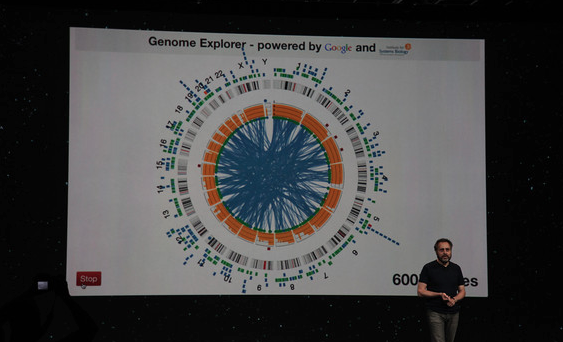 Google Senior Vice President Urz Holzle revealed the Infrastructure platform allows any sized businesses with large computing requirements to run applications on Google data center servers. Computer Engine also features multiple storage options with expansive connectivity to end-users.
It already beta tested with customers, as the Institute for Systems Biology, for instance, applied it to a Genome Explorer app. Holzle even demonstrated the ISB genome explorer running on 600,00 cores, but he noted there are 771,886 cores available to the app.
Google just announced at its second day of Google I/O that Chromebooks and Chromebox would come to 100 Best Buy stores in the United States and Dixon’s stores in the United Kingdom. Google’s Chromebook website already has a “Buy In Store” option, which will allow you to locate a Best Buy location near you that is stocking the Chromebooks. Google also promised more retailers and more OEMs would get their hands on Chromebooks before the 2012 holiday season. Lucky, I/O attendees were given a free Chromebox, which means we will soon have a hands-on for you.
[tweet https://twitter.com/googlechrome/status/218399112062701568]
[youtube=http://www.youtube.com/watch?v=tSKZy2ayvMs&feature=player_embedded]
Update: The app is already available in some international App Stores and will hit the U.S. store soon.
Google just announced at Day 2 of Google I/O that Chrome for iPhone & iPad will come to the App Store later today for devices running iOS 4.3 or later. The app will feature many of the features present in other versions of the browser, including: Chrome sync, incognito mode, and its unique tab UI. Google also announced during the keynote that it would bring its recently launched Google Drive cloud service to iOS devices.
As noted by Daring Fireball, the Chrome iOS app will have to rely on WebKit:
Expand
Expanding
Close