Stay up to date on news from Google headquarters. Be the first to learn about plans for Android, Google Plus, Google Apps, and more!
Stay up to date on news from Google headquarters. Be the first to learn about plans for Android, Google Plus, Google Apps, and more!

In a recent interview with Bloomberg Businessweek, Google’s Chief Executive Officer Larry Page talked at length about his new role as chief and his plans for the future of Android, Motorola, and the rest of the company. Much the interview revolved around Android and Google’s relationship with other companies, and Page was asked about his relationship with Steve Jobs towards the end. He was also asked about the state of Android tablets and his thoughts on Apple’s recently announced dividend.
When the interviewer mentioned Google and Jobs had their “differences” about Android, presumably referring to Jobs’ claims that Android is a “stolen product,” Page claimed Jobs’ anger towards Android/Google was “actually for show”:
I think the Android differences were actually for show. I had a relationship with Steve. I wouldn’t say I spent a lot of time with him over the years, but I saw him periodically. Curiously enough, actually, he requested that meeting. He sent me an e-mail and said: “Hey, you want to get together and chat?” I said, “Sure, I’ll come over.” And we had a very nice talk. We always did when we had a discussion generally… He was quite sick. I took it as an honor that he wanted to spend some time with me. I figured he wanted to spend time with his family at that point. He had a lot of interesting insights about how to run a company and that was pretty much what we discussed.
He continued when encouraged to elaborate on his “for show” comment:
Expand
Expanding
Close

Google today revealed what we have been talking about for months (here and here): Google Glasses. The project is called “Project Glass,” and now there is even a Plus page on it.
[slideshow]
I probably do not have to say this, but TAKE MY MONEY!!!!
Expand
Expanding
Close

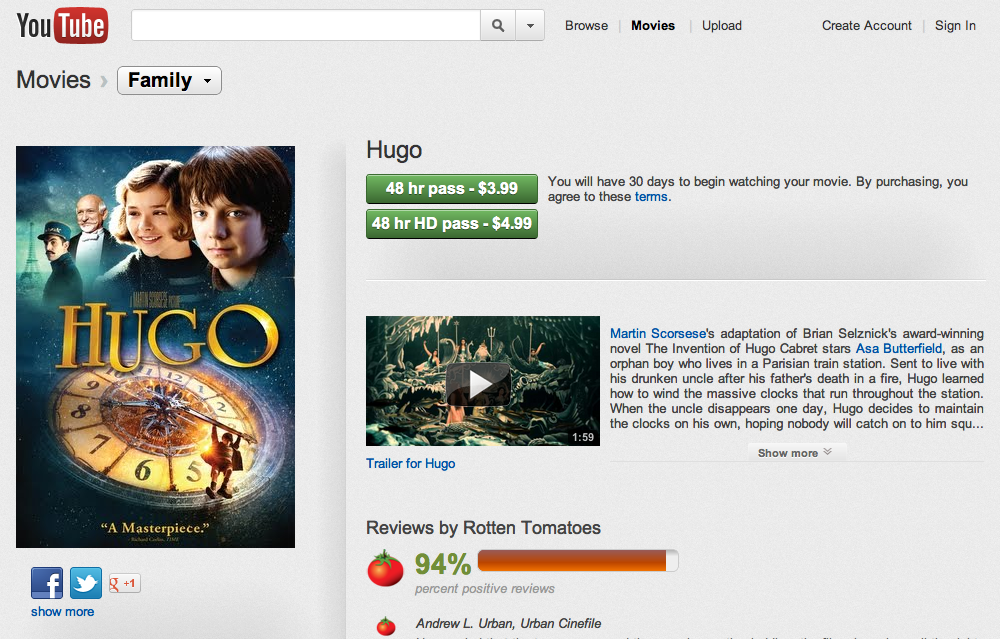
YouTube announced a new licensing agreement with Paramount Pictures today that will bring 500 new rentable movie titles to its video-sharing platform and Google Play.
“With the addition of Paramount, we now have five of the six major studios and over ten independent movie studios offering nearly 9,000 movies for rent to millions of people around the world,” announced Director of Content Partnerships at YouTube Malik Ducard on the official YouTube blog.
The United States and Canada will have access to the new catalog over the next few weeks. A sampling of Paramount Pictures’ featured movies through Google include “Hugo” for $3.99, “Transformers” for $2.99, “Ferris Bueller’s Day Off” for $2.99, and “The Godfather” for $2.99.
According to recent reports, Google’s Drive is coming any day now. Dropbox, not wanting to lose an opportunity to get in under the wire, is doubling its referral bonuses. Instead of the normal 250MB, users can now get 500MB per referral for a maximum of 16GB of free space (both referrer and referee). If you are a pro/paid user, your maximum referral limit is 32GB of free space.

Google+ now displays Google Contacts data in friends’ profiles.
“Many of you, like me, use Google Contacts to manage your personal address book. If that’s the case, then starting today we’ll include this contact info on your friends’ Google+ profiles — for your eyes only, of course,” announced Product Manager Sean Purcell on Google+.
Thus, Gmail and Android users’ Google Contacts are now integrated with the social network. For example: If a coworker has a new number recently stored in Google Contacts, it will automatically sync with Google+ in the “Details from Google Contacts” section. Purcell also provided a visual example of the new feature in the above image.
Google’s dominance in mobile advertising and Apple’s growing iAd platform on iOS convinced Samsung to launch its own rival advertising platform called “Samsung AdHub Market.” The Wall Street Journal reported the company officially announced the platform on Tuesday, which uses technology from OpenX Technologies Inc. According to the report, the company will allow advertisers to buy space within apps through developers and Samsung. The ads are expected to appear on Samsung phones and tablets sometime in last half of the year.
Samsung said Tuesday it’s adding a mobile phone advertising exchange platform using technology from closely held U.S. firm OpenX Technologies Inc…The platform, called Samsung AdHub Market, will enable advertisers to place targeted messages within apps on Samsung phones and tablets… The move is part of Samsung’s broader push to bring targeted advertising to electronic devices including Internet-connected televisions. It will also pit the company against other mobile-ad services from Apple, Google and Millennial Media Inc., which held an initial public offering last week.
Following Nielsen’s latest survey that showed over 90 percent of United States smartphone buyers are choosing iOS or Android, research firm comScore today released its data of the top smartphone platforms and OEMs in the U.S. The survey included more than 30,000 people over a three-month period ending February 2012. It found Android was up 17 percentage points from a year ago with 50.1-percent of the U.S. smartphone market. In comparison, Apple’s 30.2-percent accounted for an increase of 5 percentage points from the same period a year ago.
According to comScore, Google passed the 50 percent milestone for the first time during February 2012. The numbers represent a 3.2-percentage point increase over previous three-month period for Google, and a 1.5-percentage point increase for Apple.
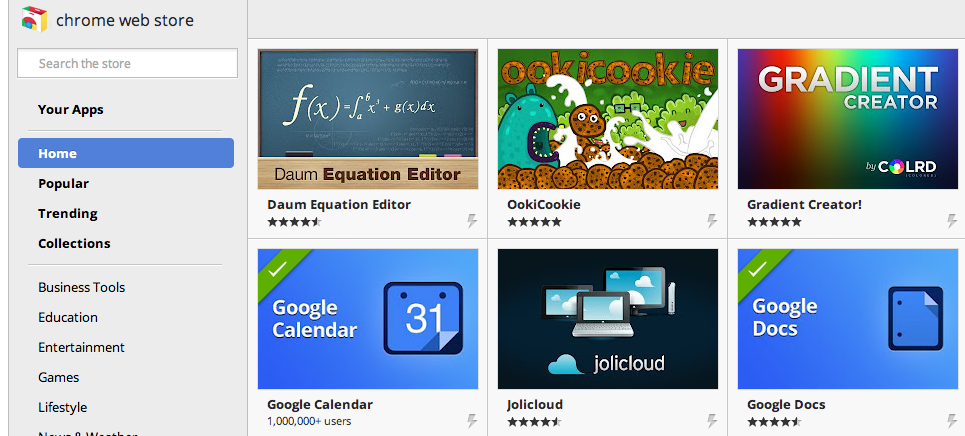
The Chrome Web Store now offers a trending section for the hottest apps and improved methods for finding the perfect extension.
Today’s automatic update allows users to view apps and extensions ranging from “warm” or “on fire” in the new “Trending” view of the Chrome Web Store. App subcategories were also included, such as “Music & Radio” under “Entertainment.”
A screenshot gallery is available below.
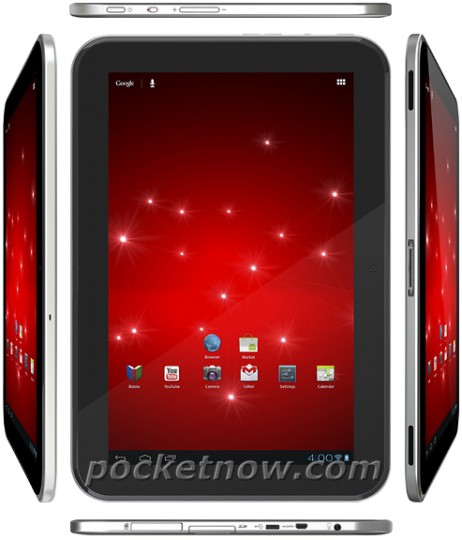
The Android rumor mill is quick to debate the authenticity of recently surfaced image leaks (above) that have an albeit-slim “Nexus Tablet” association.
The Android Community (via PocketNow) dissected the rendering and concluded the tablet boasts standard buttons and Ice Cream Sandwich-specific apps on the display, which means the leak is a potential Nexus Tablet rendering.
 It also features an ASUS-style tablet port, MicroUSB port, USB port, SIM card slot, and full-sized SD card slot. It is worth mentioning the Android Market icon is visible, even though the Google Play Store replaced it last month.
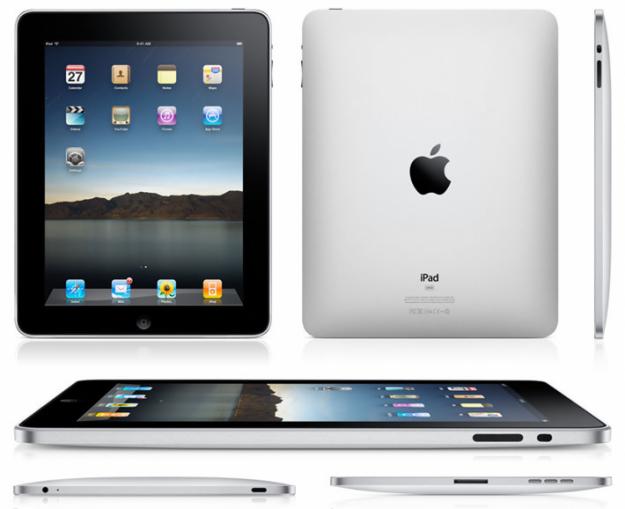
Reports fail to mention, however, that the slate in question looks uncannily similar to a first-generation Apple iPad (right). With that said, the image leak could easily be fabricated with a few spare Android tablet shots and a copy of Photoshop. Oh, and PocketNow’s absent source attribution begs the question of legitimacy.
[youtube=https://www.youtube.com/watch?v=4ZdCByYeNRU&feature=player_embedded]
“New content, new partners, new countries, new features”
Google’s Art Project is expanding to 30,000 high-resolution images at 151 museums in 40 countries from an initial 1,000 images at 17 museums in nine countries. The project’s goal is to give people access to the world’s great works.
The expanded Art Project embraces all sizes of institutions, specializing in art or in other types of culture. For example, you can take a look at the White House in Washington, D.C., explore the collection of the Museum of Islamic Art in Qatar, and continue the journey to the Santiniketan Triptych in the halls of the National Gallery of Modern Art, Delhi. In the United States alone, some 29 partners in 16 cities are participating, ranging from excellent regional museums like the Gibbes Museum of Art in Charleston, South Carolina to top notch university galleries such as the SCAD museum of art in Savannah, Georgia.
Even The White House got “Streetviewed”:
Here are a few other new things from the expanded Art Project that you might enjoy:
Expand
Expanding
Close
Google today revealed that it purchased mobile payments company TxVia for an undisclosed sum of money.
we’ve acquired payments technology company TxVia to complement our payments capabilities and accelerate innovation towards our full Google Wallet vision. TxVia is a technology pioneer that offers a fast, flexible and highly reliable payments platform—which we believe is one of the best in the world.
Since 2008, TxVia has supported the management of more than 100 million accounts. They’ve partnered with the industry’s best known brands, and their leadership team has played an instrumental role in defining the fast-growing prepaid card segment of emerging payments. In this time, TxVia has also certified and directly connected to the major payment networks, which establishes a solid foundation for Google Wallet and our partners to drive innovation on a global scale and in a partner friendly way.
Google Wallet has been somewhat slow in adoption due in no small part to the competing Verizon-AT&T-T-Mobile ISIS consortium. Google’s Payments team has also undergone some strife…

The latest marketshare-ish numbers are in for Android and it seems that people continue to update their phones…to Gingerbread. Almost two-thirds of all Android phones hitting the market in the last two weeks are running Android 2.3.x with a significant share—23.1-percent still on Android 2.2 Froyo. Honeycomb, the Tablet-only fix OS, is at around 3.3-percent, while Ice Cream Sandwich is on a scant 2.9-percent of devices including Galaxy Nexus, Acer Transformer Prime, and newly updated HTC Vivid (along with some custom builds and some unlocked manufacturer phones).
The distribution over time (below) is showing the long haul ICS has ahead of it (and do not forget we are likely going to hear about Jelly Bean at Google I/O in June).
[youtube=http://youtu.be/bkkBxY8OlaQ]
RadioShack’s “Trade & Save” app is now on Google Play and helps a user determine an old Android device’s worth for optimum trade-in value.
The app will also offer to buy the device, while providing the free prepaid shipping label, in exchange for a RadioShack gift card for use in-store or online. The gift card is sent by mail.
Screenshots are available below.
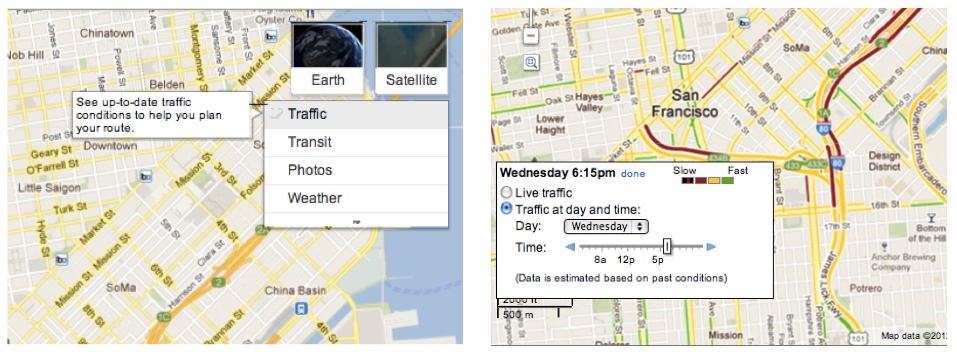
Google announced today that its live traffic pattern service will now include roads, not just highways.
“Starting today, if you’re planning a trip for which you anticipate traffic, you can find out what typical traffic is like on these arterial roads, rather than just on highways,” explained Google Maps Software Engineer Szabolcs Payrits on the official Google Lat-Long blog.
Drivers can type their starting and ending points into Google Maps to get directions, but they must enable the traffic layer in the upper right-hand corner, and then click “change” in in the legend to view Typical Traffic on regular roads.
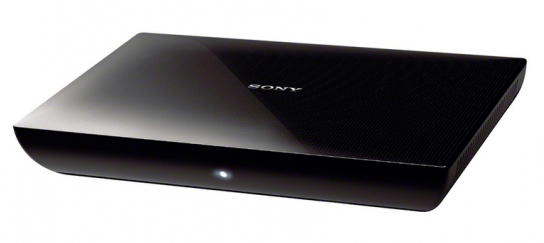
Sony plans to expand Google TV-based set-top-boxes to Europe starting this September.
According to GigaOM (via machine-translated Les Echos), Sony France Marketing Director Stephane Labrousse said a set-top box will sell in France for €200 ($266 USD) and another box with a built-in Blu-ray player will go for €300 ($399 USD).
Aside from a France launch, Les Echos indicated a simultaneous release in Spain, Germany, and the United Kingdom. Google TV is currently only available in the United States, but Sony announced at Las Vegas’ 2012 Consumer Electronics Show that two Google TV-compatible set-top boxes would go international within the year.
We knew it was coming since January when Google confirmed the Galaxy Nexus would launch on Sprint after first releasing exclusively on Verizon. According to a document sent to The Verge from an anonymous Walmart employee, the device will launch April 22 at Sam’s Club. There will not be many surprises when it finally does launch, as leaked ads in January revealed a 1.5GHz processor, opposed to the 1.2GHz packed in Verizon’s variant. Other than that, we will likely see a device that is identical to Verizon’s Galaxy Nexus, but Sprint—unlike Verizon—will support Google Wallet.
Expand
Expanding
Close

The Department of Justice plans to share settlement money with law enforcement agencies that participated in an investigation about Google distributing online advertisements from Canadian pharmacies illegally selling prescription drugs to Americans.
According to the Associated Press (via Boston.com), the agencies that participated in the investigation include Rhode Island state police, National Guard, attorney general’s office, North Providence police, and East Providence police.
Google ponied up $500 million last year to settle the investigation. The DOJ detailed the settlement’s particulars on its website. Meanwhile, U.S. Attorney Peter Neronha scheduled a news conference for this afternoon to discuss the money’s distribution between agencies.
Google, which seems to give every department a mission for today, has a bunch of great stuff (like every year):
 Besides the 8 bit maps, above, we have:
Google Chrome multitask:
LLCoolJ makes a special appearance to explain Tap, the new Morse Code Keyboard for Android devices (Japanese version):
Google Self Driving NASCAR Racing:
http://www.youtube.com/watch?feature=player_embedded&v=dP_Et8-pQNo
YouTube comes to DVD…
Fiber Bar for Kansas City:
Also, Google’s Really Advanced Search, weather control, Interplanetary Analytics, GoRo, Google Street Roo, underwater image search (Chinese), and Voice for Pets.

[youtube=http://www.youtube.com/watch?v=1KhZKNZO8mQ&feature=youtu.be]
I was just thinking about something like this.
By the way, is that LL Cool J at the end?
Expand
Expanding
Close
In case you were worried that 8-Bit Maps were the only new release today, fear not. Google is releasing the Google Racing Autonomous NASCAR racing team in a variety of flavors, including Android, YouTube, and Chrome.
Expand
Expanding
Close
[youtube http://www.youtube.com/watch?v=rznYifPHxDg]
Love this. And it is not “just for Nintendo.” It is for everyone.
(Also, notice the “Google Store”? That might not be a joke.)
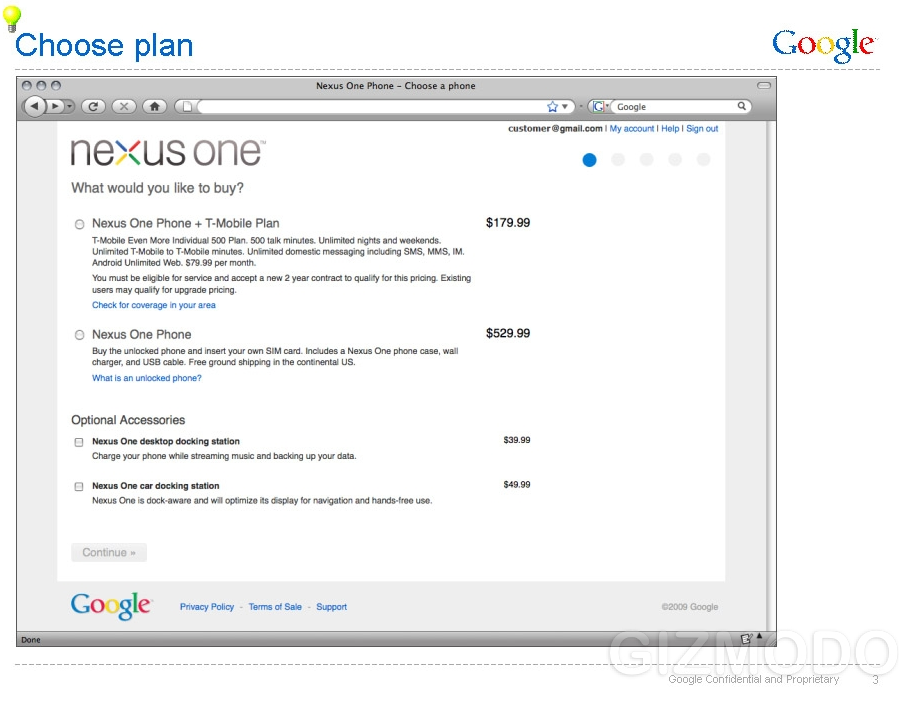
ye olde Nexus One Store circa 2010
The Wall Street Journal today reports that Google is in the process of building an online store to sell tablets running the Android operating system, including some with Google branding. We heard about the ASUS 7-inch Google tablet before, but the WSJ says Samsung may make devices too.
The Internet search company is planning to market and sell tablets directly to consumers through an online store, similar to rivals Apple and Amazon.com Inc., according to people familiar with the matter. The move is an effort to turn around sluggish sales of tablet computers powered by Google’s Android software.Some of the online store’s future tablets are expected to be co-branded with Google’s name, said people familiar with the matter. Google won’t make the devices and its existing partners such as Samsung Electronics Co. and ASUSTeK Computer Inc. will be responsible for the hardware. One Android tablet that may be sold in the online store is due to be released later this year by Taiwan-based Asus, said one of these people. Some details about the project remain unclear, including when Google plans to unveil the online store. Google is expected to release the next version of its Android software, called Jelly Bean, in the middle of this year, people familiar with the matter have said.
Google killed its Nexus One mere months after opening it in 2010. However, the company said carriers were crushing its ability to sell the device (tablets often sell without contracts).
Oh, and they expect JellyBean to be announced mid-year (read: Google I/O).
[youtube=http://youtu.be/90MIiBvXYcw]
World—meet Google Consumer Surveys: Just when it looks like Google has extended its reach into every dark corner of the Internet, the search engine launches a new service to reap more cash online.
DuckDuckGo entered the search engine game in 2008, and it is averaging almost 1.5 million average direct queries per day and announcing system upgrades less than four years later.
The technology is simple: DuckDuckGo gathers results from crowd-sourced websites, such as Wikipedia and direct-competitor Bing, to display a host of search findings. It started as a privacy-conscious alternative to Google.
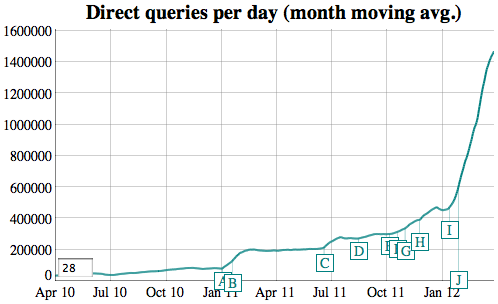 The chart to the right illustrates DuckDuckGo’s momentum. It just passed the 1 million mark last month, jumping from 630,441 average daily queries in January 2011 to 1,041,493 in February. Current calculations place the search engine at 1,468,690 average daily queries.
Due to the search engine’s success, Founder Gabriel Weinberg announced two major projects underway today that include better programming and speed. The company is even open sourcing more heavily and improving entry points.
“For speed, just this week we upgraded our whole caching system, which should significantly speed up a lot of queries,” wrote Weinberg on Hacker News. “This change should equalize a lot of the location differences, which is the main issue. In some parts of the world we were way slower.”